

Social Media is littered with extensive and many a times un-substantiated information on daily protein requirements for Indians and sources of best protein for Indians. All debates and “Reels” centre on whey powders, panner, greek yogurts and soy as primary sources of protein for Vegetarians and “reluctantly” eggs and chicken for Non-Vegetarians. Decades of massive mis-information on RED Meat has ensured that an arguably one of the healthiest animal protein source – Mutton doesn’t even find mention, as if merely touching Mutton itself will result in Cardio-vascular issues. Such is power of mis-information. This write up tries and bring some sense, semblance and extensive science to the discussions on RED MEAT. Go Ahead and have Ad-Libtum Mutton for its extensive health benefits. You will save on Hospital Bills for sure.
The Great INDIAN Meat Paradox
Chicken vs Fish vs Mutton — What Should Non-Veg Indians Actually Eat? Hopefully after reading this, some Vegetarians may also start considering animal proteins. You may also wish to check our earlier work – Toor Dal v/s Mutton.
For decades, one of the simplest pieces of dietary advice given to health-conscious Indians has been: Choose chicken. Eat fish. Limit mutton.
It sounded Sensible till Science proved it otherwise.
Chicken is “lean white meat.”
Fish is associated with omega-3 fatty acids.
Mutton is classified as “red meat” and therefore often placed in the dietary danger zone. But there has always been a problem with this simplified hierarchy untill now – lets debunk the RED MEAT Myth, once and for all.
Meat is not simply meat
The nutritional composition of an animal protein is influenced by its species, genetics, age, muscle, fat content, feed, production systems and processing. Even the way Indians cook it—deep-fried, tandoori, grilled, curried or pressure-cooked—can substantially change the nutritional consequences of the meal.
And there is another fascinating biological distinction – A chicken and a goat are not simply two different sources of protein. They are two fundamentally different biological systems for processing dietary fat and hence their meats are wy different in NUTRITION.
For decades, urban Indian consumers, fitness enthusiasts and clinical practitioners have been advised to replace traditional red meats with broiler chicken, farmed fish, or lean poultry. Public health narratives still frequently brand mutton—specifically Goat and Lamb—as an arterial liability that should be severely restricted or altogether avoided.
Reality couldn’t have been more ironic – A Nutritional Powerhouse as RED MEAT – has been venerated by Doctors, Indian Vegetarian & Jain Nutritionists as well as Ill-FLUENCERS who have ZERO knowledge of animal biology and ZERO knowledge of True Nutrition Science, as is demonstrated here.
Biological Machines: Monogastrics vs. Ruminants
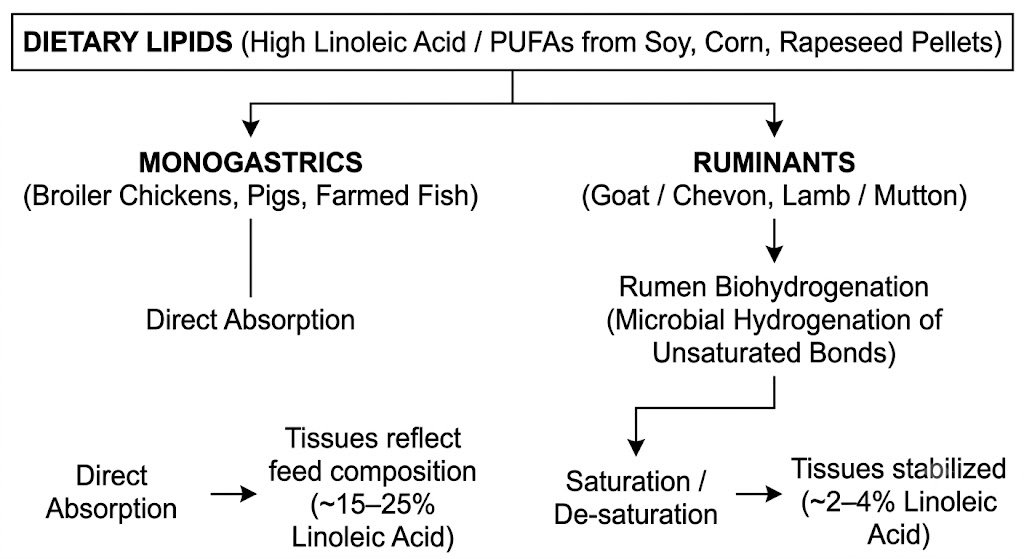
To understand why the fatty acid and nutrient profiles of meats differ across animal species, one must examine the fundamental divide in animal digestive anatomy:
-
monogastric digestive systems (chickens, pigs, farmed fish) versus
-
ruminant biohydrogenation (goats, sheep)
A. Monogastrics: Direct Lipid Storage
Chickens (Gallus gallus) and pigs (Sus domesticus) possess simple monogastric stomachs. They lack the microbial machinery in stomach which is required to modify dietary fats (fed to broilers and pigs at farms) prior to absorption.
-
Metabolic Outcome: Polyunsaturated fatty acids (PUFAs)—specifically linoleic acid (18:2-6) from soy, corn, and vegetable oil feeds—pass through the intestine intact and are directly deposited into the animal’s tissue fat and cell membranes.
-
Simply and plainly put – Chicken and Pork meats have Very High Levels of Linoleic Acid which is a Long Chain Omega-6 Fatty Acid. In case your Doctor, Nutritionist and Ill-fluencer forgot to tell you – Omega-6 Fatty acids are Inflammatory in nature and Human Beings need to strictly maintain a ratio of Omega-6 to Omega -3 Fatty Acids at 4: 1 ideally or 6:1 in worst case. Few reports peg the current ratios at upwards of 40:1, thanks to our food habits and hence a deluge of Cardio-Metabolic Diseases in India
B. Goats and Sheep: The Hydrogenation Shield
Goats (Capra hircus) and sheep (Ovis aries) have multi-chambered stomachs and are foregut fermenters. Their rumen houses billions of anaerobic bacteria, protozoa, and fungi that process ingested forage.
-
Metabolic Outcome: When a goat or lamb ingests plant fats, ruminal microbes undergo lipolysis and ruminal biohydrogenation. Microbial enzymes convert 85% – 95% of unsaturated dietary fats into HEALTHY Saturated fatty acids (e.g., converting linoleic acid to stearic acid) or beneficial intermediates like heart friendly – conjugated linoleic acid (CLA) and vaccenic acid.
-
Simply and plainly put: Regardless of minor variations in forage, the rumen of Goat and Lamb biohydrogenates dietary fats and oils. Consequently, goat and lamb tissues maintain a strictly regulated, very low-linoleic-acid lipid profile. Consequently Mutton and Lamb are healthier than Chicken and Pork (the white mets). And Consequently, Mutton and Lamb Meats Do Not Increase Omega-6 to Omega-3 Fatty Acids Ratios in those Human Beings who consume these meats.
What the Animals In the Aisle Actually Ate
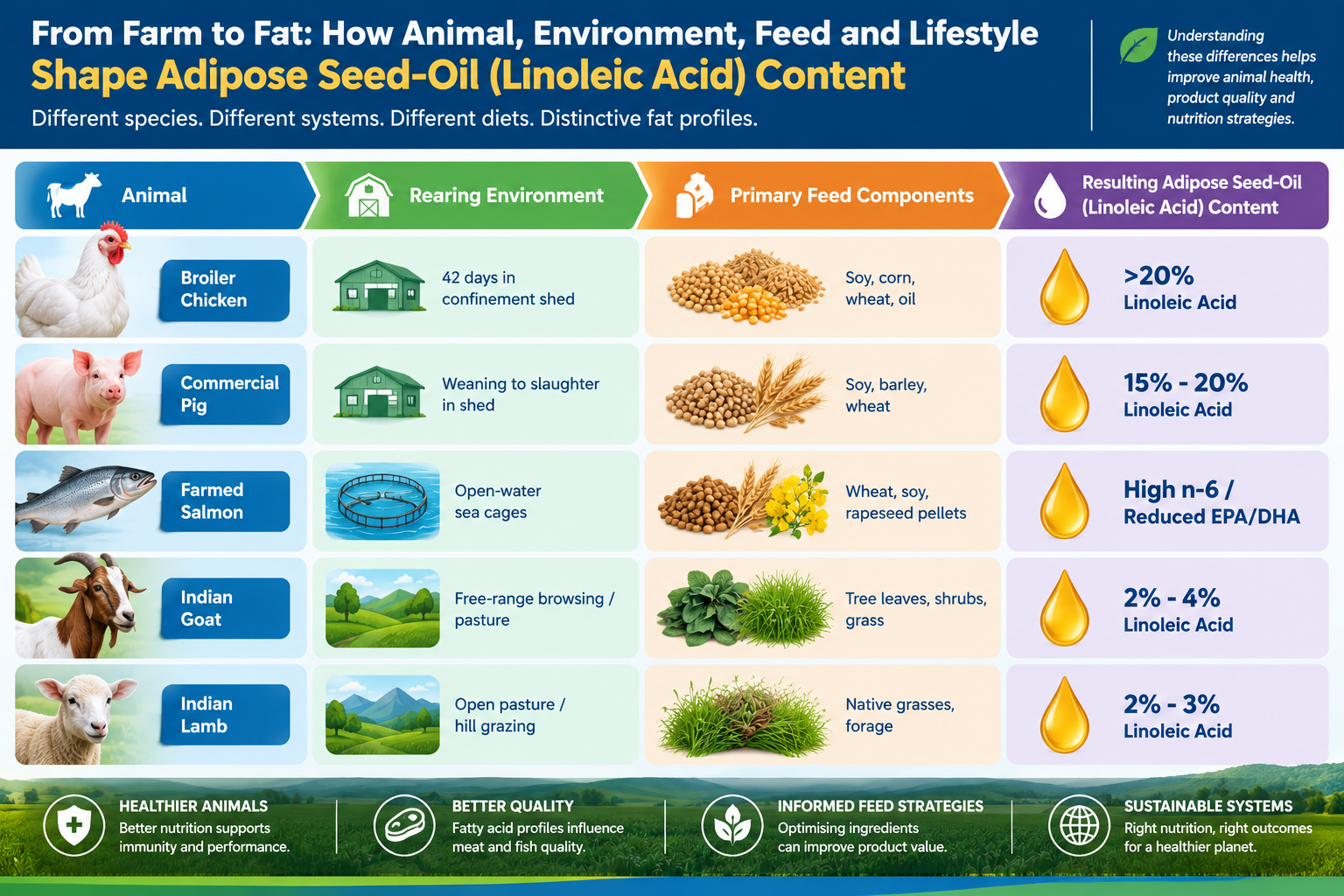
1. The Broiler Chickens – Raised in climate-controlled sheds for 35 to 40 days max, commercial poultry subsists on high-density formulations of soybean meal, yellow corn, broken rice, bajra and vegetable oil pellets. Because birds are monogastrics, their fat directly mirrors this feed—regularly exceeding 20% linoleic acid, driving up inflammatory omega-6 intake in the consumer.
2. Farmed Fish – While wild fish consume marine organisms rich in EPA and DHA, aquaculture feeds for Fish and Prawns rely heavily on compressed pellets of wheat, broken rice, soy and rapeseed oil, substantially altering their natural lipid balance and making them rich in Inflammatory Omega-6 Fatty Acids.
3. Indian Goat (Chevon) & Lamb (Mutton) – Goats are natural browsers that feed on deep-rooted shrubs, tree leaves (Khejri, Neem, Subabul), and wild herbs. Lambs graze open pasture grasses. Because goats convert pasture and vegetation through a ruminal system, their fat contains only 2% to 4% linoleic acid. Furthermore, goat meat is naturally leaner than beef or pork, making it an optimal source of dense protein with minimal oxidized fat. Your Doctor and Nutritionist NEVER Knew this and hence Never Told You To Eat Mutton.
Solution to India’s Hidden Micronutrient Crisis & Sarcopenia
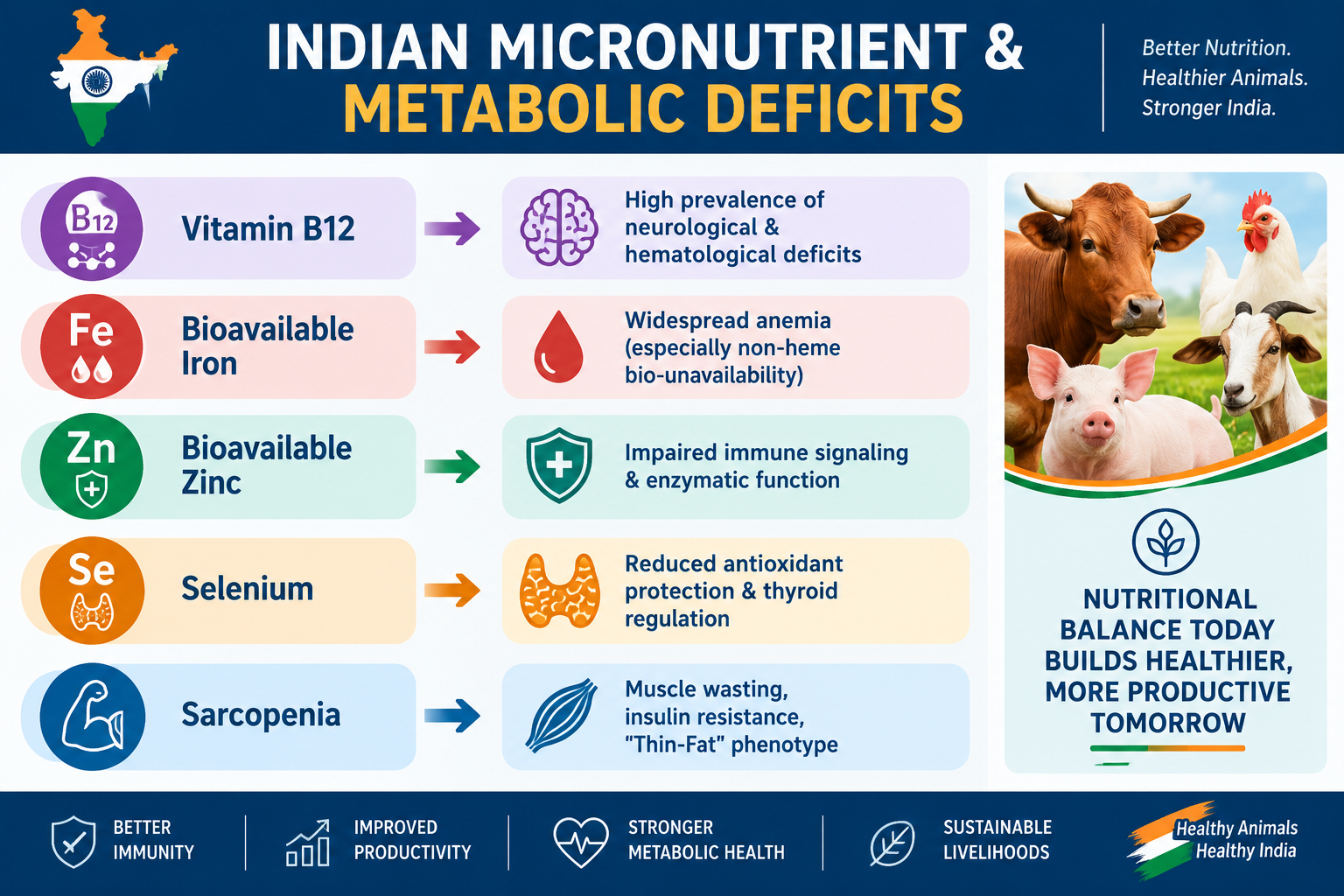
The Indian population faces severe, well-documented micronutrient deficiencies alongside a rising prevalence of sarcopenia (loss of muscle mass and strength), exacerbated by high-carbohydrate diets and low intake of bioavailable animal protein. Integrating goat and lamb meat into Daily Diets and if possible in Mid-Day Meals, directly addresses these public health challenges:
A. Reversing Anemia with Heme Iron
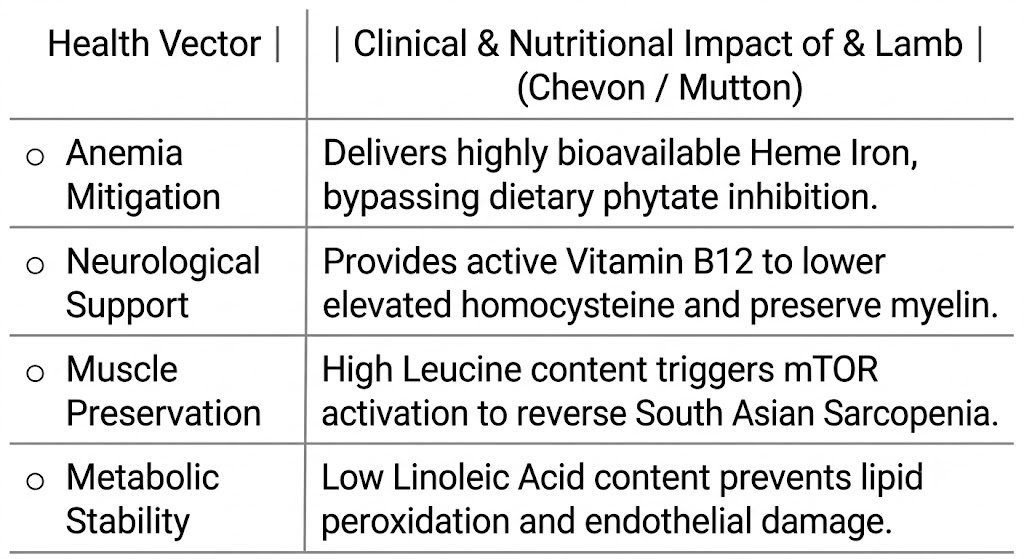
Anemia affects over 50% of women and children in India. Vegetable iron (non-heme iron) has poor bioavailability (2% – 5%) due to dietary phytates and oxalates – neither your Doctor nor your Fancy Nutritionist ever told you this. Goat and lamb meat provide rich concentrations of heme iron, which is absorbed directly via intestinal heme transporters at a rate of 15% – 35%, uninhibited by anti-nutrients.
B. Vitamin B12 & Neurological Integrity
Vitamin B12 (cobalamin) deficiency is widespread in South Asia, contributing to elevated homocysteine levels, peripheral neuropathy, and accelerated cognitive decline. Goat and lamb are exceptionally dense sources of active Vit B12, providing complete biological utility that plant foods cannot offer.
C. Zinc, Selenium, and Thyroid Function
-
Zinc: Essential for cell division, insulin synthesis, and immune defense. The high phytate content in Indian grain-based diets severely chelates zinc; goat meat provides highly bioavailable zinc that bypasses phytate inhibition.
-
Selenium: Acts as an essential cofactor for glutathione peroxidase and thyroid hormone conversion (T4 to T3). Goat Meat and Mutton provide organic selenoproteins necessary for metabolic regulation.
D. Combating Sarcopenia & the “Thin-Fat Indian” Phenotype
South Asians frequently display the “Thin-Fat Indian” phenotype—characterized by high visceral fat, low lean skeletal muscle mass, and premature insulin resistance.
-
Leucine & Essential Amino Acids: Goat and lamb meats deliver high concentrations of essential amino acids, particularly leucine, which directly activates the mTORC1 pathway to stimulate muscle protein synthesis.
-
Creatine & Carnosine: These bioactive compounds, exclusive to red meats, support mitochondrial ATP resynthesis, muscular performance, and intracellular buffering, providing a direct countermeasure against age- and diet-related sarcopenia.
Lipid Biochemistry: Why Goat Meat & Mutton Protect Cardiovascular Health
The un-founded and oft repeated clinical concern that goat and lamb meats cause vascular inflammation ignores basic lipid chemistry:
-
Low Oxidative Stress: Because goat and lamb fat contain only 2% – 4% linoleic acid, their tissues are rich in stable stearic acid (18:0) and oleic acid (18:1, the main fat in olive oil). Unlike polyunsaturated seed oils, these fats resist free-radical oxidation and hence are cardio-protective unlike chicken or seed oils.
-
Prevention of Toxic Aldehydes: Highly polyunsaturated fats from grain-fed chicken meat oxidize into toxic aldehyde byproducts such as 4-hydroxynonenal (4-HNE) and malondialdehyde (MDA) when cooked or digested. Goat fat remains stable under standard cooking temperatures, preserving vascular endothelial health. We bet even your Doctor never told you this, forget about your Nutritionist.

Re-evaluating dietary recommendations for Indian populations requires looking beyond superficial labels and stupid, un-founded, oft repeated cliches such as Red Meats are bad for Health. If anything, RED MEATS are Cardio-protective as proved above.
Traditional ruminant meats like goat and lamb—shaped by natural browsing and ruminal biohydrogenation—offer a nutrient-dense, structurally stable food source capable of addressing systemic micronutrient deficiencies and supporting long-term metabolic health. A caution – do not, we repeat do not cook your mutton in seed oils as you will be defeating the whole purpose of good health and nutritional benefits from Mutton and purpose of this article. Use Desi Ghee ONLY.
Further, India has more than 140 Million Goats and more than 75 Million Sheep to sustain steady supplies and maybe increased demand after this write up, may end up doubling rural farmers’ incomes apart from lower healthcare costs.
Academic Sources & Citations:
-
Park, Y. W., et al. (2007). Physico-chemical characteristics of goat and sheep meat and their nutritional value. Small Ruminant Research, 68(1-2), 32–46.
-
French, P., et al. (2000). Fatty acid composition, including conjugated linoleic acid, of intramuscular fat from steers offered pasture, grass silage, or concentrate-based diets. Journal of Animal Science, 78(11), 2849–2855.
-
Gupta, A. K., & Damji, A. (2018). Vitamin B12 deficiency prevalence among South Asians: Implications for cardiovascular and metabolic health. Asia Pacific Journal of Clinical Nutrition, 27(6), 1190–1198.
-
Yajnik, C. S., et al. (2008). Vitamin B12 deficiency and hyperhomocysteinemia in rural and urban Indians. Journal of the Association of Physicians of India (JAPI), 56, 115–122.
-
Ponnampalam, E. N., et al. (2014). The contribution of red meat to the nutritional intake of iron, zinc, and B-group vitamins in human diets. Meat Science, 98(3), 443–452.
-
Mandal, G. P., et al. (2014). Effect of dietary essential oil supplementation on growth performance, nutrient digestibility, and meat quality of Black Bengal goats. Animal Feed Science and Technology, 198, 62–71.