


Disclaimer – Can one bowl of dal really replace a serving of mutton? This is an evidence-based nutritional comparison for Indians. Your dietary choices are truly your soverign, solemn decision – this write up is only an attempt at what science, hopefully conclusively, says about Protein from Plant v/s Protein from Animal Source. To our knowledge this is the most comprehensive, fact based scientific comparison for fellow Indians so far, but pls do your own verification as well.
Toor Dal vs Mutton: Which Is the Better Protein – Protein Quality, Macronutrients and Why This Comparison Matters
Introduction
Protein has become one of the most talked-about nutrients in India thanks to a number of influencers sharing “their own knowledge and gyaan” about an important and foundational topic about human health.
You walk into any supermarket (if you still are from that era), browse q-commerce products or spend a few minutes on social media – you’ll find endless and sometimes unfounded claims about high-protein foods, plant proteins and protein supplements. You may even be told about The Wole Truth despite The Wole Truth itself having a Big Hole in its claims.
Such is power of fancy marketing and rhetoric. In this whole cacophony playing out daily, we forget to ask – why do I even need a protein bar, which should have been barred in frst place, for its composition, and why should I not look at Real Food like Real People, such as our elders and ancestors.
This one simple, innocuous question continues to spark debate and certainly has the potential to divide our young brigade in 2 halves. Since we don’t have any dogs in this race, we will try and tackle this question with facts, figures and solid science, things which seem to be getting drowned in hyperbole on social media these days.
Does a bowl of Toor Dal provide the same nutrition as a serving of Mutton?
For millions of Indian families, this is more than a nutrition question. It is influenced by culture, religion, affordability, health beliefs and emerging lifestyle choices.
Vegetarians often vehemently believe that pulses provide all the protein the body needs and end of discussion, while others assume meat is and has always been nutritionally superior, times immemorial – End of Discussion.
Well, everyone deserves the right answers and has the right to demand scientific evidence in support of a particular argument. This evidence, our Dear Gentle Readers, is laid out over this 3 Part Series. Don’t miss out a single word of these 3 parts, should you be interested in settling this issue.
The answer, however, to this innocent and simple sounding question is not so straightforward as we try and share scientific evidence and facts – for you, the ultimate-decision maker – to decide yourself.
Toor Dal and Mutton are Way Different than just only Veg v/s Non-Veg
Both Toor Dal (Pigeon Pea) and Mutton (goat meat) are highly nutritious foods. However, they are not nutritionally interchangeable. They differ not only in the amount of protein they provide, but also in protein quality, amino acid composition, digestibility, vitamin and mineral content, bioavailability, satiety and their ultimate effects on muscle health.
One of the biggest misconceptions is that 20 grams of protein from dal is nutritionally equivalent to 20 grams of protein from meat and one can use either of these food sources effectively. Modern nutrition science shows this is certainly not true, not one bit, much to chagrin of Toor Dal lovers.
Your intelligent and highly efficient, marvel of a body evaluates different protein sources not only by quantity but also by the balance of essential amino acids and how efficiently these amino acids are digested and absorbed by your body.
This article reviews current scientific evidence from multiple sources such as – Indian Food Composition Tables (ICMR–NIN), USDA FoodData Central, FAO/WHO Expert Consultation on Protein Quality, and leading peer-reviewed nutrition journals to compare these two commonly consumed foods.
Rather than promoting vegetarian or non-vegetarian diets, our goal is to answer a simple question: What does the science actually say on this topic? You are entitled to continue to have your own opinion, even if contrary to this scientific evaluation.
Why This Comparison Matters More Than Ever Now
India is often described as one of the world’s largest vegetarian populations – despite the fact that over 65% of the population claims to be non-vegetarian, though largely, weekend non-vegetarians.
At the same time, vast Indian population faces a growing burden of protein inadequacy, particularly among children, adolescents and women during young ages and a massive, extensive problem of Sarcopenia in older adults, both male and female and as ironic as it can get, Obesity in just over 20% of the population.
An additional, a bit controversial topic also is of average life expectancy of Indians at 69+ Years of Age compared to Hong Kong (World’s highest per capita, per day non-veg consumption of 650 gm per person, every single day) having an average life expectancy of 85+ Years.
Recent national surveys and dietary assessments suggest that a vast majority of Indians have Twin Troubles in form of not only consuming Less Quantity of Protein Daily but they also consume less quantity of, high-quality protein than recommended, even when total calorie intake appears just adequate for Indians. This is bound to happen when you get overwhelming majority of your daily calories from cheap cereals, though mostly because of our poor per capita incomes.
The consequences of excess consumption of cheap cereals paired with vegetables, and devoid of good quality proteins and fats, extend beyond muscle growth – into areas such as Highest Diabetes Burden, Cardio-Vascular Disease Burden and Hidden Hunger. All these challenges start and eventually end, with our food choices.
Inadequate quantity and in-appropriate quality of protein intake on a daily has been associated with:
-
Reduced muscle strength, poor growth
-
Sarcopenia (age-related muscle loss)
-
Slower recovery from illnesses
-
Reduced immune function
-
Poor growth in children, stunting in children
-
Increased frailty in older adults
-
Indirectly linked to lower life expectancy
This makes understanding protein quality just as important as understanding protein quantity.
Protein Quantity vs Protein Quality
One of the most common mistakes in nutrition discussions is assuming that all proteins are nutritionally identical ad hence can be inter-changed. There can’t be a bigger fallacy than this.
Imagine two meals. Meal A provides 20 grams of protein from Toor Dal. Meal B provides 20 grams of protein from Mutton. At first glance they may appear equivalent. They are not. Your body evaluates proteins using several criteria including:
-
Essential amino acid profile
-
Digestibility of the protein
-
Bioavailability of the protein – meaning how much body can actually and eventually utilize
-
Ability to stimulate muscle protein synthesis and lastly
-
Efficiency of utilisation of the protein
This explains why nutrition scientists increasingly focus on protein quality, and not simply the number printed on a food label. And O’ Lovely Influencers on Insta, you thought, it was so simple.
Comparing Foods the Right Way
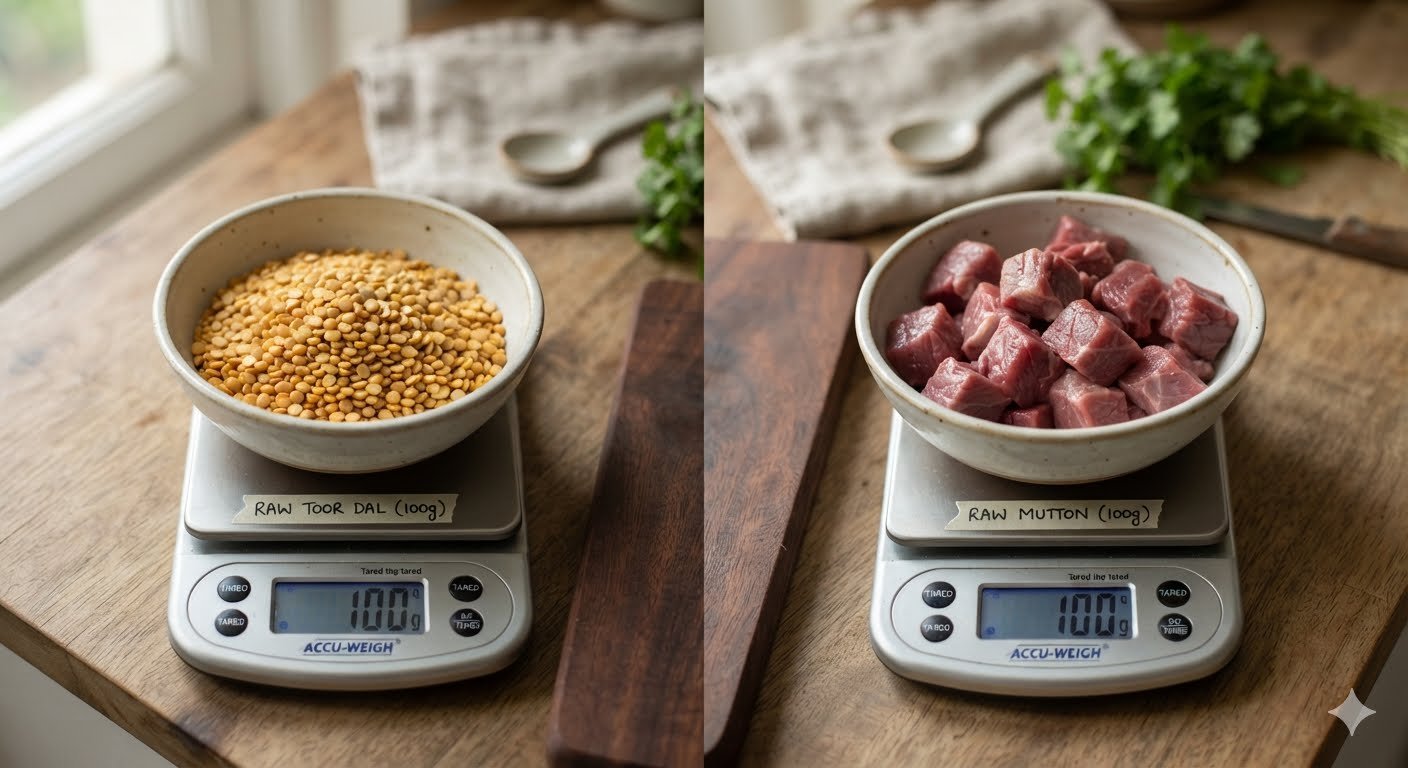
Many internet articles compare 100 grams of dry dal with 100 grams of cooked meat. This is scientifically misleading. Dry pulses contain very little water, whereas cooked meat contains approximately 60–70% water. To provide a fair comparison, we will use three reference points throughout this series:
-
100 g raw Toor Dal
-
100 g cooked Toor Dal
-
100 g cooked mutton
We will also compare typical Indian serving sizes, because that is how people actually eat.
Nutrient Components in 100g RAW Toor Dal, 100g COOKED Toor Dal and 100g COOKED Mutton
Nutrient Components |
100 g RAW Toor Dal |
100 g COOKED Toor Dal |
100 g COOKED Mutton |
Energy |
343 Kcal |
121 Kcal |
258 Kcal |
Protein |
21.7 g |
6.76 g |
25.6 g |
Total Carbohydrates |
62.78 g |
23.25 g |
0.00 |
Dietary Fibre |
15.9 g |
6.7 g |
0.00 |
Total Fat |
1.49 g |
0.38 g |
16.5 g |
Saturated Fat |
0.26 g |
0.08 g |
6.90 g |
Mono-unsaturated Fat |
0.01 g |
0.003 g |
7.0 g |
Poly-unsaturated Fat |
0.72 g |
0.2 g |
1.2 g |
Cholesterol |
0.00 mg |
0.00 mg |
95.0 mg |
Very rarely Indian Nutritionists and certainly Indian Influencers factor the Carbohydrate concentrations of Toor DAL (Raw or Cooked) while comparing Toor Dal with Mutton which has ZERO Carbs. Anyone seriously considering REVERSAL of Insulin Sensitivity now knows what to choose.
In addition, we hate to break the Party of Plant Protein Lovers but monounsaturated fatty acids (MUFAs) present in Mutton are highly beneficial for human health and are considered an essential component of a heart-healthy diet.
Health Benefits of MUFAs
-
Lower Heart Disease Risk: MUFAs actively reduce LDL (bad) cholesterol while maintaining or improving HDL (good) cholesterol
-
Improve Insulin Sensitivity: Replacing saturated fats with MUFAs helps the body manage blood sugar levels and lowers the risk of Type 2 diabetes
-
Reduce Inflammation: Diets rich in MUFAs lower systemic markers of inflammation like C-Reactive Protein (CRP) as in hs-CRP Test
-
Support Cellular Health: MUFAs help maintain the fluid structure of cell membranes throughout the body
Complete Amino Acid Profile (mg per 100g) of Toor Dal vs Mutton
Mutton provides an almost “complete” protein profile with higher absolute amounts of all essential amino acids. Toor dal contains notable levels of Lysine but is limiting in Methionine and Cystine. Check the data:
Amino Acids |
100 g RAW Toor Dal |
100 g COOKED Toor Dal |
100 g COOKED Mutton |
Tryptophan |
210 mg |
65 mg |
310 mg |
Threonine |
810 mg |
250 mg |
1,120 mg |
Isoleucine |
860 mg |
270 mg |
1,230 mg |
Leucine |
1,610 mg |
500 mg |
2,010 mg |
Lysine |
1,510 mg |
470 mg |
2,240 mg |
Methionine |
240 mg |
75 mg |
660 mg |
Cystine |
270 mg |
80 mg |
320 mg |
Phenylalanine |
1,980 mg |
610 mg |
1,050 mg |
Tyrosine |
620 mg |
190 mg |
840 mg |
Valine |
970 mg |
300 mg |
1,390 mg |
Histidine |
710 mg |
220 mg |
820 mg |
Micronutrients (Vitamins & Minerals) Toor Dal vs Mutton
Toor Dal offers significant levels of Folate, Potassium and Magnesium. While Mutton excels dramatically in Vitamin B12, Zinc and highly-bioavailable Iron levels. And the winner is – you decide:
Amino Acids |
100 g RAW Toor Dal |
100 g COOKED Toor Dal |
100 g COOKED Mutton |
Vitamin B12 |
0.00 mcg |
0.00 mcg |
2.16 mcg |
Folate (Vit B9) |
456.00 mcg |
111.00 mcg |
5.00 mcg |
Iron |
5.23 mg |
1.11 mg |
2.40 mg |
Zinc |
2.76 mg |
0.90 mg |
4.00 mg |
Calcium |
130 mg |
43.0 mg |
10.0 mg |
Magnesium |
183 mg |
46 mg |
23 mg |
Phosphorus |
362 mg |
119 mg |
190 mg |
Potassium |
1,392 mg |
384 mg |
310 mg |
Sodium |
17 mg |
5 mg |
66 mg |
Thiamine (Vit B1) |
0.64 mg |
0.15 mg |
0.11 mg |
Riboflavin (Vit B2) |
0.19 mg |
0.06 mg |
0.21 mg |
Niacin (Vit B3) |
2.97 mg |
0.78 mg |
5.90 mg |
Summary of All Comparisons, so far: Toor Dal vs Mutton
Feature |
Toor Dal |
Lean Mutton |
Practical Winner |
Total Protein Quality |
Moderate |
Excellent |
🥩 Mutton |
Complete Protein |
No |
Yes |
🥩 Mutton |
Dietary Fibre |
Good |
None |
🌱 Toor Dal |
Vitamin B12 |
Absent |
Excellent |
🥩 Mutton |
Folate |
Excellent |
Moderate |
🌱 Toor Dal |
Magnesium |
High |
Moderate |
🌱 Toor Dal |
Zinc |
Moderate |
High |
🥩 Mutton |
Iron Bioavailability |
Low |
High |
🥩 Mutton |
Digestibility |
Moderate |
Very High |
🥩 Mutton |
Leucine Density |
Moderate |
High |
🥩 Mutton |
Satiety |
Low |
Very High |
🥩 Mutton |
Cost per Gram of Protein |
Lower |
Higher |
🌱 Toor Dal |
Overall |
Moderate |
Excellent |
🥩 Mutton, By a Mile |
Ten Evidence-Based Take-Home Messages
-
Mutton provides a complete, highly digestible protein containing all nine essential amino acids in optimal proportions with NO lImiting amino acids unlike Toor Dal
-
Toor Dal is a very good source of plant protein but is relatively low in the sulphur-containing amino acids such as methionine and cysteine
-
The protein in mutton is absorbed more efficiently than the protein in pulses
-
Toor Dal contains virtually no Vitamin B12, whereas mutton is naturally rich in Vitamin B12 – a Vitamin, vast majority of Indians are hopelessly deficient in
-
Mutton provides haem iron, which is absorbed much more efficiently than the non-haem iron found in pulses – >67% of Indians are Iron Deficient
-
Toor Dal is naturally rich in dietary fibre, folate, magnesium and potassium—nutrients that are either absent or present in much smaller amounts in meat
-
The body does not judge proteins solely by the number of grams they contain – digestibility and amino acid quality are equally important
-
A thoughtfully planned vegetarian diet may meet protein requirements, but it generally requires greater dietary variety than an omnivorous diet
-
Older adults, athletes and individuals recovering from illnesses benefit particularly from proteins with higher leucine content and superior digestibility such as Mutton
-
For most Indians, either Mutton, if permitted to consume as per customs, or Dairy Products are inherently better sources of high quality, digestible and more bio-available protein than plant proteins
Select Sources
-
https://aashirvaad.com/blogs/what-is-toor-dal-uses-benefits-and-nutrition.html
-
https://www.healthline.com/nutrition/foods/lamb
-
https://tools.myfooddata.com/nutrition-facts/642404/wt1
-
https://m.andrafarm.com/_andra.php?_i=daftar-usda&_en=ENGLISH&kmakan==16102
-
https://www.verywellfit.com/lamb-nutrition-and-health-facts-5206982
-
https://pmc.ncbi.nlm.nih.gov/articles/PMC11946737/
-
https://thebetterchicken.com/blogs/blog/mutton-nutrition-calories-protein-essential-minerals?srsltid=AfmBOorCkPe20W2-tEXzA_ClLnnvbIxzgkIjAQ9QbJAs82BXm8PitDAb
-
https://instacuppastore.com/blogs/main-page/dal-protein-which-dal-has-the-most-protein-full-guide-for-indians?srsltid=AfmBOoolQarGQPyjMRhSYD2RhNV86H6PCJt35F0zkMj1IIsrRFV9pQtV
-
https://foodlabelmaker.com/blog/label-guide/pdcaas-protein-digestibility-diaas-of-common-foods/