



Indians have high to very high levels of Vit D3 deficiency because of a multitude of reasons. We have extensively covered this topic earlier and you can access previous posts on this Topic – here, here and here.
This post specifically covers Vit D3 Deficiency in Doctors and HealthCare Workers – the most important force of a nation, who keep populations healthy and are available at all times during emergencies. This commitment of Doctors and HealthCare workers, unfortunately, is taking a toll on their own health in form of Vit D3 Deficiency and related complications.
The purpose of this post is to acknowledge the excellent work being done by Indian Doctors / HealthCare Workers at cost of their own personal health and secondly share this message with others, specially White Collar Office Workers who too spend most of the “daily sunlight” time inside their offices under artificial, LED Lights. They too are at same if not more or less risk than the Doctors. Read on…
Vit D3 Deficiency Epidemic in India
Despite operating in a tropical nation blessed with abundant year-round solar radiation, Indian healthcare professionals face an alarming, under-recognized occupational health hazard: severe, widespread Hypovitaminosis D (Vitamin D deficiency).
Multiple clinical trials, observational cohorts, and cross-sectional studies published across major Indian medical journals confirm that prolonged indoor duty hours, night shifts, dark-room clinical environments, and restrictive clinical attire create an operational barrier to Ultraviolet B (UVB) absorption.
This article synthesizes key empirical studies, details the biochemical mechanisms of indoor depletion, and outlines workplace strategies to safeguard the health of medical personnel.
1. Key Empirical Evidence: Studies Focused Exclusively on Healthcare Workers
Recent epidemiology moves past general population estimates to investigate the severity of Vitamin D deficiency within medical institutions. Large cohort studies evaluating doctors, nurses, and paramedical personnel show consistent, widespread deficits.
A. The 18-City Nationwide Multi-Center Study
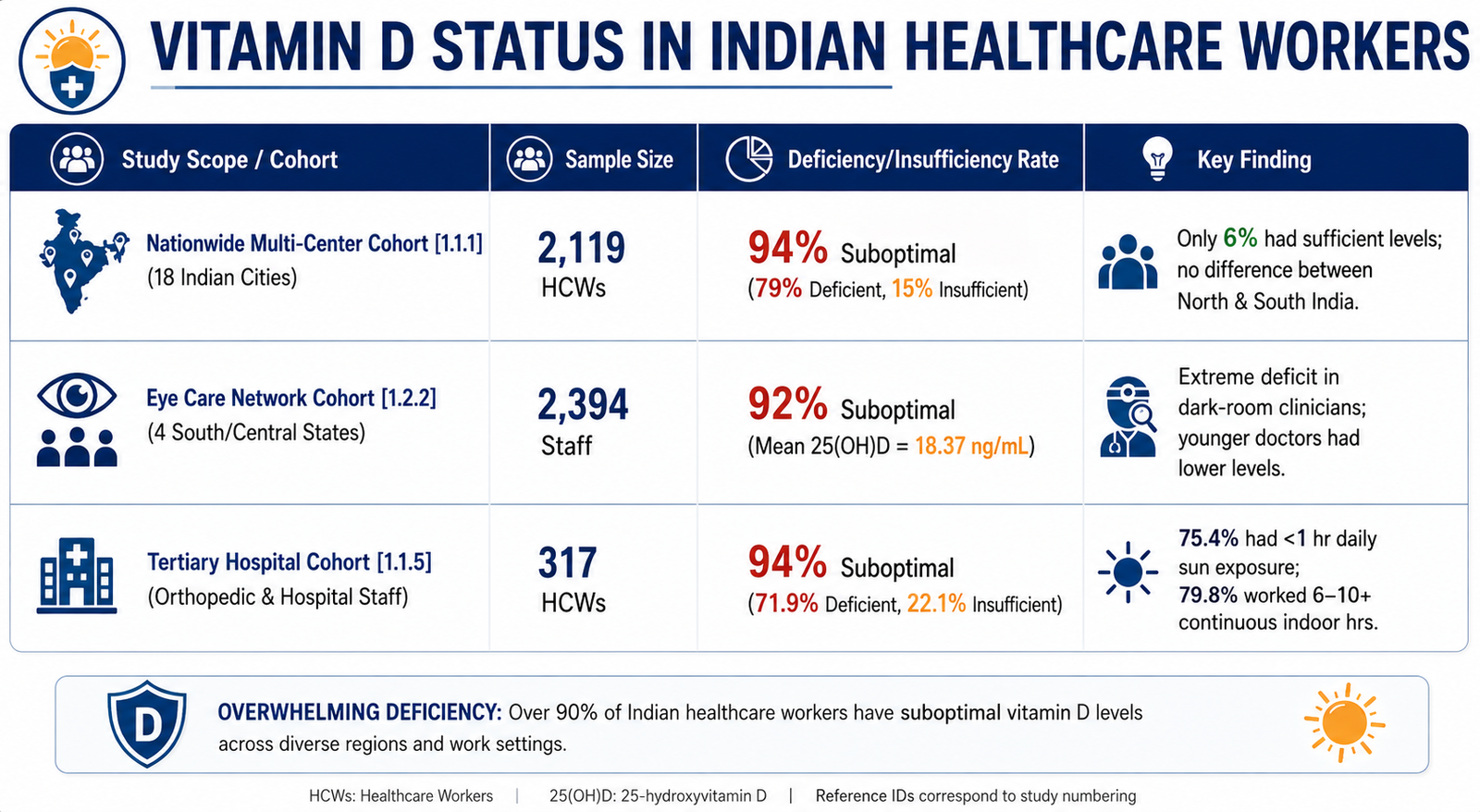
In one of the largest cross-sectional epidemiological studies conducted on medical personnel in India, researchers evaluated 2,119 medical and paramedical professionals across 18 major cities (including Mumbai, Chennai, Kolkata, Bangalore, and New Delhi).
-
The 6% Rule: Only 6% of participants demonstrated optimal serum 25(OH)D levels (>30 ng/mL)
-
Deficiency Rates: 79% were clinically deficient (<20 ng/mL), and 15% had insufficient levels (20 -30 ng/mL)
-
The Latitudinal Paradox: There was no statistically significant difference in serum levels between healthcare professionals in North India (14.4 ± 8.5 ng/mL) and South India (13.3 ± 6.4 ng/mL). This confirms that occupational indoor confinement overrides geographical sunshine availability
B. The Eye Care Hospital Network Cohort
A study published in the Indian Journal of Ophthalmology assessed 2,394 employees across an extensive eye care hospital network spanning Andhra Pradesh, Telangana, Karnataka, and Odisha:
-
Dark-Room Pathology: Ophthalmologists, optometrists, and diagnostic technicians working in darkened diagnostic clinics and operating suits exhibited a 92% prevalence of suboptimal Vitamin D.
-
The Junior Doctor Risk: Younger resident medical staff (mean age 29 years) recorded significantly lower mean Vitamin D levels (18.37 ng/mL) than senior consultants (33.7 years, P < 0.0001), reflecting the longer, uninterrupted indoor duty hours demanded of junior doctors.
C. Tertiary Hospital Clinical Cohort
A cohort study evaluating hospital workers at a major Indian tertiary care center revealed that 71.9% were deficient and 22.1% were insufficient, leaving only 6.0% with adequate status.
-
Over 75.4% of workers received less than 1 hour of direct sunlight daily
-
79.8% worked indoor shifts lasting 6 to 10+ consecutive hours
-
Symptomatic manifestations were common: fatigue (34.4%), hair fall (21.5%), and diffuse musculoskeletal pain (19.9%)
2. Pathophysiological & Occupational Mechanisms
-
The Solar-Shift Window Disconnect
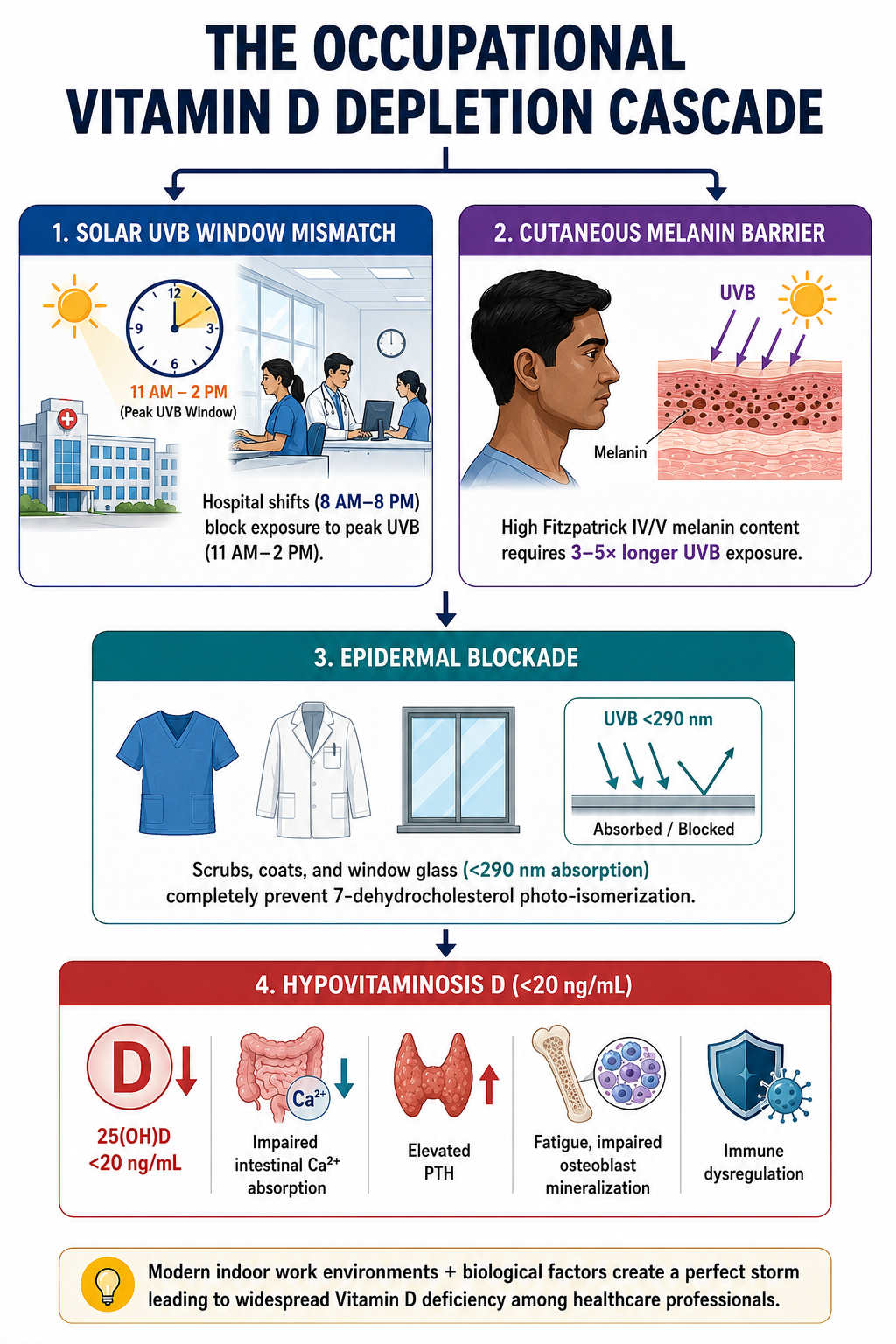
Cutaneous synthesis of Vitamin D3 requires Ultraviolet B (UVB) photons at wavelengths of 290–315 nm. In tropical latitudes like India, peak UVB availability occurs strictly between 11:00 AM and 2:00 PM. Healthcare professionals typically work continuous 8-to-12 hour shifts during these exact solar hours, entering and exiting clinical facilities when the solar zenith angle is suboptimal for Vitamin D synthesis.
-
High Melanin & Exposure Duration
Indian skin types primarily fall into Fitzpatrick Scale Types IV and V, characterized by elevated baseline epidermal melanin. Melanin acts as a natural sunscreen, absorbing UVB photons. Consequently, Indian skin requires 3 to 5 times longer direct sun exposure (approximately 30 to 45 minutes of mid-day sun on arms and legs) to synthesize equivalent amounts of pre-vitamin D3 compared to lighter skin types—a timeframe impossible to achieve during indoor hospital shifts.
-
Structural Barriers: PPE, Scrubs, and Window Glass
Standard hospital attire (long lab coats, clinical scrubs, surgical gowns, and personal protective gear) covers up to 90% of total Body Surface Area (BSA). Furthermore, standard glass windows in modern air-conditioned hospitals block 100% of UVB radiation, meaning indoor sunlight exposure through windows provides zero Vitamin D synthesis.
3. Workplace Solutions for Hospital Administrations
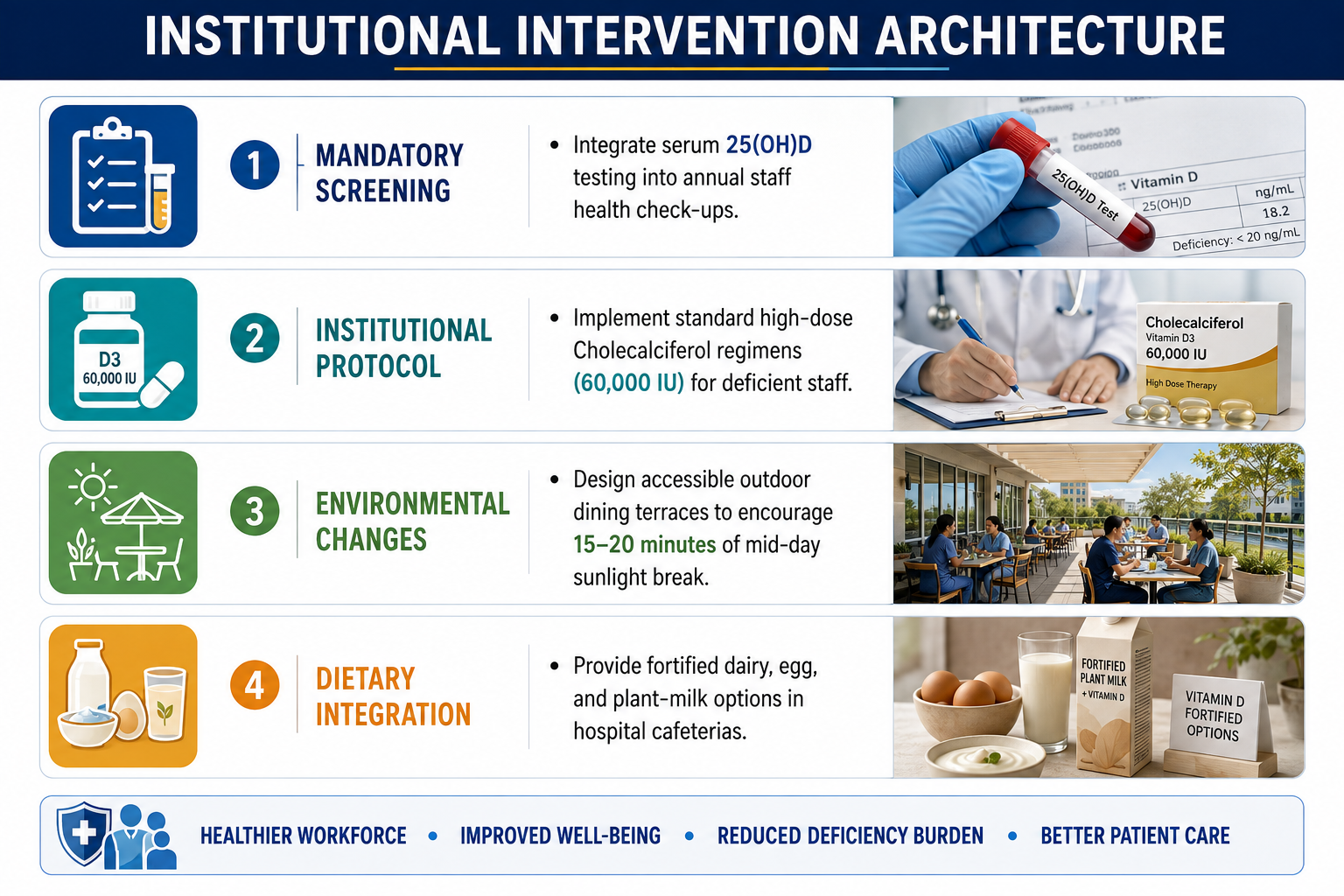
To address this occupational health deficit among clinical staff, occupational health divisions recommend an integrated strategy:
-
Annual Occupational Screening: Include serum 25(OH)D testing as a routine component of annual executive health check-ups for all clinical and administrative hospital staff.
-
Targeted Supplementation Protocols: Establish institutional guidelines offering evidence-based oral supplementation (e.g., Cholecalciferol 60,000 IU weekly for 8 weeks, followed by monthly maintenance) for staff identified with serum levels <20 ng/mL.
-
Architectural & Shift Adaptation: Design hospital break areas, rooftop gardens, or dining terraces that allow medical personnel to access safe, direct outdoor sunlight for 15–20 minutes during midday breaks.
References & Data Sources
-
Beloyartseva, M., et al. “Widespread vitamin D deficiency among Indian health care professionals.” Archives of Osteoporosis, 7(1-2), 187–192
-
Watts, E., et al. “Vitamin D deficiency in healthcare professionals across the network of an eye care organization in India.” Indian Journal of Ophthalmology, 69(2), 276–280
-
Kumar, A., et al. (2026). “Prevalence of Vitamin D Deficiency among Health Care Workers of a Tertiary Care Centre in India.” Journal of Orthopaedic Case Reports, 16(8)
-
Aparna, P., et al. “Vitamin D deficiency in India.” Journal of Family Medicine and Primary Care, 7(2), 324–330
-
Sowah, D., et al. “Vitamin D levels and deficiency with different occupations: a systematic review.” BMC Public Health, 17(1), 519