



If you love your Heart and care for your Heart Health – you won’t miss a word of this special series on Heart Health for Indians. As part of our Evidence-Explained™ series – we present you findings from a 20-Year study, known as Inter99 – a Danish medical study designed to establish if taking a daily Vit K2 Supplement can slow down or even stop arterial hardening in older adults. Savour the details and take good care of your Heart…
What is Inter99 Study and What does this Mean for Indians
The InterVitaminK trial (often referred to as the Inter99 Vitamin K study) is a Danish medical study designed to see if taking a daily Vitamin K2 supplement can slow down or stop the hardening of heart arteries in older adults. The trial is a spin-off from a large, long-running public health project in Denmark known as the Inter99 study.
Here is how the study works in simple terms:
- The Participants: Researchers selected older adults from the original Inter99 group who already show early signs of calcium buildup in their heart’s blood vessels (measured by a high coronary artery calcium score)
- The Experiment: Participants are split into two groups. One group takes a daily Vitamin K2 (MK-7) pill for 3 years, while the other group takes a harmless lookalike pill called a placebo
- The Goal: The primary goal is to find out if Vitamin K2 keeps blood vessels flexible by preventing calcium from depositing in the artery walls, which can reduce the risk of heart attacks
-
Bonus Checks: Researchers are also testing if the supplement improves bone density and blood sugar regulation
We explain in Simple Details, the outcomes from this study and its application for Indians, in the following paras.
What ACTUALLY is Vitamin K – and Vit K1 vs Vit K2
When we think of Vitamin K, we usually think of blood clotting. However, researchers have discovered that Vitamin K—specifically Vitamin K2—plays an essential role in keeping our blood vessels flexible and directing calcium into our bones rather than our arterial walls as we age.
The Inter99 Study—a major 20-year scientific project following a large cohort of older adults—examined how long-term Vitamin K status affects two distinct aspects of cardiovascular health: arterial function (how flexible blood vessels remain) and arterial structure (whether physical calcium deposits or blockages have accumulated).
Here is a simple, evidence-backed breakdown of what the researchers discovered, the vital differences between Vitamin K1 and Vitamin K2, and the widespread impact of Vitamin K2 deficiency in Indian populations.
1. What Is Vitamin K2? (K1 vs. K2)
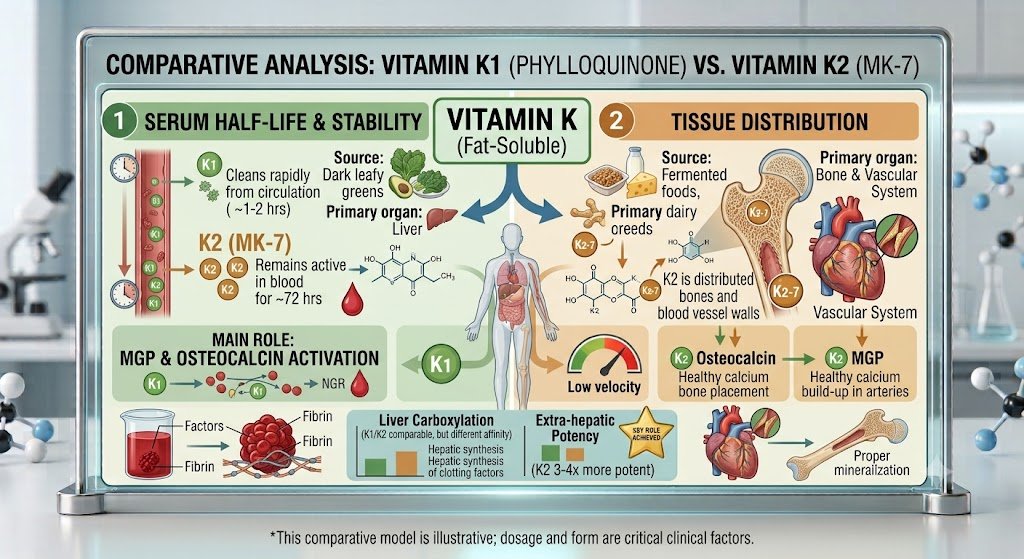
Vitamin K is not a single compound, but a family of fat-soluble vitamins divided into two primary forms: Vitamin K1 (Phylloquinone) and Vitamin K2 (Menaquinones / MKs).
-
Vitamin K1 (Phylloquinone): Primarily found in green leafy vegetables like spinach, kale, and broccoli. The body routes most K1 directly to the liver, where it activates clotting proteins to ensure normal blood coagulation
-
Vitamin K2 (Menaquinones): Synthesized by bacteria and found in fermented foods (such as natto and fermented cheeses), dairy and only animal products. Vitamin K2 travels beyond the liver into systemic circulation, where it activates specific proteins that regulate calcium in the bones and blood vessels
-
Subtypes: K2 includes short-chain menaquinones (like MK-4) and long-chain menaquinones (like MK-7, MK-8, and MK-9). Among these, MK-7 has the highest biological activity and longest half-life in human tissue.
-
2. Why Vitamin K2 Is Superior to K1 for Heart and Bone Health
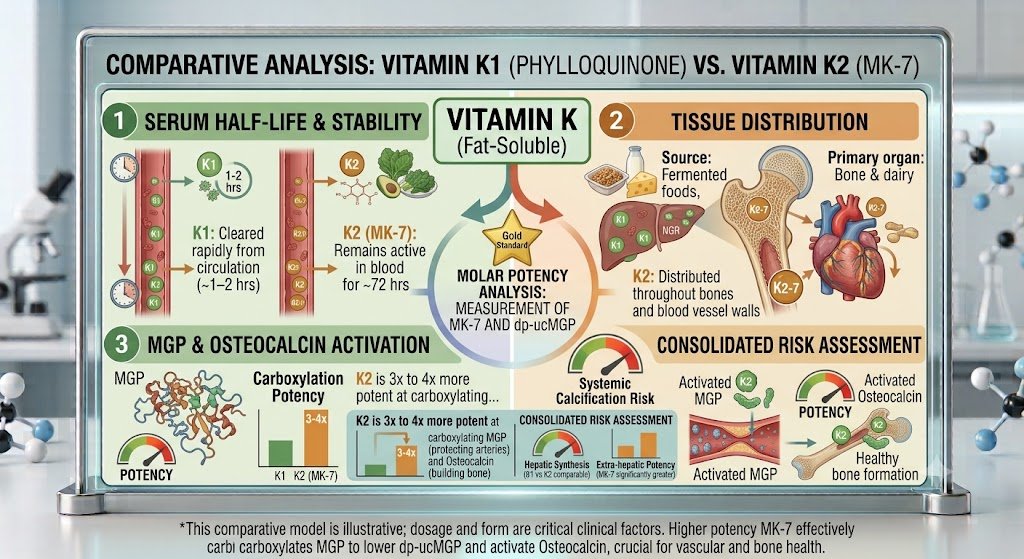
While Vitamin K1 is vital for survival (preventing bleeding disorders), Vitamin K2 is far more effective for long-term cardiovascular and skeletal protection due to three biological advantages:
The “Calcium Paradox” & Matrix Gla-Protein (MGP)
As people age, calcium frequently deposits in the walls of blood vessels (causing arterial hardening) instead of staying in the bones (leading to osteoporosis). This phenomenon is known as the Calcium Paradox.
Vitamin K2 solves this paradox by activating two key proteins:
-
Matrix Gla-Protein (MGP): Found in blood vessel walls. When activated by K2, MGP acts as the body’s strongest natural inhibitor of soft tissue calcification, preventing calcium from adhering to arterial walls
-
Osteocalcin: Found in bone tissue. When activated by K2, Osteocalcin binds calcium directly into the hydroxyapatite matrix of bones and teeth
Without sufficient Vitamin K2, these proteins remain inactive (uncarboxylated), allowing calcium to accumulate in blood vessels while bones weaken.
The 20-Year Inter99 Study: What the Science Found
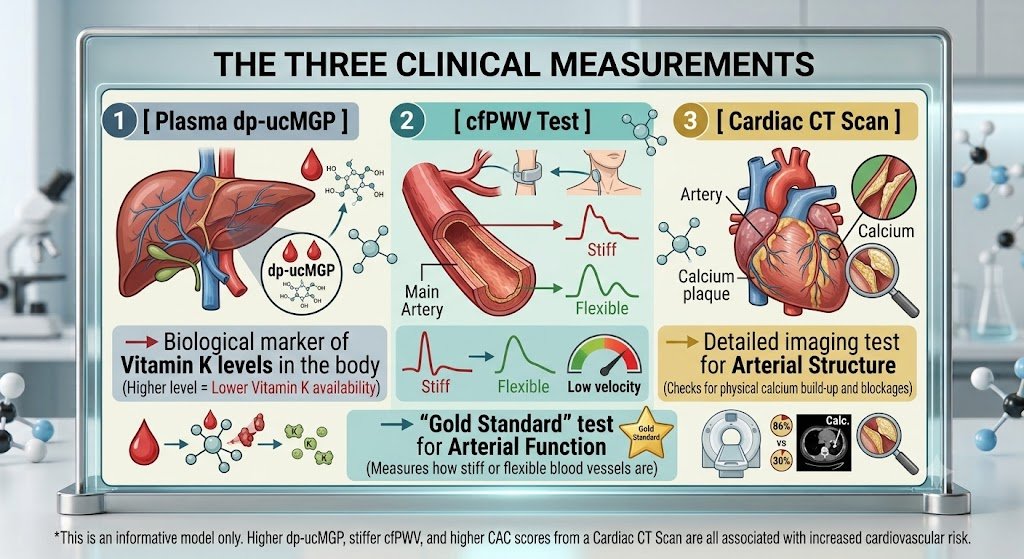
The Inter99 study evaluated Vitamin K status using dp-ucMGP (desphosphorylated-uncarboxylated MGP)—a specific blood biomarker that rises when Vitamin K levels are deficient.
Key Findings: Function vs. Structure
-
Arterial Function (Flexibility): Participants with higher dp-ucMGP (lower Vitamin K status) had significantly higher carotid–femoral pulse wave velocity (cfPWV)—indicating stiffer, less elastic arteries. This association remained strong even after adjusting for age, blood pressure, kidney function, and other major risk factors
-
Arterial Structure (Calcium & Narrowing): Vitamin K status showed no significant direct association with coronary artery calcification (CAC) or obstructive stenosis at that specific single point of CT imaging
Clinical Insight: Vitamin K status influences the functional elasticity of your blood vessels day-to-day before large, physical calcified plaques become visible on standard structural CT scanners.
Epidemiology of Vitamin K2 Deficiency in Indians
Lets try and understand how Inter99 is relevant and critically important for Indians. But to understand that lets first evaluate the Vit K2 status in Indians.
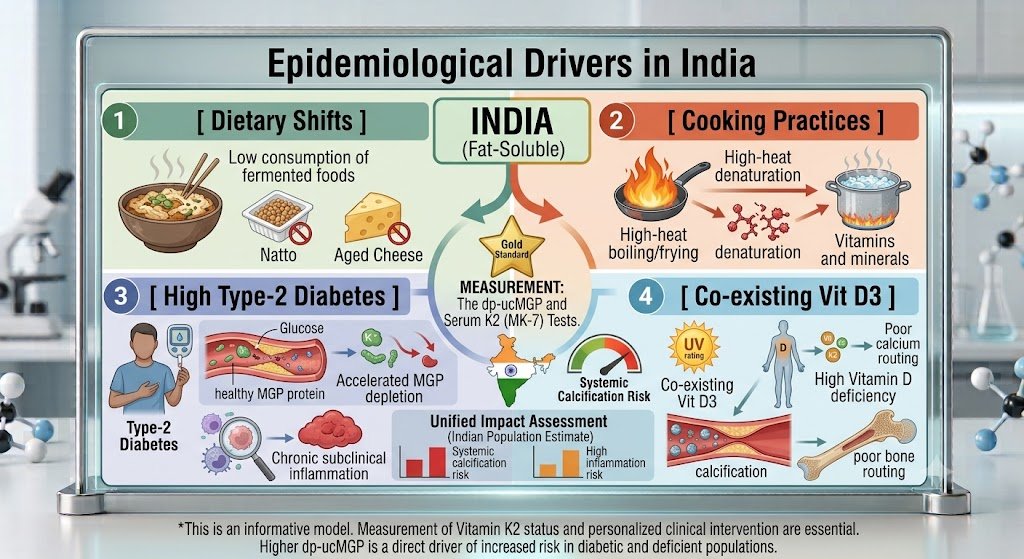
Vitamin K2 deficiency is surprisingly widespread across the Indian subcontinent, driven by dietary patterns, metabolic risk factors and our cooking habits.
Key Epidemiological Factors
-
Lack of Fermented K2 Sources: The richest dietary source of Vitamin K2 (MK-7) is natto (fermented soybeans) alongside aged fermented cheeses. These foods are largely absent from traditional Indian diets. While traditional curd (dahi) contains small amounts of MK-4, it provides significantly lower doses than required for optimal extra-hepatic MGP activation
-
Vegetarian Dietary Profiles: Over 30 – 40% of the Indian population follows a strict vegetarian diet. While vegetarians often get adequate Vitamin K1 from leafy greens, their intake of preformed Vitamin K2 (found in poultry, egg yolks, and specific fermented dairy such as aged cheeses) is minimal
-
High Prevalence of Cardiometabolic Disease: India faces high rates of Type-2 Diabetes Mellitus (T2DM) and Metabolic Syndrome. Chronic hyperglycemia accelerates the depletion of active MGP and increases arterial stiffness, raising the physiological requirement for Vitamin K2
-
The Vitamin D3 Co-Factor Gap: Widespread Vitamin D deficiency across India (affecting 70 – 90% of the population) has led to widespread high-dose Vitamin D3 supplementation. Supplementing with Vitamin D3 increases the body’s production of Vitamin K2-dependent proteins (MGP and Osteocalcin). If Vitamin D3 is taken without adequate Vitamin K2, these proteins remain inactive, increasing the risk of vascular calcification
Key Takeaways for Indians & Recommended Daily Sources
-
Focus on Both Forms: Eat green vegetables for Vitamin K1 (for blood clotting health), but MUST consider food sources or targeted supplementation of Vitamin K2 (MK-7) for heart and bone health.
-
Food Sources of Vitamin K2:
-
MK-7: Natto, hard/aged cheeses (Gouda, Edam), fermented dairy
-
MK-4: Pasture-raised egg yolks, chicken liver, nutton liver and butter
-
-
Pair D3 with K2: If taking Vitamin D3 supplements for bone density or immune health, discuss adding Vitamin K2 (MK-7, typically 50 – 100 mcg/day) with your physician to ensure calcium is routed into bones rather than blood vessels