



As part of our Evidence-Explained™ – we present you learnings from a long, 20 years running clinical study on Osteoporosis and Fractures in Americans and the applications and learnings for Indians from this study. Please do share with your loved ones and elders who may need these details, the most.
Osteoporosis and Fractures in Indians
Accordding to a 2019 Publication – An estimated 50 to 61 million Indians suffer from osteoporosis, making it a major public health concern that affects both men and women. Osteoporosis and fragility fractures have become a major healthcare challenge globally in the recent years.
However, this problem has only recently been accorded its due importance in developing countries such as India. India is a model case study for the management of osteoporosis and fragility fractures in a resource-limited setting, as it harbors a large geriatric population and has the highest prevalence of osteopenia globally.
Prevalence and Statistics
- High overall numbers: Over 61 million people in India live with osteoporosis
- Women are affected most: Studies show that the prevalence of osteoporosis in Indian women ranges widely from 8% to 62%, depending on age and region
- Early onset of fractures: Osteoporotic fractures in Indians tend to happen 10 to 12 years earlier than in Western populations
- Common fracture types: More than 250,000 people suffer a hip fracture, and over 4.5 million women over 60 suffer a fractured spine every year in India
Situation in America
A landmark serial cross-sectional study published in The American Journal of Clinical Nutrition—analyzing National Health and Nutrition Examination Survey (NHANES) data from 1999 to 2023—uncovered a critical public health paradox.
Despite widespread health awareness and wellness trends, adult bone mineral density (BMD) has declined while osteoporotic fractures at the hip, wrist, and spine have risen.
The primary culprit is not simply a lack of dietary calcium, but a compound dietary imbalance: the combination of surging dietary anti-nutrients (oxalates and phytates) paired with declining calcium and dairy intake.
While this study assessed adults in the United States, its findings carry profound implications for the Indian population. India is currently experiencing a silent skeletal health crisis, driven by traditional high-oxalate diets, low calcium bioavailability, and widespread vitamin D deficiency.
NHANES 1999–2023 Study: Unpacking the Findings
For decades, nutritional guidelines focused almost exclusively on absolute calcium intake to prevent osteopenia and osteoporosis. However, the 2025 NHANES analysis highlights that calcium bioavailability—how much ingested calcium is actually absorbed into the bloodstream—is governed by dietary co-factors.
Key Trends Discovered in the 24-Year Analysis
-
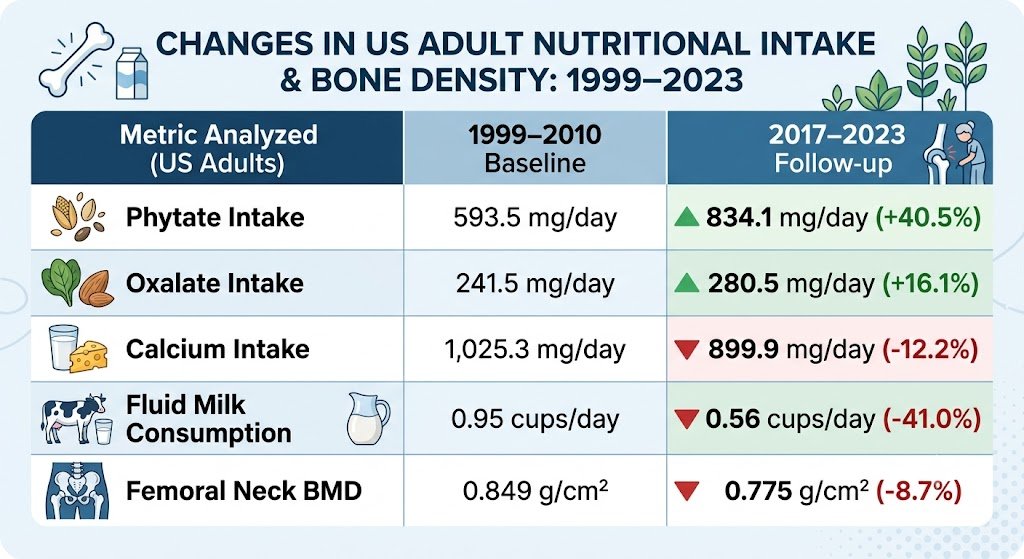
Surging Anti-Nutrient Intake: Between 1999 and 2020, average daily phytate intake increased by 40.5% (from 593.5 ± 23.2 mg/day to 834.1 ± 26.2 mg/day). Average daily oxalate intake rose by 16.1% (from 241.5 ± 6.6 mg/day to 280.5 ± 6.6 mg/day). This increase was largely driven by plant-based dietary shifts, higher consumption of green smoothies, nuts, seeds, and unrefined grains.
-
Declining Bioavailable Calcium: Daily calcium intake peaked at 1,025.3 mg/day in 2009–2010 but dropped to 899.9 mg/day by 2021–2023. Simultaneously, fluid cow’s milk consumption dropped from 0.95 cup-equivalents per day in 1999 to just 0.56 cup-equivalents in 2020.
-
Depressed Serum Calcium and Bone Density: Average serum calcium levels declined from 9.46 mg/dL to 9.29 mg/dL. Dual-energy X-ray absorptiometry (DXA) scans showed significant drops in bone mineral density: total femur BMD fell from 0.982 g/cm² to 0.934 g/cm², and femoral neck BMD fell from 0.849 g/cm² to 0.775 g/cm².
-
Increased Fracture Rates: Periods characterized by lower bioavailable calcium directly corresponded with a higher prevalence of self-reported hip, spine, and wrist fractures.
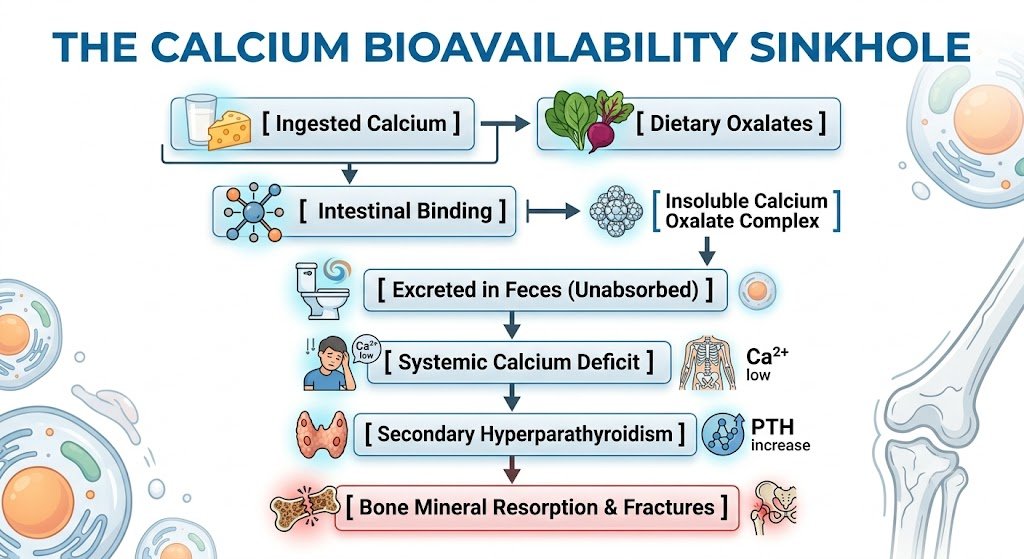
The underlying biochemistry is straightforward: oxalic acid (C2H2O4) forms an insoluble salt when it contacts calcium ions (Ca²+) in the digestive tract. Because insoluble calcium oxalate cannot be absorbed across the intestinal lumen, it passes unabsorbed through the digestive tract. When dietary oxalate intake is high and calcium intake is low, the body pulls calcium from skeletal reserves to maintain serum homeostasis, gradually lowering bone density over time.
Indian Context: An Unrecognized Skeletal Crisis
While the NHANES study highlights a growing dietary shift in Western populations, high oxalate consumption combined with low bioavailable calcium has been a long-standing norm across the Indian subcontinent.
Epidemiological Reality: Osteoporosis and Fractures in India
India faces a major osteoporotic burden, accelerated by shifting demographics and widespread dietary gaps:
-
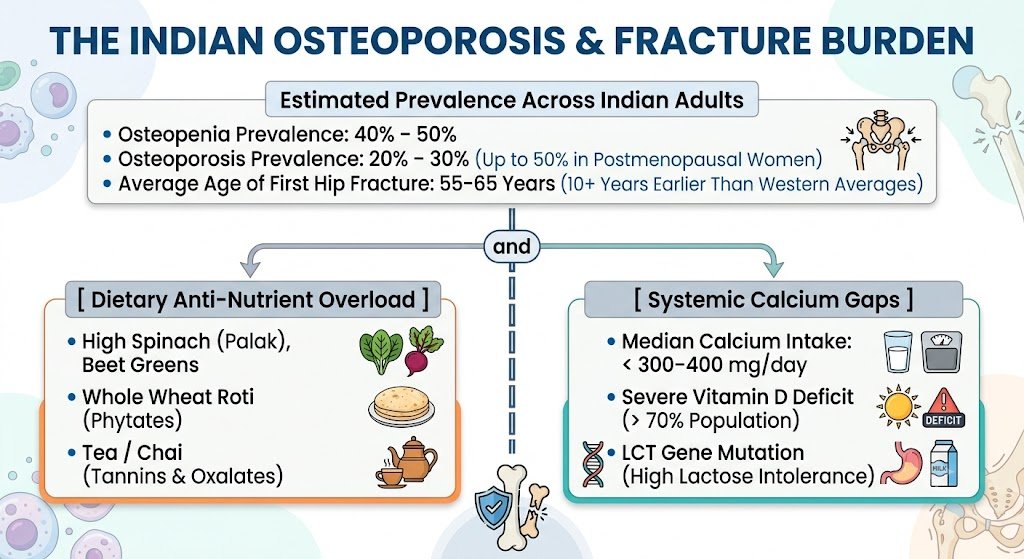
Prevalence of Osteopenia & Osteoporosis: Systematic reviews and meta-analyses estimate that approximately 20% to 30% of Indian adults suffer from osteoporosis, while over 40% to 50% present with osteopenia. Postmenopausal Indian women are disproportionately affected, with osteoporosis rates in urban and rural cohorts exceeding 38% to 50%
-
Fragility Fractures: It is estimated that India sees millions of osteoporotic hip fractures annually. Worryingly, hip fractures in Indians occur 10 to 15 years earlier on average compared to Western populations, often striking individuals in their late 50s and 60s
-
The “Low BMD Peak” Hypothesis: Indian adults achieve a lower peak bone mass (PBM) in early adulthood compared to global averages. While genetics plays a role, chronic childhood and adolescent micronutrient deficiencies—specifically low calcium absorption—are major contributing factors.
Why Indians Are at High Risk for Oxalate-Induced Calcium Deficits
The dietary habits of typical Indian households create a scenario where oxalates and phytates frequently bind available dietary calcium.
1. High-Oxalate Staples in Daily Indian Cuisine
The traditional Indian diet relies heavily on plant foods naturally rich in oxalic acid:
-
Leafy Greens: Palak (spinach), Amaranth (chaulai), Bathua (goosefoot), and beet greens are dietary staples. Uncooked or lightly cooked spinach contains up to 1,000 mg of oxalates per 100 gm
-
Legumes, Pulses, and Nuts: Chana (chickpeas), Rajma (kidney beans), soybeans, and nuts (almonds, cashews) contain high levels of both oxalates and phytates
-
Spices and Tea: India is one of the world’s largest consumers of black tea (chai), which is rich in soluble oxalates and tannins. Spices like turmeric, cumin, and coriander powder also contribute to daily anti-nutrient loads
In many Indian households, daily oxalate intake exceeds 400 – 800 mg/day, significantly higher than the 280 mg/day recorded in the US NHANES dataset.
2. Severe Inadequate Dietary Calcium Intake
According to the Indian Council of Medical Research (ICMR-NIN 2020 guidelines), the recommended dietary allowance (RDA) for calcium in adults is 1,000 mg/day. However, dietary surveys show that the median calcium intake across Indian states ranges from just 300 to 500 mg/day—less than half the recommended amount.
When a baseline calcium intake of 400 mg is combined with an oxalate load of 600 mg, nearly all available ionic calcium is bound in the gut. This results in minimal net calcium absorption, driving down serum levels and triggering bone resorption.
3. Widespread Lactose Intolerance and Declining Dairy Absorption
While India is the world’s largest milk producer, adult lactase non-persistence (lactose intolerance) affects an estimated 60% to 70% of the adult population. As a result, many adults avoid fluid milk, removing a primary source of bioavailable calcium.
4. The Widespread Vitamin D Deficit
Calcium absorption across the intestinal wall relies on active transport mediated by 1,25-dihydroxyvitamin D3. Over 70% to 80% of Indians present with clinical Vitamin D deficiency (<20 ng/mL), driven by indoor lifestyle patterns, skin pigmentation (melanin reducing cutaneous synthesis), and atmospheric pollution. Without adequate Vitamin D, intestinal calcium absorption efficiency drops below 10 -15%, compounding the effects of dietary oxalates.
How Oxalates Weaken the Skeleton
Understanding the pathway from dietary intake to bone fracture requires examining two primary biological mechanisms:
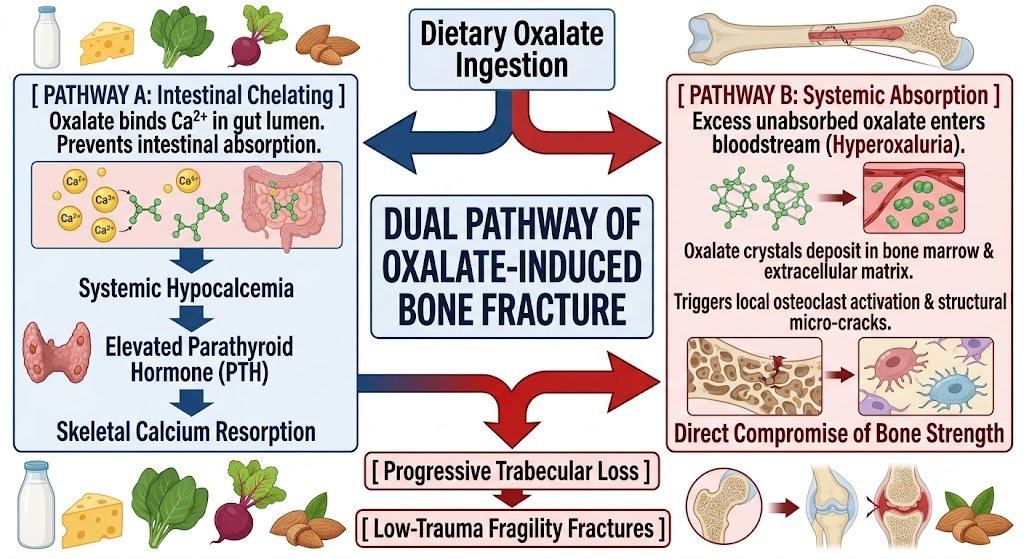
Pathway A: Intestinal Chelation and Secondary Hyperparathyroidism
-
Intestinal Binding: Soluble oxalates bind to dietary calcium ions in the stomach and small intestine, forming insoluble calcium oxalate complexes
-
Reduced Absorption: The bound calcium cannot pass through intestinal transport proteins and is excreted in stool
-
Parathyroid Cascade: The resulting drop in serum calcium triggers the parathyroid glands to release Parathyroid Hormone (PTH)
-
Bone Resorption: Elevated PTH activates osteoclasts, which break down the bone matrix to release stored calcium into the bloodstream, maintaining serum homeostasis at the expense of structural bone density
Pathway B: Systemic Oxalemia and Bone Matrix Toxicity
When dietary calcium intake is extremely low relative to oxalate intake, uncomplexed oxalates are absorbed directly into the bloodstream (hyperoxaluria). High circulating oxalate levels can form micro-crystals within bone marrow and the extracellular bone matrix, inducing localized inflammation, impairing osteoblast function, and accelerating bone tissue degradation.
Practical Strategies to Mitigate Oxalate Risks for Indians
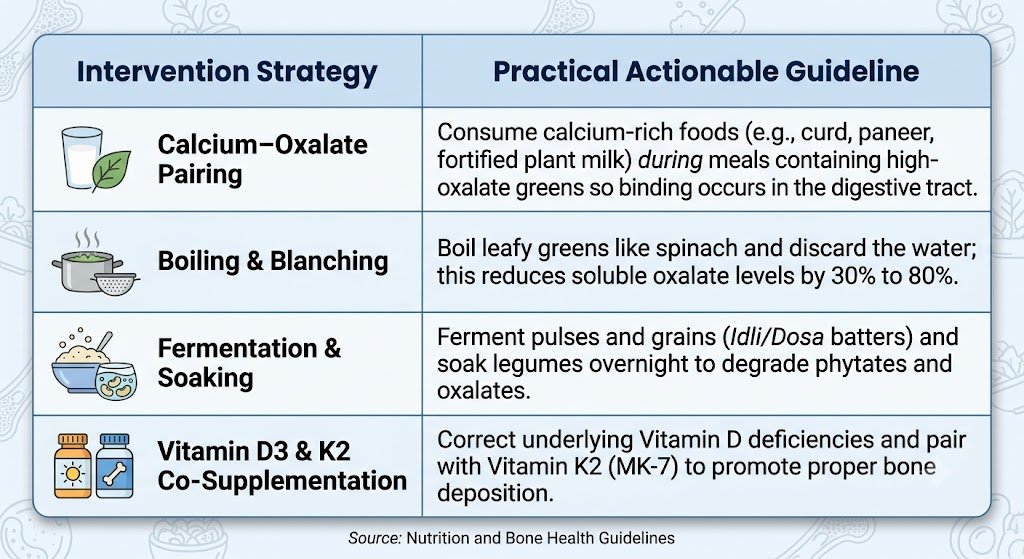
Addressing oxalate-induced bone loss in India does not require eliminating nutrient-rich plant foods. Instead, targeted culinary and dietary modifications can help neutralize anti-nutrients and protect bone density:
-
Pair Oxalates with Calcium at the Same Meal: Consuming a calcium source alongside high-oxalate foods causes binding to occur within the stomach and intestines. The insoluble calcium oxalate passes out through the stool, protecting both bone density and kidney function. For example, pairing spinach curry (Palak) with cottage cheese (Paneer) or yogurt (Raita) helps neutralize dietary oxalates.
-
Use Cooking Methods That Reduce Oxalates: Boiling high-oxalate vegetables and discarding the cooking water can reduce soluble oxalate content by 30% to 80%. Steaming or roasting is less effective, as it retains the anti-nutrients.
-
Ferment and Soak Grains and Legumes: Traditional Indian culinary practices like soaking beans (Rajma, Chana) overnight and fermenting batters (Idli, Dosa) activate endogenous phytase and oxalactate enzymes, breaking down anti-nutrients prior to ingestion.
-
Maintain Hydration and Gut Microbiome Health: Intestinal bacteria like Oxalobacter formigenes naturally degrade oxalates in the gut lumen. Avoiding unnecessary broad-spectrum antibiotic use helps preserve these protective bacterial colonies.
Conclusions and Public Health Roadmap
The 2025 NHANES analysis serves as a clear warning: evaluating bone health based on absolute calcium intake alone is insufficient. Anti-nutrients like oxalates and phytates directly influence calcium bioavailability, significantly affecting long-term bone density and fracture risk.
For India, addressing this challenge requires a dual approach. Public health policies must raise awareness about how culinary preparation methods affect nutrient absorption, while encouraging dietary combinations that maximize calcium bioavailability.
On an individual level, pairing high-oxalate plant foods with bioavailable calcium, adopting traditional preparation techniques like boiling and fermentation, and maintaining adequate Vitamin D levels can help protect bone health and reduce long-term fracture risks across the population.