



If you are a PURE Vegetarian – this write up and every single word of this, greatly helps you understand the inherent risk of oxalates present in plant foods / vegetarian foods. This is our incredible guide that covers everything about oxalates, their health risks and startegies to minimize / mitigate risks from high oxalates in vegetarian foods. This write up is only about risk of OSTEOPOROSIS AND FRACTURES because of high oxalate foods. Apart from Fractures and Osteoporosis, Oxalates are very well known for causing kidney stones. Your are very welcome…
What the Hell are Oxalates
Oxalates (also called oxalic acid) are natural compounds found in many plants, vegetables and are also produced by the human body that can become harmful by binding with calcium resulting in either Osteoporosis or painful kidney stones or both.
For most people, if consumed in less amounts, oxalates are completely harmless and leave the body through urine or stool.
- Plant / Vegetable sources: They are found in healthy foods like spinach, beets, rhubarb, nuts, and whole grains
- Body production: Your liver naturally creates oxalates as a normal waste product
- Normal processing: Healthy bodies easily filter and flush out normal amounts of oxalates without issue
Why Are Oxalates Considered Bad?
- Kidney stones: When high levels of oxalate combine with calcium in the urinary tract, they form sharp crystals that can turn into painful kidney stones
- Mineral binding (Anti-nutrients): Oxalates can attach to essential minerals like calcium and iron in your digestive tract, slightly reducing how many of these nutrients your body absorbs – leading to osteoporosis and fragility fractures
-
Rare tissue buildup: In very rare genetic or severe medical conditions, excess oxalates can build up in body tissues and organs, a dangerous condition known as oxalosis
Which Foods Actually Have Oxalates
Plant organisms synthesize oxalic acid / oxalates primarily as a metabolic byproduct or defence mechanism against herbivores. Since plants and vegetables are static and can not run away from predators – these plants and vegetables have oxalates as one of their defense mechanisms.
If you read this above highlighted line again, you would realize that NATURE does not want human beings to be PURE VEGETARIANS but rather OMNIVORES. However, if you still wish to follow pure vegetarianism – please read all the following details very carefully to help mitigate risks from high oxalate foods.
Consequently, oxalates are predominantly found ONLY in plant-based foods (Vegetarian). Animal tissues (Non-Vegetarian foods) contain zero to negligible traces of oxalates.
Comparative Analysis of Indian Foods by Oxalate Content
Oxalate classifications typically follow clinical standards for dietary management:
-
Very High Oxalate: >100 mg per 100 g
-
High Oxalate: 25 – 99 mg per 100 g
-
Moderate Oxalate: 10 – 24 mg per 100 g}
-
Low / Negligible Oxalate: <10 mg per 100 g}
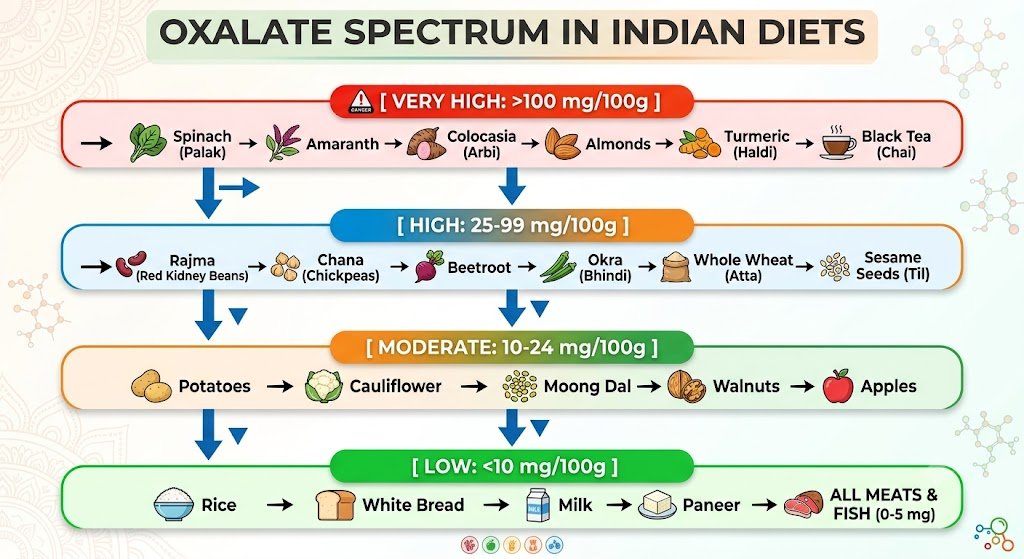
Master Guide: Oxalate Levels in Vegetarian vs. Non-Vegetarian Indian Foods
Category |
Food Item (English / Hindi Name) |
Oxalate Level (mg per 100g fresh weight) |
Oxalate Risk Classification |
Primary Type of Oxalate Present |
Vegetarian — Leafy Greens |
Spinach (Palak) |
600 – 900 mg |
Very High |
Soluble & Insoluble |
Amaranth (Chaulai) |
700 – 1100 mg |
Very High |
Soluble & Insoluble |
|
Colocasia Leaves (Arbi ke Patte) |
400 – 800 mg |
Very High |
Soluble Calcium Oxalate |
|
Bathua (Chenopodium album) |
300 – 600 mg |
Very High |
Soluble |
|
Curry Leaves (Kadi Patta) |
150 – 280 mg |
Very High |
Mostly Insoluble |
|
Mustard Greens (Sarson) |
40 – 90 mg |
High |
Insoluble |
|
Fenugreek Leaves (Methi) |
30 – 55 mg |
High |
Insoluble |
|
Coriander / Cilantro (Dhania Patta) |
25 – 50 mg |
High |
Insoluble |
|
Vegetarian — Vegetables & Roots |
Beetroot (Chukandar) |
150 – 300 mg |
Very High |
Soluble |
Okra (Bhindi) |
50 – 100 mg |
High – Very High |
Insoluble |
|
Sweet Potato (Shakarkand) |
80 – 130 mg |
Very High |
Soluble |
|
Yam (Jimikand / Suran) |
50 – 90 mg |
High |
Insoluble |
|
White Potato (with skin) |
25 – 50 mg |
High |
Insoluble |
|
Eggplant (Baingan) |
25 – 45 mg |
High |
Insoluble |
|
Cauliflower / Cabbage / Onion |
2 – 8 mg |
Low |
Negligible |
|
Vegetarian — Pulses, Dal & Grains |
Soybeans / Soya Chunks |
180 – 350 mg |
Very High |
Soluble |
Kidney Beans (Rajma) |
80 – 160 mg |
Very High |
Soluble & Insoluble |
|
Chickpeas (Kala Chana / Chole) |
40 – 80 mg |
High |
Insoluble |
|
Whole Wheat Flour (Chakki Atta) |
60 – 90 mg |
High |
Insoluble (Fibers) |
|
Finger Millet (Ragi) |
40 – 70 mg |
High |
Insoluble |
|
Split Red Lentils (Toor / Masoor Dal) |
20 – 40 mg |
Moderate |
Insoluble |
|
Green Gram (Moong Dal) |
8 – 15 mg |
Low – Moderate |
Insoluble |
|
White Rice (Chawal) |
2 – 6 mg |
Low |
Negligible |
|
Vegetarian — Nuts, Seeds & Spices |
Green Cardamom (Elaichi) |
2,000 – 4,000 mg |
Extremely High (Used in tiny amounts) |
Soluble |
Turmeric Powder (Haldi) |
1,600 – 1,900 mg |
Extremely High (Used in tiny amounts) |
Soluble |
|
Sesame Seeds (Til) |
350 – 550 mg |
Very High |
Insoluble |
|
Almonds (Badam) |
400 – 480 mg |
Very High |
Soluble & Insoluble |
|
Cashews (Kaju) |
150 – 260 mg |
Very High |
Soluble |
|
Black Tea Powder (Chai) |
300 – 500 mg |
Very High |
Soluble |
|
Non-Vegetarian — Meats & Poultry |
Chicken (Breast / Thigh / Curry cut) |
0 mg |
Zero |
None |
Mutton / Goat Meat |
0 mg |
Zero |
None |
|
Beef / Pork |
0 mg |
Zero |
None |
|
Organs (Chicken / Goat Liver & Kidney) |
0 – 3 mg |
Negligible |
None |
|
Non-Vegetarian — Seafood & Fish |
Freshwater Fish (Rohu, Katla) |
0 mg |
Zero |
None |
Marine Fish (Pomfret, Surmai) |
0 mg |
Zero |
None |
|
Prawns / Shrimps / Crabs |
0 – 2 mg |
Negligible |
Trace |
|
Non-Vegetarian — Eggs & Dairy |
Chicken Eggs (Whole / White / Yolk) |
0 mg |
Zero |
None |
Cow / Buffalo Milk |
0 – 1 mg |
Zero |
None |
|
Paneer / Cheese / Curd (Dahi) |
0 – 2 mg |
Key Clinical Insights for Indian Diets
-
The Meat vs. Plant Dichotomy: Animal tissues do not produce oxalic acid. A non-vegetarian meal consisting of chicken, mutton, fish, or eggs contributes essentially zero oxalates to the gut. However, non-vegetarian Indian gravies (Chicken Curry, Mutton Masala) often inherit moderate oxalate levels from added plant ingredients like onion, tomato paste, cashew paste, and spices (Haldi, Dhania powder)
-
Soluble vs. Insoluble Oxalates:
-
Soluble Oxalates (found in Palak, Chai, and Turmeric) readily dissolve in gut fluids and bind strongly to circulating dietary calcium or get absorbed into the bloodstream
-
Insoluble Oxalates (found in grains, Atta, and seeds) are already bound to minerals like calcium or magnesium in the plant matrix and pass largely unabsorbed through the stool
-
Core Principle: The “Gut Binding” Rule
High-oxalate foods (Palak, Chaulai, Rajma, Almonds) and high-phytate foods (Whole Wheat, Chana) contain natural anti-nutrients that bind to calcium ions (Ca²+) in your digestive tract.
When bound, calcium forms insoluble complexes that cannot be absorbed into your bloodstream, forcing your body to pull calcium directly from your bones to maintain blood levels, essentially leading to osteoporosis.
The Golden Rule: Always combine high-oxalate plant foods with a source of bioavailable calcium within the same meal. Binding in the gut prevents oxalates from blocking systemic calcium absorption and protects against bone mineral density loss.
High-Oxalate Foods vs. Calcium Neutralizers
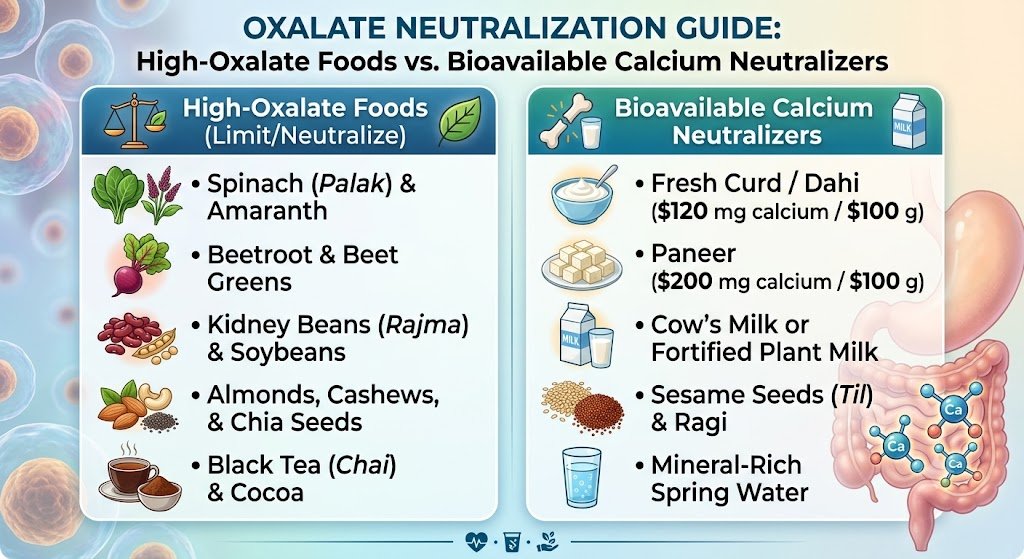
Recommended Meal Combinations & Preparation Tips
Meal Combination Matrix
-
Instead of: Plain Palak Sabzi + Whole Wheat Chapati
Eat This: Palak Paneer or Palak Dahi Sabzi + Fermented Missi Roti
Why: The calcium in Paneer or Dahi binds the oxalic acid directly in the pan/stomach, leaving net bioavailable calcium for your bones.
-
Instead of: Morning Black Tea (Chai) with 5 Soaked Almonds
Eat This: Masala Milk (Doodh) boiled with crushed Sesame Seeds (Til) and 2 Walnuts
Why: Black tea and almonds deliver a high-oxalate double-hit on an empty stomach. Dairy milk neutralizes oxalates instantly.
-
Instead of: Rajma Curry + Unsoaked Brown Rice
Eat This: Overnight-Soaked Rajma cooked with Curd/Dahi gravies + White Basmati Rice or Ragi Dosa
Why: Overnight soaking removes up to 40% of phytates, while curd in the gravy neutralizes residual oxalates.
-
Instead of: Raw Spinach & Beetroot Smoothie
Eat This: Blanched & Drained Spinach Smoothie blended with Greek Yogurt / Curd
Why: Raw green smoothies are concentrated oxalate traps. Blanching drastically cuts oxalate concentration.
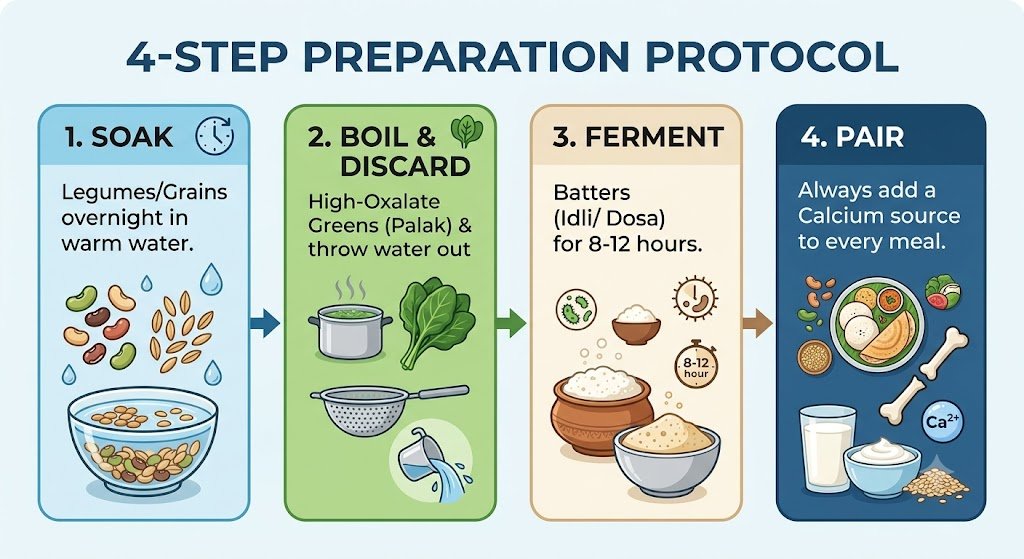
4-Step Anti-Nutrients Neutralization Protocol
-
Boil & Discard Water (Blanching): Boiling leafy greens (Palak, Bathua) for 3 to 5 minutes and discarding the water reduces soluble oxalates by 30% to 80%. Avoid steaming or microwaving high-oxalate greens
-
Overnight Soaking: Soak pulses, Rajma, Chana, and whole grains in warm water with a pinch of salt or lemon juice for at least 8 to 12 hours. Discard the soaking water before cooking to leach out phytates and oxalates
-
Fermentation: Fermenting batters (Idli, Dosa, Dhokla) activates the enzyme phytase, which breaks down up to 70% of calcium-binding phytates in grains
-
Timing Your Supplements: Take prescribed Calcium supplements 1 hour after meals or at bedtime with water—never alongside high-fiber, high-oxalate meals or tea/coffee
Daily Micronutrient Targets to MAINTAIN Bone Density
-
Elemental Calcium: 1,000 – 1,200 mg/day (through diet such as milk and curd + supplementation)
-
Vitamin D3: 1,000 – 2,000 IU/day (maintains target serum 25(OH)D > 30 ng/mL)
-
Vitamin K2 (MK-7): 45 – 90 mcg/day (carboxylates osteocalcin to lock calcium into the bone matrix – and avoids fractures)