



This is our Part 4 of 5-Part Series on Obesity in Indians. This is the most important Part as this covers Nutritional as well as Resistance Training Approach to Weight Loss for Indians. For Part 1, Part 2 and Part 3 – Click the respective hyperlinks.
We have established that obesity is a complex neuro-biological disease, that ultra-processed foods hijack natural satiety pathways, and that modern multi-incretin therapies (GLP-1, GIP, and Glucagon receptor agonists) restore gut-brain signaling to drive profound weight reduction though at some risk of side effects.
However, the rapid and significant weight loss induced by potent agents like semaglutide, tirzepatide and retatrutide presents a new clinical challenge: protecting body composition.
When an individual loses 15% to 25% of their total body weight rapidly, a substantial portion of that loss can come from Lean Body Mass (LBM)—which includes skeletal muscle, organ tissue, and bone mineral density—rather than pure adipose tissue. Preserving LBM is not merely an aesthetic concern; skeletal muscle is the body’s primary site for insulin-mediated glucose disposal, the primary determinant of Basal Metabolic Rate (BMR), and the foundation of functional independence and physical longevity.
Without structured nutritional strategies and mechanical loading, pharmacologically induced weight loss risks causing sarcopenic obesity in reverse—a state where body weight drops, but metabolic rate and functional strength are disproportionately compromised.
Physiology of Lean Mass Loss During Rapid Weight Deficits
During treatment with GLP-1 and dual GLP-1/GIP receptor agonists (like semaglutide and tirzepatide), lean mass reduction typically accounts for roughly 20% to 40% of total weight lost. This proportion is consistent with rapid weight loss from standard calorie-restricted diets, and standard scans often misattribute lost water, glycogen, and intramuscular fat as muscle loss.
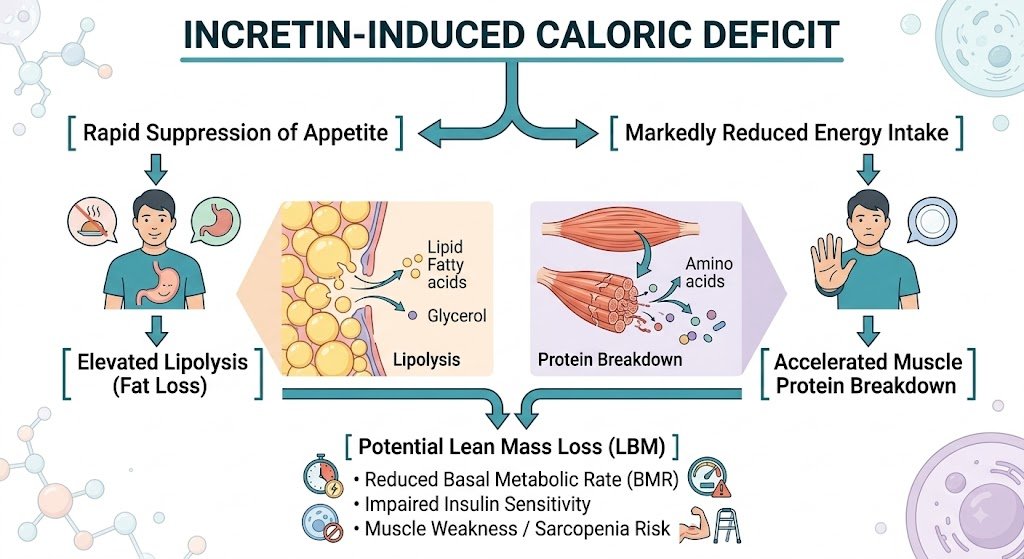
Why This Loss Happens – During significant energy deficits, the body enters a catabolic state where it draws upon both stored lipid reserves (triglycerides in adipocytes) and endogenous amino acid pools (skeletal muscle proteins) to meet baseline energetic and structural demands.
25% Rule of Weight Loss Composition
Historically, across all weight loss modalities—whether achieved through standard calorie restriction, bariatric surgery or pharmacotherapy—approximately 20% – 30% of total weight lost consists of lean tissue, with the remaining 70% -80% coming from fat mass.
In clinical trials for GLP-1 and dual GIP/GLP-1 receptor agonists (such as STEP-1 and SURMOUNT-1 sub-studies utilizing dual-energy X-ray absorptiometry [DXA]):
-
Total fat mass drops dramatically (30% -40% reduction from baseline)
-
Lean mass decreases proportionally (15%-25% of total weight lost)
-
While the ratio of fat-to-lean mass improves overall (increasing relative muscle percentage), the absolute loss of muscle tissue can lead to reduced functional strength, decreased bone density, and a lower post-weight-loss metabolic baseline if unmanaged.
Nutritional Strategy 1: Protein Kinetics and Hyper-Aminoacidemia
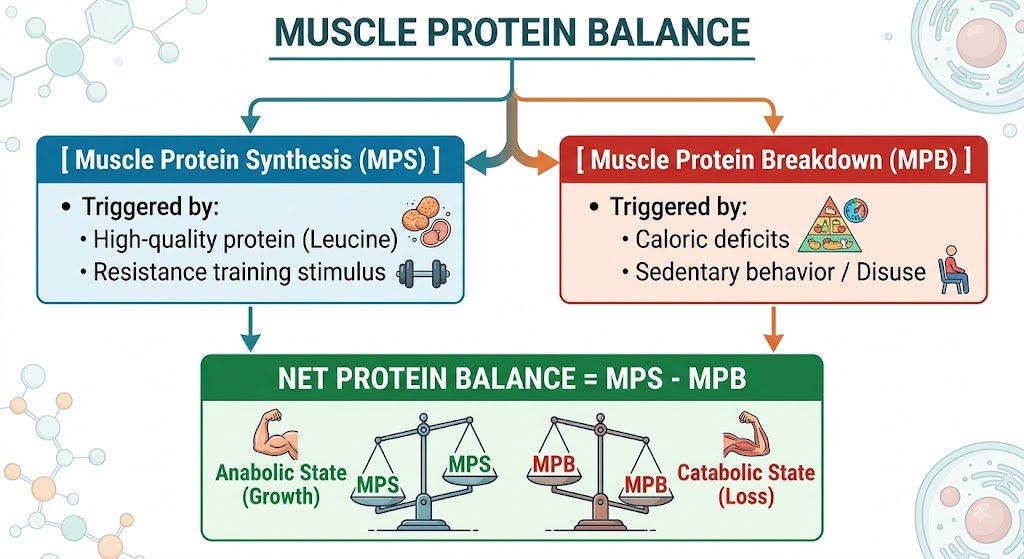
The primary dietary lever / strategy to prevent muscle protein breakdown (MPB) and stimulate Muscle Protein Synthesis (MPS) during an incretin-mediated calorie deficit (using weight loss drugs) is to target protein intake and timing.
1. Daily Protein Requirements
Standard Recommended Dietary Allowances (RDA) of 0.8 g/kg Body Wt /day are designed merely to prevent deficiency in sedentary, energy-balanced individuals. For patients undergoing rapid weight loss on GLP-1/GIP therapies, expert consensus guidelines recommend nearly doubling this baseline:
Target Protein Intake = 1.2 to 2.0 g/kg of Ideal Body Weight (IBW) per day
-
Typical Target: 1.6 g/kg Body Wt/ day
-
Clinical Rationale: Higher protein intake offsets the reduced sensitivity of muscle tissue to amino acids (“anabolic resistance”) that occurs during energy restriction
2. The Leucine Threshold and Meal Distribution
Because incretin therapies (weight loss drugs) slow gastric emptying and significantly reduce appetite, patients often default to eating tiny, fragmented meals or skipping meals entirely. This creates a problem for muscle signaling:
-
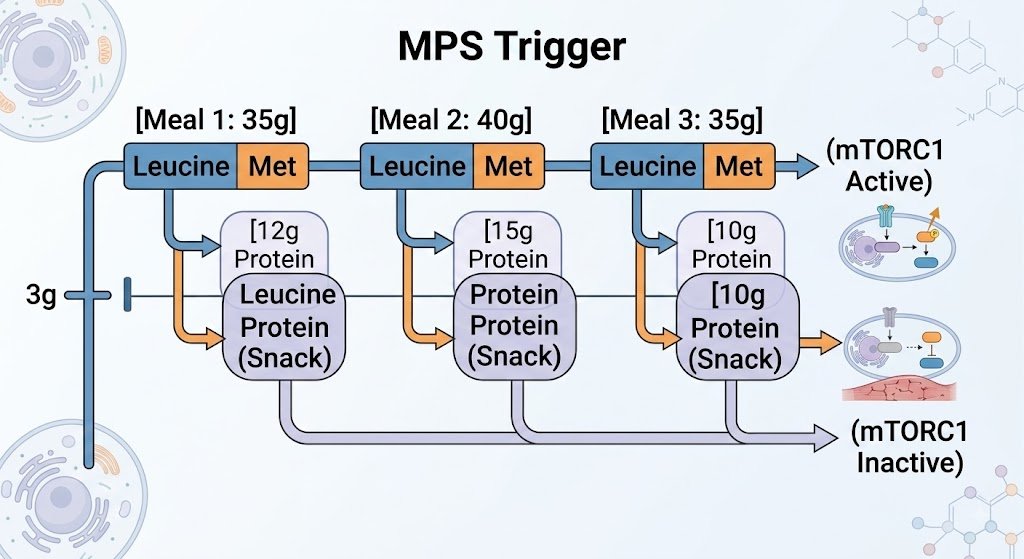
Threshold Mechanism: To trigger intracellular MPS via the mTORC1 pathway, a meal must deliver a critical threshold of essential amino acids—specifically approximately 2.5 to 3.0 grams of Leucine (found in 30 to 40 grams of high-quality animal proteins only
-
Distribution Over Nibbling: Consuming 15 grams of protein four times a day fails to reach the leucine threshold required to initiate robust MPS. Instead, patients should aim for 3 to 4 structured meals containing 30–40g of high-quality animal protein per meal.
Nutritional Strategy 2: Micronutrient Density and Gastrointestinal Tolerance
Because total food volume drops by 30% to 50% under incretin (weight loss drugs) treatment, every bite of food must deliver high nutritional density.
-
Hydration and Electrolyte Management:
-
Reduced carbohydrate intake leads to glycogen depletion and fluid loss. Additionally, GLP-1 receptor activation can subtly alter thirst perception
-
Patients must target 2.0–3.0 liters of fluids daily, supplemented with sodium, potassium, and magnesium to prevent fatigue, constipation, and orthostatic dizziness
-
-
Mitigating Gastrointestinal Side Effects:
-
Delayed Gastric Emptying: High-fat, greasy foods remain in the stomach significantly longer, exacerbating nausea, acid reflux, and vomiting
-
Fiber Intake: Dietary fiber (25 to 30 g/day) from soluble sources (e.g., oats, psyllium, cooked berries) is critical to prevent incretin-induced / weight loss drugs induced constipation, but must be paired with adequate water intake
-
-
Essential Micronutrient Supplementation:
Due to reduced overall intake, routine monitoring and supplementation should include:
-
Vitamin D3 & Calcium: To safeguard bone mineral density alongside lean mass
-
Vitamin B12: Especially in patients with concurrent metformin use or marked reductions in meat consumption
-
Multivitamin / Mineral Complex: To prevent trace element deficiencies (Zinc, Iron, Selenium)
-
Resistance Training Protocol: Non-Negotiable Anabolic Stimulus
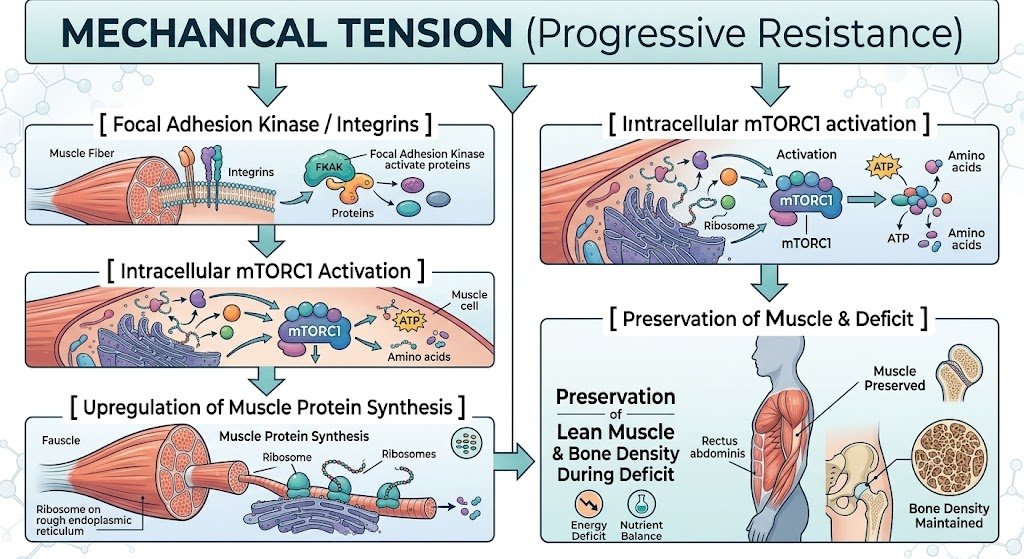
Protein intake provides the building blocks for muscle, but mechanical tension is the signal that commands the body to preserve lean tissue rather than burn it for fuel.
Resistance vs. Aerobic Cardio During Incretin Therapy / Weight Loss Drugs Therapy
While aerobic exercise (walking, cycling, swimming) provides substantial cardiovascular benefits, aerobic exercise alone does not prevent lean mass loss during a severe calorie deficit. In fact, high-volume cardio paired with low calorie/protein intake can accelerate muscle degradation.
Resistance training must serve as the primary exercise modality:
Exercise Parameter |
Clinical Recommendation for Patients on GLP-1/GIP Therapies |
Frequency |
2 to 4 sessions per week on non-consecutive days |
Focus / Modality |
Compound, multi-joint movements (squats, presses, rows, deadlifts, leg presses, cable pulls) that recruit large muscle groups |
Intensity |
Moderate to high effort (60–80% of 1-Repetition Maximum or reaching an Intensity of RPE 7–9 out of 10) |
Volume |
2 to 4 sets per exercise, 8 to 12 repetitions per set, prioritizing progressive overload (gradually increasing weight or reps over time) |
Bone Density Protection |
Heavy axial loading (squats, step-ups, carry variations) stimulates osteoblast activity to prevent weight-loss-induced bone mineral loss |
Comprehensive Nutrition and Exercise Framework
When initiating or escalating a patient’s dose of GLP-1, GIP, or glucagon receptor agonists, clinicians should incorporate this structural lifestyle protocol alongside pharmacotherapy:
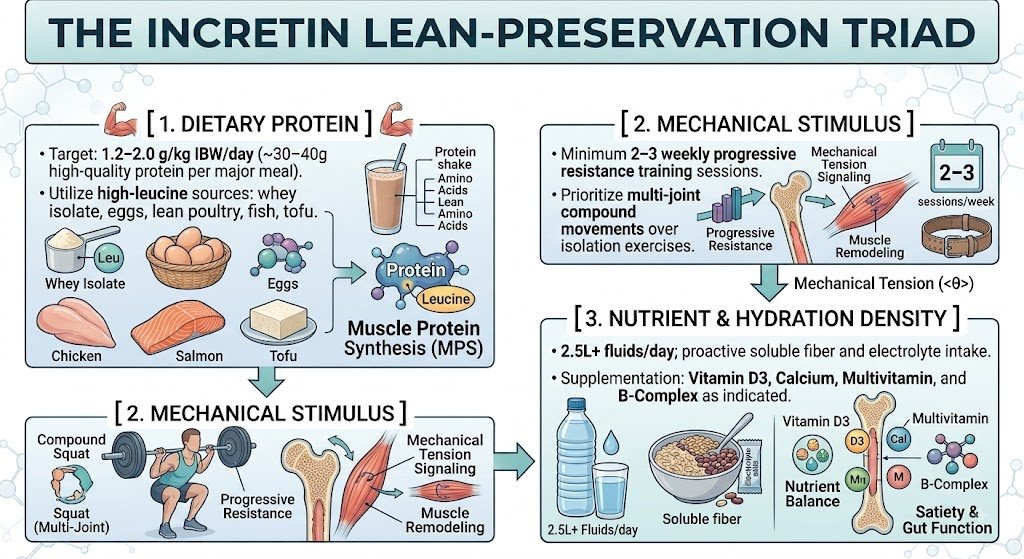
Key Takeaways
-
Weight Loss Quality Over Quantity: The goal of modern obesity management is not merely reducing numbers on a scale, but selectively eliminating visceral and subcutaneous fat while preserving functional lean tissue
-
The Anabolic Signal Is Required: Protein intake (1.2 to 2.0 g/ kg Body Wt /day) paired with progressive resistance training provides the essential biochemical and mechanical signals needed to prevent catabolism of skeletal muscles
-
Proactive Clinical Management: Nutritional counseling must occur concurrently with drug initiation—not as an afterthought after muscle mass and metabolic rate have already declined
Obesity being a chronic condition – targeted Weight Loss is not only tough to achieve but even tougher to maintain the weight once lost and avoid any re-bound weight gains, once therapy stops. Modern weight loss drugs such as Semaglutide and Tirzepatide may help loose body weights but with cessation of therapy, body starts regaining lost weight.
Another way, in our humble opinion, is to initiate high quality diet and resistance training regimens to achieve and maintain body weight loss. It would be an interesting trial to evaluate “quality” of weight loss with Semaglutides / Tirzepatides v/s High Protein, Low Carb Diets coupled with Resistance Training.
Both STEP1 and SURMOUNT-1 trials had a duration of more than 60 Weeks (14 Months and maybe more) – so, a similar duration on High Protein, Low Carb Diet with Regular Resistance Training may produce non-inferior (clinical trials lingo) / may produce equally good or even better results with no long term side effects’ and risks potentially with some significant costs savings too.
Homo sapiens are very intelligent species and we are sure the above suggestion may have crossed intelligent minds already or this may find resonance with some. You now have been shared all details – over to you for an informed choice.