



This is our 5-Part Evidence-Explained™ Series on OBESITY in Indians and what Indians can and must do to manage this chronic condition. This is Part 1 of 5-Part Series.
Obesity in India – India is as unique a country as one gets. On one extreme, India has high number of stunted children possibly due to poor nutrition and at the other extreme – obesity including childhood obesity is increasing rapidly, possibly due to over-eating not-so-healthy foods and sedentary lifestyles. Nearly 24% of women and 23% of men are now affected, as per recent UNICEF Report.
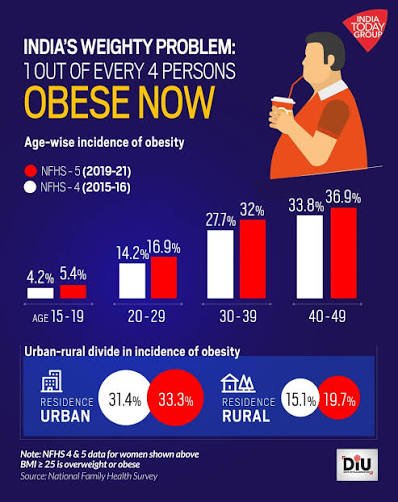
Obesity Statistics and Trends in India
- Adult Rates: According to the National Family Health Survey, adult obesity has doubled over recent years, impacting nearly a quarter of the adult population
- Childhood Surge: Rates among children under five and school-aged adolescents have surged by over 100%, with millions of young people affected
- Urban vs. Rural: City areas show much higher numbers, though rural villages are also seeing increases due to better transport and mechanization
-
The “Thin-Fat” Risk: Many South Asians carry higher belly fat and hidden body fat even with a normal weight, raising health risks early in Life
What Actually is Obesity
For decades, obesity has been explained using a remarkably simple equation:
Calories In > Calories Out = Weight Gain
At first glance, this seems perfectly logical. Eat more calories than your body burns, and the excess energy is stored as fat. Eat fewer calories than you burn, and your body uses stored fat for energy, resulting in weight loss.
From a physics standpoint, this is true. The First Law of Thermodynamics still applies to the human body—energy cannot be created or destroyed. Long-term changes in body weight require an imbalance between energy intake and energy expenditure. But here is the critical question:
If the equation is correct, why do two people eating the same number of calories often experience very different weight outcomes?
Why do some individuals regain nearly all the weight they lose despite maintaining a calorie-restricted diet? Why does the body fight against weight loss by increasing hunger and reducing energy expenditure?
And why has obesity become one of the world’s fastest-growing chronic diseases despite widespread awareness of calorie counting?
Modern obesity research shows that the traditional calorie equation describes what must happen, but it does not explain why it happens. Understanding the biological systems that regulate hunger, metabolism, fat storage, and energy expenditure is essential for explaining why obesity develops and why maintaining weight loss is often so difficult.
This article explores the science behind obesity and explains why body weight is regulated by a sophisticated network involving the brain, hormones, adipose tissue, the gastrointestinal tract, skeletal muscle, and the immune system—not simply by willpower.
How to Tame The Beast – Obesity Management
For decades, the standard advice for obesity management was distilled into a four-word mandate: “eat less, move more.” This advice assumed that body weight is governed by a static, mechanical balance where willpower dictates input and effort dictates output.
Modern metabolic science, advanced neurobiology, and clinical consensus tell a very different story. Obesity is not a character flaw or a simple accounting error of calories. It is a complex, progressive, and relapsing chronic disease defined by dysfunctional energy homeostasis.
Understanding how to treat obesity requires re-evaluating what obesity actually is and unpacking the true biology of the “Calories In vs. Calories Out” (CICO) framework.
Obesity Measurement – Beyond the BMI
Historically, obesity was defined primarily by the Body Mass Index (BMI): a simple mathematical ratio calculated as:
BMI = Body Weight (in Kg) / Height (m^2)
-
Normal: 18.5 – 24.9 kg/m^2
-
Overweight: 25.0 – 29.9 kg/m^2
-
Class I Obesity: 30.0 – 34.9 kg/m^2
-
Class II Obesity: 35.0 0 39.9 kg/m^2
-
Class III (Severe) Obesity: > 40.0 kg/m^2
Limits of BMI
While BMI serves as a useful population-level screening metric, it fails at the individual clinical level. BMI does not differentiate between lean muscle tissue and adipose (fat) mass, nor does it capture fat distribution. A bodybuilder and an individual with severe visceral adiposity might share the exact same BMI.
Modern Medical Definition of Obesity
Major medical organizations (including the World Health Organization, American Medical Association, and European Association for the Study of Obesity) define obesity not by weight alone, but by tissue function:
Obesity: A chronic, relapsing disease characterized by abnormal or excessive accumulation of body fat (adiposity) that impairs health, alters endocrine regulation, and increases the risk of long-term metabolic, cardiovascular, and mechanical complications.
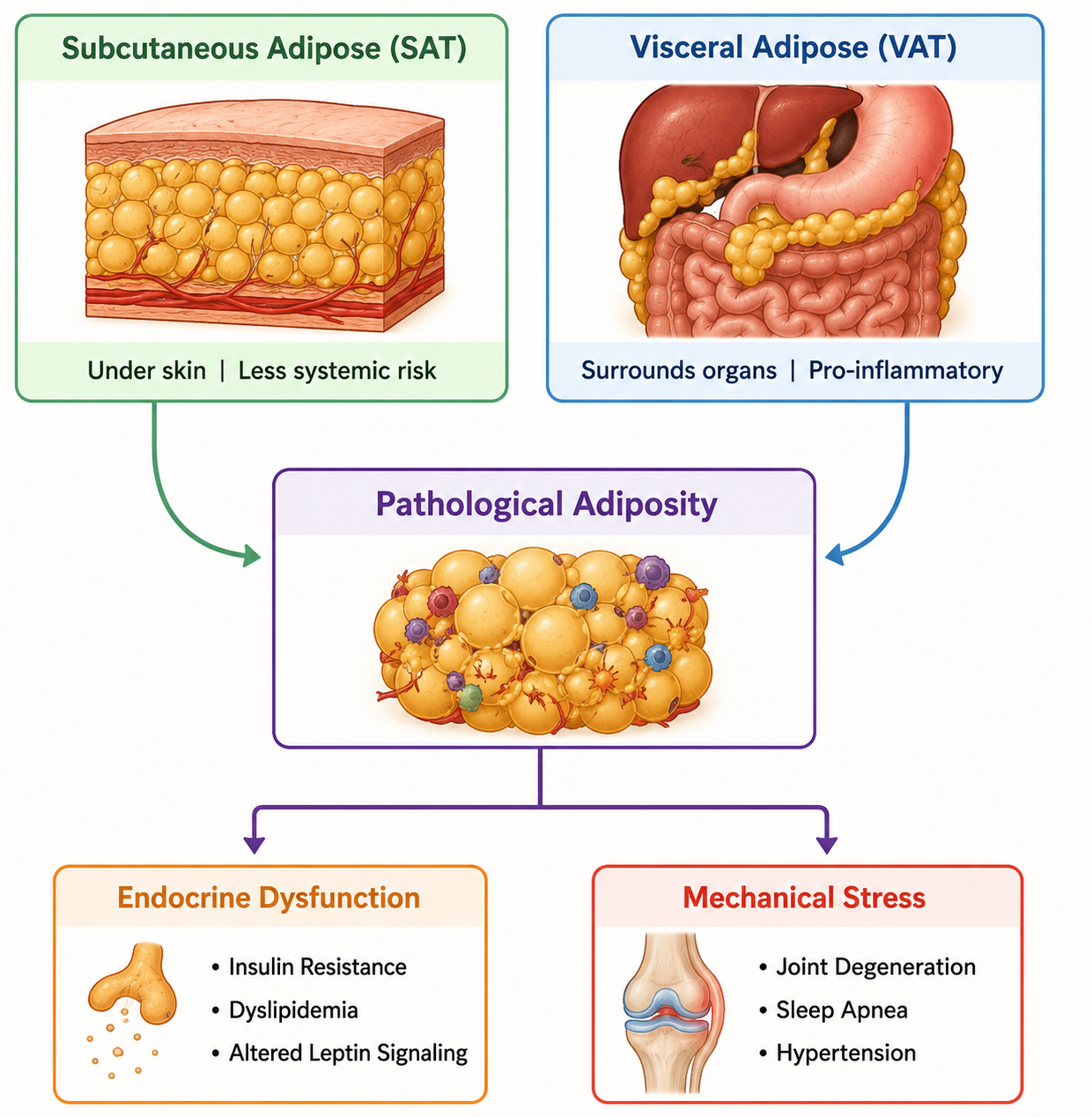
It is helpful to distinguish between two main types of fat deposition:
-
Subcutaneous Adipose Tissue (SAT): Fat stored directly under the skin. While metabolically active, it is less hazardous to systemic organ function.
-
Visceral Adipose Tissue (VAT): Fat wrapped around internal organs (liver, pancreas, intestines). VAT acts as an active endocrine tissue, secreting pro-inflammatory cytokines (like IL-6 and TNF-alpha), inducing systemic insulin resistance, and increasing cardiovascular risk.
Calories In vs. Calories Out” (CICO): Physics vs. Physiology
The First Law of Thermodynamics dictates that energy can neither be created nor destroyed—only transformed. Therefore, changes in stored body energy must equal energy intake minus energy expenditure:
Body Energey Changes = Energy Intake – Energy Eexpenditure
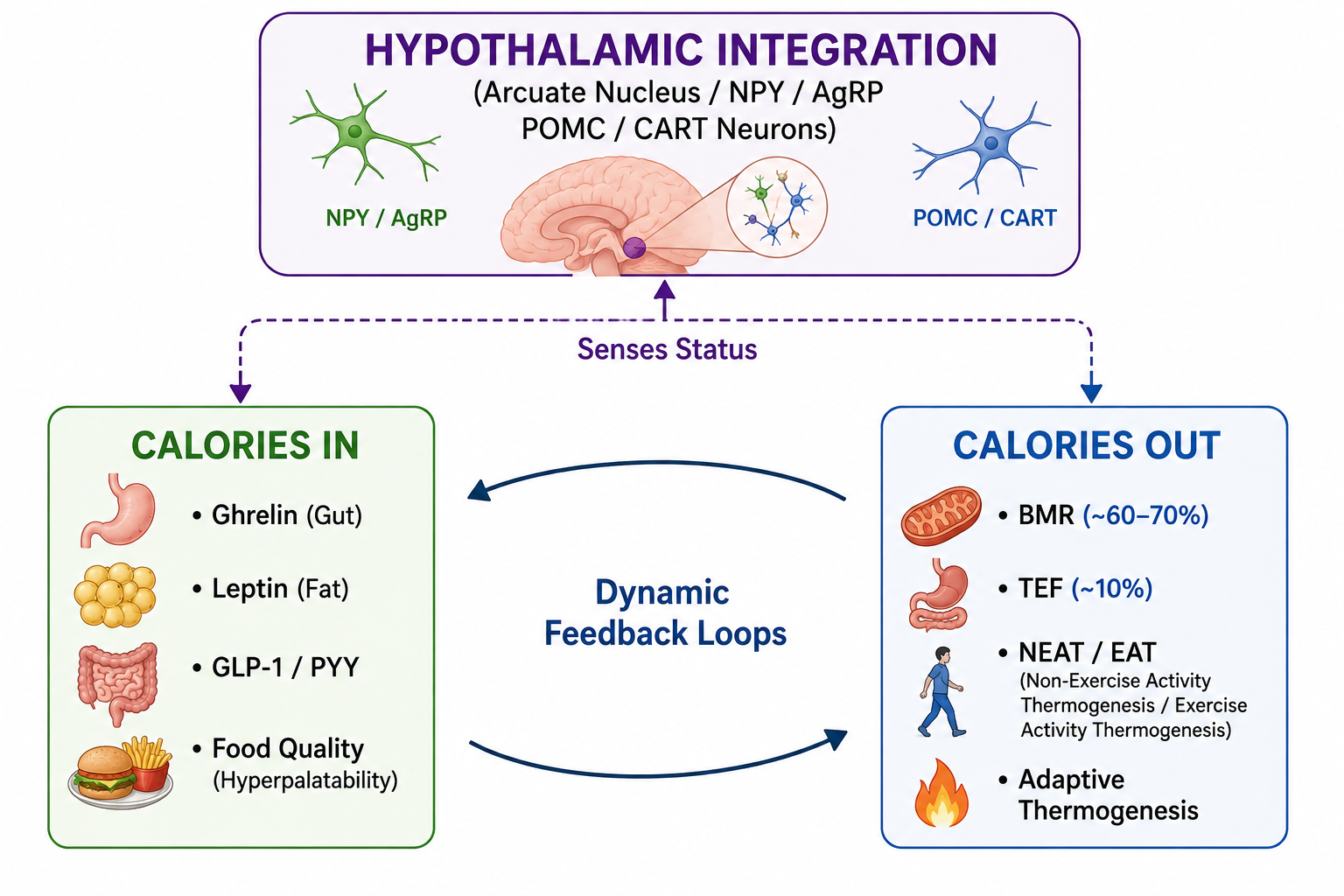
While the physics of CICO is undisputed, the physiological interpretation is often misunderstood. The biological system does not operate like a simple piggy bank where “Calories In” and “Calories Out” act as independent, isolated variables. Instead, they are interdependent, highly regulated variables governed by the central nervous system.
Unpacking “Calories In” (Energy INTAKE)
Energy intake is not simply a matter of daily decision-making; it is governed by an automated neuro-hormonal drive.
-
Satiety & Hunger Signaling:
-
Ghrelin: Released primarily by the stomach when empty, driving hunger signals to the arcuate nucleus in the hypothalamus
-
Leptin: Secreted by adipocytes (fat cells). In healthy physiology, higher fat mass increases leptin, telling the brain to reduce appetite and raise expenditure. In obesity, chronic high leptin levels lead to leptin resistance—the brain perceives starvation despite abundant fat stores
-
Satiety Peptides (GLP-1, PYY, CCK): Secreted by the gut in response to nutrient intake, slowing gastric emptying and signaling brainstem/hypothalamic fullness
-
-
Food Matrix & Ultra-Processed Foods:
-
Not all 2,000-kcal intakes affect the body identically. In a landmark NIH study (Hall et al., 2019), participants given diets matched for total calories, sugar, fat, fiber, and macronutrients consumed ~500 extra kcal/day when eating ultra-processed foods (UPFs) compared to unprocessed whole foods.
-
UPFs bypass normal gut-brain satiety signaling because of high energy density, soft texture (faster eating rate), and hyper-palatable ratios of fats and refined carbohydrates.
-
Unpacking “Calories Out” (Energy Expenditure)
Total Energy Expenditure (TEE) consists of four primary components:
TEE = BMR + TEF + NEAT + EAT
Component |
Share of TEE |
Description |
Basal Metabolic Rate (BMR) |
60–70% |
The energy required to maintain basic cellular functions, respiration, circulation, and organ function at rest. Highly influenced by Lean Body Mass (LBM). |
Thermic Effect of Food (TEF) |
~10% |
The metabolic cost of digesting, absorbing, and processing nutrients. Protein has the highest TEF (20–30%), followed by carbs (5–10%) and fats (0–3%). |
Non-Exercise Activity Thermogenesis (NEAT) |
15–30% |
Energy expended for everything that is not sleeping, eating, or sports-like exercise (fidgeting, walking to work, yard work, maintaining posture). |
Exercise Activity Thermogenesis (EAT) |
5–10% |
Energy expended during intentional, structured physical exercise. |
Why CICO Fails as a Simple Formula: Biological Counter-Regulation
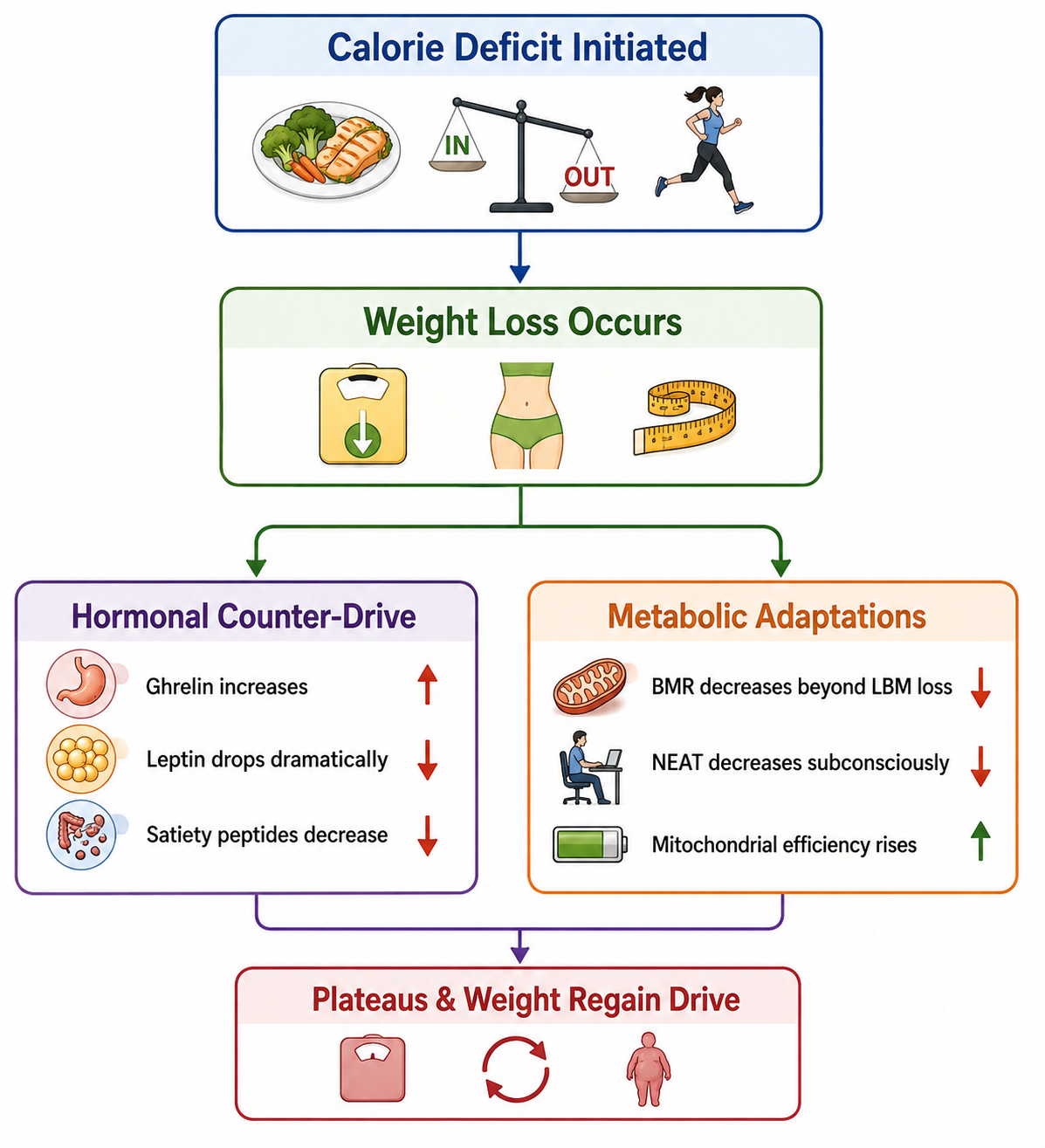
When an individual attempts to lose weight by creating a calorie deficit, the brain interprets the loss of body fat as a threat to survival. It defends its previous weight “set point” through a process called adaptive thermogenesis (or metabolic adaptation):
-
BMR Suppression: As body weight drops, BMR decreases beyond what can be explained by the loss of muscle and fat mass alone. The mitochondria become more efficient, burning fewer calories for the same cellular work.
-
Hormonal Shift: Leptin levels drop sharply, while Ghrelin surges. This produces persistent, heightened hunger and an increased brain response to visual food cues.
-
NEAT Downregulation: Subconscious activity declines. People naturally fidget less, sit more, and move less efficiently without realizing it.
Because of this physiological adaptation, reducing caloric intake does not lead to a linear, indefinite weight loss. Instead, weight loss slows over time and eventually plateaus as total energy expenditure decreases to match the reduced calorie intake.
Key Takeaways for Clinical Obesity Management
-
Obesity is an Endocrine/Neurobiological Condition: Treating obesity solely through dietary willpower overlooks the internal physiological mechanisms that regulate hunger, satiety, and metabolic rate
-
CICO Describes the Mechanism, Not the Drivers: Energy balance explains how weight changes, but it does not explain why someone is overeating or burning fewer calories. Hormones, food processing levels, sleep, stress, and genetics govern the levers of I and E
-
Sustainable Interventions Must Address Biological Regulators: Long-term Obesity Management relies on strategies that minimize adaptive thermogenesis, preserve lean body mass, and lower hunger signals
-
Hormones, the brain, genetics, sleep, gut-derived signals, and adipose tissue all influence how much we eat and how much energy we expend
-
After weight loss, the body often mounts adaptive responses that increase hunger and reduce energy expenditure, helping explain why long-term maintenance is difficult
-
Viewing Obesity as a complex, chronic disease rather than a failure of willpower provides a more accurate framework for prevention and treatment