



This is our 2nd Write Up on an important topic such as IBS-C. We firmly and strongly believe Nutrition and choice of food produts that we consume go a long way in shaping our health and equally taking care of certaion diseases. IBS-Constipation is one such disease which we can easily and effectively manage with right food choices. Gas vs. Bulk: Which IBS-C Protocol Actually Works? (Low FODMAP vs Zero Fiber). Compare the Low-FODMAP diet and Zero-Fiber protocol for constipation-predominant IBS. Discover the mechanical, fermentative, and clinical differences to choose the right strategy. Read on…
What is IBS – Irritable Bowel Syndrome
The magnitude of patients with functional gastrointestinal disorders visiting outpatient clinics in India is at all time high and now accounts for up to one third of outpatient consultations.
Irritable bowel syndrome (IBS) is a functional gastrointestinal disorder characterized by abdominal pain, discomfort and alteration of bowel habits in the absence of any organic disorder. The prevalence of IBS in the general population varies from 9% to 22% in the United States and European countries. The rapid socioeconomic development in the last 20 years has also created a transition in the health and environmental situation in India. The prevalence of IBS among Indians appears to be on the rise.
Epidemiology in India
Epidemiology is the study of how often a disease happens in a population.
- Overall IBS Prevalence: Community-based studies in India report that about 4% to 4.2% of the general population suffers from IBS
- Share of IBS-C: According to data from the Indian Society of Gastroenterology Task Force, roughly 39% of people with IBS in India have the constipation-predominant (IBS-C) subtype
- Comparison to General Constipation: Clinical studies show that among patients who report chronic constipation in India, about 24.4% have IBS-C, while the rest have functional constipation (which lacks the distinct belly pain of IBS)
- Impact: Patients with IBS-C in India often report high symptom severity and a lower quality of life due to ongoing discomfort
IBS – Constipation Management
Both the Low-FODMAP diet and the Zero-Fiber protocol offer targeted dietary strategies for managing Constipation-Predominant Irritable Bowel Syndrome (IBS-C). However, they operate on fundamentally distinct physiological mechanisms, address different aspects of gut dysfunction, and yield contrasting clinical outcomes.
A low-FODMAP diet is a temporary, three-step eating plan designed to help people identify specific carbohydrates that trigger uncomfortable digestive symptoms like bloating, gas, and abdominal pain.
FODMAP is an acronym for Fermentable Oligosaccharides, Disaccharides, Monosaccharides, and Polyols. These are short-chain carbohydrates and sugar alcohols that the small intestine absorbs poorly, causing them to ferment in the gut and draw excess water.
-
Oligosaccharides: Fructans and galactans found in wheat, onions, garlic, and legumes
- Disaccharides: Lactose found in dairy products like milk, yogurt, and soft cheese
- Monosaccharides: Excess fructose found in honey, apples, and high-fructose corn syrup and other packaged food products – Pls read labels
-
Polyols: Sugar alcohols like sorbitol and mannitol found in stone fruits and artificial sweeteners
While the Low-FODMAP diet is designed to reduce microbial gas production and osmotic shifts, the Zero-Fiber protocol focuses on removing physical intraluminal bulk and mechanical obstruction in a sluggish colon.
Comparison of Low-FODMAP v/s 0 Fiber Diets
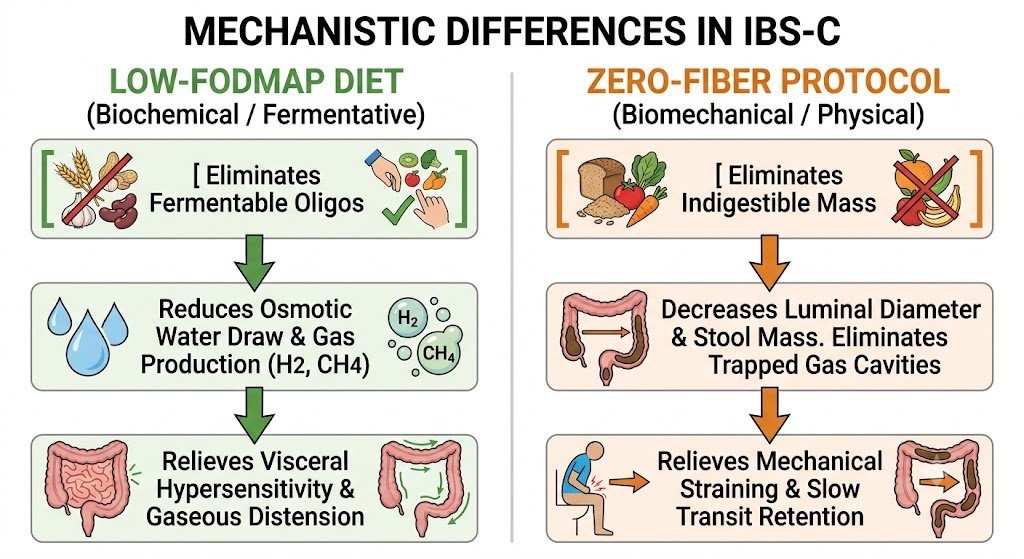
1. The Low-FODMAP Diet: Biochemical & Fermentative Modulation
FODMAPs (Fermentable Oligosaccharides, Disaccharides, Monosaccharides, and Polyols) are short-chain carbohydrates that are poorly absorbed in the small intestine.
-
Osmotic Shift: Small, highly osmotically active molecules (e.g., fructose, polyols) draw water into the small intestine, causing luminal distension
-
Fermentation & Gas Accumulation: Unabsorbed carbohydrates pass into the colon, where colonic microflora rapidly ferment them into Short-Chain Fatty Acids (SCFAs), carbon dioxide (CO2), hydrogen (H²), and methane (CH4)
-
Visceral Hypersensitivity Trigger: In IBS patients with visceral hypersensitivity, gaseous volume stretches the intestinal wall, triggering pain, bloating, and reflex dysmotility
-
The Methane Conundrum in IBS-C: In IBS-C, Methanobrevibacter smithii converts H² into methane gas (CH4). Methane directly acts as a neuromuscular paralytic in the gut, slowing colonic transit time. By eliminating fermentable substrates, the Low-FODMAP diet reduces methane production
2. The Zero-Fiber Protocol: Biomechanical & Structural Removal
Unlike FODMAP restriction, which targets small carbohydrate molecules, a zero-fiber protocol eliminates all non-starch polysaccharides (cellulose, hemicellulose, lignin, pectin, psyllium).
-
Removal of Physical Bulk: In chronic slow-transit or dys-synergic constipation, the colon struggles to propel large stool volumes. Insoluble fiber increases fecal mass without supplying the neuromuscular force required to move it, creating a mechanical “traffic jam.” Removing fiber decreases luminal diameter and reduces total stool volume, requiring less propulsive force to evacuate
-
Elimination of Gas Entrapment Sites: Bulky fiber networks trap bacterial gas inside the stool matrix. Eliminating fiber removes the primary physical matrix where gas gets pocketed, resolving luminal distension
-
Reduction of Shear Friction: Large, dry, fiber-bulked stools create high friction against the mucosal lining during dyssynergic defecation. Reducing stool mass directly attenuates straining, mucosal irritation, and anal fissures
Clinical Efficacy in IBS-C: Side-by-Side Comparison
Parameter |
Low-FODMAP Diet |
Zero-Fiber Protocol |
Primary Clinical Target |
Abdominal pain, bloating, gas, visceral hypersensitivity |
Straining, incomplete evacuation, slow transit time, severe bloating |
Bowel Movement Frequency |
Variable / Modest Effect. May improve consistency, but often fails to dramatically increase frequency in severe slow-transit constipation |
High Efficacy. Demonstrated in trials (e.g., Ho et al., 2012) to restore daily bowel movements in patients resistant to standard fiber therapy |
Bloating & Distension |
High Efficacy. Significantly reduces gas-driven bloating by cutting off fermentable bacterial substrates |
High Efficacy. Completely eliminates both fermentation substrates and fiber-trapped gas cavities (0% bloating in trials) |
Abdominal Pain |
High Efficacy. Reduces mechanical stretch on hypersensitive visceral nerves |
High Efficacy. Reduces pain caused by severe colonic distension and straining against large fecal loads |
Straining & Stool Hardness |
Moderate. Osmotic effects can soften stool, but large fecal bulk may still require significant straining effort |
High Efficacy. Eliminates the large fecal mass, dramatically reducing straining and mechanical friction during defecation |
Efficacy Evidence Base |
Extensively validated by RCTs and international gastroenterology guidelines (ACG, BSG) as a top-tier IBS intervention |
Supported by targeted clinical trials (e.g., Ho et al., Voderholzer et al.) specifically in idiopathic chronic constipation and slow-transit populations |
Comparative Pros, Cons, and Clinical Utility
The Low-FODMAP Diet
-
Pros:
-
Supported by extensive randomized controlled trials (RCTs)
-
Systematically targets visceral pain and gas dynamics
-
Allows reintroduction protocols to identify specific carbohydrate triggers
-
-
Cons:
-
Complex Protocol: Requires a strict 3-phase elimination, reintroduction, and personalization process, ideally guided by a specialized dietitian
-
Microbiome Alterations: Long-term strict elimination can decrease beneficial gut microbes, such as Bifidobacteria, due to reduced prebiotic availability
-
Does Not Solve Severe Mechanical Inertia: If constipation is driven by impaired pelvic floor coordination or colonic inertia, removing FODMAPs alone often fails to resolve infrequent bowel motions
-
The Zero-Fiber Protocol
-
Pros:
-
Simple Execution: High compliance due to clear, non-ambiguous parameters (zero plant-derived non-starch polysaccharides)
-
Direct Mechanical Relief: Bypasses sluggish neuromuscular reflexes by minimizing the volume of material the colon must move
-
Rapid Symptom Resolution: Patients often experience dramatic reductions in straining and bloating within 1 to 2 weeks
-
-
Cons:
-
Social & Culinary Restrictions: Requires strict elimination of fruits, vegetables, grains, legumes, and nuts
-
Nutritional Vigilance: Long-term implementation requires monitoring for micro-nutrient intake (e.g., Vitamin C, folate) and phytonutrient diversity
-
Paradoxical to Standard Advice: Patient and physician hesitation due to deeply entrenched public health messages regarding dietary fiber
-
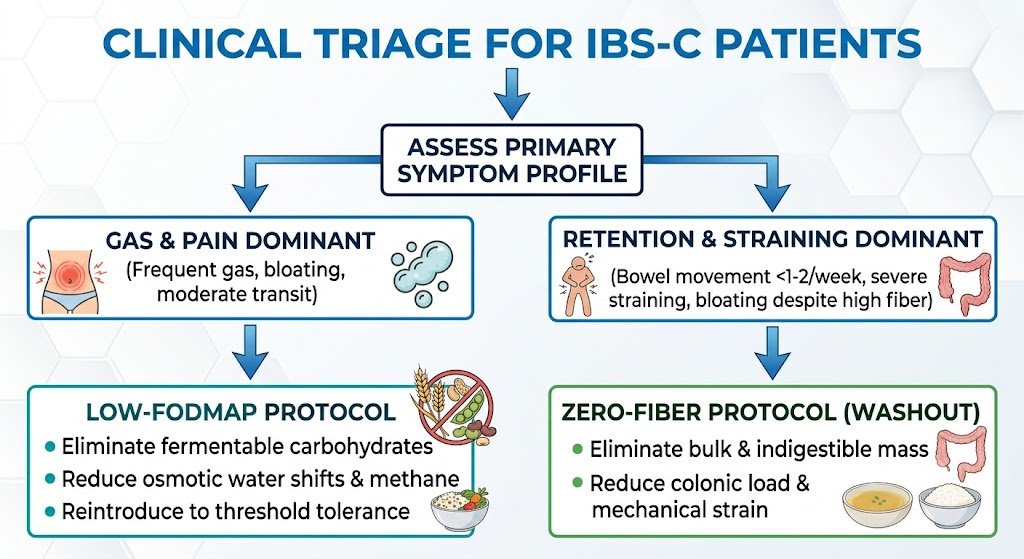
Clinical Decision Framework: When to Use Which?
-
Start with Low-FODMAP if: The patient’s primary complaint is severe postprandial pain, excessive gas, and bloating, with mild to moderate delays in bowel frequency
-
Pivot to Zero-Fiber (or Low-Residue) if: The patient presents with severe slow-transit constipation, refractory straining, and abdominal distension that has persistently worsened after following standard advice to increase dietary fiber, bran, or psyllium