



This is the concluding, Part 5 of our 5-Part Series on Understanding Obesity, Weight Loss Mechanisms and details about commercially available Weight Loss Drugs such as Semaglutide aand Tirzepatide. This last and concluding part scientifically covers the weight loss maintenance after stoppage of weekly weight loss injections. Savour the details..
Over the course of this 5-Part Series, we have traced obesity from a misunderstood “willpower failure” to a complex neurobiological disease, unpacked how ultra-processed foods hijack appetite signaling, explored how multi-incretin therapies (GLP-1, GIP, and Glucagon receptor agonists) restore gut-brain communication, and detailed how to safeguard lean body mass during rapid weight loss.
Sustenance of Weight Loss
Now, we address the ultimate clinical challenge in modern obesity medicine: long-term durability of weight loss or “weight correction”.
What happens when weight targets are reached? Should patients remain on pharmacotherapy indefinitely? What occurs at the neuro-hormonal level when GLP-1/GIP therapies are tapered or discontinued, and how can clinicians and patients construct a physiological and behavioral fortress to defend their new weight set-point against relapse?
Biological Reality of Discontinuation: The “STEP-1 Extension” Effect
To manage weight maintenance effectively, we must first understand what happens when incretin therapies / weight loss drug therapies are withdrawn or stopped.
In the landmark STEP-1 Extension Study (Wilding et al., Diabetes, Obesity and Metabolism, 2022), participants who had lost an average of 17.3% of their body weight on semaglutide 2.4 mg over 68 weeks were taken off the medication and followed for an additional 52 weeks without pharmacological support.
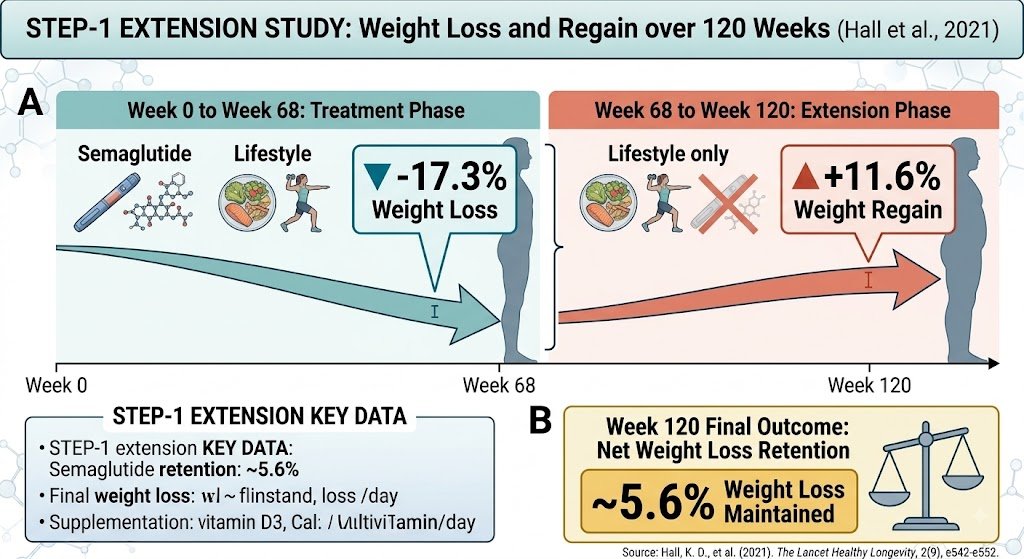
Conclusion from STEP-1 Extension Study – One year after withdrawal of once-weekly subcutaneous semaglutide 2.4 mg and lifestyle intervention, participants regained two-thirds of their prior weight loss, with similar changes in cardiometabolic variables. Findings confirm the chronicity of obesity and suggest ongoing treatment is required to maintain improvements in weight and health.
Neuro-Hormonal Rebound
When synthetic incretin receptor stimulation is withdrawn, the central nervous system experiences a sudden removal of satiety signaling while the body’s underlying metabolic adaptations are still active:
-
Re-Emergence of “Food Noise”: Mesolimbic dopamine circuits, no longer dampened by GLP-1/GIP receptor agonism, experience a surge in reactivity to visual, olfactory, and environmental food cues
-
Surging Endogenous Ghrelin & Suppressed Leptin: Because the individual is now at a significantly lower fat mass than their biological baseline, fat-derived leptin remains suppressed, while stomach-derived ghrelin surges. The brain interprets this state as acute starvation
-
Accelerated Gastric Motility: Gastric emptying rates return to baseline speed, reducing postprandial stomach distension and dramatically shortening the duration of fullness after meals
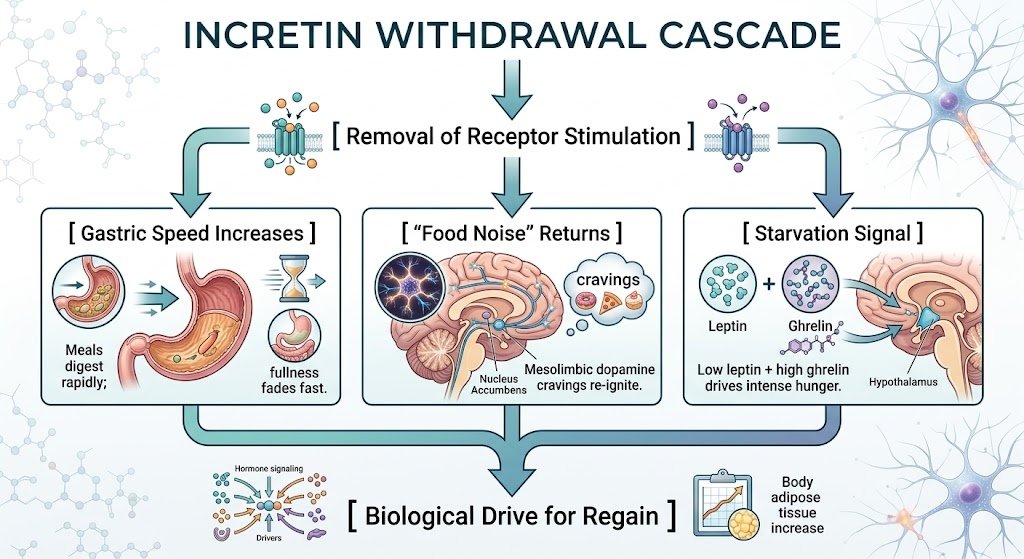
Without a structured management plan, these biological drivers lead to passive weight regain—not due to a lack of commitment, but because the body is executing an evolutionary defense mechanism.
Understanding and Resetting the Biological “Set-Point”
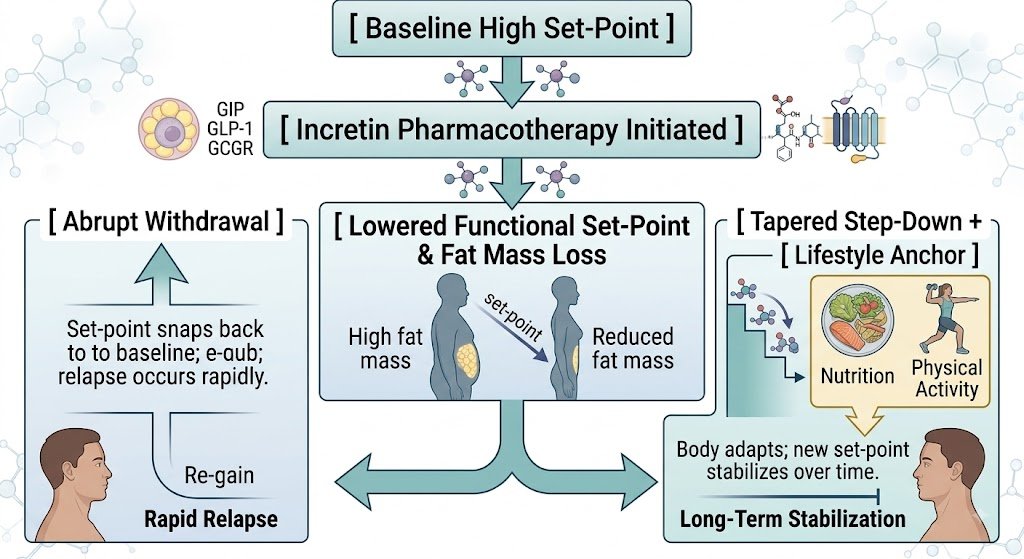
The human body regulates adiposity through a central feedback loop centered in the arcuate nucleus of the hypothalamus, commonly referred to as the adipostat or weight set-point
Is the Set-Point Permanent?
A common clinical question is whether the weight set-point can ever be permanently lowered. Evidence suggests the hypothalamic set-point is malleable, but it adapts on a delayed timeline:
-
Time Lag: While fat mass can drop within 6 to 12 months on pharmacotherapy, central metabolic circuits may take 18 to 36 months of sustained lower weight to recalibrate their baseline leptin sensitivity and accept the new weight as “normal.”
-
Indefinite Maintenance vs. Tapering: For individuals with long-standing, class II or III obesity, chronic continuous maintenance therapy may be clinically indicated (similar to antihypertensive or statin therapy). For others, a structured step-down strategy can test whether the new set-point has stabilized.
Tapering Strategies: Moving from Treatment to Maintenance
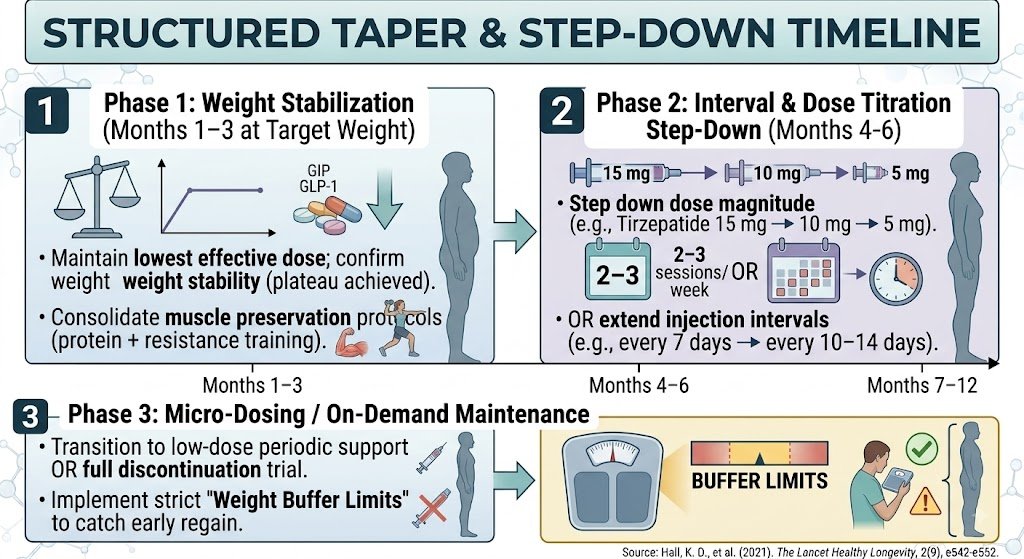
Abruptly stopping high-dose multi-incretin therapy often triggers severe appetite rebound and gastrointestinal readjustment. If discontinuation or dose reduction is desired, clinicians should employ a gradual, step-down protocol.
Step-Down Protocols
-
Dose Reduction Method: Gradually lower the dose to the minimum level that prevents intrusive “food noise” and weight gain (e.g., stepping down semaglutide from 2.4 mg to 1.7 mg, then 1.0 mg, spending 4–8 weeks at each step)
-
Interval Extension Method: Keep the dose constant but extend the spacing between injections (e.g., from every 7 days to every 10, then 14 days). Because long-acting incretins have steady-state half-lives of ~5 days, this creates a smooth, gradual decay in plasma concentration
Non-Pharmacological Anchor: Preventing Weight Regain
When pharmacological assistance is reduced, lifestyle habits must transition from “supporting weight loss” to actively anchoring energy balance.
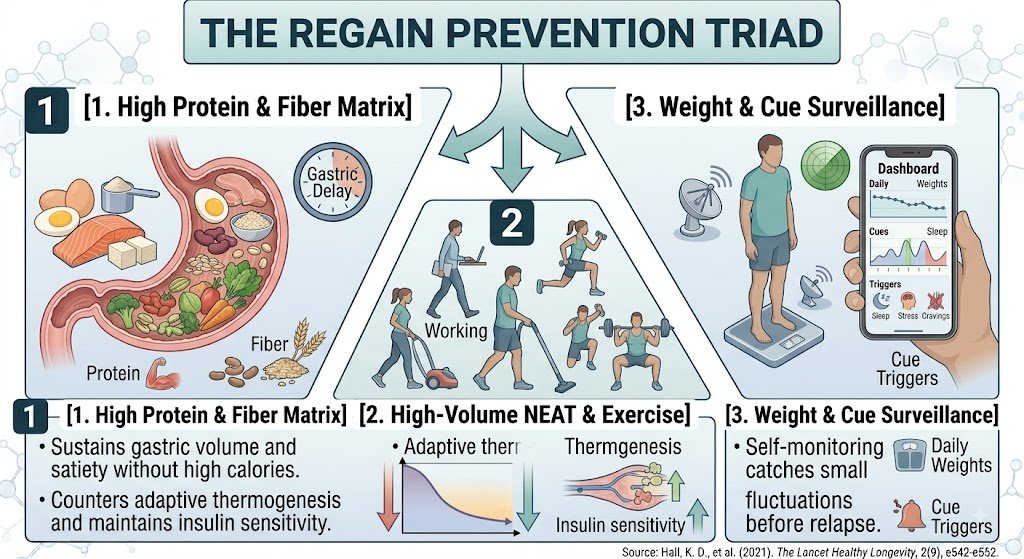
1. Satiety Engineering: Whole-Food Fiber & Protein
Without GLP-1-induced gastric delay, dietary composition becomes the physical mechanism to slow digestion:
-
The Protein Wall: Maintaining 1.2 to 1.6 g/kg Body Wt/day of protein provides high Thermic Effect of Food (TEF) and stimulates endogenous satiety signals
-
Viscous Soluble Fiber: Consuming 30 to 40 grams of fiber daily (from oats, legumes, chia seeds, vegetables) forms a gel matrix in the stomach, naturally slowing gastric emptying and stimulating the distal L-cells to produce native GLP-1
2. Physical Activity as the Ultimate Maintenance Predictor
Data from the National Weight Control Registry (NWCR)—which tracks individuals who have maintained a minimum 30-lb weight loss for over 5 years—demonstrates that physical activity is the single strongest predictor of long-term weight maintenance:
-
Target Volume: 200 to 300 minutes per week of moderate-to-vigorous physical activity and resistance training
-
Non-Exercise Activity Thermogenesis (NEAT): Intentionally maintaining high daily step counts (8,000 to 10,000 steps/day) offsets the subconscious drop in spontaneous movement that occurs after weight loss
-
Progressive Resistance Training: Preserving lean muscle tissue maintains the baseline metabolic engine (BMR) and prevents excess calories from being shunted into fat storage
3. The “3-Pound Buffer” Rule and Self-Surveillance
Catching small weight shifts early prevents full-scale relapse:
-
Establish a Threshold: If a patient’s target weight is 70 kg, establish a 3-pound (~1.5 kg) buffer zone (71.5 kg)
-
Actionable Protocol: Hitting the upper buffer zone is not a personal failure; it is an objective signal to adjust the protocol—whether by auditing ultra-processed food intake, re-engaging structured resistance training, or temporarily reinstating a low maintenance dose of incretin therapy
Synthesis: Comparative Framework Across the Series
Metric / Aspect |
Phase 1: Initiation & Active Loss (Parts 1–3 of Series) |
Phase 2: Lean Preservation (Part 4 of Series) |
Phase 3: Long-Term Maintenance & Taper (Part 5) |
Primary Goal |
Rapid reduction of adiposity; reset appetite signaling. |
Protect Lean Body Mass (LBM) and BMR. |
Recalibrate set-point; prevent weight regain. |
Pharmacotherapy Role |
High-dose active escalation (GLP-1/GIP/Glucagon). |
Stable therapeutic dose. |
Tapered step-down, low-dose maintenance, or off-trial. |
Nutrition Strategy |
Calorie deficit; eliminate ultra-processed foods (UPFs). |
Protein intake (1.2 to 2.0 g/kgBW); leucine timing |
Satiety engineering; high-fiber whole-food matrix. |
Exercise Focus |
Habit formation; moderate aerobic activity. |
Progressive Resistance Training (2–4x/week). |
High-volume NEAT + sustained resistance training. |
Key Clinical Risk |
Gastrointestinal side effects; rapid muscle loss. |
Sarcopenic obesity in reverse; metabolic slowdown. |
Uncontrolled appetite rebound; biological regain. |
Series Conclusion: A Modern Model for Obesity Management
Over the five articles in this series, we have constructed a comprehensive, evidence-based model for obesity treatment:
-
Obesity is a Chronic Endocrine Disease: It requires medical management, not moral judgment or emotional responses
-
Environment and Biology Interact: Ultra-processed foods exploit evolutionary reward centers, driving passive overconsumption but we are smarter to resist
-
Incretin Therapies Are Disease-Modifying Tools: Multi-receptor agonists (GLP-1, GIP, Glucagon) address the root cause by restoring gut-brain satiety networks, but are dose-dependent and regular usage products, tapering off is tough
-
Lean Mass Is the Engine: Weight loss quality depends on adequate protein intake and progressive resistance training
-
Maintenance and Sustenance of Weight Loss Requires Long-Term Strategy: Whether through ongoing low-dose therapy or structured lifestyle anchors, defending a new set-point requires deliberate, long-term care