



This is our 1st write up on this very important topic of CKD. This is highly researched write up, specifically from Indian Patients’ Perspective. Please do share this with your loved ones and friends who may, unfortunately, have CKD – Chronic Kidney Disease. This, however, does not by any means, replace the Expert Medical Advice and at best may only be considered as an educational write up only.
1. Introduction & Epidemiology of CKD in India
What is CKD – Chronic kidney Disease (CKD) is a long-term condition defined as the presence of kidney damage or a reduced glomerular filtration rate (GFR) of less than 60 mL/min/1.73 m² that lasts for 3 months or more, regardless of the underlying cause. CKD is measured by a sustained drop in how effectively the kidneys filter waste from the blood (eGFR).
The condition usually develops slowly over time and can range from mild dysfunction to complete kidney failure requiring dialysis or a transplant. Chronic Kidney Disease (CKD) has emerged as one of the most critical public health challenges across the Indian subcontinent.
Recent meta-analyses and epidemiological surveys, including data from the Indian Council of Medical Research (ICMR) and the Screening and Early Evaluation of Kidney Disease (SEEK) study, estimate that the pooled community prevalence of CKD in India stands between 13% and 17.2%.
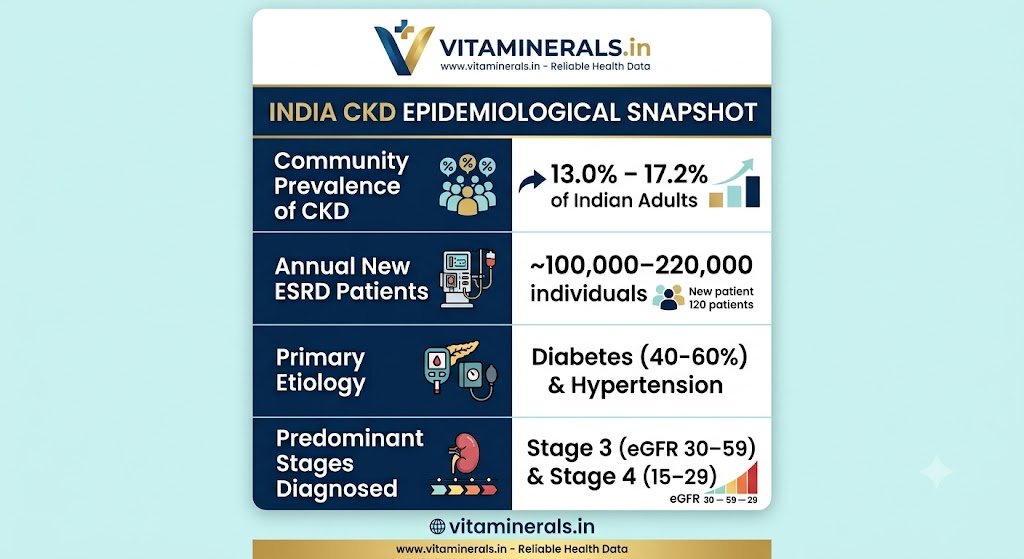
This represents over 100 million fellow Indians living with varying degrees of renal impairment. Unlike Western populations, where renal disease primarily manifests in elderly cohorts, the median age of CKD onset in India is significantly younger—frequently presenting between 45 and 55 years of age. Indians develop it at least 10 Years ahead of European Counterparts.
Late Detection / Late Diagnosis – It truly hurts to report that the burden is further amplified by late-stage clinical presentation. Over 60% of patients first seek nephrology consultation when their renal function has already deteriorated to Stage 4 or Stage 5 (End-Stage Renal Disease – ESRD), primarily due to the asymptomatic nature of early GFR decline and a lack of routine serum creatinine screening.
2. Primary Causes & Risk Factors in Indian Context
The disproportionate incidence of CKD among South Asians is rooted in a combination of metabolic vulnerability, structural socio-economic factors, and environmental exposures.
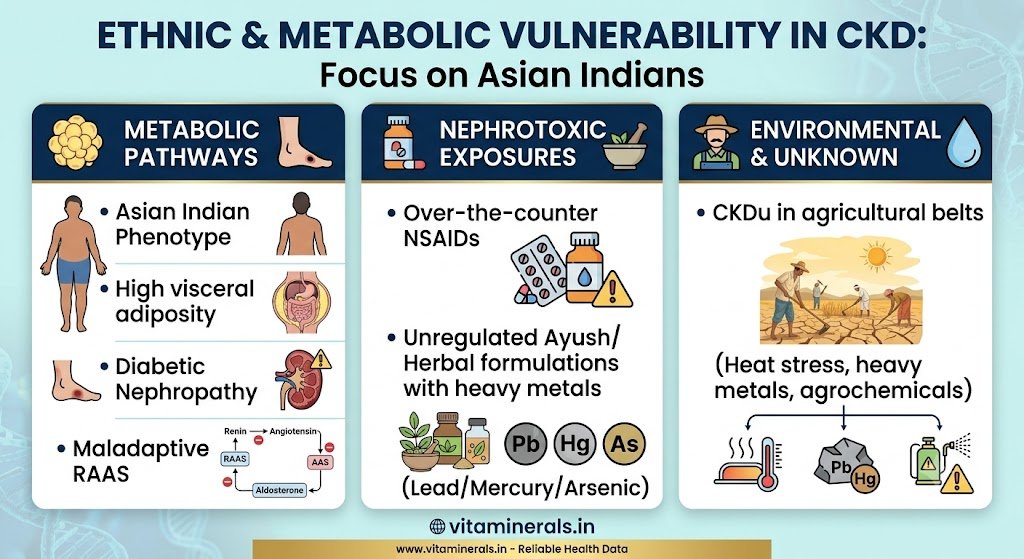
South Asians exhibit a distinct metabolic profile characterized by higher visceral adiposity, lower skeletal muscle mass, and increased systemic inflammation at relatively low Body Mass Index (BMI) levels—a phenomenon termed the Asian Indian Phenotype.
This metabolic architecture drives early insulin resistance, leading to Type 2 Diabetes Mellitus (T2DM). Diabetes accounts for 40% to 60% of all CKD cases in India. Glomerular hyperfiltration induced by chronic hyperglycemia damages the podocyte barrier, initiating microalbuminuria and accelerating diabetic nephropathy.
Hypertensive Nephrosclerosis
Systemic hypertension accounts for 15% to 25% of Indian CKD cases. Uncontrolled arterial pressures cause hyaline arteriolosclerosis of the afferent and efferent renal arterioles, causing ischemic nephron loss and progressive nephrosclerosis.
Chronic Kidney Disease of Unknown Etiology (CKDu)
Prevalent in agricultural corridors such as Andhra Pradesh (Uddanam), Odisha, and Tamil Nadu, CKDu primarily affects rural manual laborers. It is driven by chronic dehydration, heat stress, agrochemical exposure, and heavy metals in groundwater (such as silica, cadmium, and arsenic).
Nephrotoxic Medication Burden
Unregulated over-the-counter access to Non-Steroidal Anti-Inflammatory Drugs (NSAIDs) for chronic pain, alongside untested indigenous or traditional herbal formulations containing heavy metals (lead, mercury, arsenic), contributes significantly to acute tubular necrosis and chronic tubulointerstitial nephritis across urban and rural demographics.
3. Pathophysiology: The Timeline of CKD Progression
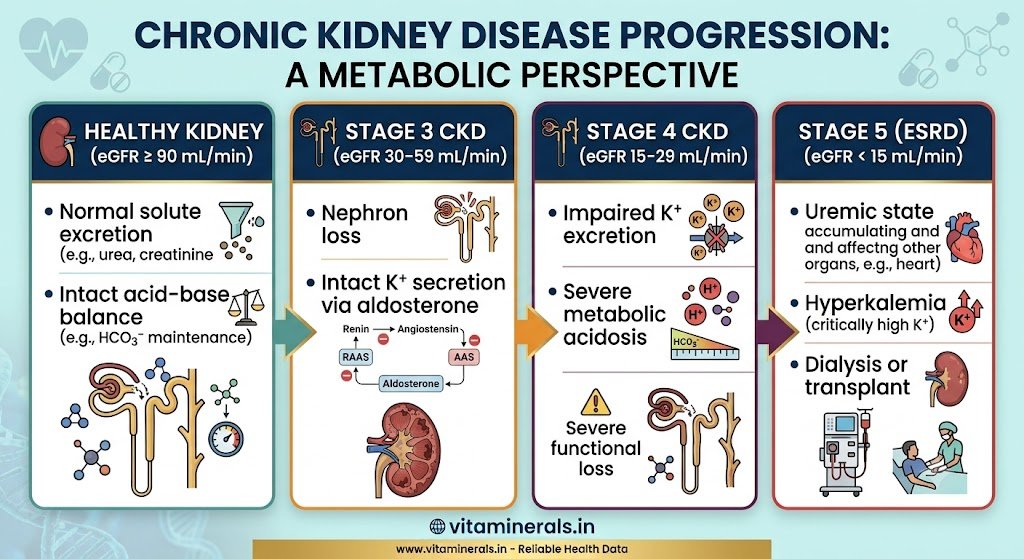
Chronic Kidney Disease is defined as structural or functional kidney abnormalities lasting longer than 3 months, characterized by an estimated Glomerular Filtration Rate (eGFR) < 60 mL/min/1.73m² or marked urinary albumin excretion (≥30 mg/24 hours).
Stage 1 & Stage 2 (eGFR ≥ 60 mL/min/1.73m² with Kidney Damage)
Compensatory hyperfiltration occurs within remaining functional nephrons. Patients are asymptomatic; renal function appears normal on standard serum blood tests unless urinary proteins are evaluated.
Stage 3A & Stage 3B (eGFR 30–59 mL/min/1.73m²)
Solute retention begins. As nephron mass declines below 50%, serum urea and creatinine start to rise.
While distal tubular secretion of potassium (mediated by aldosterone and ROMK channels) remains sufficient to keep baseline serum potassium (K+) within safe limits (3.5–5.0 mEq/L), distal urinary flow rates drop. The kidneys lose their functional reserve to clear acute potassium loads.
Stage 4 (eGFR 15–29 mL/min/1.73m²)
Severe renal failure. Aldosterone-mediated potassium excretion reaches maximal clearance capacity per surviving nephron. Compensatory colonic potassium secretion increases, but hyperkalemia (K+ > 5.5 mEq/L) becomes a persistent risk—especially when triggered by dietary excess, metabolic acidosis, or drugs like ACE inhibitors, ARBs, or mineralocorticoid receptor antagonists.
Stage 5 / End-Stage Renal Disease (eGFR < 15 mL/min/1.73m²)
Excretory function collapses. Uremic toxins accumulate, alongside metabolic acidosis and refractory fluid overload. At this threshold, survival requires Renal Replacement Therapy (RRT) via Maintenance Hemodialysis, Peritoneal Dialysis, or Kidney Transplantation.
4. The Transition to Dialysis & Electrolyte Vulnerability
When eGFR drops below 10–15 mL/min/1.73m², conservative medical management alone can no longer sustain homeostasis. Hemodialysis acts as an artificial extracellular transport system, utilizing diffusive and convective transport across a synthetic semi-permeable membrane to remove nitrogenous waste (BUN, creatinine) and restore serum electrolyte concentrations.
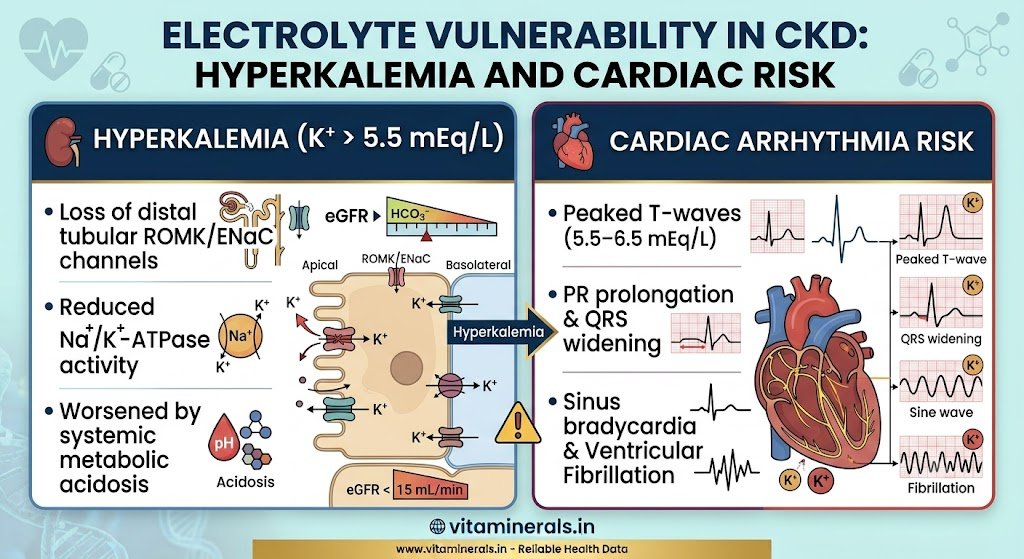
Hyperkalemia is the most lethal electrolyte abnormality in late-stage CKD. Reduced urinary excretion, combined with extracellular shifts caused by systemic metabolic acidosis (where excess H+ ions enter tissue cells in exchange for K+ exiting into the plasma), raises resting membrane potential in cardiac myocytes.
This electrical instability manifests on Electrocardiograms (ECG) as:
-
Peaked T-waves (K+ > 5.5–6.5 mEq/L)
-
PR interval prolongation and flattened P-waves (K+ > 6.5–7.0 mEq/L)
-
QRS complex widening and sine-wave patterns (K+ > 7.0–8.0 mEq/L)
-
Sudden Cardiac Arrest / Ventricular Fibrillation
Because hyperkalemia can remain asymptomatic until a fatal cardiac event, dietary potassium restriction (< 2,000 mg/day) is a foundational clinical directive for CKD Stage 3b, Stage 4, and non-dialysis Stage 5 patients.
5. Medical Nutrition Therapy (MNT) for Indian CKD Patients
Designing a diet for Indian CKD patients presents a unique clinical challenge:
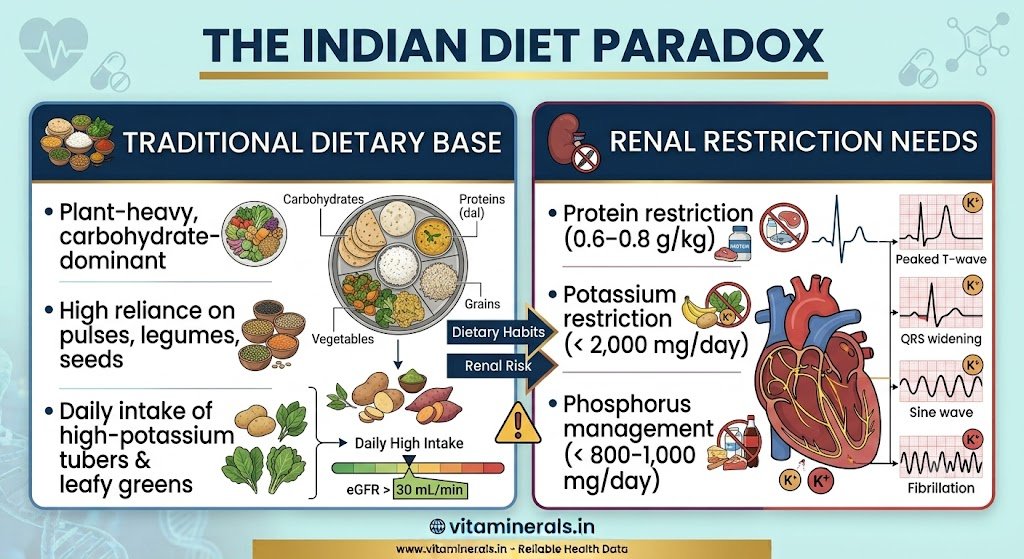
The traditional Indian diet relies heavily on pulses (dals), legumes, whole grains, tubers, and yogurt—all of which are naturally high in potassium and phosphorus.
Core Nutritional Objectives for CKD Stage 3 & 4
Nutrient |
Non-Dialysis CKD Target |
Primary Sources to Manage / Modify |
Dietary Energy |
30–35 kcal/kg body weight/day |
Complex low-protein starches (white rice, sago/sabudana, arrowroot) |
Dietary Protein |
0.6–0.8 g/kg body weight/day |
Scaled portions of leached dals, egg whites, paneer (if phosphorus permits) |
Potassium (K+) |
< 2,000 mg/day |
Whole pulses, green leafy vegetables, tubers, citrus fruits, coconut water |
Phosphorus |
800–1,000 mg/day |
Dairy products, nuts, seeds, packaged foods with phosphate additives |
Sodium (Na+) |
< 2,000 mg/day (< 5g salt) |
Table salt, pickles (achaar), papads, packaged snacks, commercial gravies |
6. Comprehensive Guide: Leaching Potassium from Indian Diets
Potassium is a water-soluble ion primarily stored within the intracellular compartments of plant cell walls. Leaching uses physical cell breakdown (peeling, slicing, boiling) to draw potassium ions out of plant matrices into surrounding water via passive diffusion.
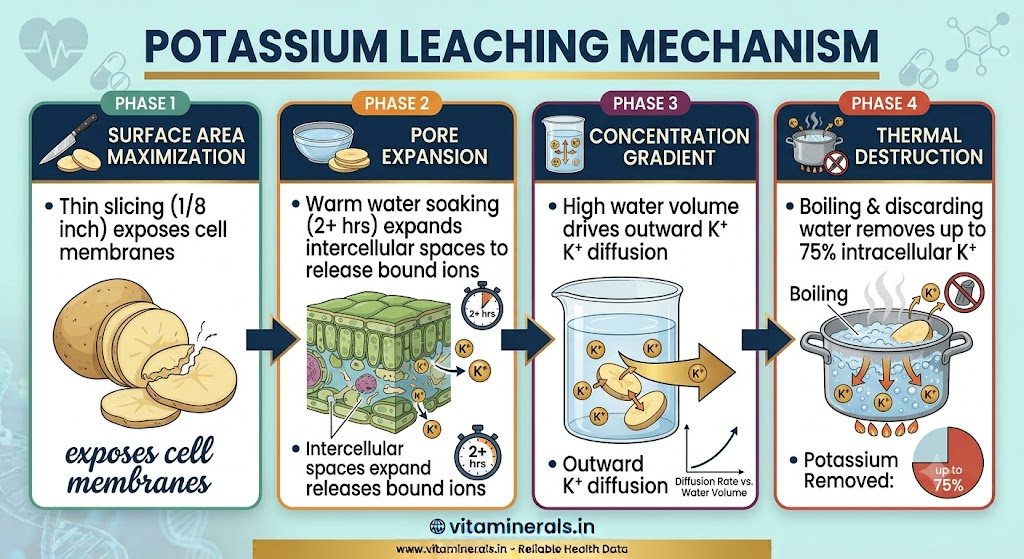
Standardized 5-Step Clinical Leaching Protocol
To lower potassium levels by 50% to 75% without completely destroying essential macronutrients, follow this procedure for all high-potassium ingredients:
-
Peel and Expose: Wash the vegetable or pulse thoroughly. Remove all outer skins (potatoes, gourds, root crops).
-
Precision Thin-Slicing: Slice vegetables into ultra-thin pieces (no thicker than 1/8 inch). Smaller pieces increase the surface-area-to-volume ratio, allowing more potassium to leach into the water.
-
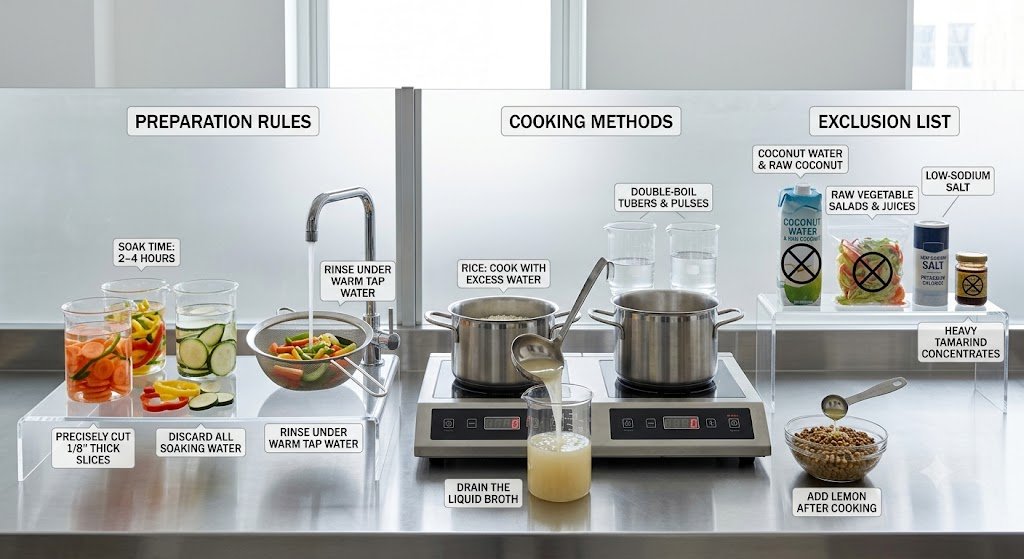
Warm-Water Soaking: Place the sliced vegetables or pulses in warm water (40° C–50° C) for at least 2 to 4 hours. Use a 10:1 water-to-food ratio (e.g., 10 cups of water for 1 cup of chopped vegetables). Discard this soaking water completely—never use it for cooking.
-
Rinse: Flush the soaked ingredients under running warm tap water for 30 seconds to wash off residual surface potassium.
-
Double Boiling / Water Discard Method:
-
Place the leached ingredients into a pot with 5 to 10 times their volume of fresh water
-
Bring to a rolling boil for 10–12 minutes
-
Drain and completely discard the boiling water
-
Refill with a small amount of fresh hot water to finish cooking the dish
-
Regional Application 1: North Indian Diet Modifications
North Indian cuisine relies heavily on whole wheat, dense legumes (Rajma, Chana, Dal Makhani), root vegetables (Aloo, Arbi), and dairy-based gravies (Paneer dishes). These dishes contain high levels of baseline potassium and organic phosphorus.
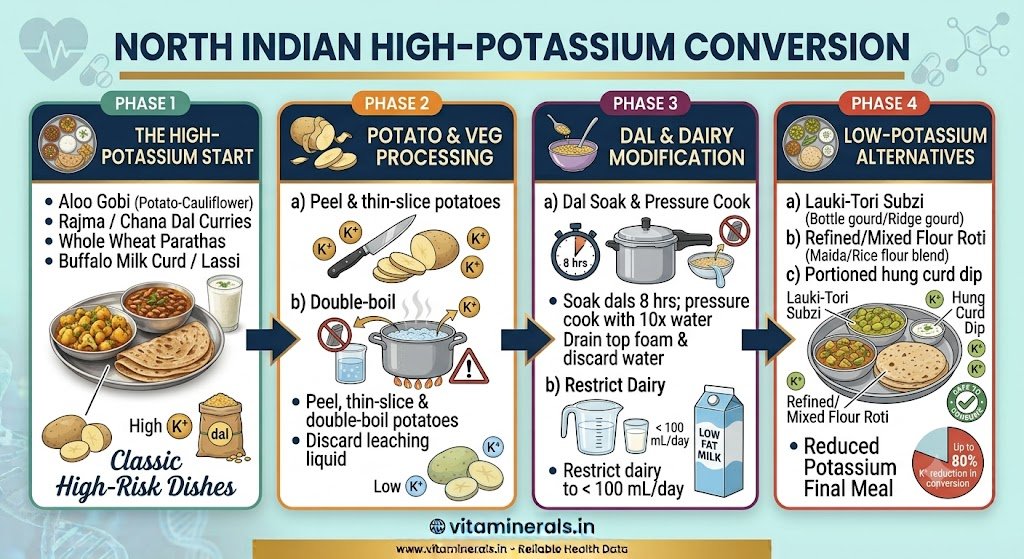
1. Dals & Legumes (Rajma, Chole, Toor Dal, Urad Dal)
-
The Problem: 100g of dry Rajma (Kidney Beans) contains over 1,300 mg of potassium
-
The Leaching Protocol:
-
Soak legumes for 12 hours in warm water with a pinch of baking soda (disrupts the outer seed coat)
-
Discard the soak water and rinse twice
-
Pressure cook using a 10:1 water ratio. Once cooked, strain out and discard the cooking broth completely
-
Sauté the cooked beans in a fresh tomato-onion paste made with minimal salt
-
Clinical Target: Switch from dense pulses to split yellow Moong Dal or pink Masoor Dal, which carry a lower baseline potassium load and leach more efficiently
-
2. Tubers & Vegetables (Aloo, Arbi, Gobi, Palak)
-
The Problem: Aloo-Gobi and spinach (Palak) are mainstays of North Indian dining, but spinach contains ~558 mg of potassium per 100g, while raw potatoes contain ~420 mg
-
The Leaching Protocol for Potato/Root Veg:
-
Peel potatoes completely; cut into thin 2 mm cubes
-
Soak in warm water for 4 hours
-
Boil in a large pot of water for 15 minutes. Straining and discarding the water reduces potassium content by up to 75%
-
Note on Spinach/Greens: Leafy greens retain potassium tightly within their matrix. Boiling removes only ~30–40% of their potassium, so greens like Palak and Sarson should be strictly limited to under 30 grams per week for Stage 4 CKD patients
-
3. Roti & Breads
-
The Substitution: Whole wheat flour (Atta) contains bran, which is high in potassium (~400 mg/100g) and phytic acid-bound phosphorus. Mix Atta with lower-potassium, lower-phosphorus flours like Maida (refined wheat flour) or Arrowroot starch in a 50:50 ratio to reduce potassium load per roti
Regional Application 2: South Indian Diet Modifications
South Indian meals feature rice, coconut, tamarind, lentils (Sambar, Rasam), and tubers (Yams, Tapioca). Coconut water, raw coconut, and tamarind extracts are major hidden sources of potassium.
1. Sambar & Rasam Preparation
-
The Problem: Traditional Sambar combines high-potassium Toor Dal, mixed vegetables (drumsticks, pumpkin, potatoes), and concentrated tamarind paste
-
The Leaching Protocol:
-
Dal Prep: Pre-boil Toor Dal or Moong Dal in excess water, strain, and discard the broth before adding to the stew
-
Vegetable Prep: Use low-potassium vegetables like Gourd (Lauki), Snake Gourd (Pudalangai), Ridge Gourd (Peerkangai), or Cabbage. Cube, soak in warm water for 2 hours, boil, and discard the cooking water before adding them to the Sambar vessel
-
Tamarind & Spice Control: Limit concentrated tamarind pulp (rich in potassium). Flavor Rasam using small amounts of fresh lemon juice added after cooking (off the heat) instead of boiling heavy tamarind extracts
-
2. Eliminating Hidden Coconut Potassium
-
The Problem: Fresh grated coconut contains ~356 mg of potassium per 100g, while coconut water is an extreme hyperkalemic trigger, containing 250–300 mg of potassium per 100 mL
-
The Substitution:
-
Strict Elimination: Coconut water, tender coconut and packaged coconut milk must be completely eliminated in CKD Stage 3b/4
-
Chutney Alteration: Replace traditional coconut chutney with Roasted Chana Dal (Pottukadalai) Chutney or Coriander-Mint Chutney made with leached herbs, diluted curd, and no raw coconut meat
-
3. Rice & Fermented Batter (Idli / Dosa)
-
The Protocol:
-
Boiled White Rice: Always cook white rice using the excess water method (boiling rice in a 1:8 water ratio and straining out the liquid starch/starchy water). Never use closed electric pressure cookers or absorption methods, as they trap potassium inside the grain
-
Batter Formulation: Increase the ratio of polished white rice to Urad Dal in Idli/Dosa batters (e.g., shift from a 4:1 ratio to a 6:1 ratio) to lower total pulse content per serving
-
7. Comparative Potassium Content Reference Table
This table details the potassium content of common Indian food items before and after applying the standard leaching protocol:
Food Item |
Typical Category |
Raw Potassium (mg per 100g) |
Post-Leached Potassium (mg per 100g)* |
Recommended Clinical Action |
Coconut Water |
Beverage |
250–350 mg / 100mL |
Cannot be leached |
Strictly Avoid |
Spinach (Palak) |
Leafy Green |
558 mg |
~330–380 mg |
Limit to < 30g/week |
Kidney Beans (Rajma) |
Legume/Pulse |
1,350 mg |
~400–500 mg |
Double-boil & limit portion |
Potato (Aloo) |
Tuber |
420 mg |
~100–120 mg |
Mandatory Thin-Slice & Leash |
Bottle Gourd (Lauki) |
Low-K Vegetable |
150 mg |
~50–60 mg |
Preferred daily vegetable |
White Rice (Boiled) |
Grain |
35 mg |
~15–20 mg |
Drain excess starch water |
Toor Dal (Pigeon Pea) |
Legume/Pulse |
1,100 mg |
~350–450 mg |
Soak 8h, drain primary broth |
Banana |
Fruit |
358 mg |
Cannot be leached |
Swap for Apple or Guava (sliced) |
*Note: Leaching values assume strict adherence to peeling, thin-slicing (1/8 inch), 4-hour warm water soaking, and double-boiling with water removal.
8. Summary & Checklist for Patients and Caregivers
-
Never use cooking liquid: Always drain and discard the water used for soaking or initial boiling of vegetables, pulses, and rice
-
Avoid “Low-Sodium” Salt Substitutes: Commercial low-sodium salts replace sodium chloride (NaCl) with potassium chloride (KCl). They can cause severe hyperkalemia in CKD patients and must be strictly avoided
-
Control Portion Sizes: Leaching reduces potassium content significantly, but it does not eliminate it entirely. Portion control remains essential for Stage 3b and Stage 4 CKD management
You may have, by now realized, how critical a condition like CKD is, not only for the patient but also for the family members. While a CKD Patient continues to have good nutrition requirements – Potassium content of Indian Diets – creates truly unique operational and practical challenges for CKD Patients.
Rule No 1 – Avoid CKD at any cost and Rule No 2 is to never forget the Rule No 1.
Prevention and timely diagnosis of CKD goes a long way in ensuring Health, Wellness and Quality of Life – the only motto of www.vitaminerals.in
References & Clinical Literature
-
Rajapurkar, M. M., et al. (2012). What do we know about chronic kidney disease in India: First report of the Indian CKD registry. BMC Nephrology, 13(1), 10
-
Singh, A. K., et al. (2013). Epidemiology and risk factors of chronic kidney disease in India – results from the SEEK (Screening and Early Evaluation of Kidney Disease) study. BMC Nephrology, 14(1), 114
-
Indian Council of Medical Research (ICMR) – National Institute of Nutrition (NIN). (2024). Dietary Guidelines for Indians & Nutrient Requirements for Indians (RDA & EAR). ICMR-NIN Publication Division, Hyderabad
-
Varma, P. P. (2015). Prevalence of chronic kidney disease in India – Where are we heading? Indian Journal of Nephrology, 25(3), 133-135
-
Burrowes, J. D., & Ramer, N. J. (2008). Removal of potassium from tubers by leaching and cooking methods. Journal of Renal Nutrition, 18(6), 504-512
-
Bethke, P. C., & Jansky, S. H. (2008). The effects of boiling and leaching on the content of potassium and other minerals in potatoes. Journal of Food Science, 73(5), C346-C350
-
KDIGO (Kidney Disease: Improving Global Outcomes) Diabetes Work Group. (2023). KDIGO 2023 Clinical Practice Guideline for Diabetes Management in Chronic Kidney Disease. Kidney International, 104(5S), S1-S127