



What Modern Science Says About Healing your Pancreas, Diabetes Remission and Protecting Your Insulin-Producing Beta Cells
Part 6 of 10 Part Series on The Silent Death of Pancreas – For Part 5, Click Here
Can Pancreas Heal
One of the Most Common Questions in Diabetes. Every newly diagnosed patient eventually asks: “Doctor, can my pancreas heal?” It’s an understandable question. If beta cells make insulin…And diabetes develops because those beta cells no longer keep up…
Can they NOT recover then and How, and if Not, Then Why Not?
The answer is more nuanced than a simple yes or no. Modern research offers real reasons for optimism, but it also sets important limits. Scientists now know that beta-cell function can improve in some people, especially early in the course of Type 2 diabetes. However, there is no evidence that long-standing diabetes can routinely be cured by regenerating all lost beta cells.
Understanding this distinction helps set realistic expectations and emphasizes why early intervention matters.
Function Is Not the Same as Regeneration
Before exploring the evidence, let’s define three important terms.
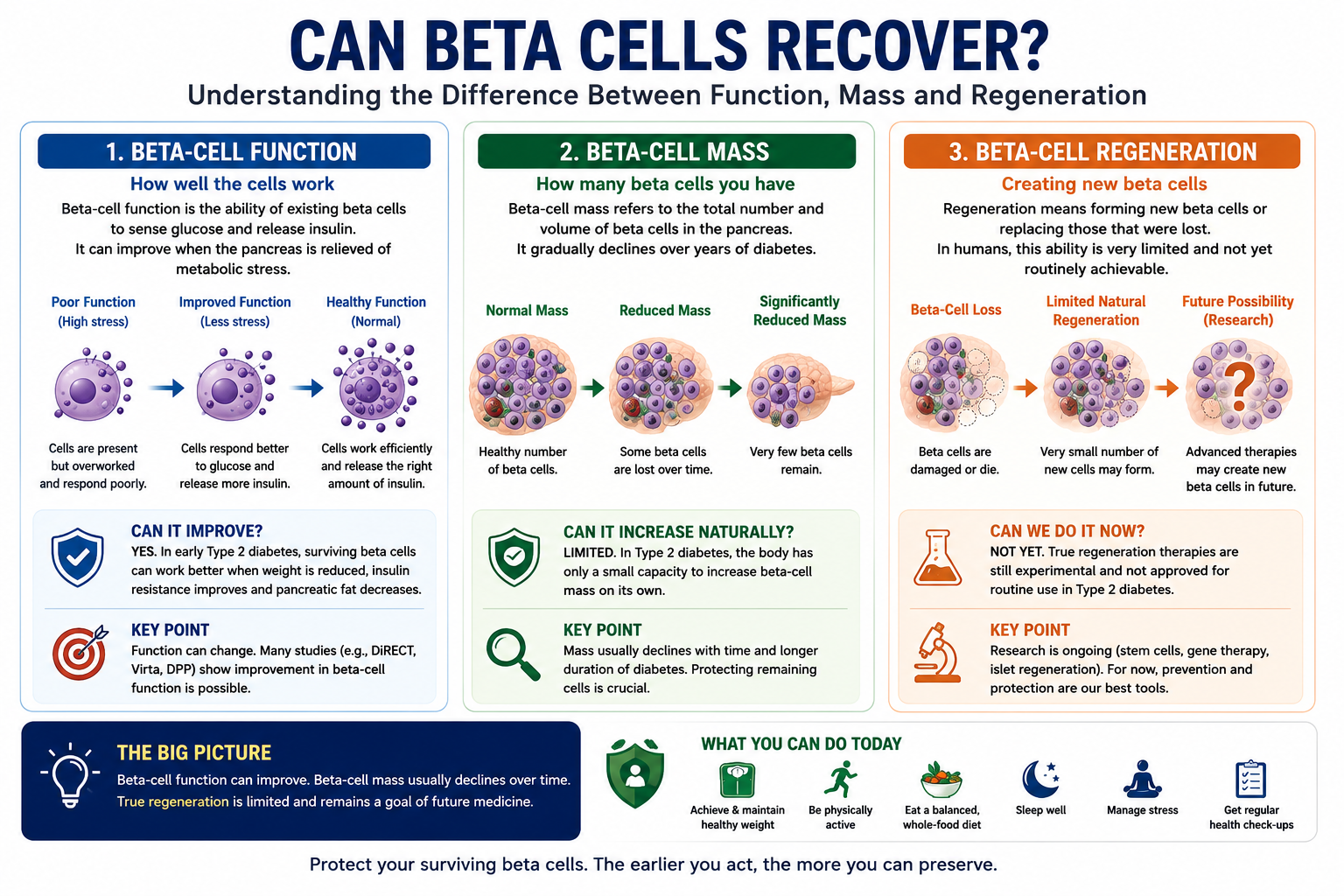
Beta-Cell Function – This refers to how effectively beta cells produce and release insulin in response to rising blood glucose. Function can improve if the cells are relieved of metabolic stress.
Beta-Cell Mass – This refers to the total number and volume of beta cells in the pancreas. Changes in beta-cell mass are much harder to measure in living people.
Beta-Cell Regeneration – This means creating new beta cells or replacing those that have been permanently lost.
In humans, meaningful regeneration appears to be limited under normal circumstances. Research is ongoing, but no established therapy currently restores beta-cell mass to normal in people with Type 2 diabetes.
Why Beta Cells Stop Working Properly
Type 2 diabetes is often described as a disease of “high blood sugar.” In reality, chronic exposure to excess nutrients creates a stressful environment for beta cells. Scientists have identified several contributors:
-
Persistent insulin resistance
-
Elevated blood glucose (glucotoxicity)
-
High circulating fatty acids (lipotoxicity)
-
Chronic low-grade inflammation
-
Oxidative stress
-
Fat accumulation within the liver and pancreas
-
Genetic susceptibility
Imagine asking a factory to operate at maximum capacity 24 hours a day for years without maintenance. Eventually, productivity declines. Similarly, beta cells become less efficient after prolonged metabolic overload.
The Twin Cycle Hypothesis
One of the most influential ideas in modern diabetes research comes from Professor Roy Taylor at Newcastle University.
The Twin Cycle Hypothesis proposes that excess calorie intake over many years leads to two interconnected processes:
Cycle 1: Fatty Liver – Excess calories are stored in the liver.
↓
The liver becomes resistant to insulin
↓
It releases too much glucose into the bloodstream
↓
The pancreas responds by producing even more insulin
Cycle 2: Fatty Pancreas – Excess fat gradually accumulates within the pancreas
↓
Beta-cell function becomes impaired
↓
Insulin secretion falls
↓
Blood glucose rises further
According to this model, reducing excess liver and pancreatic fat may potentially help improve beta-cell function in some individuals.
The DiRECT Trial Changed Expectations
Perhaps the most influential study on diabetes remission is the DiRECT (Diabetes Remission Clinical Trial) conducted in the United Kingdom. Researchers enrolled adults with relatively recent Type 2 diabetes and used a structured weight-management program that included:
-
A temporary total diet replacement under medical supervision
-
Gradual food reintroduction
-
Long-term weight maintenance support
The results were remarkable. Many participants who achieved substantial weight loss entered diabetes remission, meaning their blood glucose returned to below the diagnostic threshold for diabetes without glucose-lowering medication for a sustained period.
Importantly: The greatest success was seen in people who had been diagnosed more recently. This suggests that preserving remaining beta-cell function is urgently and critically important.
What Happened Inside the Pancreas?
Imaging studies linked to Professor Taylor’s work showed that significant weight loss reduced:
-
Liver fat
-
Pancreatic fat
As pancreatic fat decreased, many participants showed improved insulin secretion. Researchers concluded that beta-cell function improved in many individuals, particularly when diabetes had not been present for many years.
This does not prove that new beta cells were created. Rather, surviving beta cells appeared to function better once metabolic stress was reduced.
The Virta Health Study
Another important body of evidence comes from the Virta Health Trial, which evaluated a medically supervised nutritional approach focused on carbohydrate restriction and continuous clinical support. Over time, many participants experienced:
-
Lower HbA1c
-
Reduced need for diabetes medications
-
Significant weight loss
-
Improvements in markers of metabolic health
These findings reinforce the principle that improving the body’s metabolic environment can substantially improve glucose regulation.
The Diabetes Prevention Program
The Diabetes Prevention Program (DPP) focused on people with prediabetes. It demonstrated that intensive lifestyle intervention—including healthier eating, increased physical activity, and modest weight loss—reduced progression to Type 2 diabetes by about 58% over the study period.
This highlights an important message: It is easier to preserve beta-cell function than to recover it after years of disease.
What About Exercise – Exercise does far more than burn calories. Regular physical activity:
-
Improves insulin sensitivity.
-
Reduces visceral fat.
-
Helps preserve muscle mass.
-
Lowers liver fat.
-
Reduces the amount of insulin the pancreas needs to produce.
Both aerobic exercise and resistance training play complementary roles. For Indians, resistance training is especially valuable because many adults have relatively low muscle mass.
Does Losing Weight Always Lead to Remission?
Not necessarily. Several factors influence the likelihood of remission:
-
Duration of diabetes.
-
Amount of remaining beta-cell function.
-
Degree of weight loss achieved.
-
Age.
-
Genetics.
-
Presence of complications.
-
Adherence to long-term lifestyle changes.
The earlier the intervention begins, the greater are chances of success.
Can Supplements Restore Beta Cells?
This is an area where misinformation is common. At present:
-
No vitamin, mineral, herb, or dietary supplement has been proven to regenerate beta cells in humans.
However, correcting nutrient deficiencies—such as vitamin D deficiency or vitamin B12 deficiency when present—supports overall health and may contribute to normal metabolic function. These nutrients should not be viewed as substitutes for evidence-based diabetes care. Claims that any supplement can “regrow your pancreas” or “cure diabetes” are not supported by current scientific evidence.
Scientists Are Working on the Future
Researchers around the world are investigating exciting new approaches, including:
-
Stem-cell-derived beta cells
-
Islet transplantation
-
Gene editing
-
Immunotherapy
-
Beta-cell protective drugs
-
Artificial pancreas technologies (primarily for Type 1 diabetes)
While these fields are advancing rapidly, most remain experimental or are applicable only to selected patient groups only at this moment.
What This Means for Indians
For Indians, the message is particularly important. Because many develop diabetes: At younger ages, At lower BMI, With relatively lower beta-cell reserves, early action may preserve more pancreatic function, than an action later in life.
Waiting until blood sugar is severely elevated may reduce the opportunity for meaningful recovery of beta-cell performance.
Most Important Lesson
Your pancreas is not simply a victim of diabetes. It responds to the metabolic environment you create.
Healthy eating, regular exercise, maintaining muscle mass, reducing excess visceral fat, improving sleep, and managing stress all reduce the workload placed on beta cells.
While current science does not support the idea that beta cells can be fully regenerated in routine clinical practice, it clearly shows that protecting surviving beta cells and improving their function is certainly possible—especially when intervention begins early.
Key Takeaways
-
Beta-cell function and beta-cell regeneration are not the same.
-
Early Type 2 diabetes is associated with impaired beta-cell function, some of which may improve when metabolic stress is reduced.
-
Significant weight loss can improve liver fat, pancreatic fat, insulin sensitivity, and beta-cell function in some individuals.
-
Diabetes remission is possible for some people, particularly when intervention occurs soon after diagnosis.
-
No supplement has been proven to regenerate beta cells in humans.
-
Healthy lifestyle habits remain the most effective evidence-based strategy for preserving pancreatic function.
Select References:
-
Lean MEJ, et al. Primary Care-Led Weight Management for Remission of Type 2 Diabetes (DiRECT). The Lancet. 2018.
-
Taylor R. Type 2 Diabetes: Etiology and Reversibility. Diabetologia. 2008.
-
Taylor R, Al-Mrabeh A, Zhyzhneuskaya S, et al. Remission of Human Type 2 Diabetes Requires Decrease in Liver and Pancreas Fat Content. Cell Metabolism.
-
Hallberg SJ, et al. Effectiveness and Safety of a Novel Care Model for Type 2 Diabetes at One Year. Diabetes Therapy. 2018.
-
Knowler WC, et al. Reduction in the Incidence of Type 2 Diabetes with Lifestyle Intervention or Metformin. N Engl J Med. 2002.
-
American Diabetes Association. Standards of Care in Diabetes (latest edition).
-
EASD/ADA Consensus Report on the Management of Hyperglycaemia in Type 2 Diabetes.
-
Weir GC, Bonner-Weir S. Five Stages of Evolving Beta-Cell Dysfunction. Diabetes. 2004.