



This is yet another, evidence based, pure scientific piece on Plant Proteins and what are the key challenges and issues with Plant Proteins, scientifically known as Anti-Nutritional Factors and what can, should and is being done to minimize and blunt the effects of these anti-nutritional factors.
While we maintain and have shared that Animal Proteins are way better as compared to Plant Proteins on various parameters especially for Indians, but for a vast majority of Indians – Dals and Soy constitute a major source of daily protein supply. Lets get a better understanding about one of these anti-nutritional factors in Plant Proteins, and what practices our elders have been consciously following to counter the effects of these anti-nutritional factors – even if our elders never knew the fancy names of these anti-nutritional factors.
What are Anti-Nutritional Factors
Antinutritional factors in soy and daal (pulses/lentils) are natural chemical compounds that interfere with the body’s ability to digest food and absorb essential nutrients. Common factors include:
-
-
Phytic acid (Phytates): Binds to minerals like iron, zinc, and calcium
-
Trypsin/Protease inhibitors: Block protein-digesting enzymes
-
Lectins: Interfere with gut absorption and carbohydrate use
-
Tannins: Bind iron and decrease protein quality
-
Oligosaccharides: Cause gas and bloating
-
Why Are Anti-Nutritional Factors with Plant Proteins
Plants do not produce these compounds for human benefit; rather, they form an essential part of the plant’s survival toolkit:
- Natural Defense: They act as chemical deterrents to protect seeds and plants from being eaten by insects, fungi, bacteria, and grazing animals
-
Nutrient Storage: Compounds like phytic acid serve as a crucial storage reservoir for phosphorus, which the seed needs to fuel itself during germination and early growth
Eternal Debate in India – Plant vs Animal Proteins
When evaluating protein quality from plant vs animal proteins, total amino acid concentration is only one part of the equation. A primary determinant of how efficiently the human body utilizes protein is the bioavailability—a factor significantly impaired in plant-based diets by natural defense compounds of plants known as protease inhibitors (PIs).
While plant foods remain valuable sources of micronutrients and dietary fiber, their native protein fraction comes bound with antinutritional factors designed to disrupt human as well as animal digestion. This article provides a scientific, evidence-based review of protease inhibitors in vegetarian foods, their biochemical mechanisms of action, thermal and processing solutions, and a comparative analysis against animal-derived protein sources.
1. What Are Protease Inhibitors? (Biochemical Mechanism of Action)
Protease inhibitors are naturally occurring proteins found in high concentrations within plant seeds, particularly legumes (soybeans, chickpeas, lentils), cereals (wheat, barley, rye), and tubers (potatoes).
In plant biology, protease inhibitors serve a strong defensive purpose: they act as biochemical shields against herbivores, vegetarians, insects and microbial pathogens by disabling the digestive enzymes of the organisms that somehow consume these very seeds.
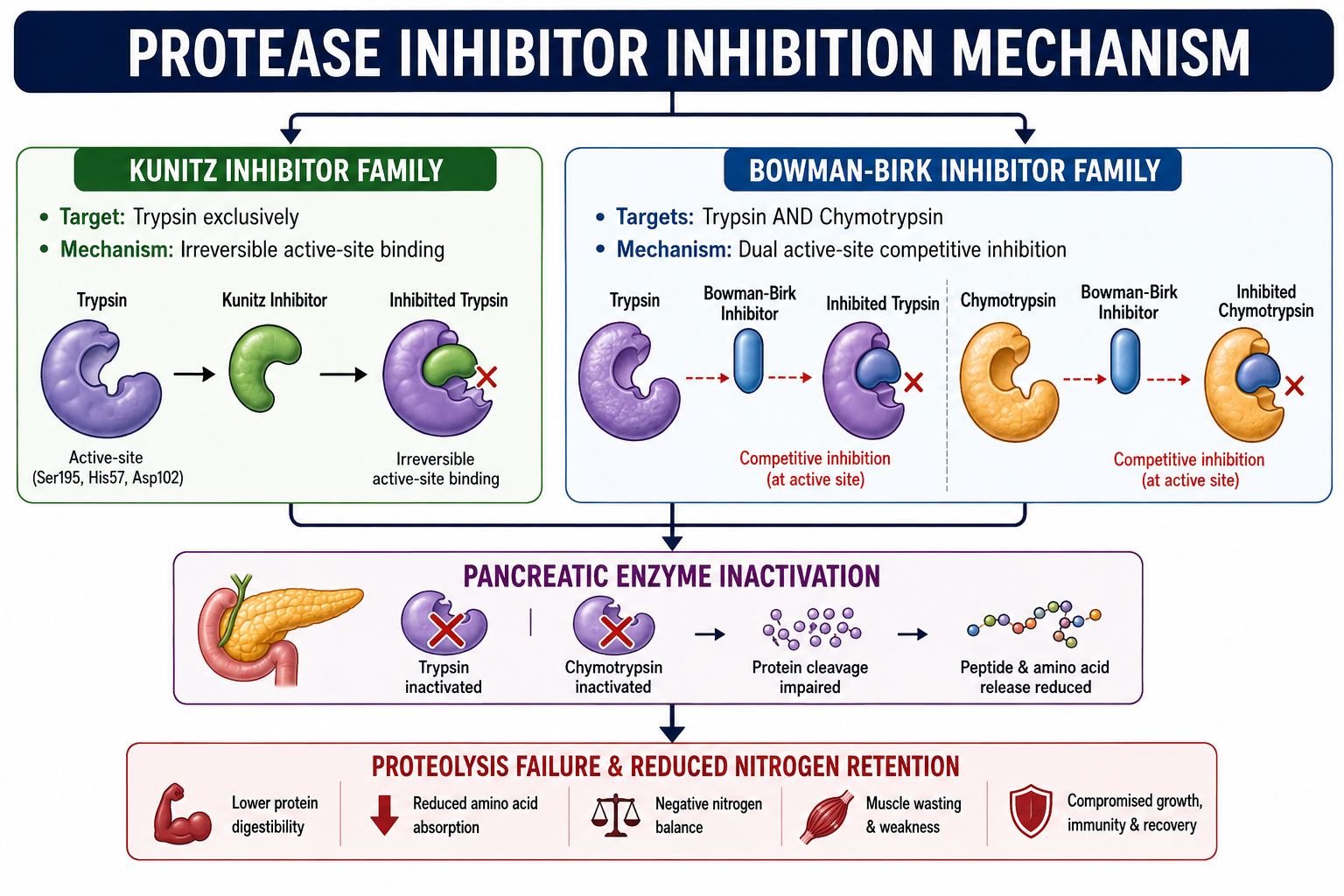
The Two Primary Families:
-
Kunitz Trypsin Inhibitors (KTI): Larger proteins (~20 kDa) that specifically bind to and deactivate trypsin, a key pancreatic enzyme responsible for cleaving peptide bonds at the carboxyl side of lysine and arginine.
-
Bowman-Birk Inhibitors (BBI): Smaller, highly cross-linked proteins (~8 kDa) featuring two distinct active sites that simultaneously inhibit both trypsin and chymotrypsin (which cleaves peptide bonds adjacent to aromatic amino acids like leucine, tryptophan, and tyrosine).
When ingested, these inhibitors form stable, enzymatically inactive complexes with active digestive proteases in the lumen of the small intestine, preventing the breakdown of dietary proteins into absorbable dipeptides, tripeptides, and free amino acids.
2. Quantities of Anti-Nutritional Factors in Plant Proteins, frequently consumed by Indians
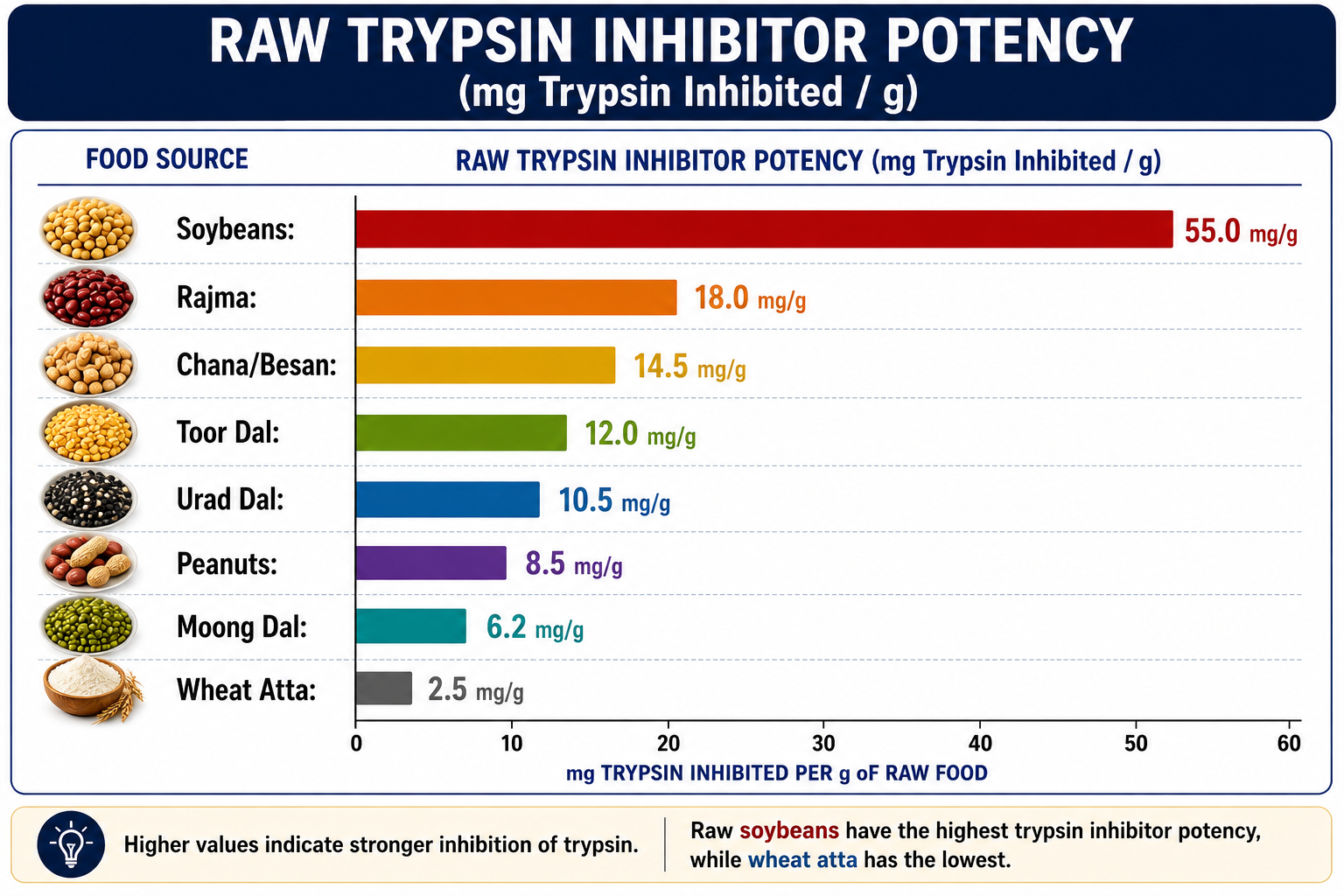
In Indian cuisine—which relies heavily on pulses, cereals, and seed crops—several staple plant foods contain high levels of native protease inhibitors (specifically Trypsin Inhibitors [TI] and Chymotrypsin Inhibitors [CI]).
The plant foods consumed in India with the highest concentrations of protease inhibitors, ranked by their antinutritional potency, include:
1. Raw & Processed Soybeans (Glycine max)
-
Inhibitor Content: Extremely High (Contains both Kunitz Trypsin Inhibitors and Bowman-Birk Inhibitors).
-
Common Indian Uses: Soy chunks (Soya badi), soy granules, soy flour added to atta (wheat flour blends), and tofu (soya paneer)
-
Impact: Raw soybeans feature the highest trypsin inhibitor activity (TIA) of any edible crop. Commercial soy chunks undergo high-heat extrusion that neutralizes most inhibitors, but home-ground soy flour or improperly cooked soybean curries retain high Trypsin Inhibitor Aactivity
2. Pigeon Peas / Arhar Dal / Toor Dal (Cajanus cajan)
-
Inhibitor Content: High
-
Common Indian Uses: The primary staple pulse used for daily Dal Tadka, Sambhar, and Khichdi across Northern, Western, and Southern India
-
Impact: Raw Toor Dal has high levels of trypsin and chymotrypsin inhibitors. Because it is a thick seed, standard stovetop boiling without prior soaking or pressure cooking often leaves residual inhibitor activity intact
3. Chickpeas & Bengal Gram / Chana & Besan (Cicer arietinum)
-
Inhibitor Content: High
-
Common Indian Uses: Whole Kala Chana, Kabuli Chana (Chole), Chana Dal, and Besan (chickpea flour used for pakodas, dhokla, cheela, and mithai)
-
Impact: Uncooked chickpea flour (Besan) contains significant active trypsin inhibitors. Quick-cooked Besan dishes (like shallow-fried cheela or rapidly steamed dhokla) may retain higher inhibitor activity compared to pressure-cooked whole chickpeas
4. Black Gram / Urad Dal (Vigna mungo)
-
Inhibitor Content: Moderate to High
-
Common Indian Uses: Dal Makhani, fermented batters for Idli and Dosa, Medu Vada, and Kachori fillings
-
Impact: Urad dal is rich in protease inhibitors. However, traditional South Indian preparation methods (overnight soaking followed by 12–24 hours of lactic acid fermentation for idli/dosa) effectively degrade 70%–90% of these inhibitors via microbial enzymatic breakdown
5. Kidney Beans / Rajma (Phaseolus vulgaris)
-
Inhibitor Content: Moderate to High
-
Common Indian Uses: Rajma Masala (a major staple in North India)
-
Impact: In addition to dangerous lectins (phytohemagglutinin), raw Rajma contains potent Bowman-Birk trypsin inhibitors. Rajma requires mandatory long-term soaking (8–12 hours) and high-temperature pressure cooking to neutralize both lectins and protease inhibitors safely
6. Whole Wheat / Atta (Triticum aestivum)
-
Inhibitor Content: Moderate (principally Alpha-Amylase/Trypsin Inhibitors or ATIs)
-
Common Indian Uses: Daily Roti, Chapati, Paratha, Puri, and Naan
-
Impact: Wheat ATIs are concentrated in the germ and endosperm. While ATIs primarily inhibit digestive amylase and trypsin, they are also recognized triggers for non-celiac gluten/wheat sensitivity and localized gut inflammation
7. Peanuts / Groundnuts (Arachis hypogaea)
-
Inhibitor Content: Moderate
-
Common Indian Uses: Chutneys, poha garnish, peanut oil, roasted snacks, and peanut chikki
-
Impact: Raw or lightly dry-roasted peanuts contain heat-stable protease inhibitors that reduce the net protein digestibility of the peanut protein matrix
Quantitative Breakdown of High-Protease-Inhibitor Indian Foods
Indian Staple Food |
Scientific Name |
Raw Trypsin Inhibitor Activity (TIA) Range |
Primary Inhibitor Family Present |
Post-Processing Residual TIA Range (Standard Cooking) |
Soybeans (Soya Badi / Flour) |
Glycine max |
45.0 – 65.0 mg/g (or 20,000–35,000 TIU/g) |
Kunitz (KTI) & Bowman-Birk (BBI) |
3.5 – 8.0 mg/g (85%–92% reduction via extrusion/boiling) |
Pigeon Pea (Toor / Arhar Dal) |
Cajanus cajan |
9.5 – 15.0 mg/g (or 8,000–12,000 TIU/g) |
Bowman-Birk (BBI) |
1.2 – 2.8 mg/g (80%–88% reduction via pressure cooking) |
Chickpeas (Chana / Besan) |
Cicer arietinum |
11.0 – 18.5 mg/g (or 10,000–14,000 TIU/g) |
Kunitz & Bowman-Birk |
1.5 – 3.2 mg/g (80%–87% reduction) |
Kidney Beans (Rajma) |
Phaseolus vulgaris |
14.0 – 22.0 mg/g (or 12,000–18,000 TIU/g) |
Bowman-Birk (BBI) |
0.8 – 2.0 mg/g (90%–95% reduction via heavy pressure cooking) |
Black Gram (Urad Dal) |
Vigna mungo |
8.0 – 13.5 mg/g (or 6,500–10,000 TIU/g) |
Bowman-Birk (BBI) |
0.5 – 1.8 mg/g (90%–95% reduction via fermentation + steam) |
Mung Bean (Moong Dal) |
Vigna radiata |
4.5 – 8.0 mg/g (or 3,500–6,000 TIU/g) |
Bowman-Birk (BBI) |
0.4 – 1.0 mg/g (90%+ reduction; lowest among major lentils) |
Peanuts (Groundnut / Mungfali) |
Arachis hypogaea |
6.0 – 11.0 mg/g (or 5,000–8,500 TIU/g) |
Heat-Stable Peanut Inhibitors |
2.5 – 4.5 mg/g (50%–60% reduction; dry roasting is less effective) |
Whole Wheat (Atta) |
Triticum aestivum |
1.5 – 3.5 mg/g (Amylase-Trypsin Inhibitors) |
Wheat ATI Family |
3. Physiological and Health Effects of Protease Inhibitors
The consumption of unpassivated or poorly processed protease inhibitors triggers a cascading series of adverse metabolic and physiological effects:
A. Impaired Protein Bioavailability and Nitrogen Balance
By deactivating trypsin and chymotrypsin, PIs cause a substantial portion of co-ingested plant protein to pass through the small intestine undigested. This leads to reduced protein digestibility, decreased fecal nitrogen retention, and lower systemic amino acid availability required for muscle protein synthesis (MPS) and tissue repair.
B. Pancreatic Hypertrophy and Metabolic Stress
The presence of unabsorbed protein-inhibitor complexes in the intestinal lumen triggers continuous secretion of cholecystokinin (CCK) from enteroendocrine I-cells. CCK signals the pancreas to synthesize and secrete elevated levels of zymogens (trypsinogen and chymotrypsinogen) in an attempt to overcome the inhibition.
-
The Cost: This persistent feedback loop induces chronic pancreatic hyperstimulation, leading to pancreatic hypertrophy (enlargement) and a depletion of endogenous essential sulfur-containing amino acids (methionine and cysteine), which are heavily utilized by the pancreas to synthesize digestive enzymes.
C. Gastrointestinal Distress and Microbiome Dysbiosis
Undigested proteins reaching the distal ileum and colon undergo bacterial putrefaction by resident microflora. This produces pro-inflammatory metabolites such as ammonia, hydrogen sulfide, amines, and phenols, leading to lower bowel gas, bloating, and localized mucosal irritation.
4. Processing Protocols: Can You Neutralize Plant Protease Inhibitors?
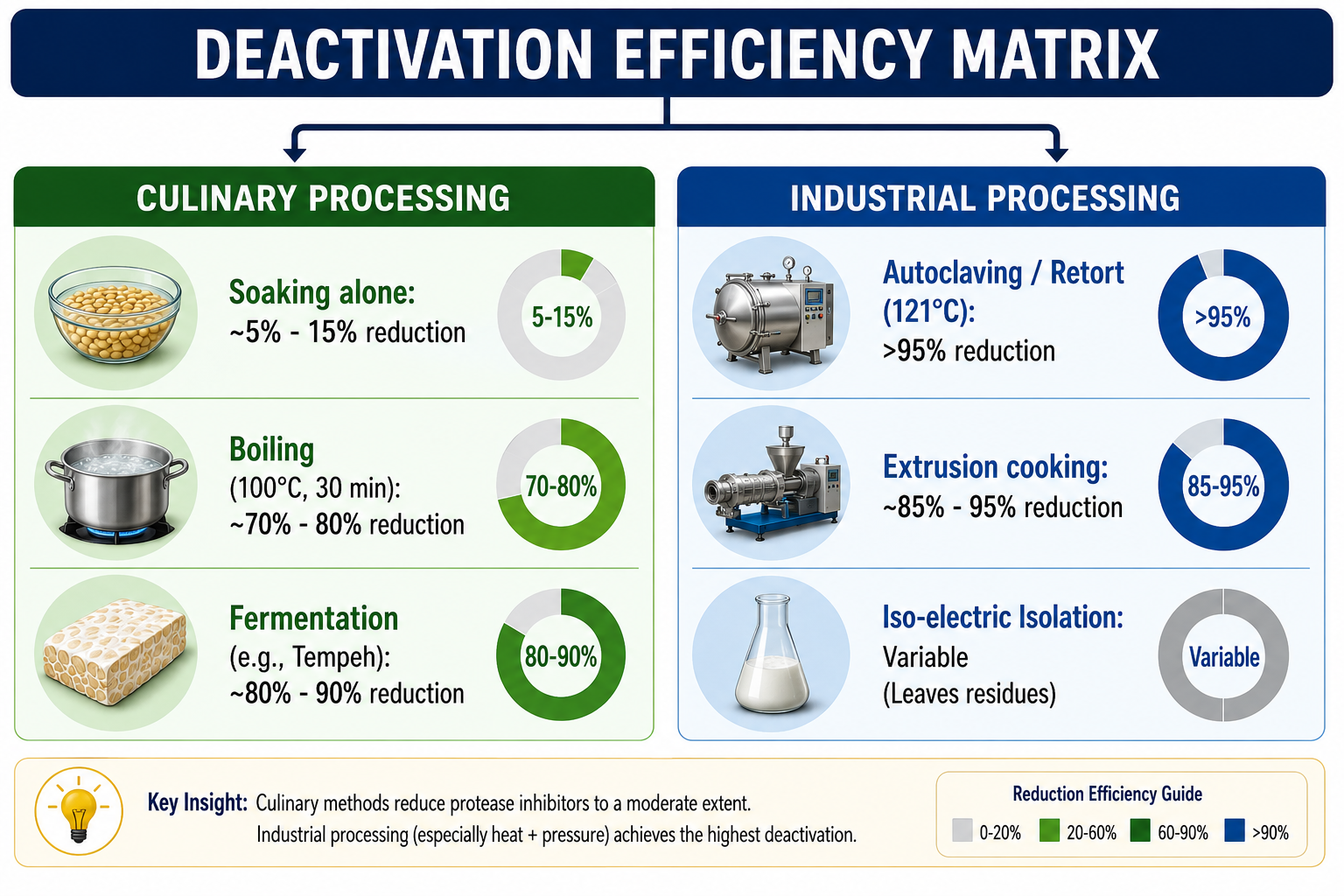
Because protease inhibitors are themselves proteins, their tertiary structure can be denatured (deactivated) through specific culinary and industrial processing techniques. However, complete elimination is challenging.
-
Moist Heat Cooking (Boiling/Autoclaving): Heat breaks the disulfide bonds holding Bowman-Birk and Kunitz inhibitors together. Prolonged wet boiling ($100^\circ\text{C}$ for 30–60 minutes) or pressure cooking ($121^\circ\text{C}$ under pressure) neutralizes 80% to 98% of trypsin inhibitor activity (TIA). Dry heat (roasting) is substantially less effective.
-
Germination (Sprouting): Soaking seeds in water triggers endogenous plant enzymes that degrade storage proteins, including PIs, reducing inhibitor activity by 20% to 50% over 48–72 hours.
-
Fermentation: Microbial fermentation (e.g., converting soybeans into tempeh or natto using Rhizopus oligosporus or Bacillus subtilis) utilizes fungal and bacterial proteases that degrade plant PIs by up to 90%, significantly boosting digestibility.
Physiological Impact of Residual Inhibitor Levels
Even after traditional Indian preparation methods, residual TIA persists depending on the dish:
-
Uncooked / Lightly Cooked Besan (e.g., Quick Cheela, Raw Batter Spoons): Retains up to 20%–35% of native TIA, potentially causing transient pancreatic enzyme hyper-secretion (CCK elevation) and bloating.
-
Dry Roasted Peanuts: Dry heat only inactivates 40%–60% of peanut protease inhibitors, leaving a higher concentration of active inhibitors compared to wet pressure-cooked pulses.
-
Pressure-Cooked Dal (Toor, Moong, Rajma): Reaches 85%–95% TIA destruction, lowering the residual inhibitor load to $<2.0\text{ mg/g}$, which is generally well-tolerated by individuals with normal pancreatic function.
The Trade-Off: While intensive thermal processing deactivates protease inhibitors, excessive heat treatment triggers the Maillard reaction between amino acid side chains (particularly Lysine) and reducing sugars, rendering those amino acids biologically unavailable and partially offsetting digestibility gains.
5. Comparative Analysis: Why Animal Foods Offer Superior Digestibility
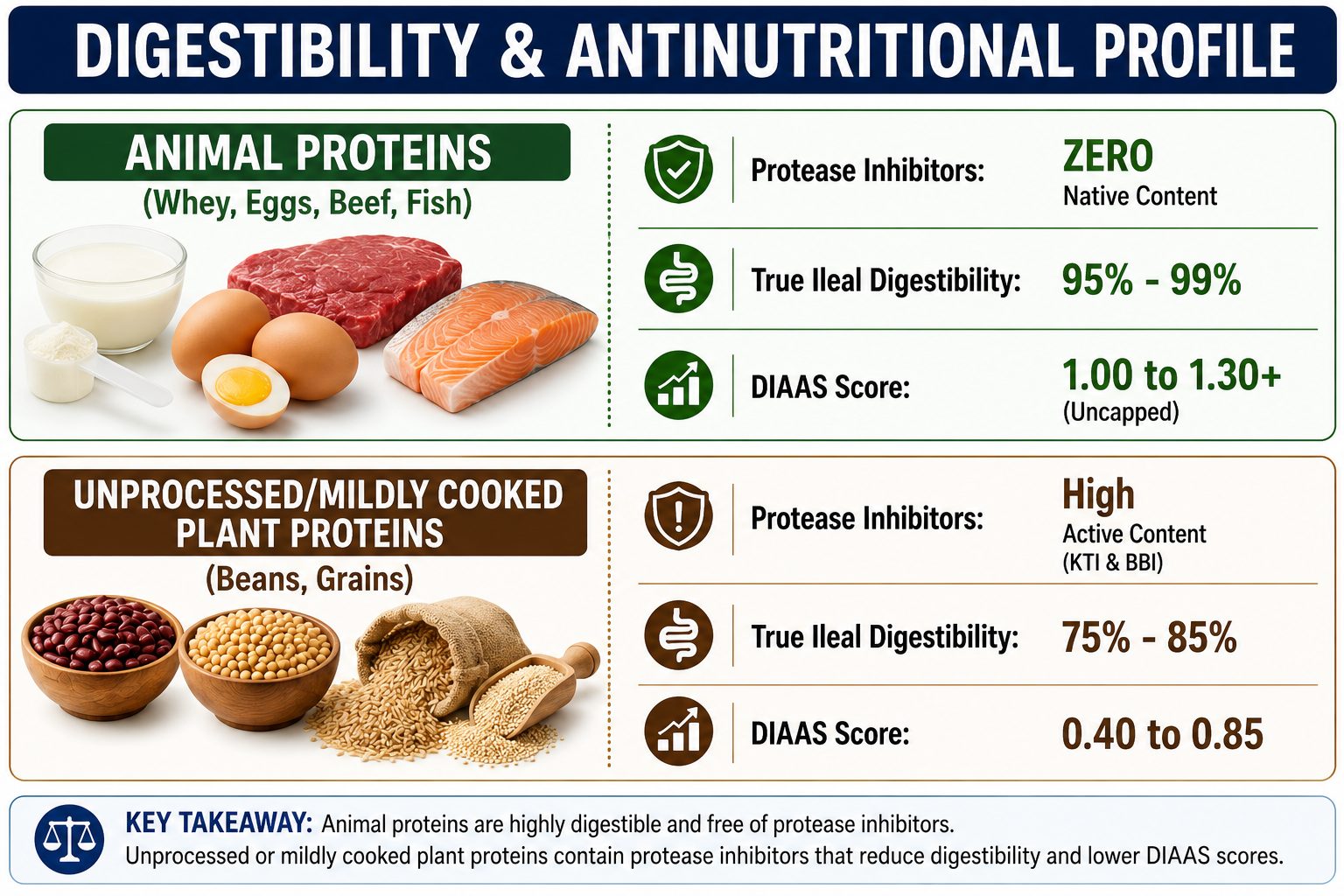
From a purely biochemical and physiological perspective, animal-derived proteins (meat, fish, poultry, eggs, dairy) avoid the digestability barriers inherent to seed-based plant foods.
1. Complete Absence of Native Protease Inhibitors
Animal muscle tissue, eggs, and dairy do not possess seed-defense structures like KTI or BBI. Consequently, human pancreatic proteases (trypsin, chymotrypsin, carboxypeptidases) operate at peak enzymatic efficiency without competitive or non-competitive inhibition.
2. Higher DIAAS (Digestible Indispensable Amino Acid Score)
The FAO-recommended DIAAS metric measures true amino acid digestibility at the terminal ileum:
-
Animal Proteins: Consistently score $>1.00$ (e.g., Whey Isolate: ~1.15, Whole Egg: ~1.13, Beef: ~1.11) due to structural accessibility and complete enzymatic cleavage.
-
Plant Proteins: Typically score between 0.40 and 0.85 due to the combined presence of residual protease inhibitors, phytates, and structural plant cell walls (fiber matrix) that physically shield proteins from enzymatic access.
3. Minimal Pancreatic Stress and Complete EAA Profiles
Animal foods deliver high concentrations of essential amino acids—specifically leucine, methionine, and lysine—without causing compensatory CCK hyper-secretion or metabolic sulfur-amino acid depletion associated with overcoming plant antinutrients.
Frequently Asked Questions (FAQ)
Q1: Does cooking completely remove trypsin inhibitors from beans and lentils?
No, but it significantly reduces them. Proper pressure cooking or boiling for 30–45 minutes deactivates approximately 80% to 95% of Kunitz and Bowman-Birk inhibitors. Dry roasting or quick cooking leaves higher residual levels of active inhibitors.
Q2: Are there any benefits to Bowman-Birk inhibitors?
In oncology research, purified Bowman-Birk Inhibitors (BBI) are being studied for potential anti-inflammatory and anticarcinogenic properties in the colon. However, from a nutritional and muscle protein synthesis standpoint, they remain antinutrients that impair systemic amino acid absorption.
Q3: Do whey or egg protein powders contain protease inhibitors?
No. Dairy, egg, and meat protein sources do not contain plant defense compounds like trypsin or chymotrypsin inhibitors, granting them higher true ileal digestibility scores (DIAAS > 1.00)
Select References
- Condori, M. A. V., & de Camargo, A. C. (2023). Trypsin inhibitors, antinutrients or bioactive compounds? A mini review. Journal of Food Bioactives, 9–16. https://doi.org/10.31665/jfb.2023.18344
- Pedrosa, M. M., Guillamón, E., & Arribas, C. (2021). Autoclaved and extruded legumes as a source of bioactive phytochemicals: A review. Foods, 10(2), 379. https://doi.org/10.3390/foods10020379
- Phongthai, S., Singsaeng, N., Nhoo-ied, R., Suwannatrai, T., Schönlechner, R., Unban, K., Klunklin, W., et al. (2020). Properties of peanut (KAC431) protein hydrolysates and their impact on the quality of gluten-free rice bread. Foods, 9(7), 942. https://doi.org/10.3390/foods9070942
- Shi, L., Mu, K., Arntfield, S. D., & Nickerson, M. T. (2017). Changes in levels of enzyme inhibitors during soaking and cooking for pulses available in Canada. Journal of Food Science and Technology, 54(4), 1014–1022. https://doi.org/10.1007/s13197-017-2519-6
Key Scientific Takeaways from the Literature
-
Raw vs. Heat-Treated Soybeans: Soybeans (Glycine max) display the highest native Trypsin Inhibitor Activity (TIA) among all commercial legumes in raw seed flour (Condori & de Camargo, 2023). High-heat processes like autoclaving or moist extrusion yield reductions exceeding 85–90% (Pedrosa et al., 2021)
-
Pulse Variations & Thermal Sensitivity: Common pulses such as chickpeas (Cicer arietinum), lentils, and beans vary widely in native protease inhibitor content, with soaking followed by wet cooking resulting in a 78.7%–100% loss of inhibitor activity across species (Shi et al., 2017)
-
Peanut & Cereal Matrices: Peanuts (Arachis hypogaea) and cereal grains harbor lower baseline trypsin inhibitor activity compared to raw legumes, but their inhibitor structures are relatively heat-stable during dry roasting or baking (Phongthai et al., 2020)
This has been one of the longest, but truly an evidence based, scientfic take on presence of certain anti-nutritional factors. Should you consume lentils / pulses and soy etc – pls do and must follow the suggested procedures for neutralizing and blunting the effects of such anti-nutritional factors.
Soaking pulses and beans in water for atleast 10 to 12 hours and then discarding that same water which was used for soaking, followed by boiling in fresh water and cooking, does take care of most of these anti-nutritional factors effectively.
Do share your experiences and suggestions at: sandeep@vitaminerals.in and we will incorporate your comments / suggestions.