


Our personal view is that virtually every Indian, yes every single Indian, is at risk of Diabetes as its more a matter of when and certainly not if. In our Special Series, Evidence-Explained™, we present you evidence from an interesting study which has profound benefits for Millions of Indians with Diabetes or at risk of this condition. Can your afternoon walk / exercise improve blood sugar much more effectively than a morning walk or morning gym session? Explore the latest research, Indian diabetes statistics and practical advice for better glucose control.
Timing of Exercise May Matter More Than Quantum
For decades, urban India’s health-conscious brigade has operated under an unwritten rule: to beat diabetes, one must wake up at 5:30 AM, lace up walking shoes, and hit the park before sunrise. The 6:00 AM neighborhood walk or gym session has achieved legendary status across Indian households, often viewed as the ultimate discipline for managing blood sugar.
For millions of Indians, this morning walk is almost a health ritual. Before work, before the traffic builds, before breakfast, people head to parks, neighbourhood streets and apartment terraces, believing that an early start is one of the best things they can do for their health.
Yet, millions of Indians diligently following this dawn ritual continue to see their HbA1c levels hover stubbornly above target lines. They are told to eat less rice, walk faster, or add more weight to the bar. But recent breakthroughs in chronobiology and metabolic science suggest the problem might not be how hard you are exercising, but when are you exercising. Read on for the evidence…
Groundbreaking research from Maastricht University published in Diabetologia (van der Velde et al., 2023) and follow-up 2024 clinical trials demonstrate a striking physiological reality: the exact same exercise routine lowers blood sugar significantly more when performed in the afternoon (between 12:00 PM and 6:00 PM) than in the early morning.
For India—a nation dubbed the “Diabetes Capital of the World” with over 101 million people living with Type 2 Diabetes (T2D) and another 136 million prediabetic according to the ICMR-INDIAB study—this finding changes everything. It offers a powerful, cost-free lever to optimize glycemic control without adding extra physical strain.
Maastricht Findings: What the Science Shows
We share evidence from 3 different studies including the Landmark – Maastricht University study which forms core of the discussion on this topic.
Study 1
One influential study, published in Physiology Reports in 2021, retrospectively compared 12 weeks of supervised morning exercise with afternoon exercise in 32 adult men at risk of or diagnosed with type 2 diabetes. Twelve participants exercised between 8 AM and 10 AM, while 20 exercised between 3 PM and 6 PM.
The afternoon group showed more favourable changes in several outcomes, including peripheral insulin sensitivity and fasting plasma glucose. Fasting glucose fell by an average of approximately 0.3 mmol/L in the afternoon group, while it rose by approximately 0.5 mmol/L in the morning group. The researchers also observed more favourable changes in exercise performance and fat mass in the afternoon group.
Study 2 – Maastricht University
The research led by Maastricht University evaluated adults with Type 2 Diabetes and metabolic dysfunction across controlled exercise protocols. The participants performed identical moderate-to-vigorous physical activities at different times of the day: early morning (6:00 AM – 10:00 AM), afternoon (12:00 PM – 6:00 PM), and evening (6:00 PM – 12:00 AM).
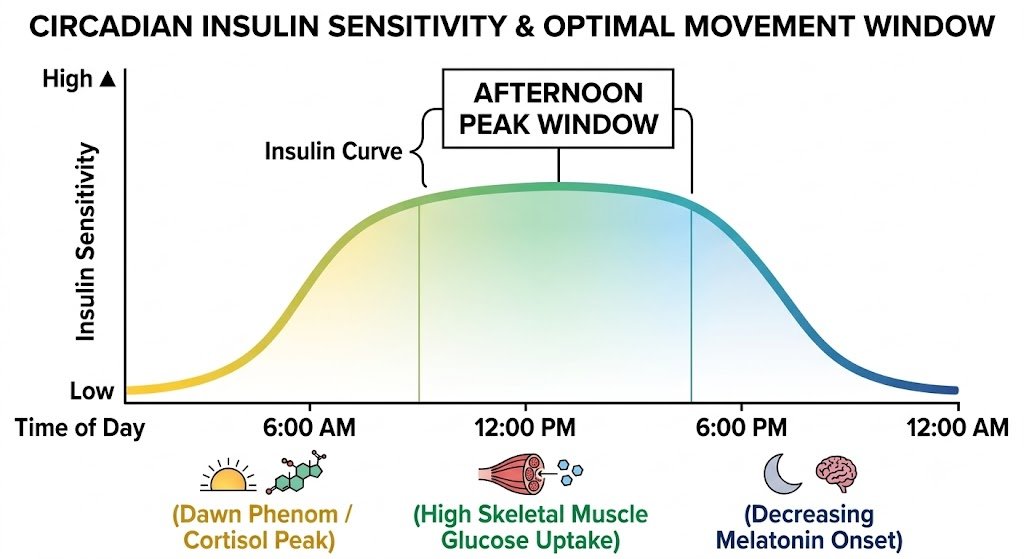
The clinical outcome was unambiguous:
-
Superior Overnight Glucose Burning: Participants who exercised in the afternoon exhibited significantly lower blood glucose levels not just immediately post-workout, but throughout the entire night and into the following morning. Their bodies continued burning glucose more effectively while they slept
-
Frequency vs. Timing: The 2023 Diabetologia study revealed that individuals who concentrated their physical activity between noon and 6:00 PM achieved the greatest reductions in insulin resistance, regardless of total daily physical activity volume or intensity
-
The Morning Deficit: Morning exercise failed to produce the same sustained overnight insulin-sensitizing effects, operating against elevated morning cortisol and natural circadian hormone rhythms
The conclusion is profound: The clock on the wall matters as much as the weight on the bar.
Study 3 – 2025 clinical study adds another piece of evidence
A crossover trial published in Diabetologia in June 2025 compared high-intensity interval exercise at 9 AM and 4 PM. It included 24 participants with type 2 diabetes—12 men and 12 women—and 24 participants without diabetes.
Key Finding – afternoon high-intensity interval exercise (4 PM) is significantly more effective for glucose management than morning exercise (9 AM) in individuals with type 2 diabetes. While morning workouts led to an adverse increase in 2-hour post-exercise glucose and higher inflammatory and cardiac biomarkers, afternoon sessions avoided these spikes.
Indian Phenotype: Why This Matters Double for Us, Indians
To understand why circadian timing is uniquely critical for Indians, one must examine the specific physiological architecture of South Asian metabolism, widely referred to in medical literature as the “Thin-Fat Indian Phenotype.“
1. Visceral Adiposity & Early Beta-Cell Exhaustion
Compared to Caucasians, South Asians develop Type 2 Diabetes at a lower Body Mass Index (BMI), at younger ages, and with substantially lower body fat percentages overall. However, Indians harbor a disproportionately higher percentage of visceral fat (fat stored around abdominal organs) and ectopic liver fat. This structural difference leads to:
-
Pronounced muscle insulin resistance (skeletal muscle absorbs less glucose).
-
Accelerated pancreatic beta-cell dysfunction, meaning Indian pancreases tire out faster under metabolic stress.
2. The High-Carbohydrate Indian Diet
The average Indian diet derives 65% to 75% of its total daily energy from refined carbohydrates—polished white rice in South and East India, and refined wheat (maida and high-glycemic atta) in North and West India.
A traditional Indian lunch (consisting of rice or chapattis, potatoes, and lentils) induces a sharp glucose spike around 1:30 PM to 3:00 PM. Exercising around 3:00 PM directly intercepts this postprandial glucose surge at its peak, using active skeletal muscle contraction to siphon glucose out of the bloodstream without demanding excess insulin from already struggling pancreatic $\beta$-cells.
3. The “Dawn Phenomenon” in Indian Diabetics
Many Indians wake up with unexplained high fasting blood sugar levels (130–160 mg/dL), despite eating a light dinner. This is driven by the Dawn Phenomenon—a natural pre-dawn surge in growth hormone, glucagon, and cortisol released by the adrenal glands to prepare the body for waking.
When an Indian diabetic exercises vigorously at 6:00 AM, this acute physical stress can trigger an additional cortisol spike. Instead of lowering blood sugar, morning workouts in a high-cortisol state often cause liver glycogen breakdown, resulting in blood glucose spikes during or immediately after the morning walk.
Mechanics: Why the Body Handles Sugar Better at 3:00 PM
Human metabolism is governed by molecular clocks located within the suprachiasmatic nucleus of the brain, as well as peripheral clocks inside skeletal muscle tissue, the liver, and adipose cells.
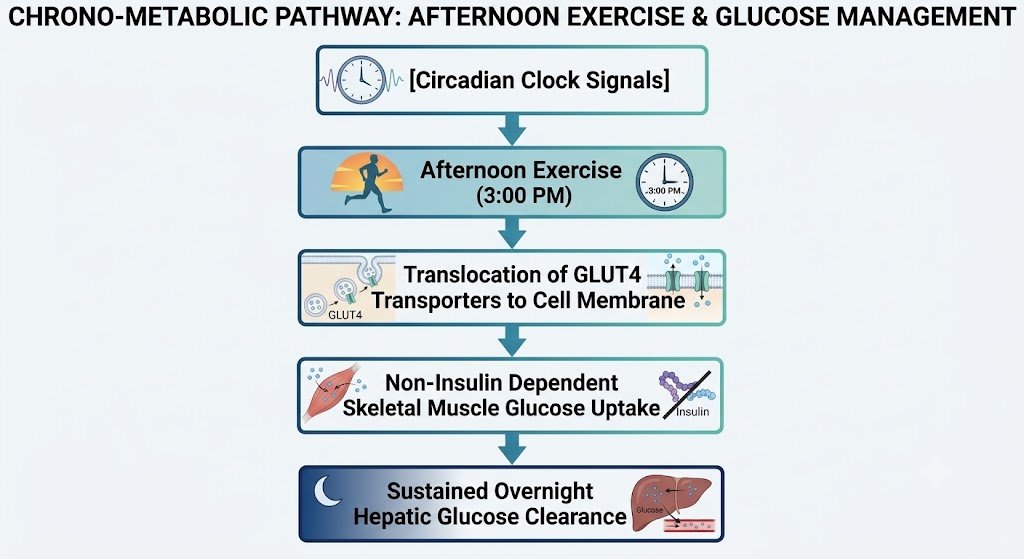
Why might the timing of exercise matter?
Our bodies do not operate identically at every hour of the day. Circadian rhythms—our internal biological timing systems—influence sleep, hormones, body temperature, insulin action and glucose metabolism. Three mechanisms may help explain why exercise timing matters.
A. Insulin sensitivity changes throughout the day
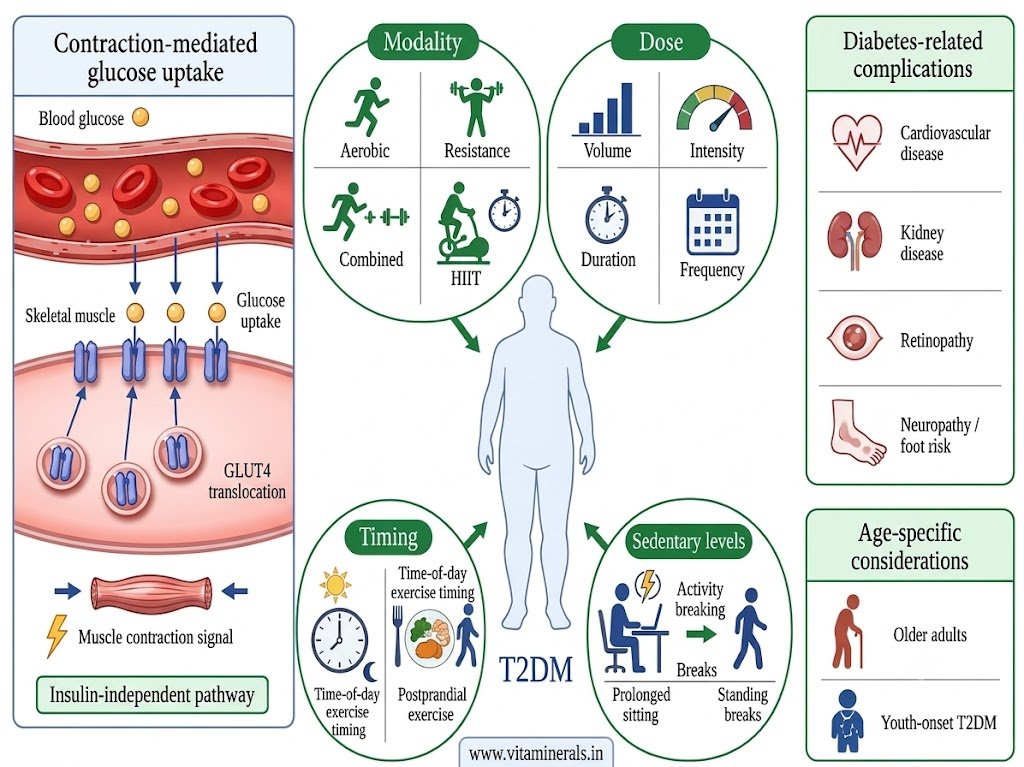
Insulin helps move glucose from the bloodstream into cells. In skeletal muscle, exercise can also stimulate glucose uptake through pathways that do not depend entirely on insulin. The effectiveness of insulin and the body’s response to food can vary with circadian timing, sleep, recent meals and physical activity. The direction and magnitude of these changes differ between healthy people and those with insulin resistance.
This is one reason a workout may not produce identical glucose readings at different times of day.
B. The liver releases glucose overnight
The liver stores glucose as glycogen and can produce additional glucose to maintain the body’s supply between meals and during sleep. In people with insulin resistance or type 2 diabetes, liver glucose production may remain inappropriately high. Blood glucose can rise overnight or towards the early morning, a pattern sometimes associated with the dawn phenomenon.
Exercise can increase glucose use by muscle and improve insulin sensitivity for hours afterwards. But its effect on overnight glucose depends on the individual’s baseline glucose regulation, meal timing, workout intensity and medication.
C. Hormones and exercise intensity influence the response
Hormones such as cortisol follow daily rhythms. Exercise itself can also stimulate the release of hormones that temporarily increase glucose availability—an important response when muscles need fuel.
That means glucose can occasionally rise during or immediately after vigorous exercise, even though regular exercise improves long-term metabolic health.
The 2025 Diabetologia study found higher morning cortisol levels and a rise in post-exercise glucose after morning high-intensity intervals in participants with diabetes. These findings are consistent with the possibility that exercise timing affects the acute glucose response, although they do not prove that cortisol alone caused the difference.
Why this Matters Particularly for Indians
India’s diabetes burden makes small, practical improvements in prevention and management worth investigating. The ICMR–INDIAB study, published in The Lancet Diabetes & Endocrinology in 2023, included 113,043 participants from rural and urban areas. Its national estimates for 2021 were approximately:
Metabolic condition |
Estimated number of people in India |
|---|---|
Diabetes |
101 million |
Prediabetes |
136 million |
Hypertension |
315 million |
Generalised obesity |
254 million |
Abdominal obesity |
351 million |
These are national estimates from the study, not a fresh headcount for 2026. They demonstrate the scale of India’s metabolic-health challenge.
For Indian households, the practical challenge is often not whether exercise is beneficial. It is how to make regular activity fit into a working day that may include long commutes, sedentary office hours, irregular meal timing and limited access to safe outdoor walking spaces.
A person who wakes early, walks for 30 minutes and then sits for nine hours may benefit from adding short bouts of movement during the day. Someone who cannot exercise in the afternoon may still gain substantial benefits from a consistent morning routine. Exercise timing should be considered a possible refinement—not a replacement for the fundamentals of diabetes prevention and care.
A Practical Exercise-Timing Plan for Indian Adults
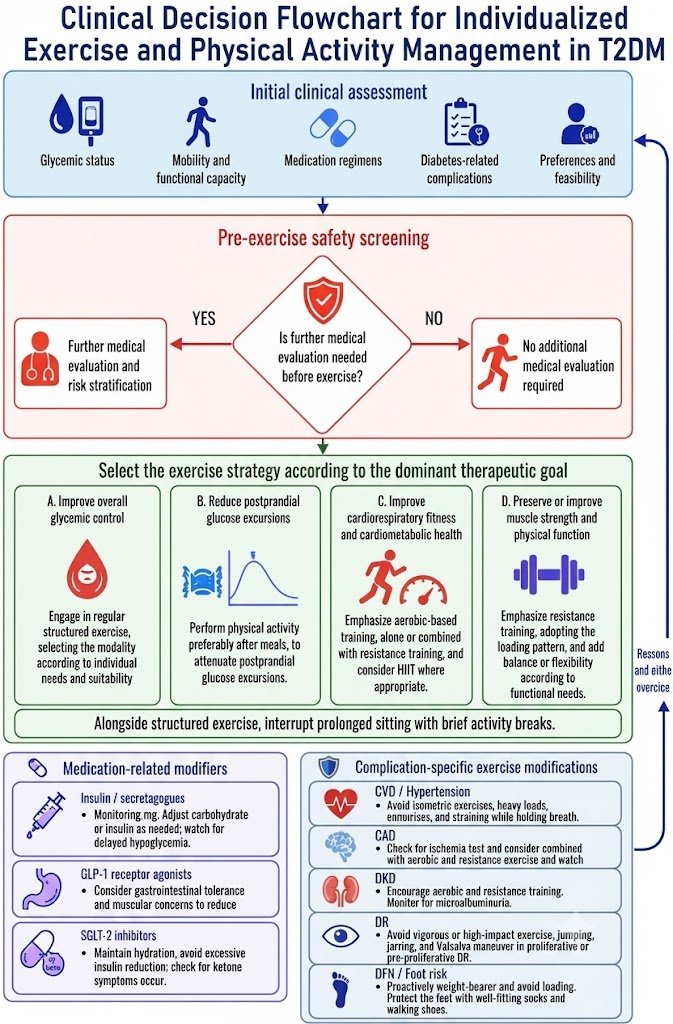
The following is a general framework for adults who are able to exercise safely. It is not an individual prescription.
Time |
Practical activity |
Potential advantage |
|---|---|---|
Early morning |
20–30-minute brisk walk, cycling or other moderate activity |
Establishes consistency and contributes to weekly activity goals |
After breakfast |
5–10 minutes of easy walking when feasible |
Adds movement after a meal |
After lunch |
10–15 minutes of comfortable-to-brisk walking |
May help manage the post-meal glucose rise |
Mid-afternoon |
A 20–30-minute walk or planned exercise session if practical |
A reasonable time to test whether afternoon exercise suits your routine and glucose response |
After dinner |
A short, comfortable walk |
Reduces prolonged sitting and adds activity after a meal |
The durations are practical examples, not a claim that each interval has a proven, identical effect on glucose. Start at a level appropriate to your fitness and medical condition.
For most adults, the World Health Organization recommends at least 150–300 minutes of moderate-intensity aerobic activity per week, or an equivalent combination of moderate and vigorous activity. Muscle-strengthening activity is also recommended.

Bottom Line: Consistency and Timing Crucial for Diabetics
The research on exercise timing is promising. Small controlled studies suggest that afternoon exercise may improve certain aspects of insulin sensitivity or the immediate glucose response in some people with type 2 diabetes. Other studies show that morning and afternoon exercise can produce similar overall glucose profiles.
For India, where the diabetes burden is substantial, the useful message is not that everyone must move their workout to 3 PM. It is that exercise timing deserves more attention—and that short walks after meals may be a practical addition to an otherwise sedentary day.
If you enjoy your morning walk, keep it. If you can comfortably move some activity to the afternoon, consider trying it. If a post-lunch or post-dinner walk fits your routine, it may be a worthwhile habit.
The best time to exercise is the time you can sustain safely and regularly. The next step is to find the timing that works best for your meals, glucose response, health and daily life—not to abandon a beneficial routine in pursuit of a universal clock-time rule.
References
-
Anjana RM, et al. Metabolic non-communicable disease health report of India: the ICMR-INDIAB national cross-sectional study (ICMR-INDIAB-17). The Lancet Diabetes & Endocrinology. 2023;11(7):474–489. PubMed.
-
Exercise training elicits superior metabolic effects when performed in the afternoon compared to morning in metabolically compromised humans. Physiology Reports. 2021. Maastricht University research record.
-
Temporal optimization of exercise to lower fasting glucose levels. The Journal of Physiology. 2023. PubMed PMID 37732475.
-
Keller MJ, Brady AJ, Smith JAB, et al. Inflammatory markers and blood glucose are higher after morning vs afternoon exercise in type 2 diabetes. Diabetologia. 2025;68:2023–2035. Full text.
-
World Health Organization. WHO Guidelines on Physical Activity and Sedentary Behaviour. Recommendations.