


Every Tom, Dick, Harry and their respective dogs would advise a constipated person to increase fiber intake without realizing that increasing fiber in such cases may only make the matters worse. Sounds Paradoxical, well under our Evidence-Explained™, we present evidence from a published study establishing that going Zero Fiber in Chronic Constipation may actually resolve symptoms much faster, reliably and irreversibly. Read on..
Fiber is Good for Humans? Really??
Lack of fiber in the diet was first postulated in 1971 as the cause of diseases such as diverticulosis, hemorrhoids and colorectal cancer – particularly for westerners who had relatively lower fiber intakes.
Since then, partly due to widespread media publicity, it is now widely accepted that dietary fiber is a necessary component of a healthy diet and is required for normal bowel movement. Although human stomach pH of 1.5 – 2.0 may belie this fact that fiber is necessary for Humans. Based on the popular opinion, Fiber is popularly used in the management of constipation by public and by a vast majority of doctors. Hopefully until now.
Insoluble fiber is known to increase stool weight and decrease colonic transit time. Fiber is said to aid in water retention in the colon and results in stools that are less dry and easier to evacuate. However, the reality is that stool moisture content remains at 70%-75% regardless of the amount of fiber and water consumed
Is More Fibre Always the Answer to Constipation?
For decades, standard clinical management for chronic constipation in India has relied on a foundational dogma: increase dietary fiber intake. Patients presenting with infrequent bowel movements, abdominal bloating, and straining are routinely advised to consume higher quantities of whole grains, raw vegetables, bran, and bulk-forming laxatives such as psyllium husk (Isabgol).
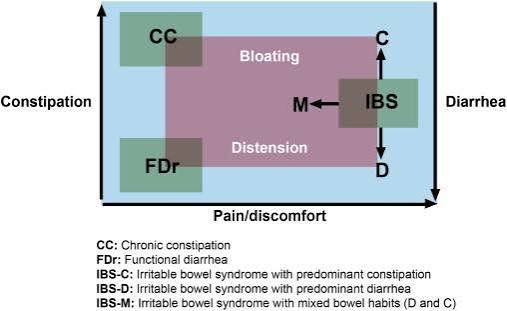
However, clinical practices across Indian gastroenterology clinics reveal a widespread paradox: a significant subset of patients with severe Chronic Idiopathic Constipation (CIC) report that increasing dietary fiber exacerbates / increase abdominal pain, severe gas, and bloating without inducing satisfactory bowel evacuation.
Indian High-Fiber Paradox; Epidemiological Context
Unlike Western populations where low-fiber processed diets are frequently implicated as a primary driver of functional constipation, traditional Indian diets are inherently very high in dietary fiber.
Standard daily consumption of whole wheat rotti, pulses (dals), lentils, legumes, and vegetable curries and green salads already yield a baseline dietary fiber intake ranging between 30 to 50 grams per day—well above global nutritional minimums and more that your poor colon could handle.
Epidemiological surveys across urban and rural India (including multi-center gastroenterology audits) report a chronic constipation prevalence of 10% to 14% in general adult populations, rising to nearly 22% in clinical outpatient cohorts. Crucially, a major proportion of Indian sufferers present with idiopathic constipation that fails to resolve despite high dietary fiber intake and chronic supplementation with bulk laxatives.
The Landmark 2012 Clinical Trial on Fiber Elimination
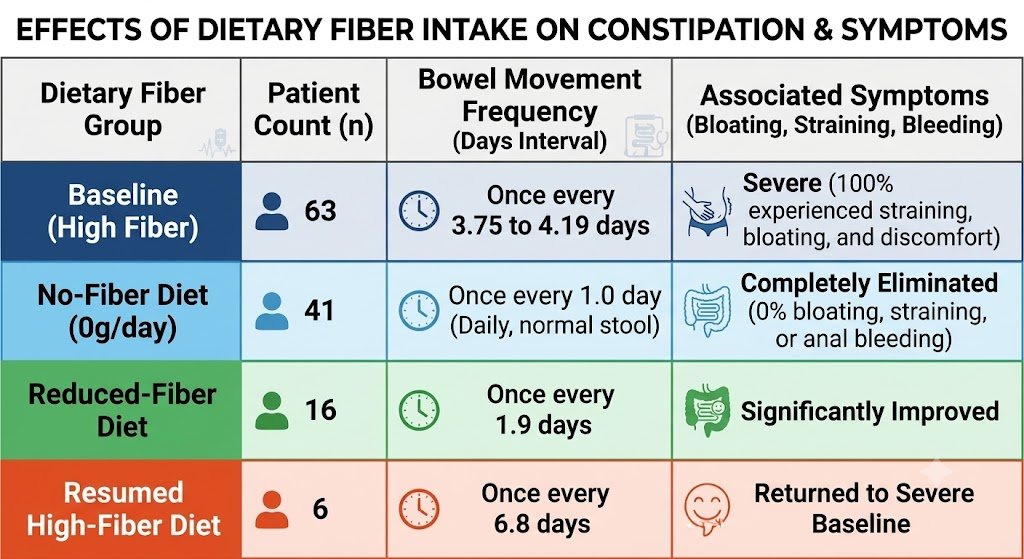
Ho and colleagues published Stopping or reducing dietary fiber intake reduces constipation and its associated symptoms in the World Journal of Gastroenterology in September 2012. This landmark clinical study evaluated the efficacy of stopping or reducing dietary fiber in patients suffering from severe chronic idiopathic constipation.
The trial monitored 63 patients (median age 47) who suffered from long-standing constipation and had failed to gain relief from high-fiber regimens.
Study Protocol; Methodology:
-
Phase 1 (Complete Fiber Cessation): All 63 patients were initially instructed to stop all dietary fiber intake completely for a period of 2 weeks.
-
Phase 2 (6-Month Follow-Up): Patients were then allowed to adjust their dietary fiber intake according to their personal preference and comfort (maintaining a zero-fiber or reduced-fiber diet) over a 6-month follow-up period.
Outcome |
No-fibre group |
Reduced-fibre group |
Continued high-fibre group |
|---|---|---|---|
Patients at six months |
41 |
16 |
6 |
Interval between bowel movements before dietary change |
3.75 days |
4.19 days |
6.83 days |
Interval after dietary change |
1.0 day |
1.9 days |
6.83 days |
Bloating at six months |
0% |
31.3% |
100% |
Straining at six months |
0% |
56.3% |
100% |
Source: Ho et al., 2012. Values are reported study findings; the three groups were not randomly assigned.
Simplified Explanation
For patients with chronic idiopathic constipation, increasing fiber is analogous to adding more cars to a blocked traffic highway. If colonic transit or pelvic floor evacuation is structurally or neuro-muscularly impaired, adding bulking agents increases luminal mass without improving propulsive motility, leading to severe distension and discomfort.
Biophysical Mechanisms; Indians’ Physiological Realities
To understand why fiber reduction or elimination resolves symptoms in specific CIC patients, three distinct physiological mechanisms must be evaluated and understood:
1. The Mechanical Bulk vs. Transit Speed Problem
Dietary insoluble fiber absorbs water and expands in the colonic lumen. In healthy individuals, this volume triggers stretch receptors that induce peristaltic contractions.
However, in patients with Slow- Transit Constipation (STC) or Dyssynergic Defecation (pelvic floor dyssynergia), colonic propulsive waves are disorganized or absent. Adding fiber merely increases stool mass behind an obstructed or slow passage, escalating pain and abdominal girth.
2. Fermentation, Gas Expansion; Small Intestinal Bacterial Overgrowth (SIBO)
Highly fermentable Indian high-FODMAP foods (such as rajma, chana, onions, and wheat fructans) undergo colonic bacterial fermentation, generating substantial volumes of Hydrogen (H2), Carbon Dioxide (CO2), and Methane (CH4) gases.
Methanogenic archaea (Methanobrevibacter smithii) produce methane gas, which actively inhibits colonic smooth muscle contractions, slowing transit time further. In
patients with concurrent SIBO, high fiber feeds small bowel bacterial populations, creating agonizing upper abdominal distension.
3. Dyssynergic Defecation Prevalence in Indian Clinics
Anorectal manometry studies in Indian tertiary medical centers reveal that up to 40–50% of patients evaluated for refractory constipation suffer from dyssynergic defecation—a condition where the anal sphincter and puborectalis muscles paradoxically contract rather than relax during straining.
Bulking stool with psyllium or bran in dyssynergic patients creates large, firm fecal boluses that cannot pass through a closed anal canal, causing anal fissures, hemorrhoidal bleeding, and rectocele progression.
India’s Constipation Burden: Why This Matters Locally
Constipation is not a minor or exclusively Western health concern. The Indian Motility and Functional Diseases Association and the Indian Society of Gastroenterology addressed the problem in their joint consensus statement published in the Indian Journal of Gastroenterology in 2018.
The authors noted that constipation is common in India, although prevalence estimates vary according to the population studied and the definition used.
One community study conducted in rural Haryana interviewed 4,767 adults and found that 555 participants—11.6% (95% confidence interval 10.7–12.5%)—reported constipation. The study was published in the Journal of Neurogastroenterology and Motility in 2011.
Other Indian studies have reported different estimates. The 2018 consensus cited a prevalence of 16.8% using Rome II criteria in a Chandigarh study and 24.8% when constipation was assessed through self-perception in the same study.
It also described substantial symptom reporting in multicentre clinical populations. These figures should not be combined into a single national prevalence estimate because the methods, populations and definitions differ.
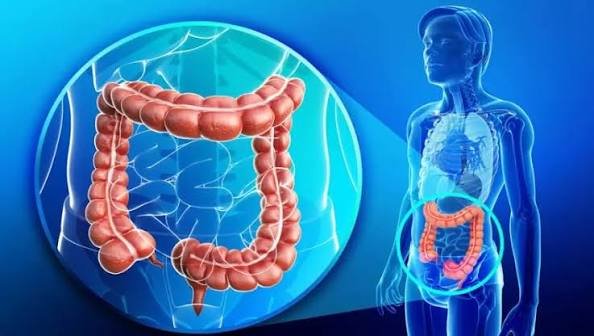

Clinical Action Plan for Indian Patients; Gastroenterology Practice
When treating an Indian patient presenting with chronic constipation unresponsive to standard high- fiber advice, clinicians should follow a structured diagnostic and dietary workflow:
-
Step 1: Rule Out Alarm Features: Screen for unintentional weight loss, rectal bleeding, nocturnal diarrhea, anemia, or family history of colorectal cancer
-
Step 2: Diagnostic Categorization: Differentiate whether the patient has simple functional constipation vs. slow-transit constipation or dyssynergic defecation via digital rectal examination, high-resolution anorectal manometry, or balloon expulsion testing
-
Step 3: Systematic Fiber Titration: If the patient experiences severe bloating and pain on high fiber, initiate a 2-to-4 week low-residue / low-FODMAP dietary trial. Reduce coarse bran, whole wheat, and high-GOS legumes while retaining small portions of well cooked, digestible soluble fiber (e.g., peeled bottle gourd, white rice, cooked pumpkin)
-
Step 4: Optimize Hydration; Soluble Osmotics: Swap insoluble roughages and fibers for gentle, non- fermentable osmotic laxatives (e.g., Polyethylene Glycol / PEG 3350 or Lactitol) or prokinetics if indicated
-
Step 5: Biofeedback for Pelvic Floor Dysfunction: For patients diagnosed with dyssynergic defecation, refer for anorectal biofeedback therapy rather than escalating dietary fiber or stimulant laxatives
What the Evidence Means—and What it Does Not Mean
The evidence supports three distinct conclusions.
First, fiber can be helpful, particularly for people whose dietary intake is low and who tolerate it well. Psyllium may have better clinical support than several other fiber supplements for chronic idiopathic constipation
Second, a subset of patients may experience more bloating or difficulty evacuating when fiber is increased. India’s own consensus recognises that high existing fiber intake and prominent bloating are reasons to re-consider fiber supplementation
Third, the 2012 study findings do not establish that a fiber-free diet is beneficial for the general population, nor do they justify recommending long-term fiber elimination to all people with constipation. The study was small, non-randomised and not designed to measure the wider nutritional consequences of sustained fibre restriction
This distinction is important in India, where dietary fiber also comes packaged with foods that provide vitamins, minerals and other beneficial nutrients. Removing whole grains, fruits, vegetables and pulses without nutritional supervision could unnecessarily narrow dietary variety.
Conclusion: Personalise Fiber Intake Instead of Treating it as a Universal Remedy
For Indians living with chronic constipation, the most useful lesson is to RE-CONSIDER fiber. Additionally, it may be prudent to stop assuming that more fibre is always the answer for chronic constipation.
A person with hard stools may benefit from a gradual decrease in fiber intake. Someone already consuming a high-fibre diet, particularly one who experiences pronounced bloating or difficulty evacuating stools, may need a different approach and assessment of the underlying cause than increasing fiber intake, as is being routinely done.
The 2012 study provides an intriguing clinical signal, while Indian consensus recommendations and international guidelines reinforce the importance of selecting treatment according to symptoms, baseline diet and likely physiology. Let your doctor decide the best for you.