


What are PPIs?
Proton pump inhibitors (PPIs) are medications that block stomach acid production to treat conditions like acid reflux, GERD, and ulcers. In India, PPIs are heavily overused, often co-prescribed unnecessarily with routine antibiotics. In addition, Proton Pump Inhibitors (PPIs)—such as Pantoprazole, Omeprazole, Esomeprazole, Rabeprazole, and Lansoprazole—are among the most over-the-counter self-prescribed and clinically overutilized medications in India. While these drugs are safe for short-term usage, chronic overuse risks certaon well documented and evidenced nutrient deficiencies and kidney injury.
PPIs in India are routinely and excessively used for GERD, peptic ulcers, and preventing stomach damage from painkillers (NSAIDs).
Extent of Usage of PPIs (Pantoperazole) in India
-
High prevalence of use across general practice and hospitals
-
Pantoprazole is the most widely dispensed and prescribed PPI
-
Frequently overused for unapproved indications or extended use, past recommended short-term windows, without any re-evaluation by Doctors
Evidenced Side Effects of PPIs such as Pantoperazole
-
Short-Term Usage Side Effects: Headaches, diarrhea, constipation, nausea, and abdominal discomfort
-
Long-Term Usage Side Effects:
-
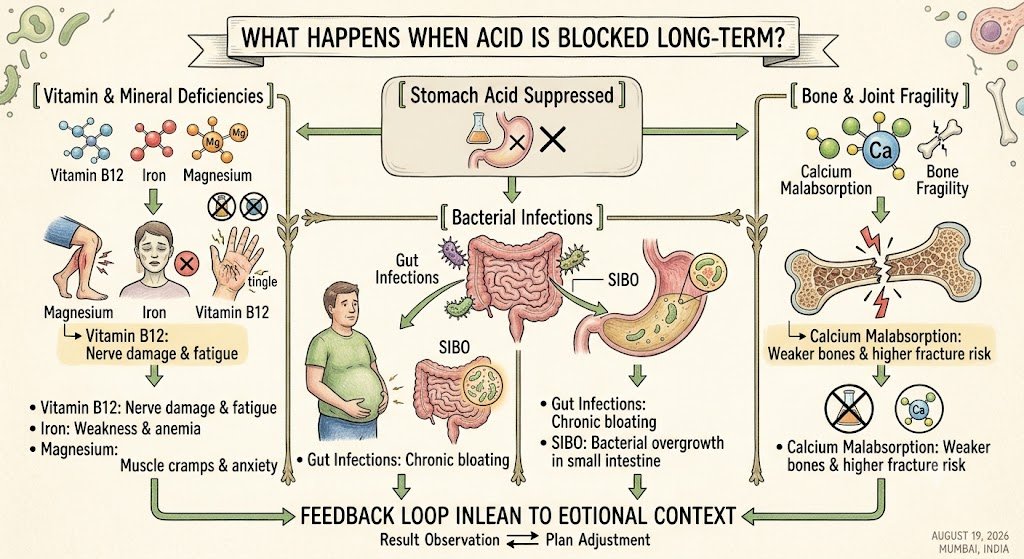
Nutrient Deficiencies: Low vitamin B12, iron, calcium, and magnesium
-
Bone Health: Higher risk of bone fractures and osteoporosis
-
Kidney Issues: Acute interstitial nephritis and chronic kidney disease
-
Infections: Increased vulnerability to Clostridium difficile and pneumonia
-
Rebound Effect: Increased acid production when trying to stop the drug
-
Why PPIs Cause Nutritional Deficiencies
Stomach of Human Beings have production of HCl which has a pH range of 1.5 to 2.0. Such a highly acidic pH is critically important and designed by Nature to help digest food, “sterilize” any microbial contamination in food, break down proteins and release Vit B12 for usage by small intestine. Human beings stomach pH of 1.5 is just below the pH of 1.0 in Vultures for consumption of “carrion”.
Gastric acid (HCl) produced by parietal cells serves three vital nutritional functions:
-
Cleavage & Solubilization: It cleaves essential micronutrients (like Vitamin B12) from dietary protein complexes and makes Vit B12 available for binding with Intrinsic Factor for its absorption in small intestine and usage by body
-
Ionization: It converts insoluble salts (such as Ferric Iron, Fe^3, or Calcium Carbonate) into soluble, highly bioavailable ionic forms (Fe^2+, Ca^2+) for intestinal absorption
-
Sterilization: It maintains gastric pH between 1.5 – 2.0, killing ingested pathogens and preventing pathogenic bacterial colonization in the small intestine and this is very important function
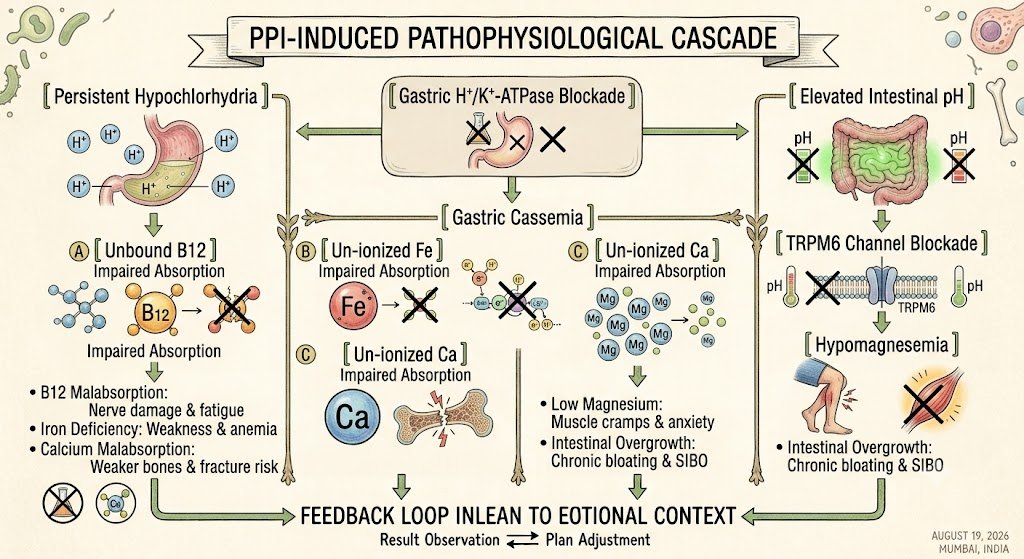
roton Pump Inhibitors such as Pantoperazole result in continued gastric acid inhibition (leading to a pH > 4.0) and create chronic hypochlorhydria, precipitating specific micronutrient malabsorptions which are listed below:
Key Malabsorption Pathways & Mechanics
-
Vitamin B12 (Cobalamin): Dietary VitaminB12 arrives bound to animal or dairy protein. Without strong, highly acidic gastric acid and pepsin, Vitamin B12 cannot be cleaved to bind Intrinsic Factor (IF) in the duodenum, causing severe subclinical deficiency of Vit B12 and no wonder a vast majority of Indians are persistently Vit B12 deficient partly because of PPI Usage
-
Magnesium (Mg^2+): PPIs alter the intestinal pH microenvironment, directly downregulating active transcellular magnesium channels (TRPM6 and TRPM7) in the ileum and colon, causing systemic hypomagnesemia
-
Iron (Fe^2+): Gastric acid is mandatory to convert non-heme ferric iron (Fe^3+, predominant in plant-based diets) into absorbable ferrous iron (Fe^2+). PPIs also upregulate hepcidin, blocking duodenal ferroportin iron export leading to all pervasive Iron Deficiency Anaemia in Indians
-
Calcium (Ca^2+): Insoluble calcium (especially calcium carbonate) requires an acidic gastric medium to ionize into free Ca^2+ for active duodenal transport. Chronic un-ionized calcium leads to secondary hyperparathyroidism and bone resorption
-
Vitamin C (Ascorbic Acid): Hypochlorhydria reduces total ascorbate concentrations in gastric juice and accelerates its degradation into inactive dehydroascorbic acid
Why the Indian Population is Uniquely Vulnerable to PPI Toxicity
Epidemiological and clinical parameters make chronic PPIs such as Pantoperazole usage significantly more dangerous for the Indians compared to Western cohorts:
-
High Baseline Prevalence of Vegetarianism: Over 30 to 40% of Indians follow strict vegetarian diets, making them dependent on plant-derived non-heme iron (Fe^3+) and bound dietary Vit. B12 from Dairy. PPI-induced hypochlorhydria halts non-heme iron conversion and Vit B12 cleavage, accelerating megaloblastic anemia and iron-deficiency anemia
-
The “Metformin + PPI” Polypharmacy Trap: India is the diabetes capital of the world. Millions of Type 2 Diabetics take Metformin daily, which independently impairs ileal Vit B12 absorption. Co-prescribing PPIs creates a synergistic dual-blockade, driving rapid neurological damage, peripheral neuropathy, and hyperhomocysteinemia
-
High Endemic Burden of Small Intestinal Bacterial Overgrowth (SIBO): Indian diets are high in complex carbohydrates and fermented fibers. Gastric acid suppression eliminates the stomach’s primary antiseptic barrier, allowing colonic bacteria to migrate upward into the small intestine, leading to SIBO, chronic bloating, malabsorption and leaky gut
-
Pre-existing Hypovitaminosis D & Early Osteoporosis: Over 70 – 80% of urban Indians are Vitamin D deficient. PPI-induced calcium malabsorption exacerbates secondary hyperparathyroidism, increasing early-onset osteopenia, osteoporosis, and fragility fracture risks.
Evidence-Based Research Summary: Global & Indian Context
Study / Citation |
Cohort & Methodology |
Key Findings & Clinical Outcomes |
A Systematic Review of Long-Term Use of Proton Pump Inhibitors (PPIs) in Older Adults on Polypharmacy: Do PPIs Deplete Nutrients? |
Review of 5 Studies with 693 Participants (n=693) long-term PPI use |
Results showed a 12-18% reduction in serum vitamin B12 over 12 months of PPI use. Calcium and parathyroid hormone levels declined significantly in a 12-month cohort, while bone turnover markers increased |
IJCMR Cross-Sectional Study (Indian Cohort, 2016) |
June 2016 cross-sectional study of 60 Indian patients. |
Long-term PPI users faced elevated risks of hypomagnesemia (26.67%) and vitamin B12 deficiency (6.67%), with the latter strongly associated with usage exceeding four years |
USFDA AERS Database Analysis (Global Cohort, 2024) |
Disproportionality analysis across 29.6+ million safety reports. |
Confirmed a statistically significant dual-interaction signal: co-administration of Metformin + PPIs dramatically increases risks of severe, hospitalization-inducing Vit B12 deficiency |
Srinutta et al. Meta-Analysis (Global Meta-Analysis) |
Pooled analysis of 16 observational studies (n=131,507). |
PPI users had an adjusted Odds Ratio (OR) of 2.13 for developing hypomagnesemia compared to non-users |
Porter et al. Observational Study (Global Cohort) |
drawing from 3,299 older adults aged ≥ 60 years), long-term high-dose proton pump inhibitor (PPI) usage (≥ 30 mg/day) |
25% of chronic PPI users exhibited frank Vitamin B12 deficiency vs 15% in controls (p < 0.001). High PPI doses (> 30 mg/day) directly correlated with elevated methylmalonic acid (MMA) |
Specific Nutritional Supplementation Protocol for PPI Users
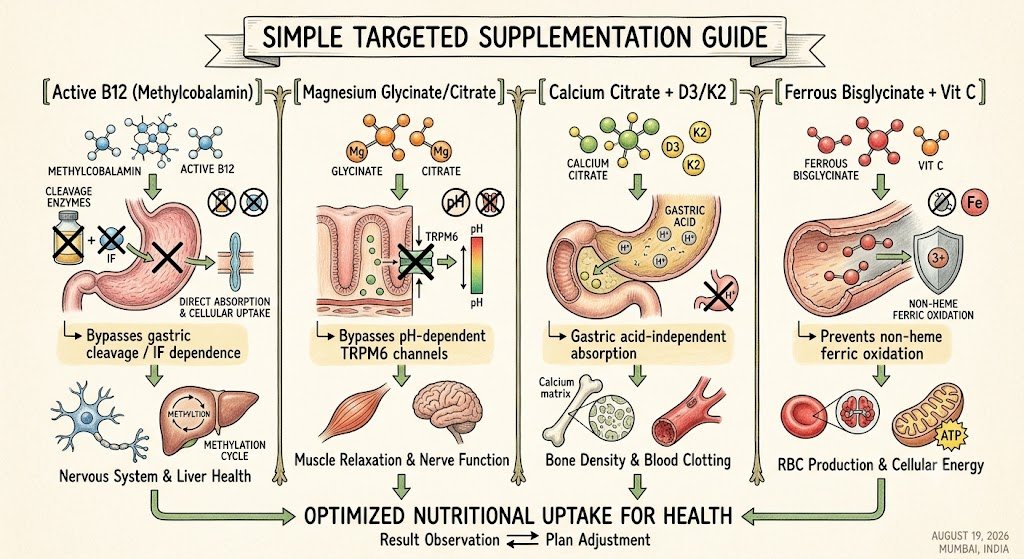
When PPI discontinuation is not immediately possible (e.g., active peptic ulceration, Barrett’s esophagus), targeted, highly bioavailable supplementation must be introduced to bypass gastric acid dependence:
1. Active Vitamin B12 (Sublingual / Injectable)
-
Form: Sublingual Methylcobalamin or Adenosylcobalamin (bypasses intrinsic factor gastric cleavage via direct passive mucosal diffusion)
-
Dosage: 1,000 -1,500 mcg/day sublingually
2. Acid-Independent Calcium
-
Form: Calcium Citrate (Avoid Calcium Carbonate, which requires acid for ionization) paired with Vitamin D3 and Vitamin K2 (MK-7)
-
Dosage: 500 mg elemental calcium twice daily with meals
3. Bioavailable Organic Magnesium
-
Form: Magnesium BisGlycinate or Magnesium Citrate (bypasses degraded TRPM6 channels via organic amino acid/acid transporter pathways).
-
Dosage: 250 – 400 mg/day elemental magnesium at night
4. Non-Heme Iron Chelates
-
Form: Ferrous Bisglycinate co-formulated with L-Ascorbic Acid (Vitamin C) (maintains iron in the reduced Fe^2+ state without causing gastric mucosal irritation)
-
Dosage: 30 – 60 mg elemental iron daily on an empty stomach
5. Probiotics & Digestive Enzymes
-
Form: Multi-strain spore-forming probiotics (Bacillus coagulans) combined with Betaine HCl (only during step-down de-prescribing phases under medical supervision) to restore physiological gastric pH and prevent bacterial overgrowth.
Safer Dietary & Lifestyle Strategies for Acidity
Managing acidity effectively often involves adjusting daily habits rather than relying solely on acid-blocking medication:
Key Dietary Rules
-
Identify Personal Triggers: Common triggers include strong tea/coffee on an empty stomach, deep-fried snacks (samosas, pakoras), excessive raw onions, garlic, and processed packaged foods
-
Eat Smaller, Mindful Meals: Overfilling your stomach increases pressure on the lower esophageal sphincter, forcing acid upward
-
The 3-Hour Dinner Rule: Finish your last meal at least 3 hours before sleeping. Never lie down immediately after dinner
-
Elevate Your Sleep Angle: Elevate the head of your bed by 6 inches or use a wedge pillow. Sleeping on your left side keeps the stomach junction above the acid level