


India is talking about protein more than ever. Protein milk, high-protein paneer, protein bars, shakes, cereals, high protein atta and snacks are now filling supermarket shelves. But behind the marketing boom lies a far more serious nutrition question: are Indians actually getting enough good-quality protein including both essential and non-essential amino acids?
India’s latest government food consumption data suggest that the average Indian may be getting a reasonable amount of protein on paper. However, newer research shows a major problem with protein quality, food choices and unequal intake between rich and poor households.
For India, protein is not simply the latest fitness trend. It is an important nutrition issue.
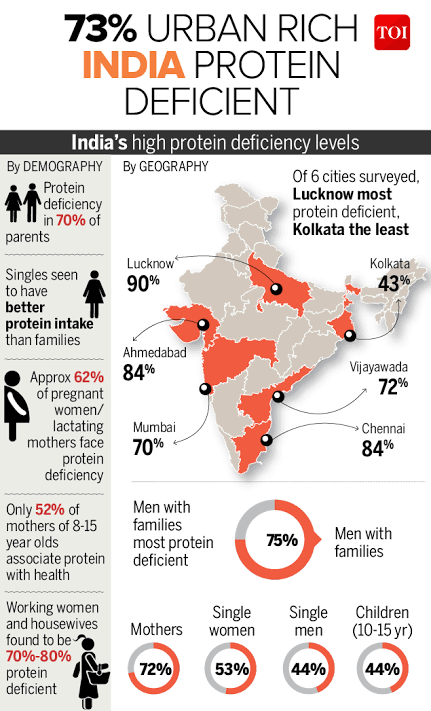
How much protein do Indians actually need?
The 2024 Dietary Guidelines for Indians from the ICMR-National Institute of Nutrition recommend 0.83 grams of protein per kg of body weight per day for healthy adult men and women. However, owing to continued under-consumption and rising burden of metabolic diseases especially Type2 Diabetes, Indians should target Not Less Than 1 gram protein/Kg Body Weight per day.
That means a person weighing 65 kg needs at least and if not more, 65 grams of protein a day. Further, Protein requirements can differ with age, pregnancy, illness and other individual factors.
Government data say Indians are getting protein. So where is the problem?
This is where the Indian protein story becomes interesting. The Government of India’s NSS Report No. 594: Nutritional Intake in India, based on the 2022-23 and 2023-24 Household Consumption Expenditure Surveys, examined food consumption across India.
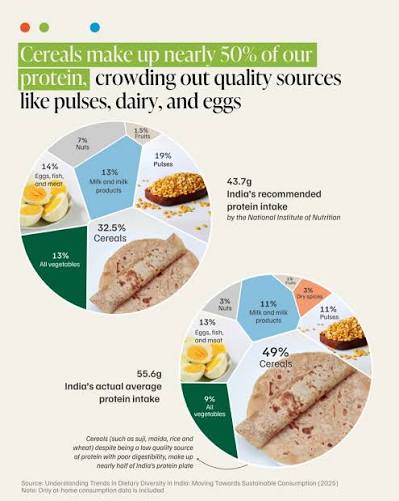
A 2025 analysis of the latest 2023-24 government data by the Council on Energy, Environment and Water estimated average at-home protein intake at 55.6 grams per person per day. At first glance, that appears adequate.
But nearly half of India’s protein intake comes from cereals such as rice, wheat, suji and maida.
Official government data show the same broad pattern. In 2023-24, cereals supplied 45.9% of protein in rural India and 38.7% in urban India.
By comparison, pulses supplied only 8.7% of rural protein and 9.1% of urban protein. Milk and milk products supplied 11% in rural India and 12.9% in urban India. Eggs, fish and meat contributed 12.4% and 14.1%, respectively.
India may be getting protein by quantity. The quality and source of that protein remain major concerns.
Rice and roti are quietly becoming India’s biggest protein sources
Most Indians do not think of rice or roti as protein foods. Yet because cereals are eaten in such large quantities, they provide a huge share of India’s daily protein.
The problem is that all proteins are not nutritionally identical. Proteins are made up of amino acids. Adults need nine essential amino acids from food because the body cannot make enough of them on its own. Majority of these 9 essential amino acids are available invariably only from animal food sources and not from vegetables, plant sources.
ICMR-NIN explains that cereals are relatively low in lysine but richer in sulphur-containing amino acids. Pulses provide more lysine but are relatively lower in methionine and cysteine. This is why traditional Indian combinations such as dal-rice, dal-roti and khichdi make some nutritional sense.
ICMR-NIN recommends combining cereals and pulses at about a 3:1 ratio by raw food weight to improve the amino acid balance of the meal. Adding milk can further improve essential amino acid intake. The problem with the modern Indian plate is not necessarily roti or rice.
It is too much cereal and too little dal, dairy, egg, soy, fish, meat, nuts and seeds.

Rural India shows a disturbing protein paradox
One of the most important recent Indian protein studies came from researchers associated with ICRISAT, IFPRI and CESS. The research examined households across six states and nine districts in India’s semi-arid regions.
More than two-thirds of the surveyed households consumed less protein than recommended, despite many having access to protein-rich foods such as pulses, dairy and livestock products.
Staple grains provided an extraordinary 60% to 75% of daily protein intake in the surveyed populations. This challenges the idea that India’s protein problem is simply caused by a lack of food.
The researchers pointed towards food habits, preferences and poor nutrition awareness as important parts of the problem.
Rich and poor Indians are not eating the same protein
National averages can hide enormous differences. The CEEW analysis of India’s 2023-24 household consumption data found that people in the highest spending group consumed about 1.5 times as much protein as those in the poorest group.
This is why saying that the “average Indian consumes enough protein” can be misleading. Imagine one person consuming 80 grams and another consuming 30 grams. The average is 55 grams. The average looks acceptable.
The person eating 30 grams still has a problem. India’s protein debate must therefore look beyond national averages and examine income, age, food habits and protein source.
India’s child nutrition data show why diet quality still matters
Protein deficiency cannot be diagnosed simply from stunting or low body weight. Child malnutrition has many causes, including poor maternal nutrition, infections, sanitation and inadequate overall diets.
However, India’s nutrition burden makes it impossible to dismiss diet quality. NFHS-5 found that 35.5% of Indian children under five were stunted, 19.3% were wasted and 32.1% were underweight.
These figures do not prove that protein deficiency alone caused the problem. But they clearly show that India cannot treat nutrition adequacy as a solved issue. A diet dominated by calories from cereals but short on pulses, dairy, eggs and other nutrient-rich foods deserves serious attention.
Why protein is essential to the human body
Protein is not only for bodybuilders. The human body uses protein to build and maintain muscle, skin, organs and many structural tissues.
Enzymes that help chemical reactions take place in the body are proteins. Many hormones and immune system components depend on proteins. Haemoglobin, which carries oxygen in the blood, is itself a protein.
Muscle is also constantly being broken down and rebuilt. Dietary amino acids provide the raw materials needed for this process. This becomes particularly important during childhood, pregnancy and ageing.
India does not need to become a nation of protein shake drinkers
The solution to India’s protein problem is not to put protein powder into every food. ICMR-NIN’s 2024 dietary guidelines favour meeting protein needs through a varied diet and caution against unnecessary or excessive use of protein supplements.
For most healthy Indians, the first step should be improving the everyday plate.
The official NIN vegetarian “My Plate for the Day” model for a 2,000-calorie diet includes 85 grams of pulses, 300 ml of milk or curd and 35 grams of nuts and seeds, alongside cereals, vegetables and fruits.
The model provides approximately 72 grams of crude protein a day. That is an important message.
A well-planned Indian vegetarian diet can provide adequate protein.
The problem is that many Indians are not eating the well-planned diet shown in the guidelines. Dal is healthy — but a bowl of “thin” dal may not solve the problem One of India’s biggest protein misunderstandings concerns dal. Pulses are excellent foods. But the actual amount of dal eaten matters. A small serving of very watery dal does not suddenly turn a cereal-heavy meal into a high-protein diet.
The latest government data show pulses contribute less than 10% of total protein intake in both rural and urban India. The same question applies to milk, curd, paneer, eggs, fish and meat.
What should Indians do differently?
The solution does not need to be expensive or complicated.
-
Know your approximate protein requirement. For a healthy adult, ICMR-NIN recommends 0.83 g to 1 g per kg of body weight daily.
-
Stop treating rice and roti as the main part of every meal. Cereals already provide too much of India’s protein share
-
Increase the actual portion of pulses. Rajma, chana, moong, masoor, urad and other dals are important Indian protein foods
-
Use affordable protein foods. Soybeans, roasted chana, peanuts, milk, curd, paneer and eggs where acceptable can significantly improve protein intake
-
Non-vegetarians should use eggs, fish and lean meat as protein sources rather than relying only on cereal-heavy meals
-
Older Indians need particular attention. Simply eating less food with age can also mean eating less protein which creates serious issues like sarcopaenia