



Osteoporosis is a progressive systemic skeletal disorder characterized by low bone mass and microarchitectural deterioration of bone tissue, resulting in increased bone fragility and susceptibility to fractures.
It is a major public health concern, particularly among postmenopausal women due to estrogen deficiency, which accelerates bone resorption and decreases bone formation. The risk of osteoporotic fractures significantly increases after menopause and contributes to reduced quality of life, physical disability, and higher healthcare costs.
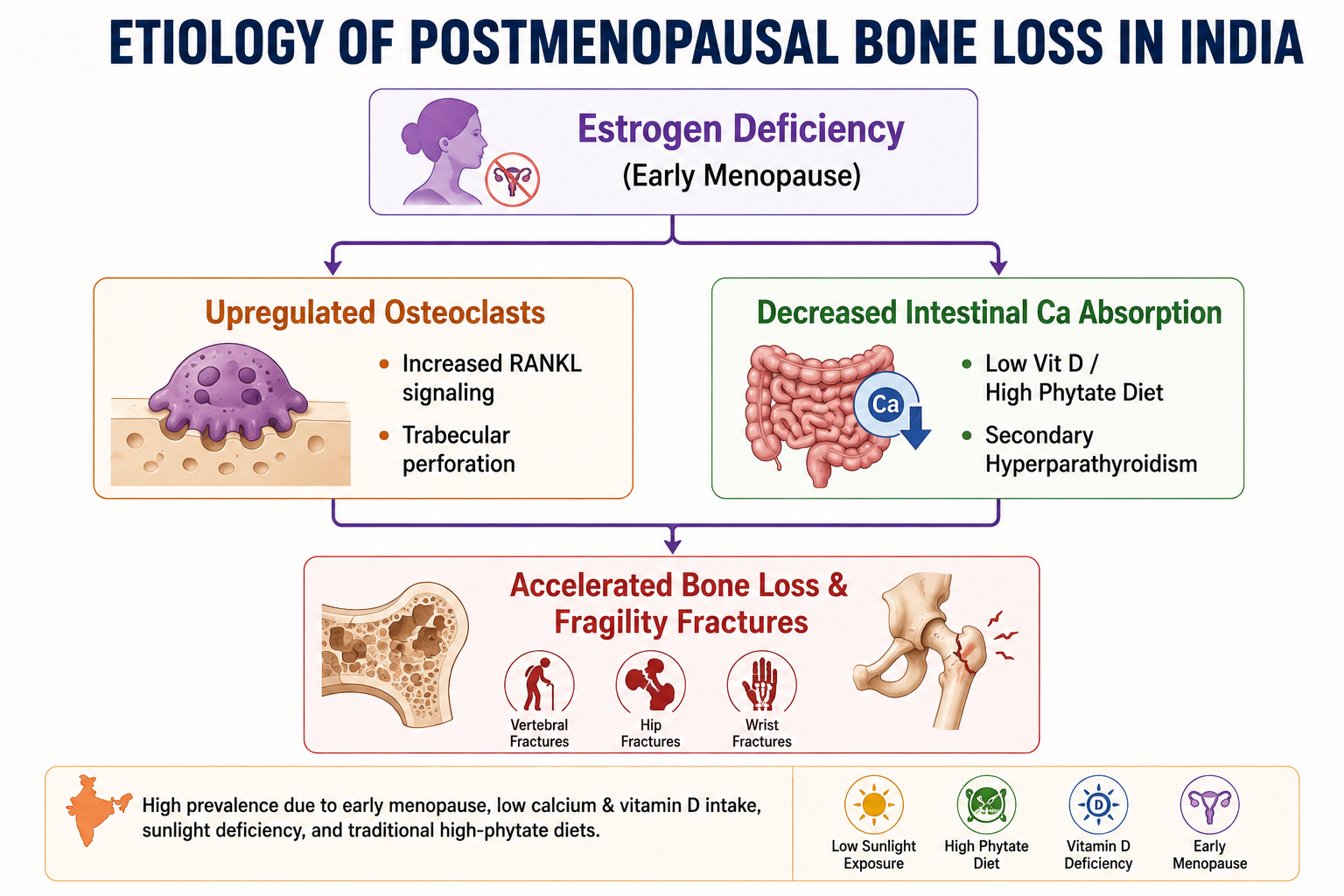
In India, postmenopausal osteoporosis represents a critical public health challenge. Indian women exhibit a distinct pathophysiological profile compared to Western populations, marked by earlier menopause onset, lower baseline peak bone mass, and widespread nutritional deficiencies.
Epidemiological & Clinical Landscape
Prevalence & Early Onset
Cross-sectional studies using Dual-Energy X-ray Absorptiometry (DXA)—the gold standard for BMD assessment—indicate that low bone mass affects over 80% of postmenopausal Indian women, with 30% to 40% exhibiting frank osteoporosis (T-score < –2.5) and 40% to 45% meeting criteria for osteopenia (T-score between -1.0 and -2.5).
Indian women achieve natural menopause at an average age of 46.2 years—significantly earlier than the Western average of 51 years. This premature cessation of ovarian estrogen production accelerates osteoclast-mediated bone resorption during a period when baseline peak bone mass is already compromised.
Pathophysiological Risk Factors
Epidemiological systematic reviews highlight several key determinants of bone loss unique to Indian women:
-
High Parity & Prolonged Lactation: Multiple pregnancies coupled with cumulative lactation periods drain maternal calcium reserves, especially when dietary compensation is inadequate
-
Phytate-to-Calcium Ratio: Cereal- and legume-heavy Indian diets contain high levels of phytic acid (myo-inositol hexakisphosphate), an antinutrient that chelates divalent cations like Calcium (Ca^2+) and Zinc (Zn^2+), inhibiting intestinal absorption
-
Widespread Hypovitaminosis D: Despite abundant sunlight, 70% to 90% of postmenopausal Indian women suffer from Vitamin D deficiency (25(OH)D < 20 ng/mL) due to skin pigmentation (melanin blocking UVB), cultural clothing habits, urban indoor lifestyles, and minimal dietary fortification
-
Sarcopenia & Low BMI: A high prevalence of low lean muscle mass reduces mechanical loading on long bones, diminishing mechanotransduction-driven osteoblast activity
Evidence-Based Nutritional Guidelines
Primary dietary intervention aims to correct calcium bio-unavailability, improve protein intake for collagen matrix support, and neutralize chronic systemic acid loads.
Calcium: Quantity & Bioavailability
The Indian Council of Medical Research (ICMR-NIN) recommends a daily calcium intake of 1,200 mg/day for postmenopausal women. Achieving this solely through a plant-based Indian diet requires intentional food selection to circumvent phytate inhibition. Copy of ICMR NIN Dietary Guidelines – ICMR NIN Dietary Guidelines 2024
-
Dairy Sources: Milk, paneer, and curd (dahi) provide bioavailable calcium with minimal antinutrient interference. Curd and buttermilk offer the added benefit of lactic acid, which lowers intestinal pH and enhances calcium ion solubility.
-
Non-Dairy & Traditional Sources: Finger millet (Ragi), sesame seeds (Til), amaranth (Rajgira), and horse gram are rich in calcium.
-
Processing Strategies: Dephytinization techniques—such as soaking, germinating/sprouting, and fermenting grains and legumes—activate endogenous phytase enzymes, breaking down phytic acid and increasing bioavailable calcium fraction.
Protein & Bone Matrix Synthesis
Bone tissue volume consists of roughly 50% protein (predominantly Type I collagen matrix). Inadequate protein intake triggers secondary hyperparathyroidism and reduces Insulin-like Growth Factor 1 (IGF-1) levels, impairing osteoblast function.
Postmenopausal Indian women should target 1.2 to 1.5 g/kg body weight/day of high-biological-value protein sourced from dairy, goat meat, eggs, chicken, pulses, fish and soy.
Micronutrient Synergy Matrix
Micronutrient |
Clinical Mechanism in Bone Physiology |
Key Dietary Sources (Indian Context) |
Recommended Target |
Magnesium (Mg) |
Required for PTH secretion & 25(OH)D conversion to active 1,25(OH) 2D. |
Whole grains, almonds, pumpkin seeds, leafy greens (Palak, Sarson). |
310 – 320 mg/day |
Vitamin K2 (MK-7) |
Essential cofactor for gamma-carboxylation of osteocalcin, directing calcium to bone matrix. |
Fermented foods (cheese, dahi, curd), eggs, fortified dairy. |
45 – 90 mcg/day |
Zinc (Zn) |
Stimulates osteoblast mineralization and inhibits osteoclast resorption pathways. |
Goat meat, liver, Fish, Chicken, Legumes, seeds, nuts, whole cereals. |
10 – 12 mg/day |
Vitamin C |
Mandatory cofactor for prolyl hydroxylase in collagen triple-helix stabilization. |
Amla (Indian gooseberry), citrus fruits, guava. |
80 – 100 mg/day |
Supplementation Protocols & Clinical Practice Guidelines
When dietary intake and sunlight exposure fall short of physiological demands, targeted pharmacological supplementation is necessary.
Vitamin D3 (Cholecalciferol) Protocol
Cholecalciferol (Vitamin D3) is preferred over ergocalciferol (Vit D2) due to superior bioefficacy in raising and maintaining serum 25(OH)D levels.
-
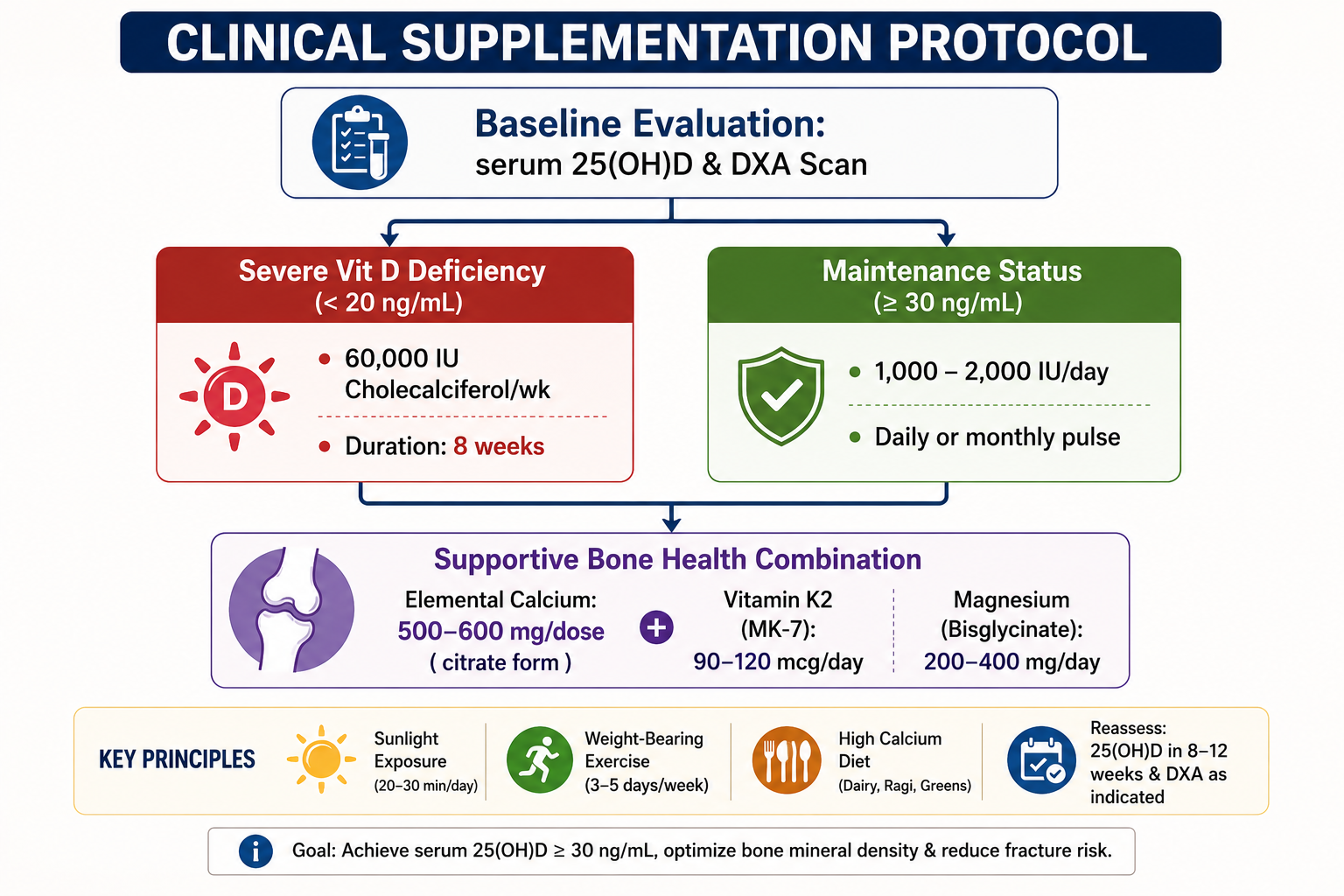
Loading Phase (for Deficiency < 20 ng/mL): 60,000 IU orally once weekly for 8 weeks, taken with a fat-containing meal to optimize lymphatic absorption.
-
Maintenance Phase: 1,000 to 2,000 IU daily or 60,000 IU once monthly to sustain target serum concentrations between 30 – 50 ng/mL.
Calcium Supplementation: Citrate vs. Carbonate
Elemental calcium supplementation should bridge the gap between dietary intake and the 1,200 mg/day target—typically requiring 500 to 600 mg of elemental calcium daily.
-
Calcium Carbonate (40% Elemental Ca): Inexpensive and widely available. Requires gastric acid for dissociation; must be ingested with or immediately after meals. Less ideal for older postmenopausal women with achlorhydria or those on proton pump inhibitors (PPIs).
-
Calcium Citrate (21% Elemental Ca): Gastric acid-independent absorption. Preferred for patients with GI sensitivities, low stomach acid, or history of nephrolithiasis (kidney stones).
Clinical Note: Single supplemental doses should not exceed 500 mg of elemental calcium, as intestinal saturation of active transport mechanisms (TRPV6) reduces fractional absorption efficiency at higher single doses.
Lifestyle & Weight-Bearing Exercise Integration
Nutritional and pharmacological measures require mechanical stimulus to effectively promote bone remodeling:
-
Progressive Resistance Training (PRT): Lifting weights or utilizing resistance bands 2–3 times weekly stimulates osteoblast proliferation via strain-generated fluid flow in lacunar-canalicular networks.
-
Weight-Bearing Impact Exercise: Brisk walking, stair climbing, and low-impact jogging provide ground reaction forces that signal bone reinforcement along mechanical stress lines.
-
Fall Prevention Strategies: Proprioceptive exercises (e.g., balance training, Yoga) reduce fall risk—the immediate trigger for over 90% of osteoporotic hip and forearm fractures.