



This is Part 2 of Our 3 Part Series on Iron Deficiency and Iron Absorption from Iron Tablets – The Iron Tablet Paradox: Why Taking More Iron Doesn’t Always Mean Absorbing More…Part 1, Click Here
For decades, doctors around the world prescribed iron tablets using a simple principle: If a patient has iron deficiency, give more iron. Not any more, hopefully.
This approach appears logical. Iron deficiency results from inadequate iron available for making haemoglobin, so increasing the dose should correct the deficiency more quickly. However, clinical practice often told a different story.
Many patients took iron tablets exactly as prescribed but experienced only a slow rise in haemoglobin or ferritin. Others stopped treatment because of constipation, nausea, abdominal pain or bloating. Some showed little improvement despite taking increasingly higher doses.
For years, these disappointing results were blamed on poor compliance, inadequate diet or continuing blood loss. Today, we know that another important factor is involved.
The body’s own biology may temporarily block iron absorption after each dose of iron – controlled by hepcidin.
Landmark Discovery That Changed Iron Therapy
One of the biggest breakthroughs in iron research came from studies led by Dr Nicole Stoffel and colleagues, published in the journal Blood. Researchers wanted to answer a simple question: Does taking an iron tablet change how much iron the body absorbs from the next tablet?
To find out, they studied iron-depleted but otherwise healthy women and measured both iron absorption and blood hepcidin levels after oral iron supplementation. The results surprised even experienced researchers.
A single oral dose containing approximately 60–65 mg of elemental iron produced a marked increase in circulating hepcidin within hours. Even more importantly, hepcidin remained elevated for about 24 hours, and in some participants the effect lasted even longer.
During this period, the intestine absorbed less iron from subsequent doses. The body’s natural defence mechanism against iron overload had effectively reduced the efficiency of the next supplement.
Why Does This Happen?
From an evolutionary perspective, this response makes perfect sense. Unlike calcium or sodium, the human body has no active mechanism to eliminate excess iron. Too much iron can accumulate in organs such as the liver, pancreas and heart, where it promotes oxidative damage through the formation of reactive oxygen species.
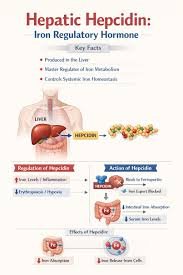
To prevent iron overload, the liver continuously monitors circulating iron. When an iron tablet suddenly increases blood iron levels, the liver responds by producing more hepcidin. Hepcidin then binds to ferroportin, the protein responsible for moving iron from intestinal cells into the bloodstream.
As discussed in Part 1, ferroportin is internalised and degraded, temporarily closing the “iron gate.” This protective response limits further iron absorption until hepcidin levels gradually decline.
More Iron Does Not Mean More Absorption
One of the most important lessons from modern iron physiology is that iron absorption is not a linear process. Imagine two people taking different doses of oral iron.
-
Person A takes 30 mg of elemental iron.
-
Person B takes 120 mg of elemental iron.
It might seem reasonable to expect Person B to absorb four times more iron. In reality, that rarely happens. Although the larger dose delivers more iron overall, the percentage absorbed becomes progressively smaller as the dose increases.
This phenomenon is known as reduced fractional iron absorption.
Higher doses stimulate a stronger hepcidin response, meaning a greater proportion of the ingested iron simply passes through the intestine without entering the bloodstream.
In other words: Taking twice as much iron does not result in twice as much iron being absorbed.

The Science Behind Alternate-Day Iron Supplementation
The discovery that hepcidin remains elevated for approximately one day after oral iron supplementation prompted researchers to ask another important question.
Would allowing hepcidin to return to normal before taking the next dose improve absorption? Clinical studies suggest the answer may be yes.
Several carefully designed human studies have shown that alternate-day oral iron supplementation often results in greater fractional iron absorption than giving the same amount of iron on consecutive days.
The explanation is straightforward. When an iron tablet is taken on Monday morning, hepcidin rises and temporarily reduces iron absorption. If another tablet is taken on Tuesday while hepcidin is still elevated, less of that iron may be absorbed.
However, if the next tablet is taken on Wednesday, hepcidin has usually returned closer to baseline, allowing the intestine to absorb iron more efficiently. This concept has attracted considerable attention in nutritional science and has influenced the way many clinicians think about oral iron therapy.
The emerging evidence simply highlights that more frequent dosing is not always more effective.
Why Some People Still Fail to Respond
Even when iron supplements are prescribed appropriately, some patients continue to show little improvement. Several factors can contribute to poor response:
Persistent inflammation – Inflammatory diseases increase hepcidin production, making iron absorption more difficult.
Ongoing blood loss – Heavy menstrual bleeding, gastrointestinal ulcers or intestinal polyps may continue to deplete iron stores faster than supplements can replace them.
Poor intestinal absorption – Conditions such as coeliac disease, inflammatory bowel disease and previous stomach surgery reduce iron uptake.
Incorrect diagnosis – Not every anaemia results from iron deficiency.
Vitamin B12 deficiency, folate deficiency, chronic kidney disease, inherited blood disorders and chronic infections may require entirely different treatments.
Poor adherence – Gastrointestinal side effects remain one of the commonest reasons patients stop taking iron tablets before completing treatment.
What This Means for India
India has one of the world’s highest burdens of iron deficiency, affecting children, adolescents, women of reproductive age and older adults. National iron supplementation programmes remain essential and have improved the health of millions.
The discovery of hepcidin does not diminish the importance of oral iron therapy.
Instead, it helps explain why treatment sometimes takes longer than expected and why successful management depends on more than simply increasing the dose. Understanding iron physiology enables healthcare professionals to make more informed decisions about dosing schedules, investigate underlying causes when treatment fails and tailor therapy to individual patient needs.
Inflammation and Iron Are Closely Connected
Whenever the immune system detects infection, injury or inflammation, it releases signalling proteins known as cytokines. One of the most important of these is interleukin-6 (IL-6).
IL-6 stimulates the liver to produce large amounts of hepcidin. As hepcidin rises:
-
Less dietary iron is absorbed from the intestine.
-
Iron stored in the liver remains trapped.
-
Macrophages retain recycled iron instead of releasing it into the bloodstream.
-
Less iron reaches the bone marrow to make new red blood cells.
This process rapidly lowers the amount of circulating iron available to invading microbes. From an evolutionary perspective, this is an ingenious survival strategy. Many bacteria require iron to grow and multiply. By temporarily reducing blood iron levels, the body attempts to starve harmful microorganisms of an essential nutrient.
Scientists refer to this protective mechanism as nutritional immunity.
When a Protective Response Becomes Harmful
During a short-lived bacterial infection, increased hepcidin is beneficial.
Once the infection resolves, inflammation falls, hepcidin declines and normal iron metabolism returns. The problem arises when inflammation becomes chronic. Persistent low-grade inflammation keeps hepcidin levels elevated for months or even years.
As a result:
-
Dietary iron absorption remains reduced
-
Iron becomes trapped inside storage cells
-
The bone marrow receives insufficient iron despite adequate body stores
-
Anaemia gradually develops
This condition is known as anaemia of chronic inflammation, previously called anaemia of chronic disease. Unlike classical iron deficiency, the body may actually contain substantial iron reserves. The problem is that much of this iron becomes biologically unavailable. Researchers sometimes describe this phenomenon as functional iron deficiency—iron is present but cannot be efficiently mobilised for red blood cell production.
Why This Matters for Modern India
India is experiencing a rapid rise in chronic metabolic diseases. Millions of adults now live with:
-
Obesity
-
Type 2 diabetes
-
Metabolic dysfunction-associated steatotic liver disease (MASLD)
-
Chronic kidney disease (CKD)
-
Polycystic ovary syndrome (PCOS)
-
Rheumatoid arthritis
-
Chronic infections such as tuberculosis
Many of these conditions are associated with persistent, low-grade inflammation. Although this inflammation may not produce obvious symptoms, it can significantly influence iron metabolism through increased hepcidin production.
This helps explain why some individuals struggle to improve their iron status despite consuming iron-rich foods or taking supplements regularly.
Diabetes and Iron Metabolism
Type 2 diabetes is also associated with chronic low-grade inflammation. Several studies have reported higher hepcidin levels in people with insulin resistance and diabetes, although the relationship is complex and influenced by liver function, obesity and iron stores.
Poorly controlled diabetes may therefore contribute to disturbances in iron metabolism through inflammatory pathways. Researchers continue to investigate how improving metabolic health may influence hepcidin regulation and iron availability.
Chronic Kidney Disease: A Classic Example
One of the best-studied examples of elevated hepcidin occurs in chronic kidney disease (CKD). Patients with CKD often develop anaemia despite receiving iron supplementation. Several mechanisms contribute:
-
Chronic inflammation stimulates hepcidin production
-
Diseased kidneys clear less hepcidin from the circulation
-
Reduced erythropoietin production limits red blood cell formation
-
Frequent blood testing and dialysis may increase iron losses
For these reasons, many patients with advanced CKD require carefully monitored intravenous iron and erythropoiesis-stimulating therapies rather than oral iron alone
Autoimmune Diseases and Chronic Infections
Conditions characterised by persistent immune activation also commonly increase hepcidin. Examples include:
-
Rheumatoid arthritis
-
Inflammatory bowel disease
-
Systemic lupus erythematosus
-
Chronic osteomyelitis
-
Tuberculosis
-
Some chronic fungal infections
In these situations, treating the underlying disease is often just as important as replacing iron. Without controlling inflammation, oral iron absorption may remain suboptimal.
Key Take-Home Messages
-
Hepcidin is activated not only by iron intake but also by inflammation, especially chronic inflammation
-
Chronic inflammation reduces dietary iron absorption and traps stored iron inside cells
-
Obesity, diabetes, chronic kidney disease and autoimmune disorders may contribute to elevated hepcidin and thus lower iron absorption from Iron Tablets
-
Functional iron deficiency occurs when iron stores are present but unavailable for red blood cell production
-
Ferritin should always be interpreted alongside other iron studies and markers of inflammation
-
Successful treatment often requires managing the underlying inflammatory condition as well as correcting iron deficiency