



Iron Deficiency Is More Than Just Low Haemoglobin – Vast majority of Indians are Iron Deficient and are on Iron Supplements, but Iron Deficiency still persist, know the reasons for this….
Iron deficiency is the most common nutritional deficiency in the world and remains one of the biggest public health challenges of the 21st century. According to the World Health Organization (WHO), anaemia affects nearly 2 billion people globally, with iron deficiency accounting for the majority of cases. Estimates suggest that more than one billion people have depleted iron stores even before anaemia becomes apparent.
India carries one of the world’s largest burdens of iron deficiency. Despite decades of public health programmes, food fortification initiatives and widespread availability of iron supplements, iron deficiency anaemia continues to affect millions of children, adolescents, women of reproductive age and older adults.
This raises an important question: If iron tablets are so widely available, why do so many people STILL remain iron deficient?
For years, the answer seemed simple—people were not eating enough iron or were not taking their supplements regularly. However, advances in nutritional science have revealed that the story is far more complex.
Today, scientists recognise that absorbing iron is often a bigger challenge than consuming it. At the centre of this discovery is a remarkable hormone called hepcidin—sometimes referred to as the body’s “iron gatekeeper.”
Understanding hepcidin has transformed how researchers think about iron deficiency and is changing the way clinicians prescribe iron therapy around the world.
India’s Hidden Iron Crisis
Iron deficiency is often associated with fatigue, weakness and low haemoglobin, but these are usually late manifestations. Long before anaemia develops, iron deficiency can silently affect almost every organ system. Iron is essential for:
-
Oxygen transport through haemoglobin
-
Energy production inside every cell
-
Brain development and cognitive function
-
Muscle performance
-
Immune defence
-
DNA synthesis
-
Healthy pregnancy and fetal development
When iron stores begin to fall, the body initially tries to compensate by drawing on reserves stored mainly in the liver, spleen and bone marrow. During this stage, haemoglobin may still remain normal, meaning many people are iron deficient without being diagnosed. As deficiency progresses, symptoms gradually appear:
-
Persistent tiredness
-
Reduced exercise capacity
-
Poor concentration
-
Hair fall
-
Brittle nails
-
Restless legs syndrome
-
Frequent infections
-
Dizziness
-
Headaches
Many people dismiss these symptoms as stress, ageing or lack of sleep, delaying diagnosis for months or even years.
Iron Deficiency Is Especially Common in India
Several factors combine to make iron deficiency particularly common among Indians.
1. Diets Naturally Low in Absorbable Iron – Many Indian diets rely heavily on cereals, rice, wheat and pulses. Although these foods contain iron, much of it is non-haem iron, which is absorbed less efficiently than the haem iron found in meat, poultry and fish.
Compounds naturally present in whole grains, legumes and some vegetables—particularly phytates and polyphenols—can further reduce iron absorption.
2. Increased Iron Requirements – Certain stages of life dramatically increase iron needs. These include: Rapid childhood growth, Adolescence, Pregnancy, Breastfeeding and Heavy menstrual bleeding.
Women lose iron every month through menstruation, making them particularly vulnerable to deficiency. During pregnancy, iron requirements nearly double because iron is needed to support the mother’s expanding blood volume, the placenta and the developing baby.
3. Hidden Blood Loss – Not all iron deficiency is caused by poor diet. Slow, chronic blood loss may gradually deplete iron stores over several years. Possible causes include:
-
Heavy menstrual bleeding
-
Bleeding piles (haemorrhoids)
-
Peptic ulcers
-
Intestinal polyps
-
Inflammatory bowel disease
-
Gastrointestinal cancers
For this reason, persistent iron deficiency—particularly in men and post-menopausal women—should never be ignored without investigating the underlying cause.
4. Poor Iron Absorption – Some people consume adequate dietary iron but still develop deficiency because their intestines cannot absorb it efficiently. Conditions associated with poor iron absorption include: Coeliac disease, Chronic inflammatory bowel disease, Previous stomach surgery, Reduced stomach acid production and Long-term use of acid-suppressing medications / PPIs
Why Simply Taking More Iron Often Doesn’t Work
A common assumption is that increasing the dose of iron tablets should correct iron deficiency more quickly. Surprisingly, this is not always true. Many patients take iron supplements faithfully for months yet see only modest improvements in haemoglobin or ferritin levels.
For decades, doctors recognised this pattern but could not fully explain it. Modern research has now provided the missing piece of the puzzle. The body does not absorb iron according to how much iron is swallowed. Instead, it absorbs iron according to how much iron it believes it needs.
That decision is controlled by a single hormone – Its name is hepcidin.
A Major Shift in Understaning of Iron Science
One of the biggest discoveries in nutritional medicine over the past two decades has been the identification of hepcidin as the body’s master regulator of iron metabolism. Before hepcidin was discovered in the early 2000s, scientists knew remarkably little about how the body controlled iron absorption.
Today, hepcidin is recognised as the central regulator that determines:
-
How much dietary iron enters the bloodstream
-
When stored iron is released
-
Why inflammation causes anaemia
-
Why some people fail to respond to iron supplements
-
Why taking larger doses of iron is not always better
This discovery has fundamentally changed the way clinicians understand iron deficiency and is influencing modern treatment strategies worldwide.
“Why are my iron levels still low even after taking iron tablets?” – Meet Hepcidin: The Tiny Hormone That Decides Whether You Absorb Iron
Imagine swallowing an iron tablet every morning. You expect your body to absorb the iron and use it to make healthy red blood cells. But what if your body simply says “No”? This is exactly what happens when hepcidin levels are high.
Although most people have never heard of it, hepcidin is now recognised as the master regulator of iron metabolism. Since its discovery in the early 2000s, this small hormone has transformed our understanding of iron deficiency, anaemia and iron supplementation.
Researchers now know that iron absorption is not controlled by the amount of iron you eat—it is controlled primarily by the amount of hepcidin your liver produces. In simple terms, hepcidin decides how much iron enters your bloodstream and how much remains locked away inside your body’s cells.
What Exactly Is Hepcidin?
Hepcidin is a small peptide hormone produced mainly by the liver. Its primary role is remarkably simple: To maintain the right amount of iron in the body.
Unlike many other nutrients, humans have no efficient way to eliminate excess iron. The body cannot actively excrete iron through urine or the intestines. Small amounts are lost naturally through shedding of skin cells, intestinal cells, sweat and blood loss, but these losses are minimal.
As a result, the body must carefully regulate how much iron it absorbs from food, rather than how much it gets rid of.
Hepcidin performs this vital task every single day.
Why Too Much Iron Can Be Dangerous
Iron is essential for life, but it is also potentially toxic. Free iron can generate highly reactive molecules called reactive oxygen species (ROS) through chemical reactions such as the Fenton reaction. These unstable molecules can damage:
-
Cell membranes
-
Proteins
-
DNA
-
Blood vessels
-
Mitochondria (the cell’s energy factories)
To minimise this risk, the body keeps almost all iron safely bound to specialised proteins such as:
-
Ferritin – the body’s iron storage protein
-
Transferrin – the protein that transports iron in the bloodstream
-
Haemoglobin – the oxygen-carrying protein inside red blood cells
-
Myoglobin – the oxygen-storage protein in muscles
Hepcidin helps ensure that iron remains tightly controlled within this carefully regulated system.
The Iron Gate: Meet Ferroportin
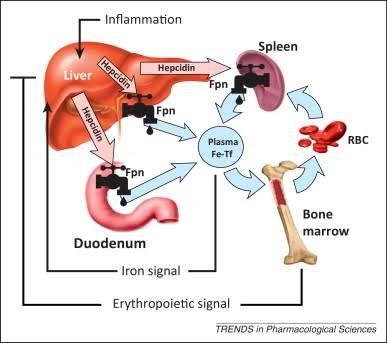
To understand hepcidin, we first need to meet another important protein called ferroportin. Ferroportin is the only known iron export protein in humans.
It functions like a doorway, allowing iron to leave cells and enter the bloodstream. Ferroportin is found mainly on:
-
Cells lining the upper small intestine (duodenum), where dietary iron is absorbed
-
Macrophages, which recycle iron from ageing red blood cells
-
Liver cells, where excess iron is stored
-
Placental cells, which transport iron to the developing baby during pregnancy
Whenever iron needs to move into the bloodstream, it must pass through ferroportin. This is where hepcidin exerts its remarkable control.
How Hepcidin Blocks Iron Absorption
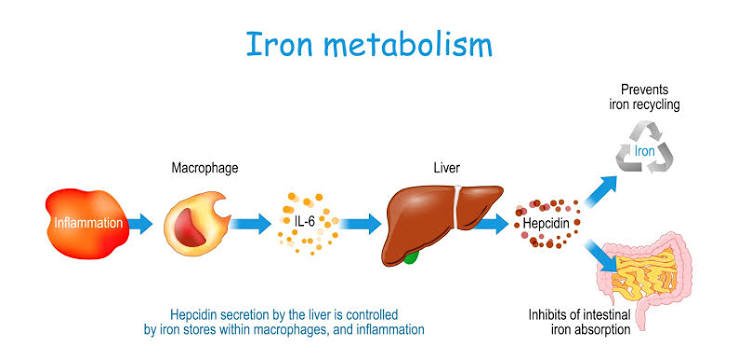
When iron stores are adequate—or when the body senses inflammation—the liver increases hepcidin production. Hepcidin then travels through the bloodstream and binds directly to ferroportin. This interaction causes ferroportin to be internalised and degraded.
In simple terms, the iron doorway disappears. Once ferroportin is removed:
-
Less dietary iron leaves intestinal cells.
-
Less stored iron is released from the liver.
-
Less recycled iron enters the circulation from macrophages.
-
Blood iron levels begin to fall.
The iron remains trapped inside cells until new ferroportin molecules are produced. This elegant mechanism protects the body against iron overload but can also contribute to iron deficiency when hepcidin remains inappropriately elevated.
What Happens When Hepcidin Is Low?
When the body genuinely needs more iron, the opposite occurs.
Low iron stores, increased red blood cell production, blood loss or pregnancy signal the liver to reduce hepcidin production. As hepcidin levels fall:
-
Ferroportin remains active
-
More dietary iron is absorbed
-
Stored iron is released from the liver
-
Recycled iron returns to the bloodstream
-
Iron becomes available for haemoglobin production
This adaptive response allows healthy individuals to increase iron absorption several-fold during periods of increased physiological demand.
The Body Constantly Adjusts Hepcidin
Hepcidin production changes continuously in response to the body’s needs. Hepcidin decreases when:
-
Iron stores are low
-
Blood loss occurs
-
Iron deficiency develops
-
Red blood cell production increases
-
Pregnancy increases iron demand
-
Oxygen availability is reduced, stimulating erythropoiesis
Hepcidin increases when:
-
Iron stores become abundant
-
Large oral iron doses are taken
-
Infection develops
-
Chronic inflammation occurs
-
Certain chronic diseases are present