



The kidney damage that may begin before you feel anything
For many people living with Type 2 diabetes, the most frightening kidney problem is not the final stage of kidney failure. It is the period years earlier, when kidney damage may already be developing but there is little—or nothing—to feel.
That is why diabetic kidney disease (DKD) is increasingly treated as a disease that must be actively screened for, rather than one that should be diagnosed only after symptoms appear. Indian evidence makes this particularly important.
Subclinical Diabetic Nephropathy (SCDN) refers to the prolonged, asymptomatic phase of diabetic kidney damage where structural glomerular and tubular alterations occur prior to the clinical detection of persistent microalbuminuria (UACR >30 – 300 mg/g) or a fall in estimated Glomerular Filtration Rate (eGFR < 60 mL/min/1.73m²).
Sub-Clinical Diabetic Nephropaty – INDIANS
In India, Sub-Clinical Diabetic Nephropathy represents a massive, unrecognized healthcare burden. While clinical diabetic kidney disease affects 30 -44% of Indian Type 2 Diabetes Mellitus (T2DM) patients, biomarker and biopsy studies indicate that subclinical structural damage is present in up to 55 – 65% of normoalbuminuric Indian diabetics within 3 to 5 years of diabetes diagnosis.
A 2025 meta-analysis of 14 Indian studies estimated that 44% of people with Type 2 diabetes had diabetic kidney disease, although the studies were heterogeneous and the pooled estimate should not be interpreted as the prevalence among every Indian with diabetes.
And a large, nationally representative ICMR-INDIAB analysis involving 25,408 adults found impaired kidney function—defined as eGFR below 60 mL/min/1.73 m²—in 3.2% of the general study population. Importantly, Type 2 diabetes was associated with substantially greater risk, while the combination of diabetes and hypertension was associated with approximately six-fold higher risk of impaired kidney function.
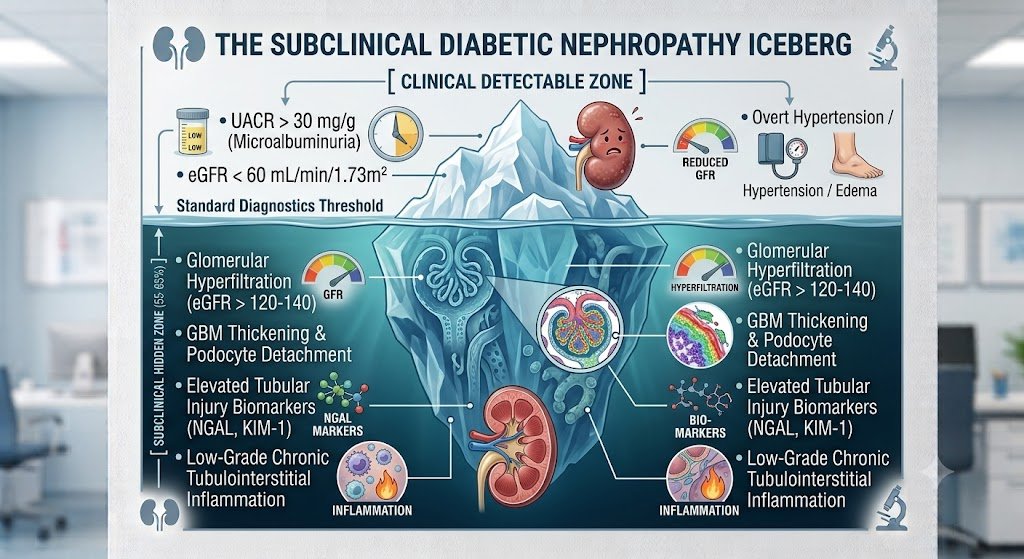
Indian Vulnerability: Why South Asians Experience Early SCDN
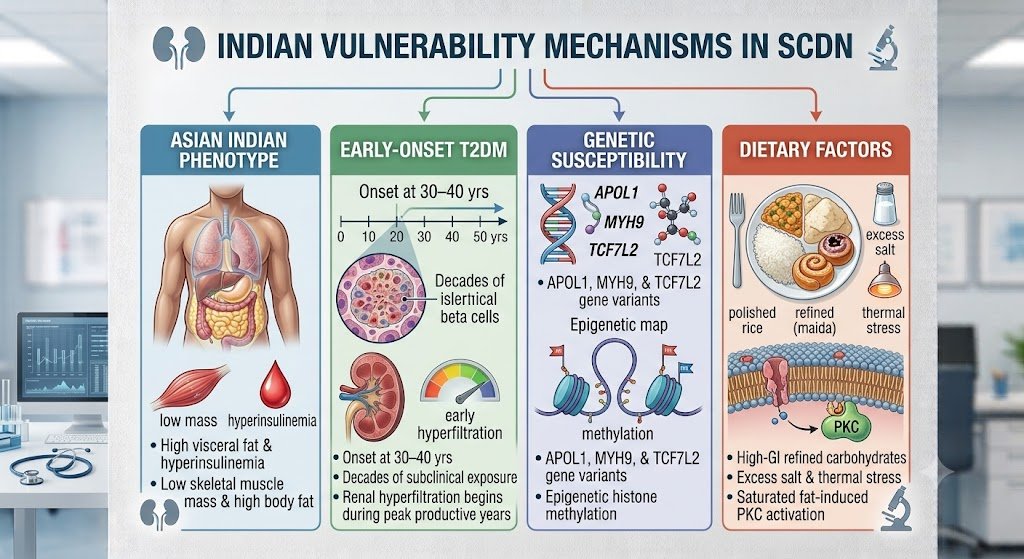
The high prevalence of SCDN in the Indian population stems from the Asian Indian Phenotype combined with unique genetic and environmental drivers:
-
Premature Metabolic Aging: South Asians develop T2DM 10 – 15 years earlier than Caucasian populations, exposing the renal microvasculature to subclinical glycemic fluctuations during their prime productive years.
-
Genetic Susceptibility: Variants in susceptibility genes (e.g., APOL1, MYH9, and TCF7L2 polymorphisms) combined with epigenetic histone methylation accelerate podocyte injury even under mild glycemic elevations.
-
High Glycemic Variability: Traditional South Asian diets, dominated by refined carbohydrates, trigger sharp postprandial glucose spikes that drive transient glomerular hyperfiltration, even when overall HbA1c appears acceptable (6.8 – 7.2%).
START-India study showed how early kidney damage can hide
One of the important Indian datasets is the START-India multicentre study. In an interim analysis of 1,500 people with Type 2 diabetes:
-
approximately 46% had CKD according to UACR ≥30 mg/g and/or eGFR <60;
-
approximately 35% had abnormal UACR;
-
approximately 23% had eGFR below 60 mL/min/1.73 m².
And here is the particularly important observation: Approximately 80% still had eGFR above 60. In other words, a person could have evidence of kidney disease while their filtration number still appeared relatively preserved. This is one reason UACR matters.
Your creatinine can be “normal” while kidney damage is already developing
This is one of the most misunderstood aspects of diabetic kidney disease. People often ask:“My serum creatinine is normal. So my kidneys are fine, right?” Not necessarily. Serum creatinine is useful, but it is not the entire kidney assessment. Two complementary measurements are particularly important:
① UACR — urine albumin-to-creatinine ratio – This looks for albumin leaking into urine.
② eGFR — estimated glomerular filtration rate – This estimates how effectively the kidneys are filtering blood.
Together they provide considerably more information than either measurement alone. Indian recommendations have long emphasized annual assessment of urine albumin and serum creatinine/eGFR in people with diabetes.
UACR: perhaps the most useful “early warning” test
A spot urine albumin-to-creatinine ratio is practical because it avoids the inconvenience of collecting urine for an entire day. Broadly:
| UACR | Category |
|---|---|
| <30 mg/g | A1 |
| 30–300 mg/g | A2 — moderately increased |
| >300 mg/g | A3 — severely increased |
But one abnormal result does not automatically prove chronic diabetic kidney disease. Albumin excretion can temporarily increase because of:
-
urinary infection,
-
fever,
-
strenuous exercise,
-
uncontrolled blood glucose,
-
uncontrolled blood pressure,
-
and other transient conditions.
Therefore, persistent abnormality needs confirmation. Older Indian diabetes recommendations specifically advise repeating elevated UACR measurements rather than diagnosing nephropathy from one isolated abnormal result.
Other half of the equation: eGFR
eGFR is derived primarily from serum creatinine together with demographic variables and is used to estimate filtration.
A persistent: eGFR <60 mL/min/1.73 m², is an important threshold for CKD classification. But there is another subtle point.
A person can have:
UACR ≥30 + eGFR >60
and still have evidence of kidney disease. Conversely, someone can have:
eGFR <60 + normal UACR
and also have kidney disease.
This latter pattern is particularly important in Indians because normoalbuminuric kidney dysfunction has been documented in Indian people with Type 2 diabetes.
Comparison of Subclinical vs. Overt Diagnostic Markers
Biomarker / Parameter |
Physiological Normal |
Subclinical Phase (SCDN) |
Overt Clinical Nephropathy |
eGFR (CKD-EPI) |
90 – 120 mL/min/1.73m² |
Hyperfiltration ( > 120 -150 mL/min) |
Progressively declines (< 60 mL/min) |
Spot UACR |
< 10 mg/g |
Micro-dipping (15 – 29 mg/g) |
Persistent 30 – 300 mg/g or > 300 mg/g |
Urinary NGAL |
< 20 ng/mL |
Elevated (40 — 100 ng/mL) |
Markedly elevated (> 150 ng/mL) |
Urinary KIM-1 |
< 0.5 ng/mL |
Elevated (1.5 — 3.0 ng/mL) |
High (> 5.0 ng/mL) |
Nocturnal BP Dip |
10 -20% BP Drop |
Non-dipper (< 10% Drop) |
Reverse dipper / Sustained Nocturnal HTN |
Glomerular Structure |
Normal GBM & Podocytes |
GBM Thickening, Podocyte Detachment |
Nodular Glomerulosclerosis (KW Lesions) |
What might you notice at home?
Early diabetic kidney disease often produces NO reliable symptoms. So there is no scientifically validated: “10-second home test for diabetic nephropathy.”
And there is no urine colour test that can diagnose early DKD. However, certain changes deserve medical evaluation.
Possible warning signals – Watch Out for:
1. New or increasing ankle/foot swelling – Especially if persistent
2. Foamy or unusually frothy urine – Persistent foam can occur with proteinuria, although foam by itself is not diagnostic
3. Increasing nighttime urination – This can occur for many reasons and is not specific to kidney disease.
4. Unexplained fatigue or weakness – These are late and nonspecific symptoms and should never be used as a screening test
5. Persistent high blood pressure – Hypertension is both a major risk factor and a potential consequence of kidney disease
6. Reduced urine output – This is more concerning and requires prompt medical assessment
Actionable Prevention, Minimization & Management Strategy
Preventing the transition from subclinical structural damage to irreversible nephropathy requires a proactive, multi-system approach tailored to the South Asian lifestyle.
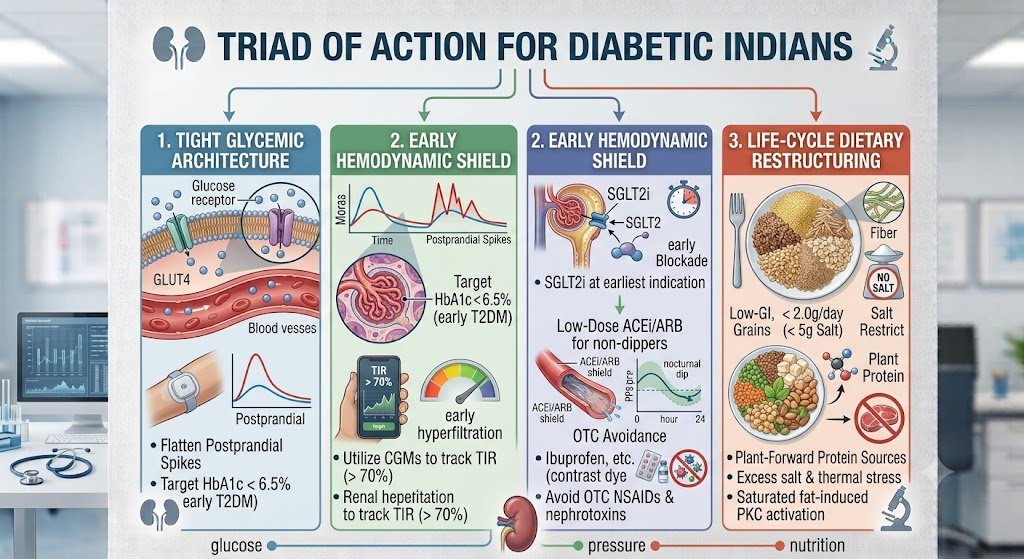
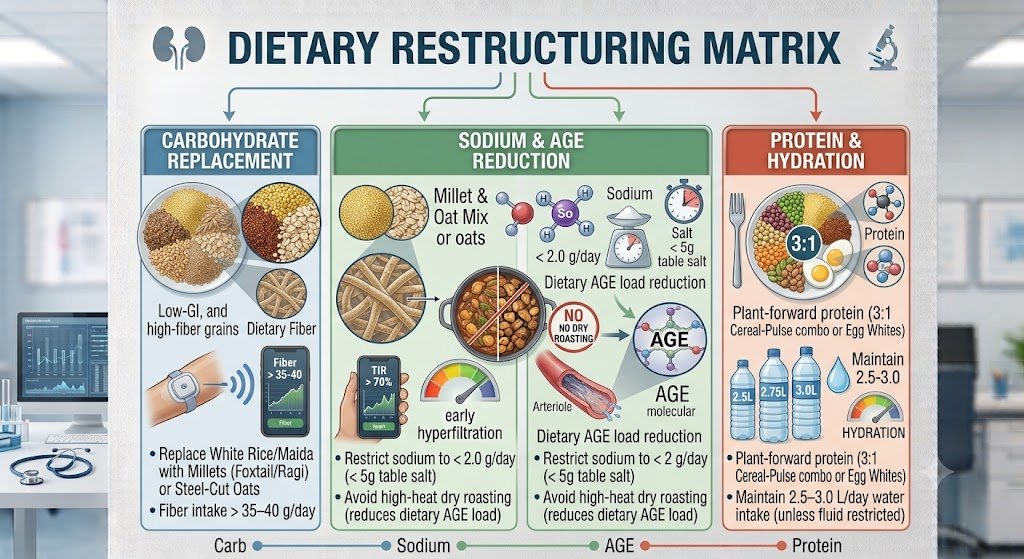
Dietary & Lifestyle Restructuring for South Asians
-
Subclinical Salt Restriction: Limit dietary sodium to < 2.0 g/day (under $5 g/day table salt). Eliminate high-sodium Indian staples like papads, commercial pickles, bakery snacks, and packaged namkeens. Excess sodium blunts the therapeutic efficacy of RAS blockade and SGLT2 inhibitors.
-
Reduce Dietary AGEs: Advanced Glycation End-Products are absorbed from food. Avoid deep-fried, high-heat dry-cooked foods (e.g., deeply fried samosas, dry-roasted meats). Favor steaming, boiling, and poaching culinary methods.
-
Plant-Forward Protein Distribution: Avoid high-protein loading. Adopt a balanced plant-forward diet incorporating legumes, Moong Dal, tofu, and egg whites, which cause significantly less intraglomerular hyperfiltration than processed red meats.
-
Hydration Architecture: Ensure an adequate fluid intake of 2.5 – 3.0 Liters/day of pure water (spread evenly throughout the day) to avoid subclinical tubulointerstitial hyperosmolality, provided cardiac function is normal.
Bottom Line
Subclinical diabetic kidney disease is real—and it can be silent.
Indian studies suggest that kidney involvement among people with Type 2 diabetes is substantial. A 2025 meta-analysis estimated pooled DKD prevalence at 44%, while Indian multicentre data have also found substantial rates of albuminuria and reduced eGFR.
The most important lesson is not to wait for symptoms.
Don’t wait for swollen feet.
Don’t wait for foamy urine.
Don’t wait for creatinine to become obviously abnormal.
Instead, identify risk early and periodically check: UACR + eGFR + blood pressure + glucose control. And nutritionally, don’t follow an extreme “kidney diet” from social media.
For most Indians with diabetes and early kidney disease, the evidence points toward a lower-sodium, minimally processed, portion-controlled, metabolically healthy Indian diet with individualized protein, potassium and phosphorus management when required.
The kidney does not usually give you a dramatic warning before the damage begins. The laboratory can. Take Care of Your Kidneys!
References & Clinical Literature
-
Anjana, R. M., et al. (ICMR-INDIAB Collaborative Group). (2023). Metabolic non-communicable disease health metrics across India (ICMR-INDIAB Study). The Lancet Diabetes & Endocrinology, 11(7), 474-489.
-
Unnikrishnan, R., et al. (2016). Diabetic kidney disease: A South Asian perspective. Current Diabetes Reports, 16(3), 28.
-
Cherney, D. Z., et al. (2014). The effect of SGLT2 inhibition with empagliflozin on renal hyperfiltration in patients with type 1 diabetes. Circulation, 129(5), 587-597.
-
Research Society for the Study of Diabetes in India (RSSDI). (2022). Clinical Practice Recommendations for Management of Type 2 Diabetes Mellitus. International Journal of Diabetes in Developing Countries, 42(Suppl 1), 1-158.
-
Nauta, F. L., et al. (2011). Glomerular and tubular damage markers are elevated in patients with type 1 diabetes and normoalbuminuria. Diabetes Care, 34(4), 975-981.
-
Kidney Disease: Improving Global Outcomes (KDIGO) Diabetes Work Group. (2023). KDIGO 2023 Clinical Practice Guideline for the Management of Diabetes in Chronic Kidney Disease. Kidney International, 104(5S), S1-S127.