

Average Height of Indians
In India, the average height is approximately 5 feet 5 inches (165 cm) for men and 5 feet (152 cm) for women.
Height can vary noticeably by region, with northern states like Punjab and Haryana recording higher averages (approx. 5 ft 7 in / 170 cm for men), while southern and eastern regions trend slightly lower.
These figures are based on data compiled by health institutions and national health surveys. However, average height can differ due to a range of factors:
-
-
Regional Variation: Northern states tend to report taller populations, whereas southern and central regions generally see averages around 5 ft 4 in to 5 ft 6 in for men
-
Nutritional Impact: While genetics play a major role, dietary habits, socioeconomic backgrounds, and access to nutritional foods heavily influence these averages. Milk in particular stands out for its impact on Human Height as proven in the details that follow
-
Average Heights in Few, Select Countries
-
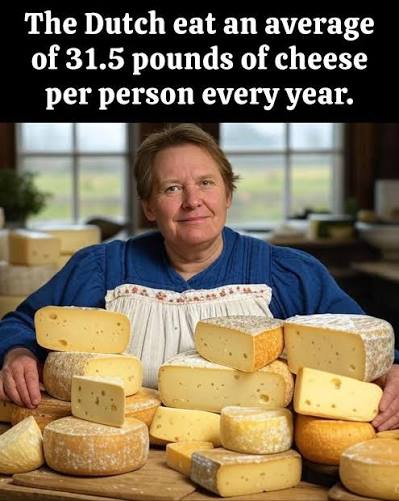
Among all the countries in the world – The Netherlands stands “TALLEST” with average height of 184 Cm – a full 19 cm taller than average Indian male. Diet of Average Netherlander – Milk, cheese, butter, more dairy per head than almost anywhere in the world
-
Montenegro – average height of 183 cm and Diet of an average Montenegran comprises largely of Meat, dairy, dairy products and a pastoral mountain diet
-
Denmark – stands tall again, with an average height of 182 cm and unsurprisingly a diet rich in Pork and no surprises, dairy and dairy products
Regional Variations in India
India’s vast geography causes significant variations in elevation between different regions:Northern India
- Men: 5 feet 8 inches (172 cm).
- Women: 5 feet 3 inches (160 cm).
Southern India
- Men: 5 feet 6 inches (167 cm).
- Women: 5 feet 1 inch (155 cm).
Northeastern India
- Men: 5 feet 4 inches (162 cm).
- Women: 4 feet 11 inches (150 cm).
Central India
- Men: 5 feet 5 inches (165 cm).
- Women: 5 feet (152 cm).
These variations highlight the influence of genetics, diet and environmental factors.
Effect of Milk on Human Height
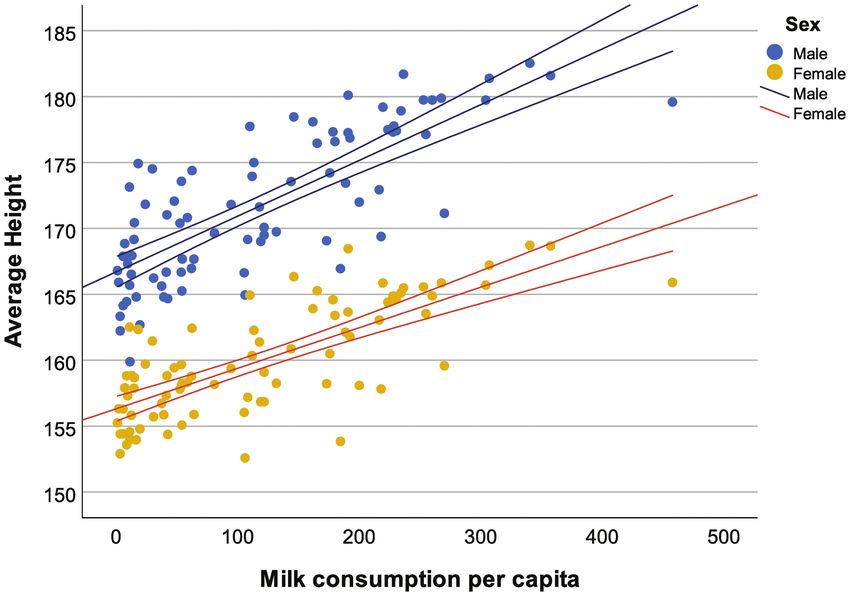
Milk helps children maximize their genetic height potential by providing essential nutrients like calcium, protein, vitamin D, and Insulin-like Growth Factor-1 (IGF-1). Studies indicate an extra 245 ml of milk daily can yield about 0.4 cm of additional growth per year. However, milk rarely increases height in adults once growth plates fuse, hence childhood and adolescent age must not be for milk and milk products’ consumption.
The Science Behind Milk and Height
Cow’s milk is uniquely suited for bone growth because of its specific chemical and hormonal composition:
-
IGF-1 & Growth Hormones: Milk contains bioactive compounds and IGF-1 that stimulate the release of growth hormones and directly assist skeletal development and bone matrix formation
-
Protein & Minerals: A high-quality protein index—specifically from animal sources like dairy—is recognized as one of the strongest dietary predictors of human height. It provides the building blocks for bone elongation
-
Calcium and Vitamin D: These nutrients are the fundamental building blocks of bone density
Published Study on Milk Consumption and Height
Comparative Study
2005 Jul-Aug;17(4):425-41.
doi: 10.1002/ajhb.20411.
Does milk make children grow? Relationships between milk consumption and height in NHANES 1999-2002
The conclusion from this study – Results indicate that adult height was positively associated with milk consumption at ages 5-12 and 13-17, after controlling for sex, education, and ethnicity.
Evidence – Other Studies
Several previous studies showed an effect of milk on height gain in pubertal children.
-
In 1984 Takahashi reported an acceleration of growth in Japan from the 1950s and suggested the importance of milk consumption. And this increase in height was prominent during puberty.
-
In a cross-sectional study, Jirapinyo et al reported that milk intake and parents’ height contributed to adolescent height in females.
-
Bonjour et al found that prepubertal girls who consumed a diet including calcium-enriched foods grew in height in a randomized, double-blind, placebo-controlled study.
-
In a US longitudinal study, the mean height gain in the high-milk consumption group was higher than that in the low-milk consumption group, and the difference in height gain between the 2 groups was 2.5 cm over 3 years period.

Why Milk RAISES Height
Calcium itself has an important role in bone health, and many studies have shown the contribution of cow milk or dairy products to bone mass and bone mineral content.
However, cow milk may have other components that promote bone health. Insulin-like growth factor I, which is present in much higher concentrations in cow milk than in human milk, is important for bone mineral accrual on periosteal surfaces.
It is relatively stable to both heat and acidic conditions; therefore, it survives the conditions of commercial milk processing. Milk whey protein, especially milk basic protein, was reported to promote bone formation and to suppress bone resorption, and daily supplementation with milk basic protein significantly increases bone mineral density independently of dietary intake of minerals and vitamins.
In summary, almost all studies have observed a height gain in the children who consumed a high amount of cow milk.
-
Milk is regarded as the best nutritional support for neonatal growth and development
-
In pubertal children, cow milk may also be an important nutrient for growth and for achieving optimal bone mass to prevent osteoporosis in later life.
-
Finally, height gain in children may depend not only on the calcium in cow milk but also on some of its bioactive components.
Drink Milk, Eat Cheese and Have Higher Height
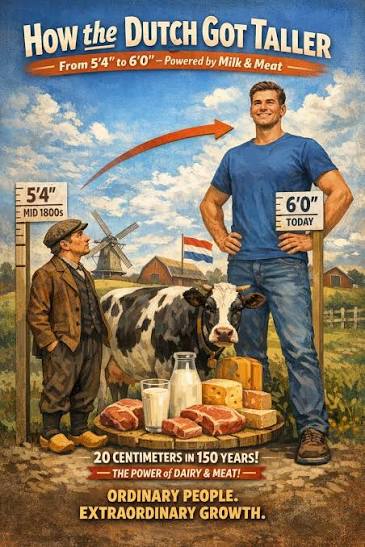
Coming back to The Netherlanders – Dutch milk and cheese consumption has evolved from historical preservation strategies into daily, dietary staples, significantly contributing to the The Netherlands boasting the tallest population globally. Over the past 150 years, Dutch men surged from an average of about 165 cm (5’5″) to roughly 184 cm (6’0″), driven primarily by socioeconomic developments, high animal-to-vegetable protein ratios, and the milk and milk products consumption.
Consume a liter of milk daily and see the magic unfold.