

FATTY LIVER DISEASE – scientifically known as Metabolic-Associated Steatotic Liver Disease (MASLD)—and formerly termed Non-Alcoholic Fatty Liver Disease (NAFLD)—has reached epidemic proportions in India.
Epidemiological evaluations indicate that Fatty Liver / MASLD affects over 1 in 3 adults (30%–35%) across urban and rural India. The clinical challenge in South Asia is driven by the “silent” nature of early liver steatosis: up to 90% of affected individuals are completely asymptomatic, remaining unaware of their condition until routine ultrasonography or advanced fibrosis (NASH/cirrhosis) develops.
Pathophysiology: The Indian Phenotype
Understanding liver fat accumulation in South Asians requires examining two underlying metabolic drivers:
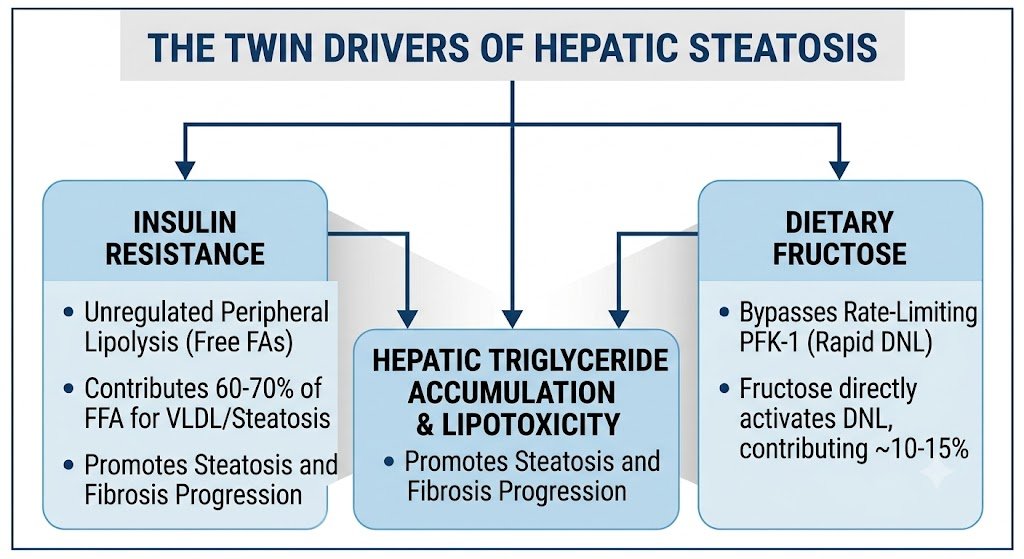
1. The Thin-Outside, Fat-Inside (TOFI) & Insulin Resistance Nexus
South Asians present a distinct metabolic footprint characterized by high visceral adiposity, high ectopic pancreatic/hepatic fat storage, and low skeletal muscle mass, even at a “normal” Body Mass Index (< 23 kg/m²).
Hyperinsulinemia impairs the insulin-mediated suppression of peripheral lipolysis / fat burn. This floods the portal circulation with Non-Esterified Fatty Acids (NEFAs), which are rapidly re-esterified into hepatic triglycerides leading to Fatty Liver.
2. The Unchecked Fructose-DNL Axis
Unlike glucose, which is regulated by Liver hexokinase/phosphofructokinase-1 (PFK-1), dietary fructose is metabolized exclusively by fructokinase C (ketohexokinase) without negative feedback control.
Fructose rapidly depletes hepatic ATP, generating substrates (acetyl-CoA) that directly fuel De Novo Lipogenesis (DNL) leading to quick and faster Fatty Liver. In fact Glucose is safer than Fructose in Fatty Liver Cases, as absurd and as oxy-moron it may sound, but that is the reality.
7 Evidence-Based Steps to Reverse Fatty Liver
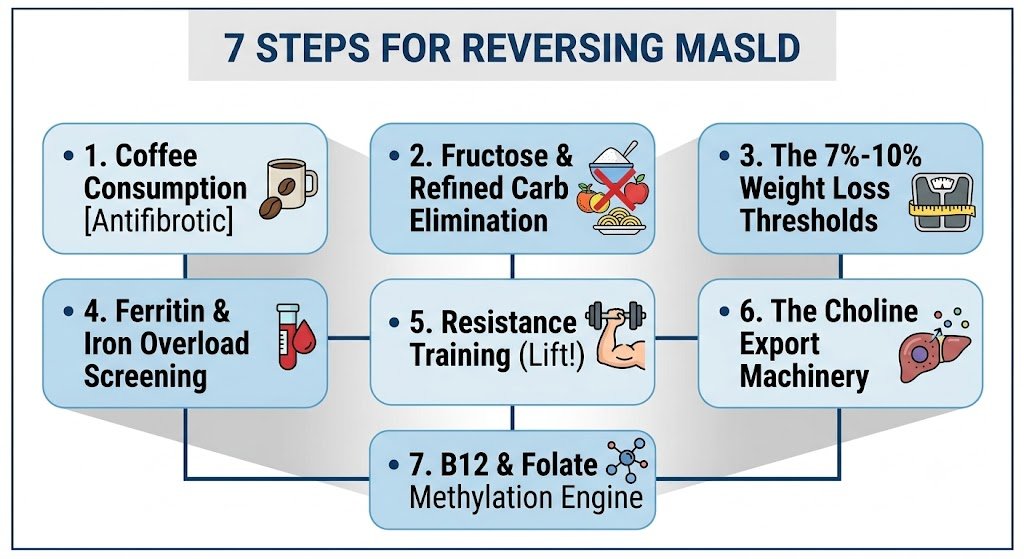
Step 1: Maximize Bioactive Hepatoprotection / Liver Protection (Coffee Protocols)
-
Mechanisms: Coffee contains chlorogenic acid (CGA), caffeine, and diterpenes (cafestol, kahweol). CGA acts as a potent antioxidant, suppressing pro-inflammatory cytokines (TNF-alpha, IL-6) and inhibiting hepatic stellate cell (HSC) activation, which prevents scar tissue synthesis. Caffeine Delivers polyphenols and caffeine to inhibit hepatic stellate cell fibrosis.
-
Clinical Data: Meta-analyses show that regular coffee consumption reduces the risk of advanced liver fibrosis by 35% to 47% in MASLD patients. Black Coffee is best, but not strictly required. Coffee WITHOUT SUGAR please. No sugar or “sugar free” non-senses in your coffee if you have Fatty Liver condition. Do read our detailed write up on “sugar-free” products (hyperlinked) and you will be convinced that plain, table sugar is way safer than “sugar-free” alternates.
-
Dosing Protocol: 2 to 3 cups of coffee per day delivers optimal bioactive concentrations.
Step 2: Eliminate Fructose & High-Glycemic Refined Carbs
-
Mechanisms: Removing high-fructose corn syrup (HFCS), commercial fruit juices, packaged sweets and refined grains (maida, white rice) cuts off the substrate supply for hepatic De Novo Lipogenesis (DNL) / fat deposition in Liver, simply put.
-
Target Swap: Replace refined flours with complex carbohydrates rich in resistant starch (e.g., millets like ragi, jowar, bajra and legumes) to blunt postprandial glucose and insulin spikes.
Step 3: Hit the 7% to 10% Weight Loss Milestones
-
The Magic Numbers: You don’t need to get exceptionally lean; you just need to shift the scale by certain specific targets by loosing fat and not by loosing muscle:
-
The 7% Threshold: Loosing about 7% of total body weight is the clinical tipping point where liver fat actively clears in clinical research.
-
The 10% Threshold: Achieving around 10% weight loss is where hepatic scarring (fibrosis) and NASH tissue damage begin to regress.
-
-
Mechanisms: Weight loss in this window depletes hepatic / liver glycogen and shifts liver metabolism toward beta-oxidation (fat burning) while triggering lipophagy (autophagy of lipid droplets) leading to improvements in your Liver Function Tests.
Step 4: Check Serum Ferritin (Screen for Iron Overload) – Thats something your Doctor may not have shared
-
Mechanisms: Serum ferritin runs high in a large percentage of individuals with fatty liver disease. Elevated ferritin can be a marker of systemic inflammation or true iron overload (dysmetabolic iron overload syndrome).
-
Clinical Impact: Excess iron generates hydroxyl free radicals via the Fenton reaction, causing severe oxidative stress and lipid peroxidation in hepatocytes, which strongly correlates with accelerated Fatty Liver disease progression and fibrosis.
-
Actionable Step: Ferritin is a cheap, accessible add-on to standard blood panels that is rarely ordered—request it alongside routine liver function tests.
Step 5: Lift Weights (Resistance Training Over Just Walking)
-
Mechanisms: Skeletal muscle is your body’s primary glucose sink ( ~ 80% of insulin-mediated glucose disposal / glucose usage). Resistance training increases type II muscle fiber density and GLUT4 translocation, allowing muscle tissue to park circulating glucose independent of insulin thus avoiding conversion of excess glucose to fat / triglycerides in Liver.
-
Key Advantage: Resistance training lowers liver fat even when total scale weight does not move. Less circulating sugar means fewer raw substrates for your liver to convert into triglycerides via DNL.
Step 6: Scale Up Choline Intake (The VLDL Export Engine)
-
Mechanisms: Your liver cannot ship fat out into the bloodstream unless it synthesizes phosphatidylcholine to build the outer shell of Very Low-Density Lipoprotein (VLDL) packaging particles. Without adequate choline, fat becomes trapped inside hepatocytes.
-
Epidemiological Gap: Only about 6% of women and 11% of men meet the recommended daily intake for choline, such is the extent of deficiency of Choline among Indians.
-
Dietary Sources: Incorporate choline-rich foods into your diet (pasture-raised eggs or bit of soy) or targeted supplementation.
Step 7: Support the Methylation Axis with B12 & Folate
-
Mechanisms: The liver can synthesize its own phosphatidylcholine via the phosphatidylethanolamine N-methyltransferase (PEMT) pathway. This pathway consumes three methyl groups per molecule of phosphatidylcholine produced.
-
The B12/Folate Link: Active Vitamin B12 (methylcobalamin) and Folate (L-methylfolate) drive the methionine-homocysteine cycle that constantly regenerates these methyl groups. If B12 or folate levels run low, the packaging line slows down, exacerbating hepatic fat accumulation. That may partly explain why more Indians have Fatty Liver as more than 60% of Indians are severely deficient in Vit B12 as well as Folate.
Practical Rules for Protecting Your Liver
Rule # |
Operational Guideline |
Clinical Rationale |
Rule 1 |
Drink 2–3 cups of coffee daily |
Delivers polyphenols and caffeine to inhibit hepatic stellate cell fibrosis |
Rule 2 |
Aim for 7% weight loss first, 10% for scarring |
7% clears liver fat; 10% reverses fibrosis and NASH damage |
Rule 3 |
Lift weights, don’t just walk |
Muscle acts as a glucose sink, lowering substrate supply for DNL even without weight loss |
Rule 4 |
Test serum ferritin on your next blood panel |
Catches hyperferritinemia and iron overload before oxidative liver damage accelerates |
Rule 5 |
Ensure adequate daily Choline intake |
Provides the raw materials needed to synthesize VLDL export packages for fat removal |
Rule 6 |
Keep Active B12 & Folate levels optimized |
Supplies the methyl groups required for endogenous phosphatidylcholine synthesis |
Rule 7 |
Eliminate liquid fructose & soft drinks |
Liquid fructose floods the portal vein directly, driving maximal hepatic lipogenesis / Fatty Liver – and No Diet Soft Drinks are NOT SAFE EITHER for a Fatty Liver Patient |
Rule 8 |
Track ALT, AST, and FIB-4 score annually |
Monitors carefully and regularly, subclinical inflammatory and fibrotic shifts before structural damage occurs |
Academic & Clinical References
Here are the key peer-reviewed citations backing the pathophysiology, clinical thresholds, and interventions detailed in the guide:
1. Metabolic Thresholds & MASLD Pathophysiology in South Asians
-
Weight Loss Thresholds (7% vs 10%): Promrat, K., et al. (2010). Randomized Controlled Trial of Lifestyle Intervention in Nonalcoholic Steatohepatitis. Hepatology, 51(1), 121–129.
-
Finding: 7% weight loss leads to significant improvement in NASH histological scores; and 10% weight loss is required for fibrosis regression and scarring reversal.
-
-
South Asian Phenotype (TOFI & Insulin Resistance): Misra, A., & Khurana, L. (2009). The metabolic syndrome in South Asians: epidemiology, determinants, and the scenario. Nature Reviews Endocrinology, 5(9), 473–483.
-
Fructose-Driven De Novo Lipogenesis (DNL): Softic, S., et al. (2016). Divergent effects of glucose and fructose on hepatic lipogenesis and insulin resistance. Journal of Clinical Investigation, 126(11), 4386–4395.
2. Hepatoprotection, Exercise & Diagnostic Biomarkers
-
Coffee & Hepatic Stellate Cells (HSCs): Kennedy, O. J., et al. (2016). Systematic review with meta-analysis: coffee consumption and the risk of cirrhosis. Alimentary Pharmacology & Therapeutics, 43(5), 562–574.
-
Finding: Caffeine inhibits adenosine A-2A receptors and suppresses HSC activation, reducing fibrosis formation.
-
-
Resistance Training vs. Liver Fat: van der Heijden, G. J., et al. (2010). Strength training reduces hepatic fat content in obese adolescents without change in body mass. Journal of Clinical Endocrinology & Metabolism, 95(1), 127–135.
-
Dysmetabolic Iron Overload & Serum Ferritin: Kowdley, K. V., et al. (2012). Elevated serum ferritin is an independent predictor of histologic severity and advanced fibrosis in patients with nonalcoholic fatty liver disease. Hepatology, 55(1), 77–85.
3. VLDL Packaging, Choline & Methylation Pathways
-
Choline Intake Deficits: Institute of Medicine (US) Subcommittee on Interpretation and Uses of Dietary Reference Intakes. Dietary Reference Intakes for Thiamin, Riboflavin, Niacin, Vitamin B6, Folate, Vitamin B12, Pantothenic Acid, Biotin, and Choline. National Academies Press (US).
-
Finding: Up to 90% of adults fall below the Adequate Intake (AI) threshold for choline.
-
-
VLDL Secretion & PEMT Pathway: Vance, D. E. (2014). Phosphatidylethanolamine N-methyltransferase, phosphatidylethanolamine, and phosphatidylcholine. Biochimica et Biophysica Acta (BBA) – Molecular and Cell Biology of Lipids, 1841(4), 541–547.
-
Finding: Endogenous synthesis of phosphatidylcholine requires three methylations of phosphatidylethanolamine via the PEMT enzyme, directly dependent on SAM (driven by B12 and Folate).
-