

The Hidden Role of Anti-Nutritional Factors in Vegetarian Foods, that you did’t realize – Phytates, Tea, Calcium, Vitamin C and Hepcidin
In Part 1 of this series, we explored one of the most fundamental concepts in nutritional science: not all dietary iron is absorbed equally. We learned that heme iron from animal foods is absorbed much more efficiently than non-heme iron from plant foods, which dominates Indian diets.
However, the story does not end there.
Even among foods containing non-heme iron, the amount eventually reaching the bloodstream can vary dramatically depending on what else is eaten in the same meal, how the food is prepared, the body’s inflammatory status, and the activity of a little-known hormone called hepcidin.
This explains why two individuals consuming similar amounts of dietary iron may still have completely different iron stores and why many Indians remain iron deficient despite apparently adequate iron intake.
Understanding these interactions is critical because improving iron absorption often requires small dietary modifications rather than simply consuming more iron.
Iron Absorption: A Delicate Biological Process
Iron absorption occurs primarily in the duodenum and proximal jejunum, the upper portion of the small intestine. For non-heme iron, absorption involves several sequential steps:
-
Ferric iron (Fe³⁺) must first be reduced to ferrous iron (Fe²⁺)
-
Ferrous iron is transported into intestinal cells by Divalent Metal Transporter-1 (DMT1)
-
Iron may be temporarily stored within intestinal cells as ferritin
-
Ferroportin exports iron into the bloodstream
-
Transferrin transports absorbed iron to tissues such as the bone marrow, liver and muscles
Every stage is influenced by dietary components, gastrointestinal health and systemic inflammation. Unlike heme iron, non-heme iron has no protected transport pathway, making it particularly vulnerable to inhibitors commonly found in Indian meals.
An interesting publication on Iron Absorption – Iron Absorption – Facts
Phytates: The Largest Barrier to Iron Absorption
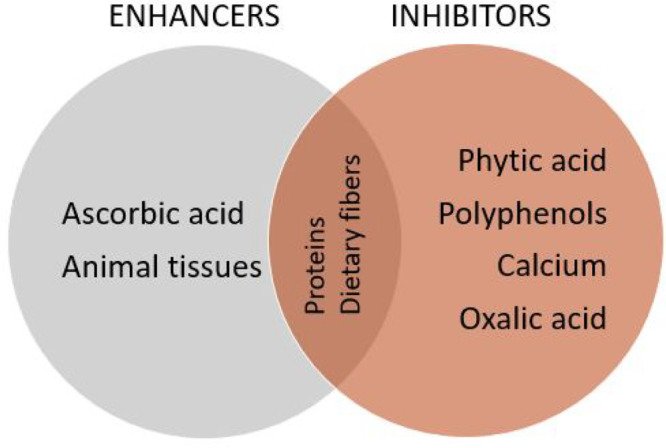
Among all dietary inhibitors, phytic acid (phytate) has the greatest impact on non-heme iron bioavailability. Phytates are the natural storage form of phosphorus in seeds and grains. While they offer several health benefits, including antioxidant activity and possible protection against metabolic disease, they also bind minerals extremely efficiently.
Once phytate binds iron, the resulting complex becomes poorly soluble and cannot be absorbed by intestinal transporters. Foods Rich in Phytates
-
Whole wheat
-
Brown rice
-
Bajra
-
Ragi
-
Jowar
-
Maize
-
Soybeans
-
Lentils
-
Chickpeas
-
Kidney beans
-
Peanuts
-
Sesame seeds
For many Indians, these foods form the foundation of daily meals. Consequently, although total dietary iron intake may appear satisfactory, bioavailable iron can be substantially reduced.
Experimental studies demonstrate that even relatively small quantities of phytate can reduce non-heme iron absorption by 50–80%, depending on meal composition.

Tea: India’s Most Common Iron Absorption Inhibitor
Tea is one of India’s most beloved beverages. Unfortunately, it is also among the strongest inhibitors of non-heme iron absorption. The principal compounds responsible are polyphenols, particularly tannins, which rapidly bind soluble iron during digestion.
Numerous metabolic studies have demonstrated that consuming tea with meals can reduce non-heme iron absorption by 40–90%, depending on brewing strength and timing.
Why Timing Matters – The inhibitory effect is greatest when tea is consumed:
-
During meals
-
Immediately after meals
The effect decreases substantially when tea is consumed 1–2 hours after eating. For individuals with iron deficiency, this simple change may improve iron absorption without altering the overall diet.
Coffee Also Reduces Iron Absorption
Although less widely consumed than tea in India, coffee contains chlorogenic acids and other polyphenols that also interfere with non-heme iron absorption. The inhibitory effect varies according to preparation method but is generally lower than that observed with strong black tea.
Nevertheless, individuals with iron deficiency should avoid consuming coffee alongside iron-rich meals or oral iron supplements.
Calcium: An Unexpected Competitor
Calcium occupies a unique position because it can inhibit the absorption of both heme and non-heme iron. Unlike phytates or tannins, calcium appears to interfere directly with intestinal transport mechanisms.
Several controlled feeding studies have shown that calcium doses of approximately 300–600 mg, equivalent to one or two servings of dairy products, may temporarily reduce iron absorption. However, long-term studies suggest that habitual calcium intake has only modest effects on overall iron status in healthy individuals.
For patients with established iron deficiency, clinicians often recommend separating calcium supplements and iron supplements by at least two hours.
Oxalates: Less Important Than Commonly Believed
Spinach has traditionally been promoted as one of India’s richest sources of iron. While spinach contains appreciable amounts of iron, it is also exceptionally rich in oxalic acid. Oxalates bind several minerals, including calcium and iron, reducing their bioavailability. Current evidence indicates that phytates exert a much greater inhibitory effect on iron absorption than oxalates.
Nevertheless, spinach should not be considered an ideal standalone source of absorbable iron. Combining spinach with vitamin C-rich foods substantially improves iron utilization.
Vitamin C: The Most Powerful Natural Enhancer of Non-Heme Iron Absorption
If phytates are the greatest inhibitor of non-heme iron absorption, vitamin C is its most effective dietary enhancer. Vitamin C improves iron absorption through multiple mechanisms:
-
Reduces ferric iron (Fe³⁺) to ferrous iron (Fe²⁺)
-
Maintains iron in a soluble form
-
Prevents iron from binding phytates
-
Enhances intestinal transport
Clinical studies consistently demonstrate that adding 50–100 mg of vitamin C to a meal can increase non-heme iron absorption two- to four-fold, depending on meal composition. Excellent Indian Sources of Vitamin C are – Amla, Guava, Lemon, Orange, Sweet lime, Tomatoes, Capsicum, Raw mango and Papaya.
A simple squeeze of lemon over dal or adding guava after meals can meaningfully enhance iron bioavailability.
Fermentation: Traditional Indian Wisdom Supported by Modern Science
Traditional food preparation methods can significantly improve mineral absorption. Fermentation activates naturally occurring enzymes called phytases, which degrade phytic acid. As phytate concentrations decline, iron becomes more available for intestinal absorption. Examples include:
-
Idli
-
Dosa
-
Dhokla
-
Fermented millet batters
Studies have shown that fermentation can substantially improve iron bioavailability from cereals and legumes.
Sprouting: Nature’s Own Bioavailability Enhancer
Sprouting or germination also activates endogenous phytases. During germination:
-
Phytate concentrations decrease
-
Vitamin C content increases
-
Certain polyphenols decline
-
Mineral bioavailability improves
Sprouted moong, sprouted chana and germinated pulses therefore provide nutritional advantages beyond simply increasing vitamin content.
Cooking in Cast Iron Utensils
One of the oldest household practices in India has gained renewed scientific interest. Cooking acidic foods such as: Tomato curry, Tamarind-based dishes, Rasam and Sambar in cast iron cookware increases the iron content of prepared foods through gradual transfer of iron from the cooking surface.
Although the magnitude varies according to cooking time, acidity and moisture, this simple practice may contribute meaningfully to dietary iron intake, particularly in resource-limited settings.
The Iron Absorption Scorecard
| Factor | Effect on Iron Absorption |
|---|---|
| Heme iron | ⭐⭐⭐⭐⭐ Excellent |
| Vitamin C | ⭐⭐⭐⭐⭐ Strong enhancer |
| Meat, fish and poultry proteins (“meat factor”) | ⭐⭐⭐⭐ Enhancer of non-heme iron absorption |
| Fermentation | ⭐⭐⭐⭐ Improves bioavailability |
| Sprouting | ⭐⭐⭐ Improves bioavailability |
| Cast iron cookware | ⭐⭐⭐ Modest increase |
| Tea | ⭐⭐⭐⭐⭐ Strong inhibitor |
| Coffee | ⭐⭐⭐ Moderate inhibitor |
| Phytates | ⭐⭐⭐⭐⭐ Strong inhibitor |
| Calcium (high-dose supplements) | ⭐⭐⭐ Moderate inhibitor |
| Chronic inflammation (via hepcidin) | ⭐⭐⭐⭐⭐ Major physiological inhibitor |
Practical Dietary Recommendations for Indian Families
Current evidence supports several simple strategies to improve iron absorption:
-
Pair dal, legumes and leafy vegetables with vitamin C-rich foods such as lemon, amla or guava
-
Avoid tea and coffee during meals; consume them at least one to two hours later
-
Use fermentation and sprouting to reduce phytate content in cereals and pulses
-
Separate calcium supplements from iron supplements when medically advised
-
Include animal-source foods / meats, as modest amounts of meat, fish or poultry can enhance the absorption of non-heme iron consumed in the same meal
-
Consider cooking acidic foods in cast iron cookware to modestly increase dietary iron content