



Disclaimer – This is purely for educational purposes and is not a real case study. The details mentioned are only and solely for a better understanding of this progressive and pervasive condition that young Indians are currently faced with. NAFLD and its new name, MASLD, Grade-2 stages can effectively and fully be reversed with Nutrition, Exercise and Discipline. Read on how..
A Disease That Often Begins in Your 30s
Rohan (name changed) is a 35-year-old software engineer from Bengaluru. He works nearly 10 hours a day, spends most of his working hours seated, sleeps after midnight, skips breakfast several days a week, relies heavily on food delivery apps, and exercises only occasionally. He does not smoke.
Alcohol intake is limited to weekends. Like many young professionals, he believes he is “healthy enough.” He has never been hospitalized. He takes no regular medication. Yet, over the past three years, subtle warning signs have started appearing:
-
Increasing abdominal fat despite stable body weight
-
Afternoon fatigue
-
Difficulty concentrating after lunch
-
Snoring noticed by his spouse
-
Reduced exercise tolerance
-
Mild elevation of liver enzymes during annual health checks
-
Borderline high fasting glucose
-
Rising triglycerides
His physician recommends an abdominal ultrasound. The report arrives the following day.
Impression: Moderate diffuse hepatic steatosis consistent with Grade II Fatty Liver Disease. Rohan is shocked. He drinks alcohol only occasionally. How can he already have liver disease? The answer lies not in alcohol, but in metabolism and thats why new, right scientific name, MASLD (Metabolic Dysfunction Associated Steatotic Liver Disease).
Meet Rohan
-
Age / Sex: 35-year-old male and Ethnicity: South Asian (Indian)
-
Diagnosis: Grade-2 Non-Alcoholic Fatty Liver Disease (NAFLD) / Metabolic Dysfunction-Associated Steatotic Liver Disease (MASLD) verified via Abdominal Ultrasonography (increased echogenicity with impaired visualization of portal vein walls and diaphragm) and Transient Elastography (FibroScan: Controlled Attenuation Parameter [CAP >280 dB/m; Liver Stiffness Measurement [LSM] ~ 6.2 kPa).
-
Height: 174 cm | Weight: 78 kg | BMI: 25.7 kg/m2 (Overweight for South Asian Cutoffs: 23.0 kg/m2); Waist Circumference: 94 cm (Elevated central adiposity)
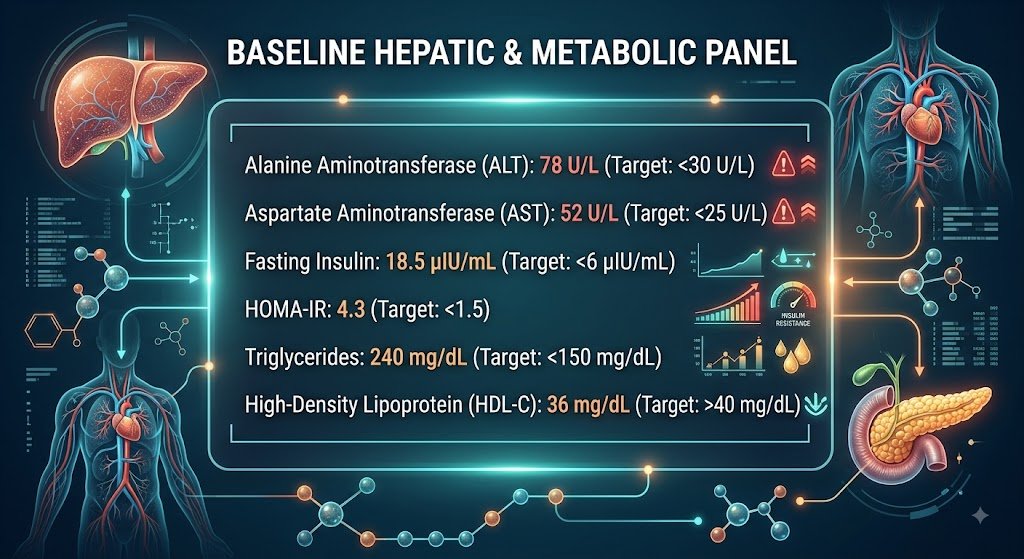
Baseline Clinical Laboratory Panel
Lifestyle Assessment
Occupation – Sedentary office work for 10–11 hours/day. Approximately 1,800–2,500 steps/day, No structured exercise, Weekend walking only and No resistance training currently
Sleep – 6–6.5 hours/night. Late bedtime, Frequent screen exposure before sleep and Occasional snoring
Diet Pattern – Breakfast often skipped; Lunch – Low Protein, Lacto-Veg diet; Dinner – Late (9:30–10:30 PM) and large portions, Restaurant meals 3–4 times/week with Cakes and desserts 2–3 times/week in office
Pathophysiology: The South Asian Phenotype
Despite a non-obese or mildly elevated BMI, South Asians systematically demonstrate the “Thin-Fat” Phenotype—characterized by low skeletal muscle mass (sarcopenia) combined with high intra-abdominal visceral fat and ectopic hepatic lipid deposition.
High-glycemic carbohydrate diets (polished rice, refined wheat flour/maida) drive excessive De Novo Lipogenesis (DNL) in the liver via persistent hyperinsulinemia, elevating hepatic triglyceride storage and reactive oxygen species (ROS) production.
Why This Case Is So Important for Indians
India is experiencing one of the fastest increases in fatty liver disease worldwide, driven by rapid urbanization, sedentary occupations, visceral obesity, and high rates of insulin resistance. Many affected individuals are in their 30s and 40s and may have only mildly elevated liver enzymes—or even normal liver enzymes—despite significant liver fat.
Unlike many Western populations, Indians often develop metabolic complications at lower BMI because of greater visceral fat accumulation and lower skeletal muscle mass.
Central Clinical Question
Can a 35-year-old Indian with Grade II fatty liver realistically improve or even reverse liver fat using structured exercise, nutrition, and carefully selected nutritional supplements—without relying on liver-specific medications?
Current international and Indian guidelines agree that lifestyle modification is the foundation of treatment. Sustained weight loss of around 5% is associated with reduced liver fat, 7–10% can improve steatohepatitis, and ≥10% may contribute to fibrosis regression in appropriate patients. Regular aerobic and resistance exercise are recommended even when weight loss is modest because they improve insulin sensitivity and reduce hepatic fat.
Copy of Indian National Association for Study of the Liver (INASL) Guidance Paper – Indian National Association for Study of the Liver (INASL) Guidance Paper
Copy of European Association for Study of Liver Guidelines – EASL–EASD–EASO Clinical Practice Guidelines on the management of metabolic dysfunction-associated steatotic liver disease (MASLD)
Interventional Framework: Exercise Physiology and Nutritional Supplementation
“The ultrasound shows the fat. The laboratory tests reveal why it accumulated.” One of the biggest mistakes in fatty liver management is treating the ultrasound report instead of the underlying metabolic disease.
Grade-2 Fatty Liver (MASLD) is not simply excess fat inside the liver. It is usually the visible manifestation of a much larger metabolic disorder involving:
-
insulin resistance / visceral obesity
-
chronic low-grade inflammation / mitochondrial dysfunction
-
altered lipid metabolism / micronutrient deficiencies
-
skeletal muscle insulin resistance / endothelial dysfunction
For this reason, current Indian as well as International MASLD guidelines recommend a structured evaluation using metabolic risk assessment together with non-invasive fibrosis testing rather than relying on treating liver enzymes alone.
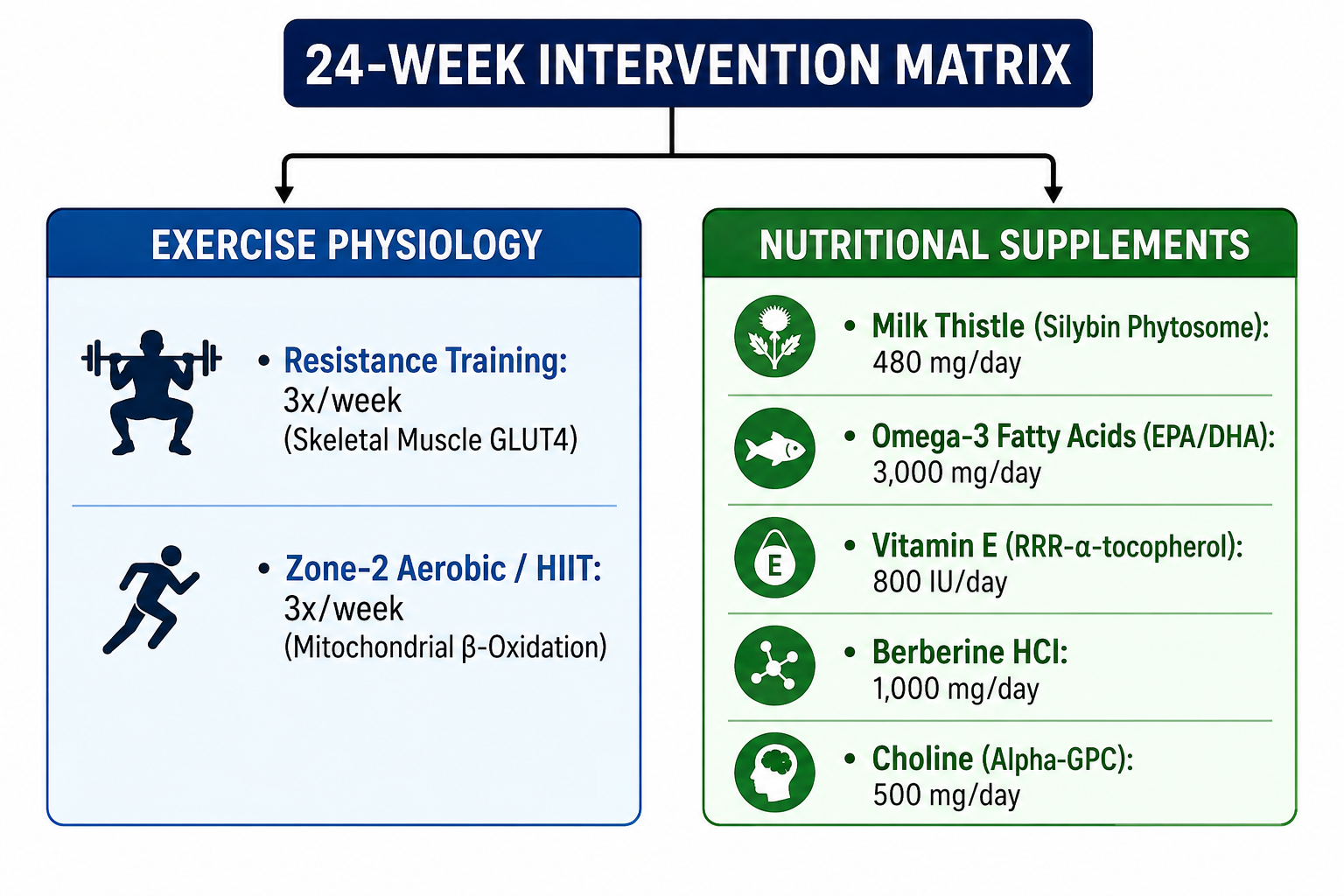
The following 24-week protocol relies entirely on targeted exercise mechanics and evidence-based bioactive supplementation to reduce hepatic steatosis, lower oxidative stress, and resolve low-grade hepatic inflammation without pharmaceutical agents.
Scientific Mechanics of the Supplement Protocol
A. Milk Thistle (Silymarin / Silybin Phytosome Complex)
-
Dose: 480 mg/day (Silybin phosphatidylcholine complex for superior lipophilic absorption)
-
Mechanism: Silybin acts as a powerful hepatic antioxidant and anti-inflammatory compound. It inhibits nuclear factor kappa B, reducing downstream pro-inflammatory cytokines in Kupffer cells. Additionally, it preserves intra-hepatic glutathione (GSH) concentrations, mitigating lipid peroxidation of hepatocytes
B. High-Concentration Omega-3 Fatty Acids (EPA & DHA)
-
Dose: 3,000 mg/day total (2,000 mg EPA + 1,000 mg DHA)
-
Mechanism: Long-chain omega-3 fatty acids act as ligands for Peroxisome Proliferator-Activated Receptor Alpha, upregulating mitochondrial and peroxisomal beta-oxidation of fatty acids in hepatocytes. Concurrently, EPA/DHA suppress Sterol Regulatory Element-Binding Protein-1c, directly turning down hepatic De Novo Lipogenesis (DNL)
C. Vitamin E (Natural d-Alpha-Tocopherol)
-
Dose: 800 IU/day
-
Mechanism: Vitamin E is a chain-breaking lipid-soluble antioxidant that halts lipid peroxidation in hepatocyte membranes caused by accumulating free fatty acids. (Supported as a primary non-diabetic MASLD intervention by the PIVENS clinical trial)
D. Berberine Hydrochloride (HCl)
-
Dose: 1,000 mg/day (split into 500 mg doses prior to main meals)
-
Mechanism: Activates AMP-Activated Protein Kinase (AMPK)—the master cellular metabolic switch. AMPK activation inhibits Acetyl-CoA Carboxylase, stopping fatty acid synthesis while enhancing peripheral glucose uptake and insulin sensitivity.
E. Choline (Alpha-GPC / Phosphatidylcholine)
-
Dose: 500 mg/day
-
Mechanism: Choline is an essential precursor for phosphatidylcholine, which is mandatory for the synthesis and secretion of Very Low-Density Lipoproteins (VLDL). Without adequate choline, triglycerides become trapped inside hepatocytes, accelerating hepatic steatosis.
Exercise Physiology Protocol
Exercise mobilizes intra-hepatic triglycerides even prior to significant body weight loss through two distinct biochemical pathways:
1. Resistance Training (Progressive Overload — 3 Days/Week)
-
Routine: Compound multi-joint movements (Squats, Deadlifts, Overhead Presses, Rows) at 65%–80% 1-Repetition Maximum (1RM)
-
Physiological Impact: Increases skeletal muscle mass and translocates GLUT4 glucose transporters to muscle membranes independently of insulin. This reduces the systemic glucose load returning to the liver via the portal vein, shutting down substrate availability for DNL
2. Zone-2 Aerobic & HIIT Conditioning (3 Days/Week)
-
Zone-2 Training: 45 minutes of low-intensity cardio (Heart Rate: 60%–70% HRmax) utilizing fatty acids as the primary fuel source, driving lipid clearance from non-adipose tissues
-
HIIT Protocol: High-Intensity Interval Training (4 X 4 minute intervals at 85%–90% HRmax) boosts post-exercise oxygen consumption (EPOC) and upregulates hepatic mitochondrial biogenesis
24-Week Post-Intervention Results
Clinical Marker |
Baseline |
Week 12 (Mid-Point) |
Week 24 (Final) |
Reference Target |
ALT (Serum Transaminase) |
78 U/L |
42 U/L |
22 U/L |
<30 U/L |
AST (Serum Transaminase) |
52 U/L |
31 U/L |
19 U/L |
<25 U/L |
Fasting Insulin |
18.5 mu IU/mL |
10.2 mu IU/mL |
5.4 mu IU/mL |
<6.0 mu IU/mL |
HOMA-IR |
4.3 |
2.2 |
1.1 |
<1.5 |
Triglycerides |
240 mg/dL |
165 mg/dL |
118 mg/dL |
<150 mg/dL |
Ultrasonography (Liver) |
Grade-2 Steatosis |
Grade-1 Steatosis |
Normal (Complete Resolution) |
Normal Echogenicity |
FibroScan (CAP Score) |
295 dB/m |
245 dB/m |
205 dB/m |
<238 dB/m |
“Fatty liver is not a disease that improves because of one good meal or one week in the gym. It improves because hundreds of small metabolic decisions are repeated every day for an entire year.”
For our health – should we need to choose between focus on Diabetes or Fatty Liver Prevention Strategies, we will choose taking care of Fatty Liver more seriously and dilligently anyday as risk for Diabetes gets mitigated if we already have Good Food and Lifestyle Practices for Fatty Liver Avoidance. Wishing You Healthy Liver and Happy Heart.
Key Scientific References and Published Literature
-
Milk Thistle / Silymarin in NAFLD:
-
Loguercio, C., et al. “Silybin combined with phosphatidylcholine and vitamin E in patients with non-alcoholic fatty liver disease.” Free Radical Biology and Medicine, 2012
-
Wah Kheong, C., et al. “Silymarin in non-alcoholic fatty liver disease: A systematic review and meta-analysis.” Journal of Gastroenterology and Hepatology, 2017
-
-
Omega-3 Fatty Acids & Hepatic Steatosis:
-
Sanyal, A. J., et al. “Eicosapentaenoic acid ethyl ester (EPA) for nonalcoholic steatohepatitis: The WELCOME trial.” Gastroenterology, 2014
-
Yan, J. H., et al. “Effect of omega-3 fatty acids on non-alcoholic fatty liver disease: A systematic review and meta-analysis.” Medicine, 2018
-
-
Vitamin E (The PIVENS Trial):
-
Sanyal, A. J., Chalasani, N., Kowdley, K. V., et al. “Pioglitazone, Vitamin E, or Placebo for Nonalcoholic Steatohepatitis (PIVENS).” New England Journal of Medicine, 362(18), 1675–1685, 2010
-
-
Berberine & AMPK Activation:
-
Yan, H. M., et al. “Efficacy of Berberine in patients with non-alcoholic fatty liver disease.” PLOS ONE, 2015
-
Zhang, Z., et al. “Berberine activates AMPK to suppress de novo lipogenesis and alleviate hepatic steatosis.” Hepatology, 2014
-
-
Exercise & Hepatic Fat Mobilization:
-
Keating, S. E., et al. “Effect of exercise training on hepatic steatosis in non-alcoholic fatty liver disease: A systematic review and meta-analysis.” Journal of Hepatology, 2012
-
van der Heijden, G. J., et al. “Aerobic exercise reduces hepatic lipid content in overweight individuals without weight loss.” Hepatology, 2010
-