



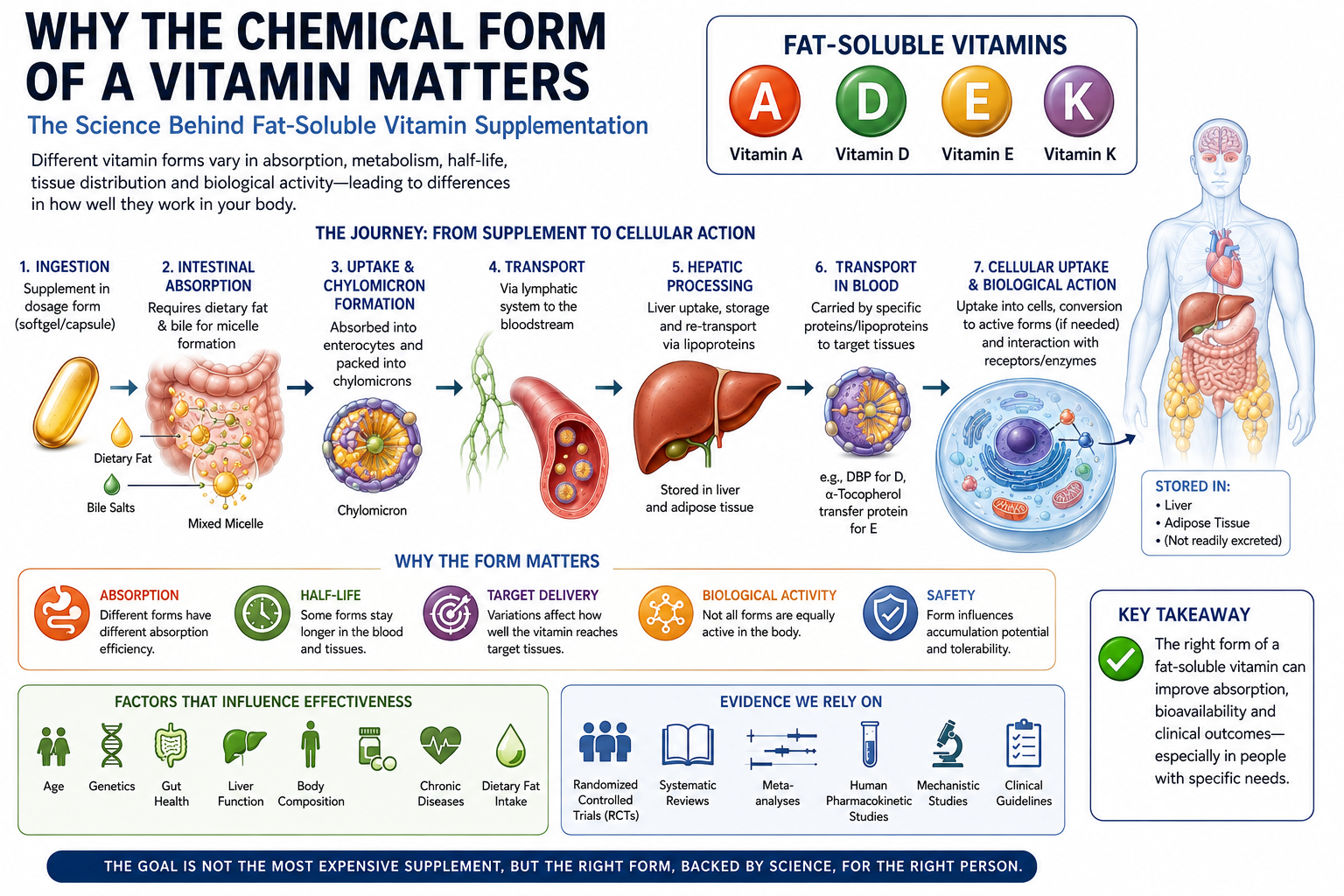
Fat-soluble vitamins, including vitamins A, D, E, and K, are energy-free molecules that are essential to the body’s functioning and life.
Their intake is almost exclusively exogenous, i.e., Only Dietary Sources as body can not synthesize Fat Soluble Vitamins on its own. As a result, fat-soluble vitamin deficiencies are common in countries with limited resources such as India.
Certain groups of people are particularly at higher risks of deficiencies, such as newborns or growing children, pregnant or breastfeeding women, and elderly or isolated individuals. Deficiencies in vitamins A, D, E, and K are also relatively frequent in subjects with digestive tract disorders, liver diseases, chronic pathologies, or in intensive care patients.
Diagnosis of a Fat Soluble Vitamin Deficiency relies on blood tests and Treatment of deficiencies requires relevant Vitamin supplementation, a well-balanced diet, and treatment of the cause. This article covers all required details to scientifically choose Best Form of Fat Soluble Vitamins for Supplementation.
Best Forms of Fat Soluble Vitamins for Supplementation
1. Vitamin A (Retinoids & Carotenoids) – we have already covered this Vitamin A Best Form – in thorough details, in a separate article – which can be accessed here. https://www.vitaminerals.in/best-vitamin-a-supplement-form/
A brief summary of best form, evidence based, is as following:
Superior vs. Suboptimal Form Comparison
Parameter |
Retinyl Palmitate (Preformed Ester) |
Synthetic β-Carotene (Isomeric Isolated) |
Conversion Dependency |
Zero (Directly converted to Retinol) |
High (BCMO1 enzyme rate-limited) – Hence not preferred |
Intestinal Uptake Efficiency |
70%–90% (via lipid micellar absorption) |
10%–28% (varies by genetic polymorphisms) |
Hepatic Storage Efficiency |
High (Directly stored in Hepatic Stellate Cells) |
Low (Requires cleavage prior to retinyl esterification). |
Safety Threshold |
High doses require monitoring for hypervitaminosis |
Non-toxic, but high doses increase oxidative stress in smokers |
2. Vitamin D (Calciferols)
Optimal Supplemental Form(s)
-
Vitamin D3 (Cholecalciferol): Derived from lanolin or lichen (Cladonia rangiferina for vegan formulations), microencapsulated or suspended in Medium-Chain Triglyceride (MCT) oil.
Biochemical & Pharmacokinetic Rationale
-
Binding Affinity & Half-Life: Vitamin D3 (Cholecalciferol) binds to Vitamin D-Binding Protein (DBP) with significantly higher affinity than Vitamin D2 (Ergocalciferol). Vit. D3 maintains a longer elimination half-life of 21 to 30 days compared to Vit. D2 (7 to 15 days).
-
Serum 25(OH)D Clearance: Meta-analyses demonstrate that Vit. D3 is 87% to 500% more potent than Vit. D2 in elevating and sustaining circulating serum 25-hydroxyvitamin D [25(OH)D] levels, particularly during intermittent or bolus dosing schedules. Making its choice for supplementation as a no-brainer.
Superior vs. Suboptimal Form Comparison
Parameter |
Cholecalciferol (D3) |
Ergocalciferol (D2) |
Origin |
Animal (Lanolin) or Lichen |
Fungal/Plant (Irradiated Yeast) |
DBP Binding Affinity |
High (Slow systemic clearance) |
Low (Rapid hepatic and renal breakdown) |
25-Hydroxylation Efficiency |
Substrate-preferred by hepatic CYP2R1 |
Lower affinity for CYP2R1 |
Area Under the Curve (AUC) |
3x–5x higher sustained serum 25(OH)D |
Rapid peak followed by fast elimination |
Based on all data and details above – do not even touch Vit D2 and Vit D3 Choilecalciferol should be an ideal, automatic choice for supplementaion.
3. Vitamin E (Tocopherols & Tocotrienols)
Optimal Supplemental Form(s)
-
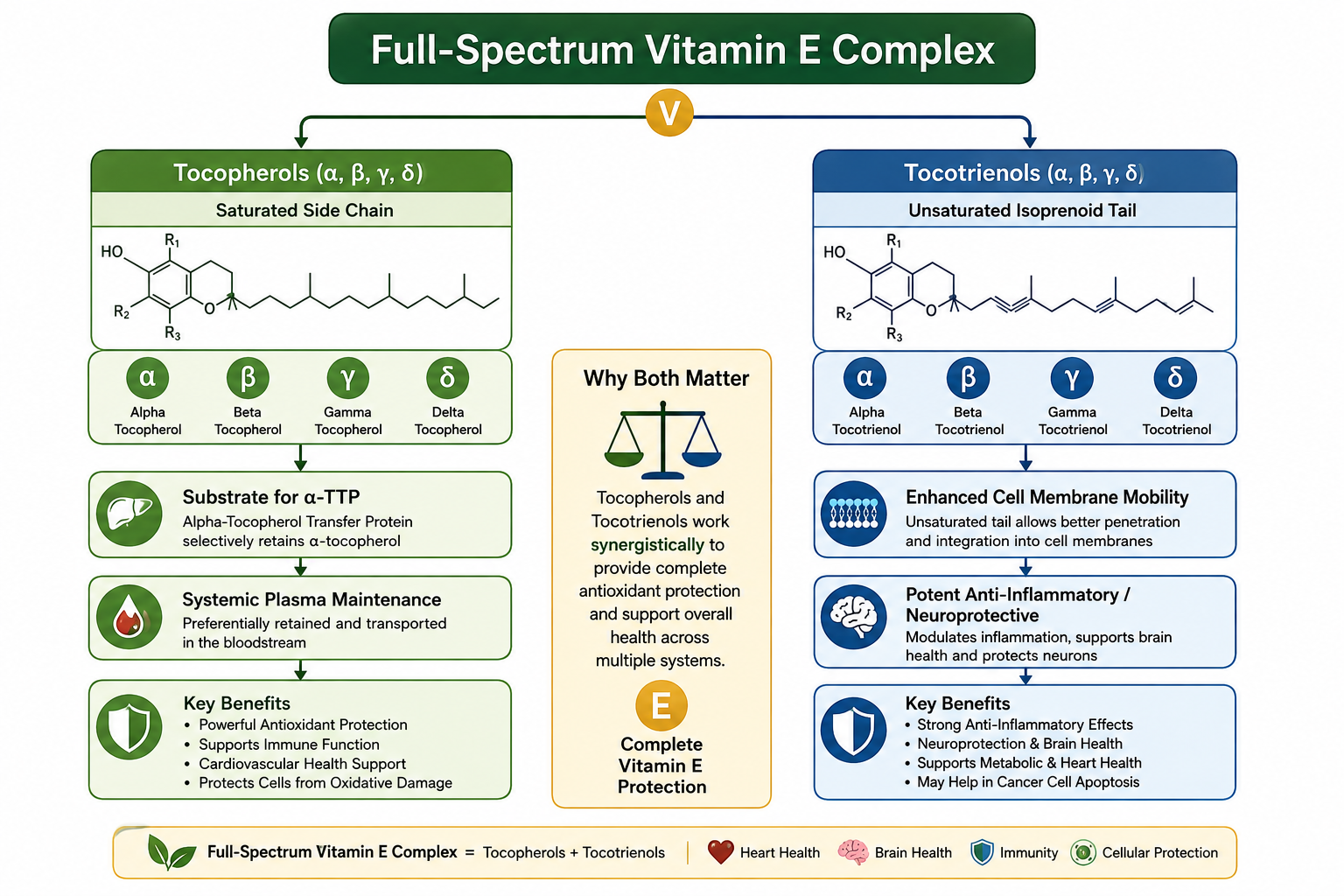
Full-Spectrum Mixed Tocopherols & Tocotrienols: Containing $d$–$\alpha$-tocopherol alongside $\gamma$-tocopherol, $\delta$-tocopherol, and mixed tocotrienols (derived from red palm fruit or annatto).
Biochemical & Pharmacokinetic Rationale
-
Natural vs. Synthetic Stereoisomers: Natural Vitamin E exists exclusively as the d-alpha-tocopherol. Synthetic forms consist of an equal mixture of 8 stereoisomers, only one of which is natural. The hepatic alpha-Tocopherol Transfer Protein preferentially binds and secretes the 2R-stereoisomers into VLDL, resulting in 2times the bioactivity and retention of natural d–alpha-tocopherol over synthetic variants.
Superior vs. Suboptimal Form Comparison
Parameter |
d-α-Tocopherol + Mixed Tocotrienols (Natural) |
dl-α-Tocopherol Acetate (Synthetic) |
Isomer Composition |
100% 2R,4’R,8’R (Bio-identical) |
Racemic mixture of 8 stereoisomers (2R and 2S) |
alpha-TTP Recognition |
100% Affinity |
<50% Effective Recognition |
RNS Trapping Ability |
High (via gamma-tocopherol fraction) |
Zero (lacks gamma-tocopherol) |
Membrane Ingress Rate |
Rapid (Isoprenoid tail in tocotrienols) |
Moderate (Saturated phytyl tail) |
Based on all data and details above – alpha-d-tocopherol form of Vit E should be an ideal, obvious choice for supplementaion.
4. Vitamin K (Phylloquinones & Menaquinones)
Optimal Supplemental Form(s)
-
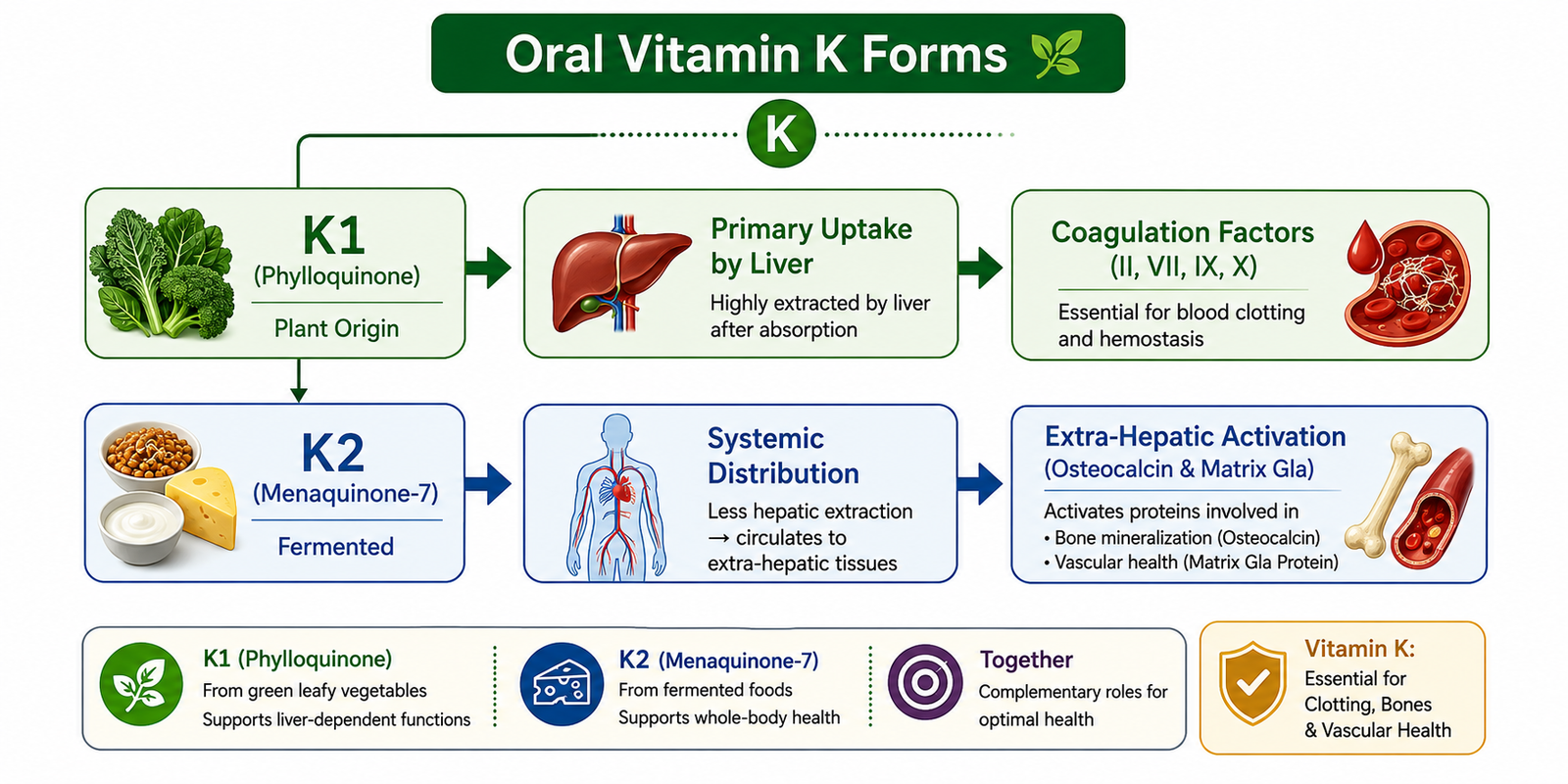
Vitamin K2 as Menaquinone-7 (MK-7): Naturally derived via Bacillus subtilis natto fermentation, synthesized as the All-Trans Isomer.
Biochemical & Pharmacokinetic Rationale
-
Pharmacokinetic Half-Life & Clearance: Vitamin K1 (Phylloquinone) has a short half-life of 1 to 2 hours and is cleared by the liver to support hepatic clotting factor synthesis. Vitamin K2 as MK-7 incorporates into VLDL/LDL particles, exhibiting a prolonged serum half-life of 72 hours. This extended circulation allows MK-7 to reach extra-hepatic tissues (vasculature and bone matrix)
-
Enzymatic Carboxylation: MK-7 serves as a cofactor for gamma$-glutamyl carboxylase (GGCX), converting inactive Glu-Osteocalcin and Glu-MGP into fully carboxylated Gla-Osteocalcin (driving hydroxyapatite deposition in bone) and Gla-MGP (inhibiting vascular smooth muscle calcification).
Superior vs. Suboptimal Form Comparison
Parameter |
Vitamin K2 (Menaquinone-7 / MK-7) |
Vitamin K1 (Phylloquinone) |
Elimination Half-Life |
72 hours – Ideal Choice |
1.5 hours |
Primary Target Tissue |
Extra-hepatic (Vascular walls, bone, cartilage) |
Hepatic (Liver coagulation proteins) |
Osteocalcin Carboxylation |
High potency at low daily doses (90–180 mcg) |
Low potency; requires high milligram-level doses |
Lipoprotein Packaging |
VLDL / LDL (Remains circulating systemically) |
Chylomicron remnants (Rapidly cleared by liver) |