



This is our Part 2 of Evidence-Explained™ Series on ADHD in Indian Children. You must, first peruse the Part 1(hyperlinked) to get a better understanding, before going through this concluding Part 2.
Four Trace Minerals Under the Microscope: Why Zinc, Iron, Ferritin and Copper Matter SO MUCH to the ADHD Brain
“The human brain represents only about 2% of body weight, yet it consumes nearly 20% of the body’s energy. Keeping this remarkable organ functioning requires a continuous supply of food and energy rich in all micronutrients that act as the brain’s biochemical workforce.”
Trace Minerals for Brain
One of the biggest misconceptions about vitamins and minerals is that they merely prevent nutritional deficiency diseases. In reality, essential trace minerals participate in thousands of biochemical reactions every single day without telling you:-). Your only 1 job is to ensure steady supply of the essential trace minerals via good, nutritious food.
Unlike carbohydrates, proteins or fats, trace minerals do not provide calories. Instead, they act as enzyme cofactors, cellular regulators, structural stabilizers, and molecular switches that allow the brain to develop normally and communicate efficiently.
This is particularly important during childhood, when the brain is undergoing rapid growth, synapse formation, myelination and refinement of neural circuits that govern attention, learning, memory and executive function.
Zinc — The Brain’s Master Regulator
If there is one trace mineral that has generated the greatest interest in ADHD research, it is Zinc. Zinc is involved in the activity of more than 300 enzymes and influences thousands of proteins responsible for cellular signalling and gene regulation. Within the developing brain, Zinc contributes to: neuronal growth, synapse formation, neurotransmitter release, antioxidant defence, immune regulation and neuroplasticity
Perhaps most importantly for ADHD research, Zinc influences dopaminergic neurotransmission. Dopamine is one of the principal neurotransmitters involved in attention, motivation, impulse control and reward processing—the very functions commonly affected in ADHD.
Experimental research suggests that inadequate Zinc availability may alter dopamine metabolism, receptor function and synaptic signalling. Zinc also modulates NMDA receptors, which regulate learning, memory and synaptic plasticity.
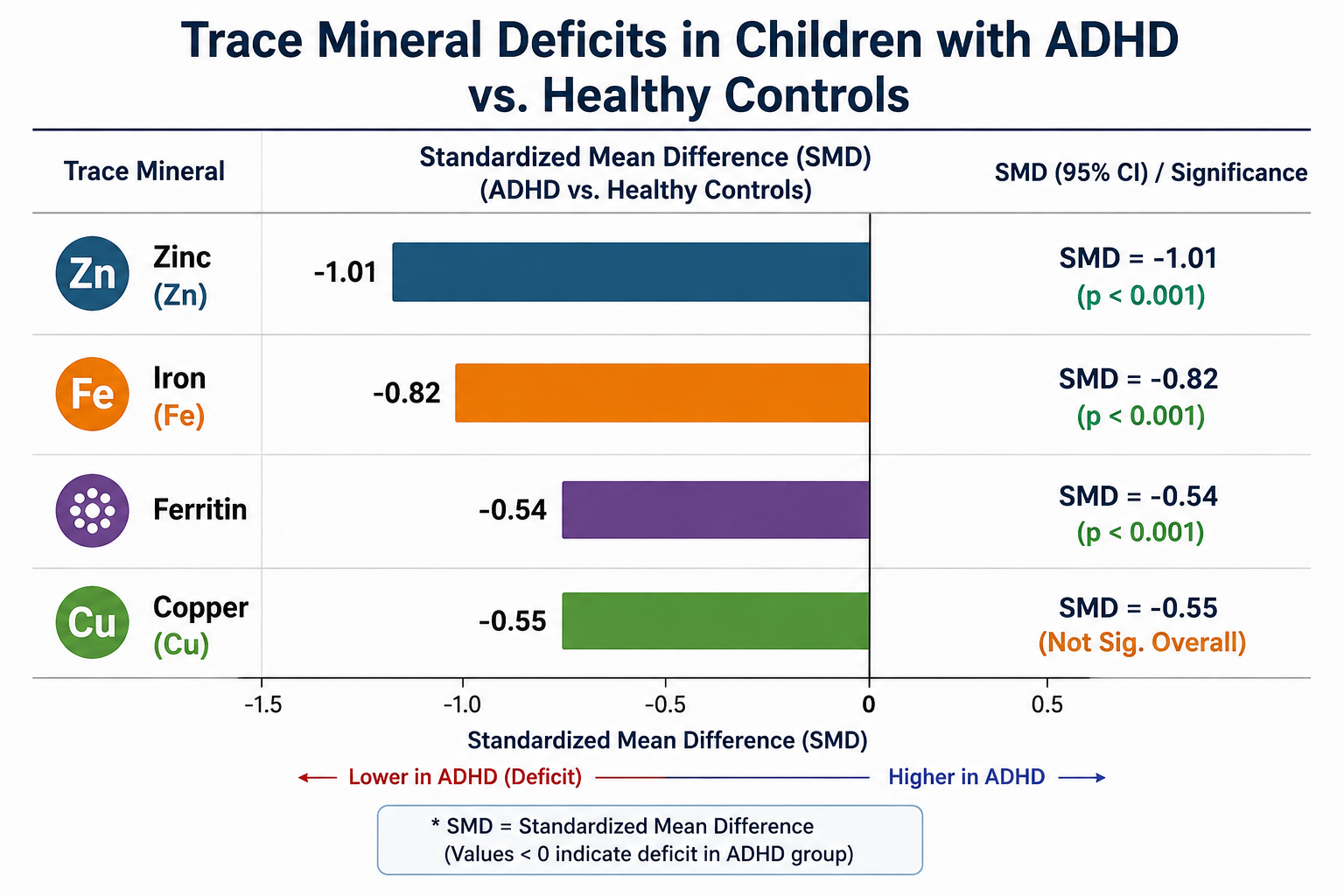
Children with ADHD had significantly lower Zinc concentrations than healthy controls across the pooled analysis, with the difference appearing even greater in children aged 12 years or younger. The association was also stronger in studies conducted in developing countries.
Iron — Fuel for the Developing Brain
Iron is often associated with red blood cells and oxygen transport. But its role in the nervous system is equally important. Brain cells require iron for: mitochondrial energy production, myelin formation, neuronal maturation and neurotransmitter synthesis.
One of iron’s most critical functions is serving as a cofactor for tyrosine hydroxylase, the enzyme that initiates dopamine synthesis. Without adequate Iron, dopamine production and signalling may be impaired.
Iron also contributes to serotonin metabolism and supports the high energy demands of rapidly developing neurons. Because ADHD has long been linked with alterations in dopamine pathways, researchers have investigated whether lower Iron status might accompany the disorder.
Across 23 studies, children with ADHD had significantly lower iron concentrations than control participants.
Ferritin — Looking Beyond Iron Levels
Many parents have never heard of ferritin, yet it may be one of the most informative laboratory markers in nutritional medicine. Ferritin is a protein that safely stores iron inside cells and releases it when needed. Think of it as the body’s Iron savings account. A child can sometimes have:
-
a normal hemoglobin concentration,
-
normal circulating iron,
-
yet still have depleted iron reserves.
Ferritin helps clinicians determine whether iron stores are adequate. Because the brain requires a continuous Iron supply for neurotransmitter production and myelination, depleted ferritin may indicate that iron availability is becoming limited even before anemia develops. The review identified nine studies reporting ferritin concentrations. After pooling their data, children with ADHD showed significantly lower ferritin levels than healthy controls.
Copper — An Important Mineral, but Less Convincing Evidence
Copper is another essential trace element involved in neurological function. It contributes to: mitochondrial respiration, antioxidant enzymes, connective tissue formation and neurotransmitter metabolism
Copper also interacts biologically with Iron. These two minerals work together in several metabolic pathways, and disturbances in one can influence the other. For that reason, researchers expected copper might also differ in children with ADHD.
However, the results were less convincing. Although some individual studies reported lower copper concentrations, the pooled analysis found no statistically significant overall difference between ADHD and control groups. This is an important finding because good science reports both positive and negative results.
Why Do These Minerals Matter Together?
One of the strengths of this review is that it encourages us to think about trace minerals as an interconnected biological network rather than isolated nutrients. For example:
Zinc supports neurotransmitter signalling and synaptic plasticity
Iron supports dopamine synthesis, oxygen delivery and neuronal energy metabolism
Ferritin reflects the body’s ability to maintain iron reserves over time
Copper participates in oxidative metabolism and interacts with iron homeostasis. The developing brain depends on all of these systems functioning together.
Neurobiological Mechanisms: Why Zinc and Iron Impact ADHD
Trace minerals act as indispensable cofactors in neurodevelopment, central neurotransmitter synthesis, and brain energy metabolism:
-
Iron and Dopamine Synthesis: Iron is an obligatory cofactor for tyrosine hydroxylase, the rate-limiting enzyme that converts L-tyrosine into L-DOPA (the direct precursor of dopamine). Depleted brain Iron reduces striatal dopamine concentration, directly contributing to impaired prefrontal executive function, motor restlessness, and poor impulse control
-
Ferritin and Sleep Restlessness: Low serum ferritin (<30 ng/mL) is linked to periodic limb movement disorder (PLMD) and restless sleep in ADHD, leading to poor sleep architecture that exacerbates daytime inattention and emotional lability
-
Zinc and Dopamine Transporter (DAT) Modulation: Zinc binds to high-affinity allosteric sites on the dopamine transporter (DAT), enhancing dopamine availability in the synaptic cleft. Additionally, Zinc modulates NMDA receptor activity, preventing glutamate-mediated excitotoxicity and promoting emotional regulation
Actionable Guidance for Parents
While the link between trace mineral deficiency and ADHD symptoms is clear, mineral supplementation must be approached systematically.
1. Test, Don’t Guess
Never start high-dose Iron or Zinc supplements without prior laboratory confirmation. Over-supplementation can lead to toxicity, abdominal pain, organ stress, or copper-deficiency anemia
2. Request Baseline Screening
Ask your pediatrician or pediatric psychiatrist to order a comprehensive trace element panel:
-
Serum Ferritin (Target for ADHD management is typically > 30 ng/mL to 50 ng/mL)
-
Serum Zinc and Serum Iron
-
Complete Blood Count (CBC) to rule out overt systemic anemia
3. Focus on Bioavailable Dietary Sources
-
Heme Iron & Zinc: Red meat, poultry, seafood (oysters, mussels), and eggs offer high bioavailability Iron along with good quality, rich in all essential amino acids – proteins. If you are a vegetarian, pls consider your child’s ADHD situation before imposing vegetarianism on your child
-
Non-Heme Sources: Pumpkin seeds, lentils, chickpeas, spinach and fortified cereals. Pair non-heme iron with Vitamin C (citrus, bell peppers) to boost absorption by up to 300%
-
Reduce Absorption Inhibitors: Avoid serving tea, dairy (high calcium), or phytate-heavy unsoaked grains at the same time as mineral-rich meals or supplements, as they inhibit divalent metal uptakes
Action Plan for Pediatricians and Clinicians
For healthcare providers, the findings from Wang et al. (2026) support incorporating micronutrient evaluation into standard ADHD clinical pathways.
Clinical Protocol Recommendations
-
Incorporate Ferritin & Zinc into Routine ADHD Tests:
-
Evaluate baseline serum ferritin in all newly diagnosed pediatric ADHD patients, especially those presenting with severe hyperactivity, sleep disturbances, or suboptimal response to psychostimulants
-
Recognize that a standard hemoglobin level within normal limits does not rule out central nervous system iron deficiency (indicated by low serum ferritin)
-
-
Dosing Protocols for Verified Deficiencies:
-
Iron Protocol: If serum ferritin is <30 ng/mL, initiate elemental iron at 3 –6 mg/kg BW /day (e.g. iron bisglycinate). Recheck serum ferritin every 8–12 weeks until levels reach >30 – 50 ng/mL
-
Zinc Protocol: If serum zinc is sub-optimal, elemental zinc (15 –30 mg/day or up to 55 mg/day in several clinical trials under strict monitoring) can be prescribed as an adjuvant
-
-
Manage Intestinal Competition (DMT1 Transport):
-
High-dose Iron and Zinc compete for uptake via Divalent Metal Transporter 1 (DMT1) in the small intestine
-
Clinical Pearl: Separate oral Iron and Zinc administration by at least 2 to 4 hours to prevent competitive inhibition and optimize serum bioavailability
-
-
Enhance Pharmacotherapy Response:
-
Evidence indicates that correcting baseline Zinc and Ferritin deficits improves symptom response to methylphenidate, frequently allowing for lower effective stimulant dosages while mitigating rebound irritability
-