



Evidence-Explained™ – ADHD in Indian Children
We are starting a new, Evidence-Explained™ Series – where we decode landmark clinical research published in major, international journals, into practical, science-backed actionable insights for parents, clinicians and healthcare professionals in India. While almost every single write up on www.vitaminerals.in is already thoroughly and extensively evidence based, this New Series attempts to simplify Global as well as Local Clinical Research into simpler, practical points for everyone to comprehend and understand easily.
The Largest ADHD Trace Mineral Study Ever: What a 46-Study Meta-analysis Reveals About Zinc, Iron and Ferritin in Children with ADHD
Could Common Nutrient Deficiencies Be Quietly Influencing ADHD?
Before we come to ADHD and findings of this study, lets first understand what is Meta-Analysis?
Meta-analysis is a statistical method that combines the numerical results of many different clinical studies on the same research topic and presents its findings. So for any Doctor, HealthCare Professional and even a Parent, a Meta-Analysis is such a powerful tool to understand the results from many clinical studies on a particular clinical condition quickly and scintifically. Instead of individually going through each and every scientific study – a perusal of findings from a good meta-analysis, easily, quickly and effectively brings out the key findings and actionable insights.
What is ADHD
Attention-Deficit/Hyperactivity Disorder (ADHD) affects millions of children worldwide and is one of the most frequently diagnosed neuro-developmental disorders of childhood. It is characterized by persistent symptoms of inattention, hyperactivity and impulsivity that interfere with learning, behaviour, and social development.
ADHD in India
Our Hearts break to report this statistics as Children are the so-precious future of any Society and Civilization. Healthy Children go on to shape destinies of companies, governments, socities and the world, hence any neuro-developmental issues like ADHD in young children must be attended to with utmost urgency, sincerity and dilligence.
In India, Attention-Deficit/Hyperactivity Disorder (ADHD) affects roughly 2% to 17% of children, and adult prevalence estimates range from about 5.5% to 25.7%. Yes – you read it correct that even some Adults do have ADHD.
In a large Systematic Review and Cross-Sectional Study (hyperlinked) conducted in Delhi NCR Region and published in June 2024 – involved 1665 adults (18-25 years; mean age 19.92) of both sexes (69.1% females) from different colleges in Delhi-NCR, India. Findings from this systematic review and cross-sectional study should alert each and every parent to this emerging healthcare crisis in our children – The systematic review revealed a high prevalence of adult ADHD ranging from 5.48 to 25.7% among general and specific populations of India. Further, in the cross-sectional study, 14% of participants were screened positive for ADHD.
ADHD Study from Mysore, Karnataka India (hyperlinked) – A community-based, cross-sectional study was conducted among 739 schoolchildren of Age 6 – 11 Years, from both Urban and Rural Schools. The overall prevalence of ADHD was 13.8%, prevalence was higher in boys (15.86%) than girls (10.86%) and significantly higher in urban schools (16.2%) compared to rural schools (9.7%) ( P = 0.01).
Key Epidemiological Findings from INDIA
- Childhood Prevalence: Community and school-based studies across different regions show varied numbers, typically clustering between 6% and 14% depending on screening tools and location. Urban settings often show higher identified rates (e.g., ~16.2%) compared to rural regions (~9.7%), largely reflecting awareness and access to screening
- Adult Prevalence: Emerging systematic data highlight that a high percentage of adults carry symptoms forward or receive late identification, with systematic reviews suggesting prevalence rates up to 25.7% in specific cohorts
- Gender Disparity: Boys are diagnosed more frequently than girls, with male-to-female ratios generally around 1.6:1 to 2:1. Girls often present with the predominantly inattentive subtype, which is quieter and leads to underreporting
- Subtypes: The combined presentation (inattentive and hyperactive-impulsive) is most frequently observed in clinical and school samples in India (accounting for over 50% of cases), followed by the inattentive and hyperactive-impulsive presentations
Public Health and Clinical Challenges
- Under-recognition: Over half of affected children identified in school screening studies had not been diagnosed or supported prior to these formal research assessments – which further highlights the critical gaps in timely diagnosis
- Comorbidities: High rates of overlapping challenges—such as specific learning difficulties (reading/writing issues), oppositional defiant behaviors and anxiety—complicate clinical identification
- Resource Gaps: Social stigma, financial constraints, and a shortage of specialized school counselors or child guidance clinics lead to high dropout or care-seeking gaps
Bottom Line – ADHD is significantly underdiagnosed, with higher reported rates in urban schools, among males and carrying substantial public health and academic impacts
Does Nutrition Has Any Role in ADHD
For decades, ADHD research has focused primarily on genetics, brain development, neurotransmitters, behavioural therapy and medication. More recently, scientists have begun asking another important question:
Could deficiencies of essential trace minerals make ADHD symptoms worse in some children? And Should we supplement such children?
This question has attracted enormous interest because minerals such as zinc, iron, and copper are not simply nutrients—they are indispensable cofactors for hundreds of enzymes involved in brain development, dopamine signalling, myelination, synaptic communication, mitochondrial energy production, and antioxidant defence.
The Meta-Analysis – 46 Case-Control Studies
In 2026, researchers published one of the largest analyses ever conducted on this subject. Instead of relying on a single clinical study, they systematically reviewed and statistically combined data from 46 independent case-control studies, including 5,515 children and adolescents diagnosed with ADHD and 8,166 healthy controls – (28 studies from Asia, 10 from Europe, and 8 from Africa, the Americas, and Oceania).
Their objective was straightforward:
Do children with ADHD consistently have different levels of zinc, iron, ferritin, or copper compared with children without ADHD?
The findings provide compelling evidence that lower Zinc, Iron, and Ferritin levels are associated with ADHD, while Copper levels did not differ consistently across studies. Importantly, the authors emphasize that these results demonstrate an association, but not the proof that these nutritional deficiencies cause ADHD.
Why This Study Matters
Individual nutrition studies often produce conflicting results. One trial may report a difference, another may not. Differences in sample size, geography, laboratory methods, and participant characteristics can make interpretation difficult.
A systematic review and meta-analysis addresses this problem by identifying all eligible studies, critically evaluating them and combining their results using predefined statistical methods. This approach increases statistical power and provides a more reliable estimate of the overall evidence than any single study alone. Because this review synthesized data from 46 studies across multiple countries, it offers a much broader perspective than isolated reports.
For clinicians and families, this means the conclusions are based on a large body of evidence rather than one research group’s experience.
You can access this Meta-analysis here – Meta- analysis ADHD
Four Minerals Under the Microscope
Zinc – Zinc supports hundreds of enzyme systems and contributes to neurotransmitter regulation, synaptic plasticity, immune function, and normal brain development.
Iron – Iron is required for enzymes involved in dopamine synthesis and plays an essential role in myelination, oxygen transport, and cellular energy production.
Ferritin – Ferritin reflects the body’s iron stores. A child may have a normal hemoglobin concentration yet still have depleted iron reserves, making ferritin an important marker when evaluating iron status.
Copper – Copper participates in energy metabolism, antioxidant enzymes, connective tissue formation, and several neurological pathways. Both deficiency and excess can be harmful, so maintaining balance is important.
Major Findings from Meta-Analysis
After pooling data from all 46 studies, the researchers found:
-
Zinc levels were significantly lower in children with ADHD
-
Iron levels were significantly lower in children with ADHD
-
Ferritin levels were significantly lower in children with ADHD
-
Copper levels did not differ significantly overall between ADHD and control groups
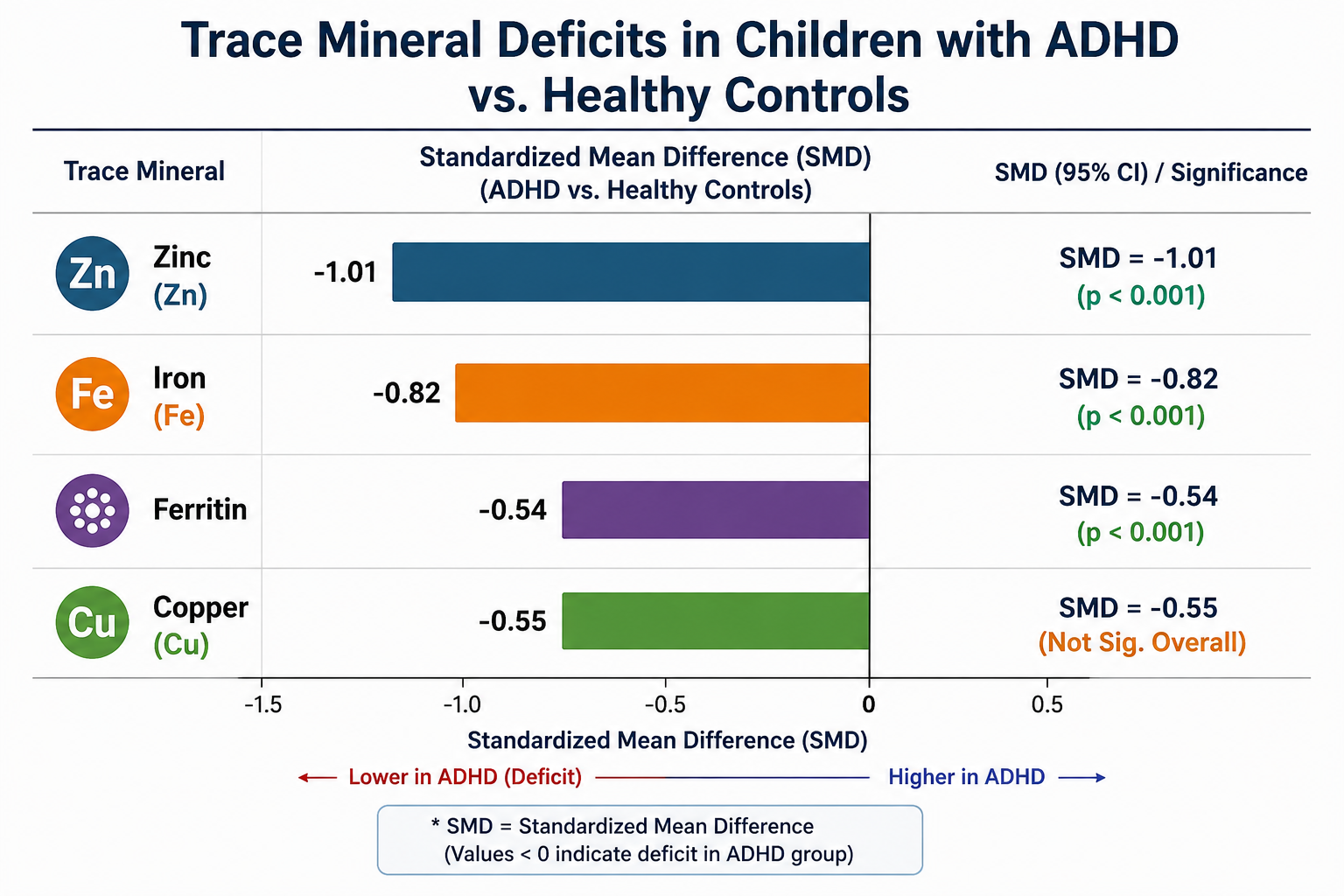
These consistent findings suggest that altered zinc and iron status may be linked with ADHD biology. However, the authors also caution that the included studies showed substantial variability, meaning the findings should be interpreted carefully rather than as definitive proof of cause and effect.
Two Particularly Interesting Observations
The investigators identified two subgroups in which mineral differences appeared more pronounced:
-
Children aged 12 years or younger showed a stronger association between ADHD and lower zinc levels
-
Children and adolescents from developing countries demonstrated more pronounced differences in zinc, iron, and copper levels compared with those from developed countries
This second observation has important public health implications for Indian children. Regions with higher rates of micronutrient deficiencies may have a greater burden of nutritional factors that coexist with neurodevelopmental disorders.
A mere perusal of www.vitaminerals.in would demonstrate that Iron, Zinc, Ferritin and to some extent Copper deficiencies are so very common and wide spread in India largely on account of our High-Cereal Grains based foods – consumed 3 times a day without much thought. Mid-day meal schemes as well as School Canteens in vast majority of Indian States / Provinces have virtually no animal based proteins and are “pure-vegetarians” – ensuring nutritional deficiencies in children at their formative stages.
In our 2nd and Concluding Part of Evidence-Explained™ – ADHD in Indian Children – we explain thecbiological importance of trace minerals in brain development and nutritional strategies for ADHD Children. Don’t Miss the Part 2 of this Series.