



Yet another Evidence-Explained™ write up – but this one focuses on our vision, actually eye health. Myopia is an ever-growing issue but understanding this condition can help minimize and delay its progression by simple, inexpensive way of increasing our Time under the Sun. Sunlight not only helps body make Vit D3 but also, not so surprisingly, plays an important role in our eye / ocular health. Simplify Life, Follow the Sun…
What is Myopia / Nearsightedness
Myopia, commonly known as nearsightedness or short-sightedness, is a refractive error in which the eye’s optical system focuses light in front of the retina, rather than directly on it. The result: distant objects appear blurry, while close objects remain clear.
This happens because of a structural mismatch in the eye:
-
Axial myopia – the most common type occurs when the eyeball grows too long from front to back (increased axial length)
-
Refractive myopia – less common occurs when the cornea is too steeply curved or the crystalline lens has excessive refractive power
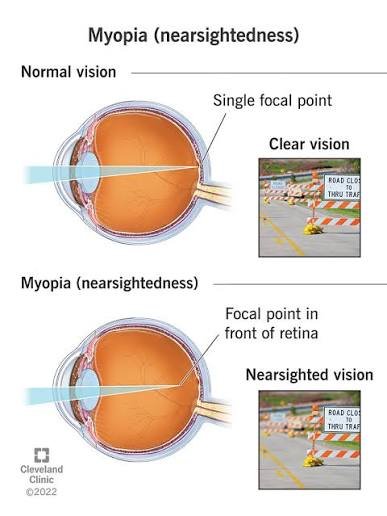
Myopia (nearsightedness) is an irreversible anatomical modification wherein the vitreous chamber of the eye stretches along its antero-posterior axis.
Myopia (nearsightedness) is rapidly rising among Indian children, with experts warning that nearly half of all school-going children in India could need spectacles by 2050. Driven by a shift toward digital learning and indoor-centric lifestyles, the country is facing a significant pediatric eye health challenge that disproportionately affects urban centers.
Myopia – Age of Onset
- Typical Range: School myopia most commonly emerges between 5 and 15 years of age, during a critical window of ocular development
- Rapid Progression Phase: It tends to progress most rapidly during the early school years (ages 6 to 11), typically stabilizing in the late teens or early twenties
- The “Younger Onset” Risk: An earlier age of onset is a major risk factor. Children who develop myopia younger (e.g., age 5–8) experience faster physical lengthening of the eye, leaving them at a much higher risk of developing severe or high myopia (above -6.00 D) later in life
Myopia – Primary Causes & Triggers
The onset of myopia in Indian children is caused by a complex interaction between genetic predisposition and drastic behavioral shifts:
- Excessive Near Work Overload: Indian school children face intense academic pressure, resulting in long hours of reading, writing, and digital learning. Spending more than 5 hours a day on close-up work drastically strains eye muscles and stimulates the eye to elongate
- The Post-COVID Digital Boom: Increased dependency on smartphones, tablets, and online classes has spiked digital eye strain. The eye continuously exerts heavy focusing effort to view close screens, accelerating myopic changes
- Lack of Outdoor & Sunlight Exposure: Natural daylight triggers the release of dopamine in the retina, a chemical that naturally prevents the eyeball from growing too long. Due to urban crowding, lack of open green spaces, and heavy homework demands, Indian children are spending minimal time outdoors
- Genetic Predisposition: Having one or both parents with myopia significantly multiplies a child’s risk
- Urban vs. Rural Disparity: Lifestyle factors tie higher myopia rates directly to urban settings and private schools, where academic and digital demands are typically higher than in rural areas. However, recent decades show a rising trend in rural environments as well
Global and Indian Epidemiological Data
The global prevalence of myopia is rising rapidly, driven by urbanization and educational intensity.
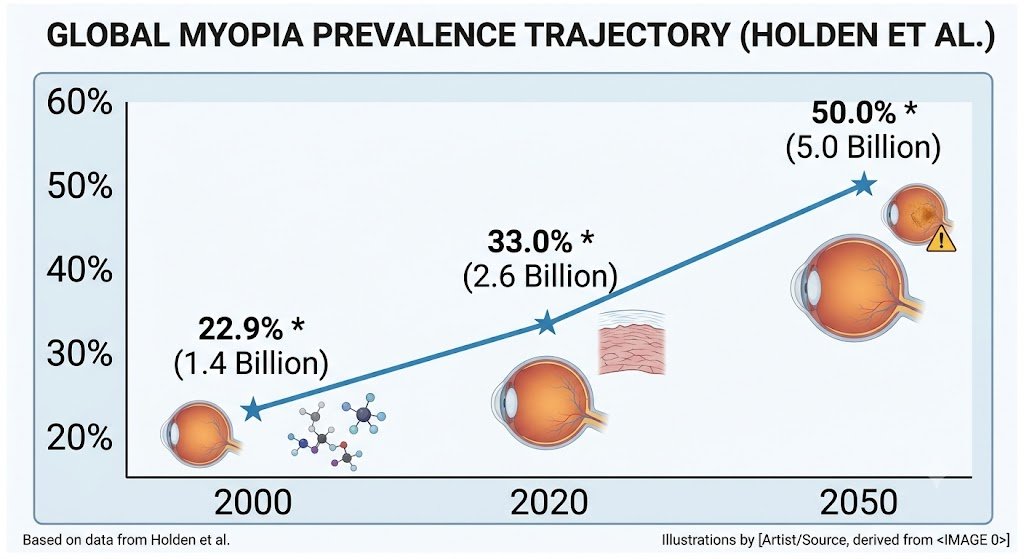
Myopia in Indians – Data
Historically, India exhibited lower myopia rates compared to East Asian nations (e.g., Singapore, South Korea, and Taiwan, where youth prevalence exceeds 80%). However, modern epidemiological surveys show a sharp rise in urban Indian centers.
-
The North India Myopia Study (NIMS) — Saxena et al. (AIIMS): Evaluated school-going children aged 5–15 in urban Delhi, reporting a myopia prevalence of 13.1%, with prevalence climbing sharply with age (reaching 19.7% in 11–15 year-olds)
-
Urban vs. Rural Disparity: Comparative trials published in the Indian Journal of Ophthalmology (IJO) highlight a pronounced gap: rural Indian children demonstrate myopia rates under 4.5%, whereas Tier-1 urban metro schools report rates exceeding 21%. Tier -1 Urban metro school children have 5X (5-Times) more Myopia incidences as compared to rural Indian Children only because Rural Indian Children spend more time outdoors, in the Sun, as compared to Metro School Children
-
Post-Pandemic Acceleration: Longitudinal data from major Indian eye institutes (LVPEI, Sankara Nethralaya, AIIMS) following remote schooling showed a 1.5 times to 2 times acceleration in annual axial elongation rates among urban children aged 6–12.
Progressive Myopia – Causes
When an Ophthalmologist informs of an increase in Power at annual eye-check – we tend to consider this as a standard routine, unavoidable correction.
However, from an anatomical standpoint, corrective, increased power spects lenses merely redirect incoming light rays to clear a blurry image—these new, higher power spects do not halt the underlying pathological mechanism: axial elongation of the eye globe.
Once scleral remodeling / myopia occurs, the eyeball cannot shrink back to its emmetropic dimensions. Each millimeter of axial length extension increases the mechanical tension exerted on the retina, escalating the cumulative lifetime risk of sight-threatening ocular pathologies.
Pathophysiology and Pathological Consequences of Axial Stretch
To understand myopia control, clinicians distinguish between refractive error (measured in Diopters, D) and axial length (measured in millimeters, mm).
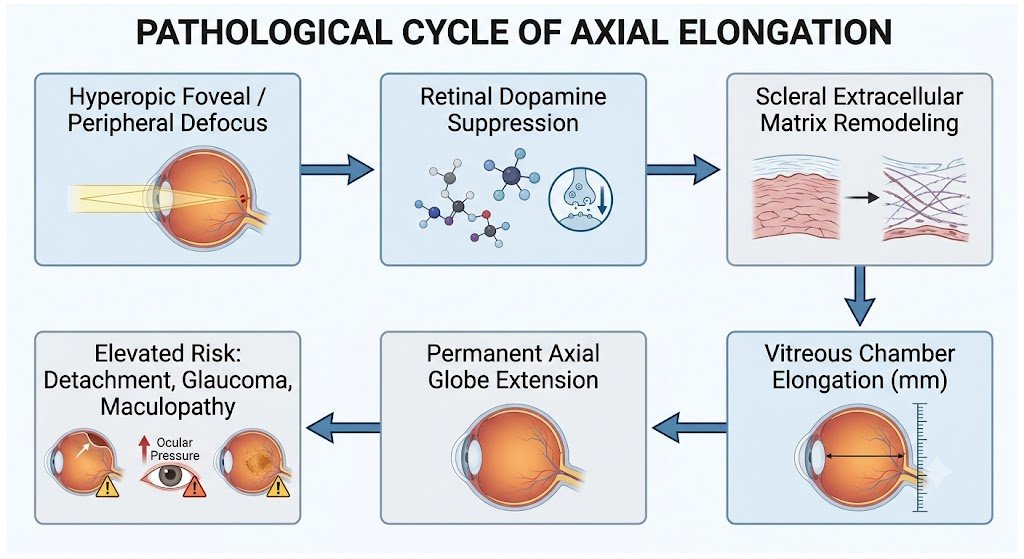
In progressive childhood myopia, the sclera undergoes active extracellular matrix remodeling, driven by retinal signals. The ocular globe elongates, causing incoming parallel light rays to focus in front of the retina rather than directly on the fovea or retina.
Risks of High Myopia
A refractive error exceeding -6.00 D or an axial length greater than 26 mm is classified as High Myopia. However, epidemiological consensus confirms there is no safe threshold: every additional 1.00 D of myopia increases the lifetime risk of myopic maculopathy by 40%.
-
Retinal Detachment: The mechanical stretching of the peripheral retina thins the neurosensory tissue, predisposing the eye to lattice degeneration, retinal tears, and rhegmatogenous retinal detachment
-
Myopic Maculopathy (Macular Degeneration): Axial stretching damages the retinal pigment epithelium (RPE) and Bruch’s membrane, causing chorioretinal atrophy, posterior staphyloma, and choroidal neovascularization (CNV)
-
Glaucoma: Elongation distorts the optic nerve head architecture and lamina cribrosa, making retinal ganglion cell axons significantly more susceptible to glaucomatous damage at normal intraocular pressures
Photobiological Mechanism: ROLE OF SUNLIGHT
The traditional hypothesis attributed myopia purely to “near-work fatigue” or ciliary muscle spasm from reading and screen time. Modern vision research shows that environmental light intensity plays a primary regulatory role.
Role of Amacrine Cells and Photopic Lux
-
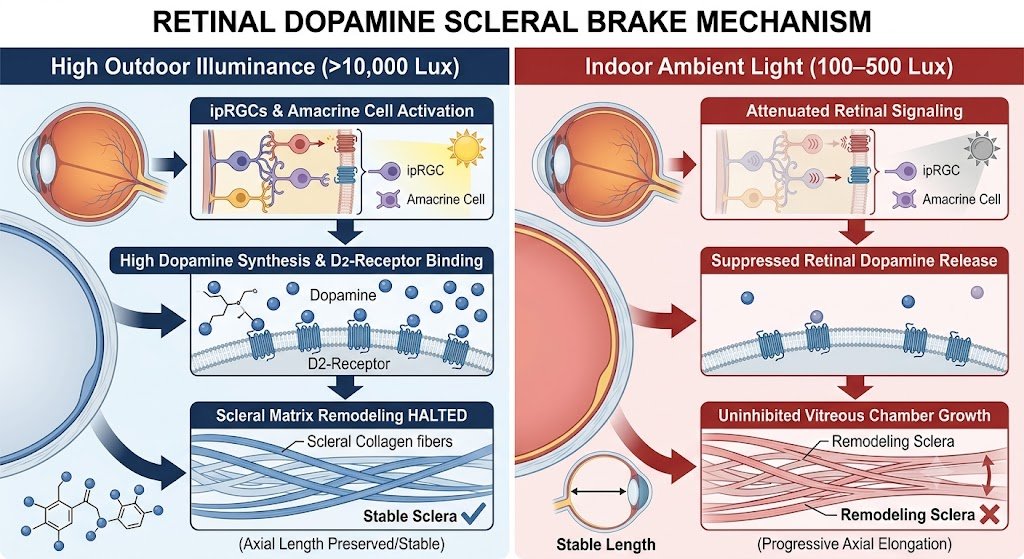
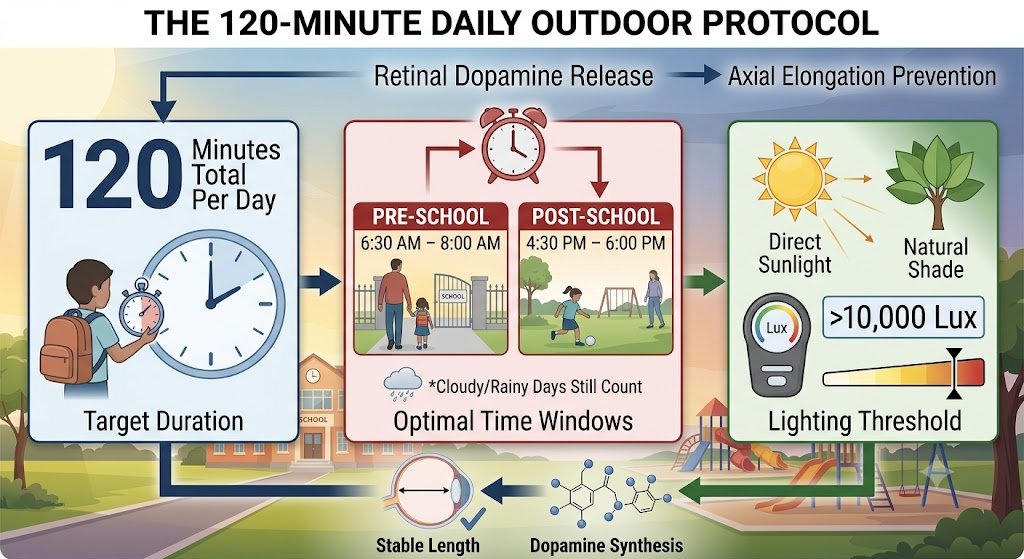
The Photon Threshold: Indoor environments deliver an average illuminance of 100 to 500 lux. In contrast, an overcast day outdoors provides 10,000 to 20,000 lux, while direct sunlight exceeds 100,000 lux
-
Retinal Dopamine Release: High photon density hitting retinal photoreceptors and intrinsically photosensitive Retinal Ganglion Cells (ipRGCs) stimulates specialized amacrine cells to synthesize and release dopamine
-
Scleral Cross-Linking: Dopamine binds to D2 dopamine receptors across the retina and RPE, triggering downstream chemical cascades that preserve collagen density in the sclera. Without adequate dopamine signaling (under dim indoor lighting), scleral cross-linking drops, allowing the globe to stretch under normal intraocular pressure
Benchmark Clinical Evidence: Outdoor SUN Exposure Studies
A. The Sydney Myopia Study (Rose et al., 2008)
-
Design: Sampled 4,137 students across primary and secondary schools in Sydney, Australia
-
Findings: Higher levels of outdoor time were associated with significantly lower odds of myopia. Crucially, the protective effect of outdoor daylight remained statistically significant even after adjusting for near-work volume, parental myopia, and ethnicity
-
The “Indoor Sport” Control: Indoor sports activity did not confer protection against myopia, isolating high-intensity ambient light—rather than physical exertion or distal accommodation—as the therapeutic variable
B. The Taiwan Recess Outside Classroom (ROC) Trial (Wu et al., 2013)
-
Design: A 1-year prospective interventional school trial where the intervention school enforced 80 minutes of daily outdoor recess, while the control school maintained standard indoor recess routines
-
Results: New-onset myopia in the outdoor intervention school was 8.4%, compared to 17.7% in the control school (p < 0.001). Axial elongation was significantly slower in the outdoor cohort
Modern Clinical Solutions and Interventions
While natural outdoor sunlight is a primary non-pharmacological preventive measure, children with active progressive myopia benefit from validated medical and optical treatments.
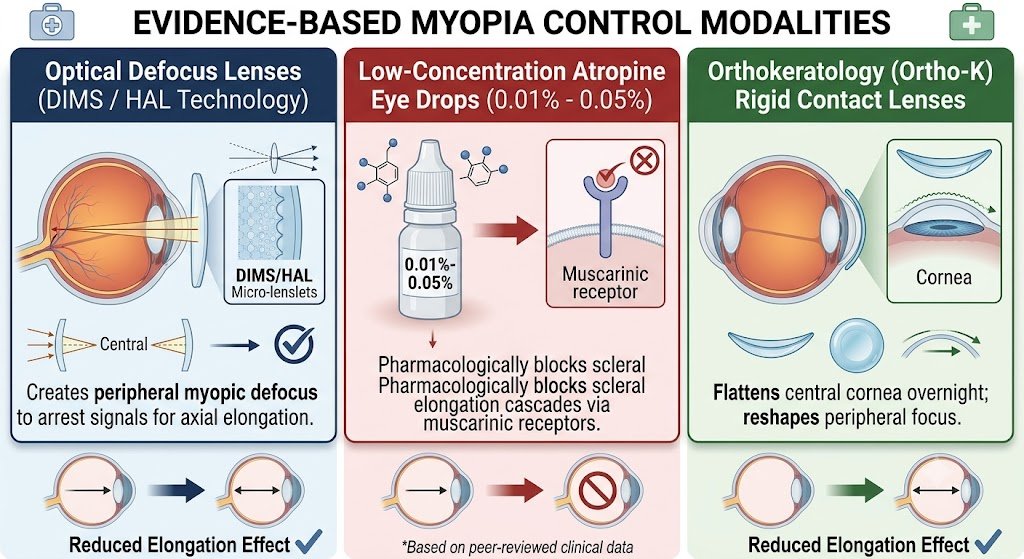
1. Optical Defocus Spectacle Lenses (DIMS & HAL)
Standard single-vision glasses correct central vision but push light behind the peripheral retina (peripheral hyperopic defocus), which can inadvertently trigger axial elongation.
-
Defocus Incorporated Multiple Segments (DIMS): Utilizes a central clear visual zone surrounded by a honeycomb segment of micro-lenses that introduce +3.50 D peripheral myopic defocus. Clinical trials demonstrate a 52% to 62% reduction in myopia progression
-
Highly Aspherical Lenslet Target (HAL): Employs concentric rings of highly aspherical lenslets to slow axial extension by altering peripheral light vectors
2. Pharmacological Intervention: Low-Concentration Atropine
-
Mechanism: Low-concentration atropine drops block muscarinic receptors in the retina and sclera, inhibiting extracellular matrix degradation and axial growth without inducing pupil dilation or loss of accommodation
-
Clinical Protocol: Doses of 0.01% to 0.05% administered once daily at bedtime. The LAMP (Low-Concentration Atropine for Myopia Progression) Study established that 0.05% atropine achieved the optimal balance between efficacy (slowing axial elongation) and minimal side effects
3. Orthokeratology (Ortho-K)
-
Custom-designed gas-permeable contact lenses worn overnight temporarily reshape the anterior corneal epithelium. Upon lens removal in the morning, the child achieves clear vision throughout the day while peripheral corneal steepening creates a protective peripheral defocus barrier
Structural Causes and Actionable Solutions for Indian Parents
Structural Drivers in India
-
Academic Hyper-Focus: The competitive structure of the Indian education system leads to extended indoor tutoring, early-age test preparation, and long periods of close reading
-
Urban Built Environment: Lack of green spaces, dense apartment living, and safety concerns in Tier-1 and Tier-2 cities keep children indoors during peak daylight hours
-
Reliance on “Blue-Light Glasses”: Many parents rely on anti-glare or blue-light blocking glasses. These products reduce digital screen glare but do not alter axial eye growth or prevent progressive myopia
Actionable Clinical Strategy for Indian Households
-
Mandate 2 Hours of Daily Outdoor Light: Ensure children spend 120 minutes per day outdoors. Morning play before school, outdoor sports, or walking during daylight hours provides the necessary lux threshold. Shade under trees or overcast weather still comfortably exceeds 10,000 lux
-
Implement the 20-20-20 Rule with Distance Realignment: During continuous near-work or study sessions, children should pause every 20 minutes to look at an object at least 20 feet away for 20 seconds. Ensure reading material is held no closer than 30–40 cm (the Harmon distance)
-
Annual Axial Length Biometry: When visiting an optometrist or ophthalmologist, request optical biometry to track the eye’s axial length in millimeters alongside standard Diopter refraction
Key Nutritional Candidates & Scientific Evidence
1. Crocetin (Saffron / Gardenia Extract)
-
Biological Mechanism: Crocetin is a natural carotenoid that upregulates EGR-1 (Early Growth Response 1), a gene expression factor in the retina that acts as an “off-switch” or brake for scleral extracellular matrix remodeling
-
Evidence: In a multicenter, randomized, double-blind, placebo-controlled trial conducted at Keio University School of Medicine, 69 children aged 6–12 were given oral crocetin or placebo over 24 weeks. The crocetin group showed a statistically significant reduction in axial length elongation compared to the control group (Mori et al., 2020)
-
Clinical Status: Promising adjunctive compound; requires larger, long-term multi-ethnic RCTs before becoming a primary clinical recommendation
2. Omega-3 Polyunsaturated Fatty Acids (DHA / EPA)
-
Biological Mechanism: Omega-3 fatty acids enhance choroidal blood flow and ocular perfusion. Choroidal thinning precedes axial elongation; improving microcirculation in the choroid help maintain scleral structural integrity
-
Evidence: Pre-clinical animal studies and human observational studies show a negative correlation between high dietary Omega-3 consumption and axial elongation. Emerging clinical trials indicate that Omega-3s may support choroidal thickness, though their direct capacity to arrest axial growth in humans remains under active investigation (Bomze, n.d.)
3. Lutein and Zeaxanthin
-
Biological Mechanism: Macular carotenoids act as blue-light filters and potent antioxidants within the retinal pigment epithelium (RPE) and choroid, reducing oxidative stress and localized inflammation
-
Evidence: A 6-month randomized controlled trial in school-aged children evaluated daily lutein ester supplementation. The treatment group demonstrated stabilization of subfoveal choroidal thickness compared to progressive thinning in the control group. However, the study noted minimal direct change in axial length over the 6-month period, indicating its primary utility may be choroidal protection rather than halting scleral growth (Pei, 2026)
4. Vitamin D3
-
Biological Mechanism: Vitamin D receptors (VDR) are expressed in scleral fibroblasts. In animal models (e.g., murine lens-induced myopia), calcipotriol (a Vitamin D3 analogue) helped maintain normal Type I collagen synthesis in the sclera and attenuated myopia progression (Bomze, n.d.)
-
Human Evidence: Epidemiological studies consistently link low serum 25-hydroxyvitamin D levels with higher myopia rates in children. However, interventional trials suggest this correlation is primarily a surrogate marker for time spent outdoors (sunlight exposure drives cutaneous Vitamin D synthesis and retinal dopamine release) rather than a direct protective effect from oral Vitamin D supplementation alone
Key Academic References
-
Saxena R, et al. “Prevalence of myopia and its associated risk factors in urban school-going children in Delhi, India.” PLoS ONE. 2015;10(2):e0117360
-
Rose KA, et al. “Outdoor activity reduces the prevalence of myopia in children.” Ophthalmology. 2008;115(8):1279-1285
-
Wu PC, et al. “Outdoor activity during class recess reduces myopia onset and progression in school children.” Ophthalmology. 2013;120(5):1080-1085
-
Holden BA, et al. “Global Prevalence of Myopia and High Myopia and Temporal Trends from 2000 through 2050.” Ophthalmology. 2016;123(5):1036-1042
-
Lam CSY, et al. “Defocus Incorporated Multiple Segments (DIMS) spectacle lenses slow myopia progression: a 2-year randomised clinical trial.” Br J Ophthalmology, 2020; 104(3):363-368
-
Yam JC, et al. “Low-Concentration Atropine for Myopia Progression (LAMP) Study.” Ophthalmology. 2019;126(1):113-124
-
Verkicharla PK, et al. “Myopia in India: A systematic review and meta-analysis.” Indian J Ophthalmol. 2020;68(1):37-44.