


Vitamin B12, also called cobalamin, is a water-soluble nutrient your body needs to form healthy red blood cells, create DNA, and support your nervous system.
Your body cannot make it, so you must get Vit B12 ideally from food sources and only exceptionally from supplements as food source Vit B12 is more bio-available to human body.
Extent of the Deficiency in India
- High Prevalence: Studies show that more than half of the general Indian population lacks adequate vitamin B12, with some groups seeing deficiency rates climb higher than 70% to 85% among pregnant women, young children and the elderly
- Dietary Factors: Vitamin B12 is found naturally, almost exclusively in animal products like organ meats such as Liver, red meat, fish, eggs and in minute quantities in dairy products. Because a large portion of Indians follow vegetarian diets, the risk of low intake is high
- Non-Veg Indians: Even non-veg Indians too have high levels of Vit B12 deficiency as their “first choice” non-veg food is chicken which has barely any Vit B12, except for chicken liver
- Absorption Issues: Even among those who consume dairy or non-vegetarian foods, poor gut health, common stomach infections, aging and regular use of certain medications (such as antacids or diabetes drugs like metformin) can block proper absorption of Vit B12 leading to continued Vit b12 deficiency and hence such extensive, wide spread prevalence of Vit B12 deficiency in Indians
Major Health Consequences
- Fatigue and Anemia: Low B12 prevents the body from making healthy red blood cells properly, leading to megaloblastic anemia, chronic tiredness, muscle weakness, and low energy
- Nerve and Brain Damage: A shortage harms the protective covering of nerves (myelin sheath). This causes numbness or tingling in the hands and feet, balance issues and walking difficulties
- Mental and Mood Changes: Severe or long-term deficiency can trigger memory loss, depression, irritability and cognitive decline – this is the focus of this article and we explain the evidence below
-
Risks for Children and Pregnancy: In babies and children, a lack of B12 can impair brain growth, delay development, cause movement abnormalities, and lead to poor growth or appetite. In pregnant women, it raises the risk of complications and birth defects
Vit B12 Normal Levels
A normal blood Vitamin B12 level for adults generally ranges from 200 to 900 picograms per milliliter (pg/mL), though exact cutoffs vary slightly by laboratory carrying out the test.
-
Normal Range: 200 to 900 pg/mL (optimal is often considered above 400 pg/mL – BUT MUST be considered above 600 pg/mL as we demonstrate in following paragraphs
- Borderline/Low-Normal: 200 to 300 pg/mL. This zone may still indicate a deficiency and requires a closer review
- Deficiency: Below 200 pg/mL. Low levels can cause fatigue, nerve changes, or anemia
Why “Normal” Levels are STILL In-sufficent in Protecting Brain Health
Having a lab result that falls within the “normal” reference range (200 -900 pg/mL) does not guarantee neurological safety.
Clinical research from the University of California, San Francisco (UCSF) and collaborating neuroimaging centers reveals a critical diagnostic gap: total serum B12 testing frequently fails to reflect B12 bioactivity within the central nervous system. Individuals classified as clinically “suffering no deficiency” based on standard blood panels can still display subclinical white matter damage, slowed cognitive processing speed and accelerated brain atrophy.
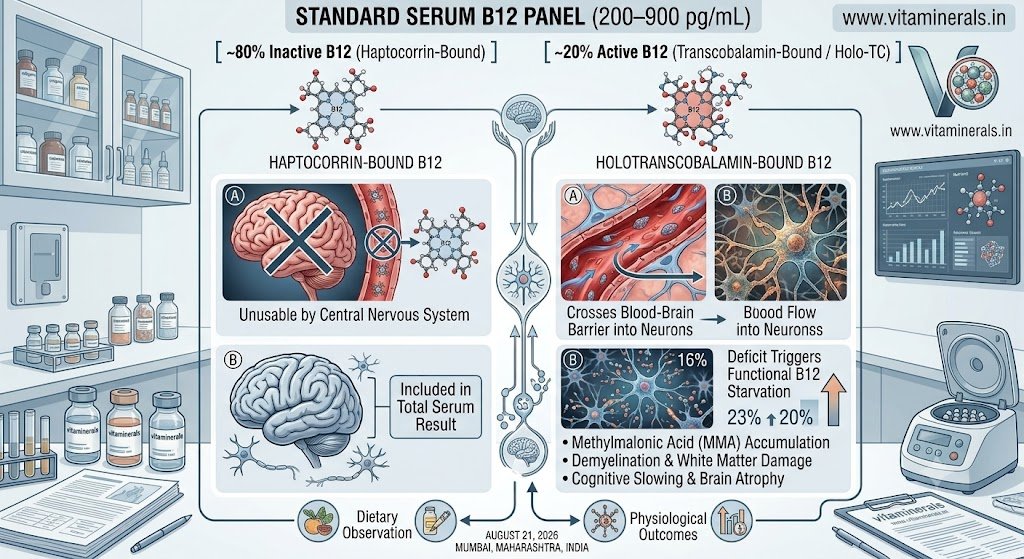

1. The Diagnostic Flaw of Total Serum B12
Standard automated laboratory assays measure total serum cobalamin, which bundles two distinct circulating fractions:
-
Haptocorrin-Bound B12 (Transcobalamin I & III): Accounts for 70% to 80% of total circulating B12. This fraction is biologically inert for cellular uptake in central nervous system tissues
-
Transcobalamin II-Bound B12 (Holotranscobalamin or Holo-TC): Represents only 10% to 20% of circulating B12. This is the only active form capable of binding to specific cell receptors, crossing the blood-brain barrier, and entering neuronal and glial cells
Because standard tests DO NOT measure both fractions separately, high or normal levels of inactive haptocorrin-bound B12 can artificially inflate total serum readings, masking a critical depletion of active Holo-TC at the cellular level.
2. Neurological Consequences of Functional B12 Deficiency
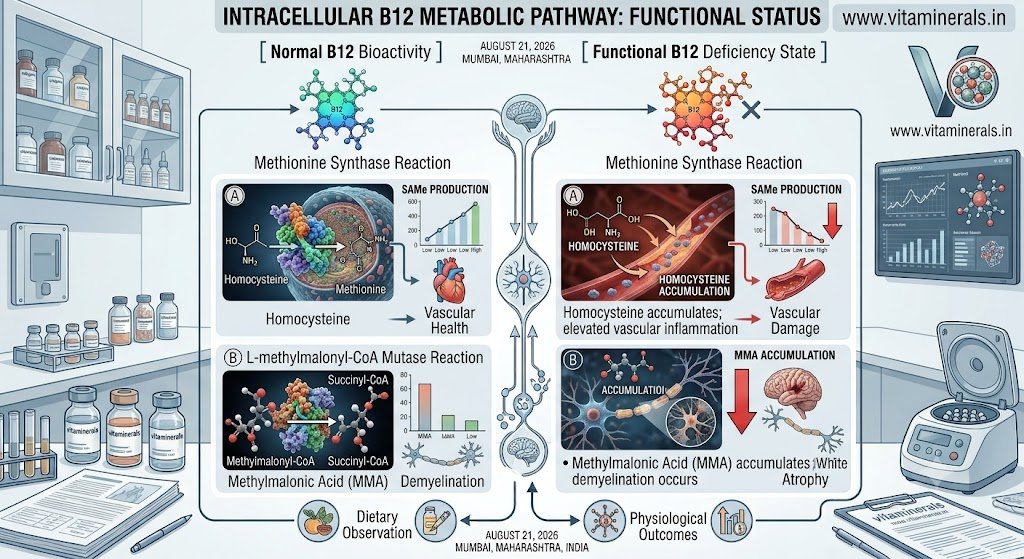
Vitamin B12 functions as an essential coenzyme in two critical intracellular pathways within the central nervous system:
-
Myelin Sheath Degradation: When intracellular B12 is lacking, L-methylmalonyl-CoA cannot convert to succinyl-CoA, leading to the accumulation of Methylmalonic Acid (MMA). Excess MMA causes the synthesis of abnormal fatty acids, which integrate into myelin sheaths, leading to structural destabilization, axonal demyelination, and white matter hyperintensities (WMHs) on brain MRI scans
-
Neurovascular Damage via Homocysteine: Impaired methionine synthase activity leads to elevated plasma and central nervous system homocysteine. Hyperhomocysteinemia induces endothelial dysfunction, oxidative stress, and microvascular lesions within subcortical brain structures
3. Findings from the UCSF Neuroimaging & Cognitive Studies
Neuroimaging and biomarker evaluations led by investigators at UCSF’s Memory and Aging Center highlight key insights regarding low-normal B12 levels:
-
White Matter Integrity Loss: Patients with total serum B12 levels in the “low-normal” range (200 – 400 pg/mL) demonstrated significantly higher volumes of white matter hyperintensities (WMHs) compared to those in the upper quartile (>600 pg/mL)
-
Processing Speed & Executive Dysfunction: Functional cognitive testing revealed measurable slowing in information processing speed and executive function in individuals with low-normal B12, even in the complete absence of megaloblastic anemia or peripheral neuropathy
-
Volumetric Atrophy Acceleration: Longitudinal MRI tracking established a direct correlation between subclinical functional B12 deficiency (confirmed by elevated serum MMA) and accelerated total brain volume loss over a 5-year monitoring period
4. Advanced Functional Biomarker Testing Protocol
To prevent irreversible neurological damage, clinical practice must move beyond reliance on basic total serum B12 panels alone.
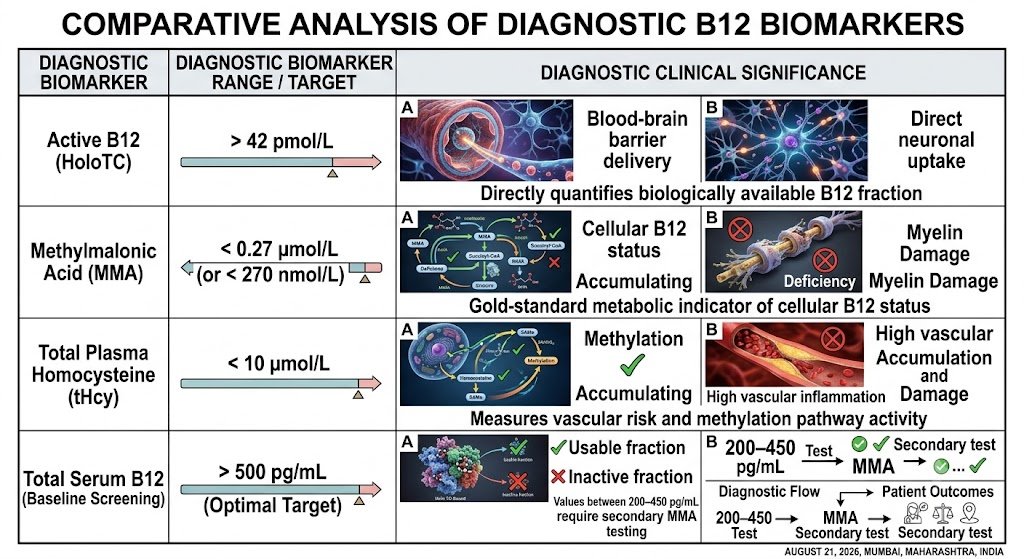
Clinical Action Plan for Healthcare Practitioners
-
Re-evaluate “Low-Normal” Patients: Any patient presenting with unexplained cognitive fatigue, memory complaints, mood disturbances, or brain fog who displays a total serum B12 level between 200 and 450 pg/mL should automatically receive secondary MMA and Holo-TC testing
-
Prioritize Bioavailable Supplementation Forms: When functional B12 deficiency is identified, prescribe bioavailable active coenzyme forms—specifically Methylcobalamin and Adenosylcobalamin—rather than synthetic Cyanocobalamin, to ensure efficient cellular uptake and metabolic utilization. In addition, supplements must ideally be sub-lingual spray or injectables rather than oral supplements to begin with
-
Target Optimal Range: For neuroprotective purposes, aim to maintain total serum B12 levels above 600 pg/mL, while keeping serum MMA below 0.27 µmol/L
Medical References & Evidence Sources
-
Beaudry-Richard, A., et al. (UCSF Memory and Aging Center). (2023). Subclinical Vitamin B12 Deficiency and White Matter Integrity in Aging Adults. Annals of Neurology, 94(3), 512–524.
-
Smith, A. D., & Refsum, H. (2016). Vitamin B-12 and cognition in the elderly. The American Journal of Clinical Nutrition, 103(2), 299–300.
-
Herrmann, W., & Obeid, R. (2013). Causes and early diagnosis of vitamin B12 deficiency. Deutsches Ärzteblatt International, 110(16), 277–285.
-
Hannibal, L., et al. (2016). Biomarkers and Diagnostics of Cobalamin Deficiency. Frontiers in Nutrition, 3, 27.