



In Part 1 of this Series, we defined obesity as a chronic, progressive disease of dysfunctional energy homeostasis, and in Part 2 of the Series, we examined how Ultra-Processed Foods (UPFs) hijack mesolimbic reward pathways and bypass natural satiety signaling, inducing you to eat more. This Part 3 of the Series explores the Pharmaceutical Drugs for Obesity Management.
Pharmacological Restoration — How GLP-1, GIP, and Glucagon Receptor Agonists Rewire Gut-Brain Signaling and Why These Drugs are Selling Like “Hot Cakes”
Obesity Drugs Evolution
For decades, pharmacological treatments for obesity yielded modest efficacy and significant side-effect profiles because they attempted to suppress systemic appetite using broad central stimulants or block nutrient absorption in the gut.
The advent of incretin-based therapies—starting with single GLP-1 receptor agonists and expanding to dual GLP-1/GIP and triple GLP-1/GIP/Glucagon receptor co-agonists—marks a paradigm shift.
Rather than forcing weight loss through central stimulation or starvation, these bio-engineered peptides restore and amplify the body’s endogenous gut-brain signaling networks, reversing metabolic adaptations and lowering the brain’s defended body weight set-point.
These GLP-1 therapies are surging in popularity because they provide unprecedented, clinically proven weight loss and blood sugar control by mimicking natural gut hormones that suppress appetite and slow digestion.
Endogenous Incretin System: Gut-Brain Cross-Talk
In neurotypical physiology, the ingestion of food / nutrients triggers the specialized entero-endocrine cells of the gastrointestinal tract to release peptide hormones known as incretins. These hormones act as immediate biochemical messengers between the gut, the central nervous system, and peripheral metabolic organs.

Body’s OWN GLP1 System – Before Advent of Synthetic Products
1. Glucagon-Like Peptide-1 (GLP-1)
Secreted by L-cells in the distal ileum and colon in response to carbohydrates, fats, and dietary fiber:
-
Central Action: Crosses the blood-brain barrier or signals via the vagus nerve to target GLP-1 receptors in the brainstem and hypothalamus, inducing satiation and suppressing hunger
-
Gastric Kinetics: Binds to enteric neurons to delay gastric emptying, prolonging postprandial stomach distension and physical fullness
-
Glycemic Control: Enhances glucose-dependent insulin secretion from pancreatic beta-cells while suppressing inappropriate postprandial glucagon release from alpha-cells
2. Glucose-Dependent Insulinotropic Polypeptide (GIP)
Secreted by K-cells in the duodenum and jejunum in response to nutrient intake:
-
Historical Paradox: GIP was long considered “pro-obesogenic” because it facilitates lipid storage in white adipose tissue. However, selective pharmacological co-stimulation of GIP receptors in the central nervous system reveals potent synergistic anti-obesity effects
-
Central Synergy: GIP receptors are heavily expressed in GABAergic neurons within the hypothalamus and brainstem. GIP co-stimulation dampens the nausea and emetic responses triggered by strong GLP-1 activation while independently enhancing satiety signaling
-
Adipose Remodeling: Increases subcutaneous adipose tissue blood flow and lipid buffering capacity, reducing ectopic fat accumulation in the liver and muscle.
3. Glucagon
Secreted by pancreatic alpha-cells during fasting:
-
Energy Expenditure: While glucagon raises blood glucose, it also binds to hepatic and central receptors to increase basal metabolic rate (BMR), stimulate lipolysis, and promote thermogenesis, counteracting the metabolic slowdown typically seen during calorie restriction.
Evolution of Multi-Receptor Agonists – Pharmaceutical Drugs
The transition from native, natural, body’s own physiological peptides to long-acting multi-receptor agonists represents a major triumph of biochemical engineering – even evident in increased adoption and sales of these products.
Native, Body’s Own GLP-1 and GIP have half-lives of less than 2–5 minutes because they are rapidly degraded by the enzyme dipeptidyl peptidase-4 (DPP-4).
Modern therapeutic peptides utilize fatty acid acylation and amino acid substitutions to resist DPP-4 cleavage and bind plasma albumin, extending their half-lives to enable weekly dosing. Hence the WEEKLY Shots.
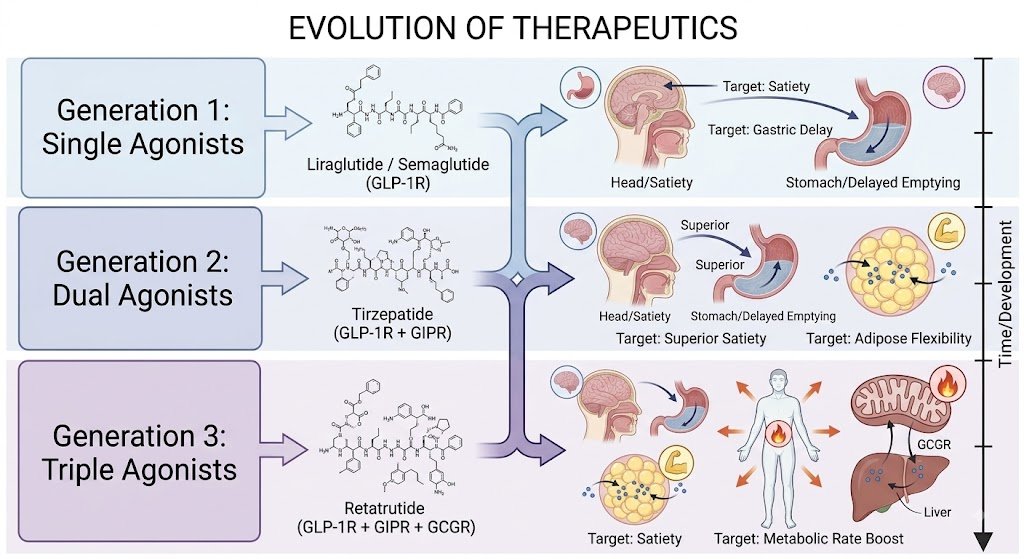
1. Single Agonists: Semaglutide (GLP-1R)
-
Mechanistic Scope: Selective GLP-1 receptor agonist
-
Clinical Efficacy (STEP-1 Trial): Achieved an average ~15% body weight loss at 68 weeks in adults with overweight or obesity
-
Primary Drivers: Substantial reduction in daily caloric intake driven by reduced hunger, diminished “food noise” (intrusive thoughts about food), and slowed gastric motility
2. Dual Agonists: Tirzepatide (GLP-1R / GIPR)
-
Mechanistic Scope: Single peptide with dual agonist activity at both GLP-1 and GIP receptors (“Twincretin”)
-
Clinical Efficacy (SURMOUNT-1 Trial): Achieved up to ~20.9% to 22.5% body weight loss at 72 weeks at highest doses (15 mg)
-
Why Dual Activation Works: GIP receptor agonism acts synergistically with GLP-1 in the brain to amplify satiety while mitigating gastrointestinal intolerance. It also optimizes adipose tissue function, preventing ectopic lipid storage
3. Triple Agonists: Retatrutide (GLP-1R / GIPR / GCGR)
-
Mechanistic Scope: Single tri-specific peptide targeting GLP-1, GIP, and Glucagon receptors (“Tri-agonist”)
-
Clinical Efficacy (Phase 2 Trials): Demonstrated up to ~24.2% body weight loss at 48 weeks—approaching the efficacy thresholds historically seen only with bariatric surgery
-
The Glucagon Advantage: By incorporating glucagon receptor activation, retatrutide directly boosts energy expenditure and accelerates hepatic fat clearance, directly addressing the adaptive thermogenesis (metabolic slowdown) that usually limits weight loss
Neurobiological Impact: Silencing “Food Noise” and Hedonic Overeating
Beyond homeostatic hunger in the arcuate nucleus, multi-incretin therapies fundamentally alter the hedonic (reward-driven) components of eating.
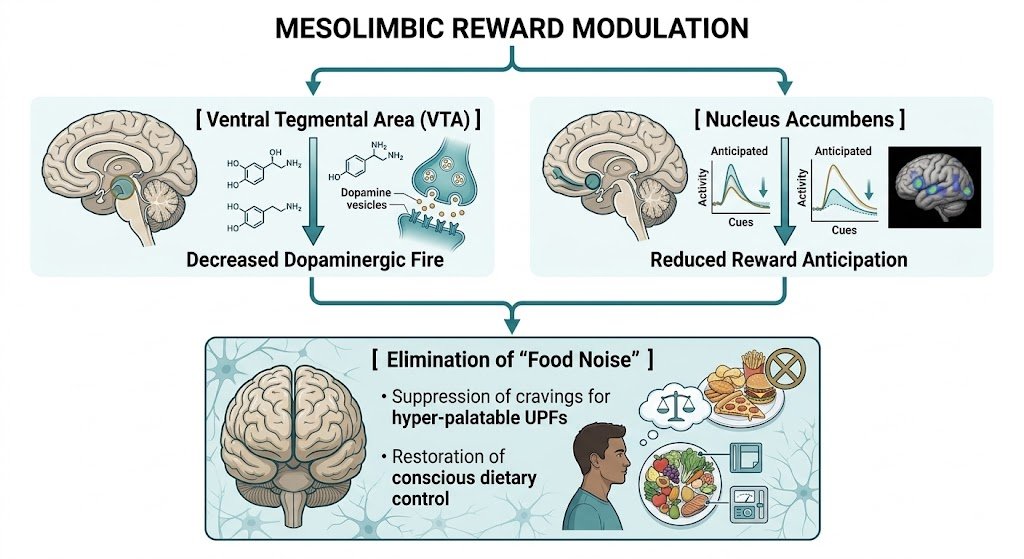
-
Attenuation of Mesolimbic Dopamine Signaling: Receptors for GLP-1 and GIP are densely populated in the ventral tegmental area (VTA) and nucleus accumbens—the core centers of the brain’s reward circuit. Activation of these receptors reduces the surge of anticipatory dopamine triggered by visual or olfactory cues of hyper-palatable foods
-
Eradication of “Food Noise”: Patients frequently report the cessation of persistent, involuntary obsessive thoughts about eating. This effect directly counters the “super-normal stimulus” of ultra-processed foods, allowing patients to easily select nutrient-dense whole foods and stop eating when satisfied
-
Resetting the Set-Point: By continuously suppressing homeostatic hunger, increasing satiety signaling, and blunting hedonic drive, these agents prevent the central nervous system from initiating the dramatic compensatory hunger drives typical of lifestyle-driven calorie deficits
Mechanistic Comparison of Incretin Pathways
Mechanistic Property |
Native GLP-1 Agonism |
Dual GLP-1 / GIP Agonism |
Triple GLP-1 / GIP / Glucagon Agonism |
Representative Agent |
Semaglutide |
Tirzepatide |
Retatrutide |
Homeostatic Satiety |
High (ARC & NTS activation) |
Very High (Synergistic central binding) |
Maximal (Tri-pathway hypothalamic integration) |
Hedonic Modulation |
High (VTA dopamine attenuation) |
Very High (Enhanced reward circuit dampening) |
Maximal (Combined reward and metabolic control) |
Gastric Emptying |
Markedly slowed |
Moderately slowed (GIP moderates GLP-1 rate) |
Moderately slowed |
Energy Expenditure |
Neutral / Unchanged |
Minimal increase via adipose flexibility |
Significantly Increased (Glucagon-mediated) |
Hepatic Steatosis Reduction |
High (via weight loss) |
Very High (Direct GIP adipose clearing) |
Maximal (Direct glucagon-mediated hepatic lipid oxidation) |
Average Weight Loss |
15% at 68 weeks |
20.9 to 22.5% at 72 weeks |
24.2% at 48 weeks |
Why GLP1 Synthetic Peptides are Popular as Weight Loss Drugs
-
Exceptional Efficacy: Drugs like Ozempic and Wegovy (semaglutide) and Mounjaro (tirzepatide) deliver weight loss results previously achievable only through bariatric surgery
-
Biological Shift in Obesity Care: They reframe obesity as a complex, chronic physiological disease rather than a simple failure of personal willpower
-
Broad Health Benefits: Beyond diabetes and weight management, clinical trials show they reduce risks for heart disease, stroke, and chronic kidney disease
-
Mainstream Media and Cultural Awareness: High-profile endorsements, viral social media trends, and widespread brand familiarity have turned them into household names
Clinical Implications & The Future of Chronic Disease Management
-
Obesity as a Remissible, Chronic Condition: Multi-incretin therapies demonstrate that when underlying neuro-hormonal pathways are restored, substantial weight loss occurs as a physiological downstream effect. However, because obesity is a chronic condition, discontinuing therapy typically results in the gradual return of baseline neuro-hormonal signaling, appetite drives, and weight regain
-
Body Composition and Lean Mass Preservation: Achieving weight loss of 20% or more requires proactive nutritional protocols (such as adequate protein intake and resistance training) to preserve lean muscle tissue and skeletal health during rapid fat mass reduction
-
Cardiometabolic Beyond Weight Loss: Beyond weight reduction, multi-incretins show profound secondary benefits: dramatic reductions in systemic inflammation (hs-CRP), improvements in non-alcoholic fatty liver disease (MASLD/MASH), reductions in major adverse cardiovascular events (MACE), and restoration of insulin sensitivity
Key Takeaways
-
Targeting the Cause, Not the Symptom: Incretin therapies address the underlying neurobiological drivers of obesity by restoring damaged gut-brain axis communication
-
Multi-Receptor Synergy: Combining GLP-1 with GIP and Glucagon receptor activation achieves superior efficacy by engaging multiple physiological levers simultaneously—amplifying satiety, improving fat storage flexibility, and increasing energy expenditure
-
Overriding Hedonic Hijacking: By modulating dopamine pathways in the brain’s reward centers, these therapies neutralize the hyper-palatable cues of ultra-processed foods, effectively turning off intrusive “food noise”
Life, and Human Biology is not so simple – a weekly injection of a weight loss drug does not and “should not” come without any side effects. Why we are saying should not is only because Natural, Body’s Own GLP1 and GIP have a half life of only 2 to 5 minutes as these natural, body’s own peptides do their job and are cleared.
Synthetic, Injectable Peptides have very long half life – making them ideal for WEEKLY Injections. Semaglutide and tirzepatide share heavily documented, proven gastrointestinal side effects driven by slowed stomach emptying and hormonal receptor activation.
The most common proven issues include nausea, vomiting, diarrhea, constipation, and reduced appetite. Less common or rare severe risks involving gallbladder problems and potential thyroid tumors. This is Neither an advice for usage of these drugs and nor a recommendation – not to use such drugs. Your Doctor / Your Endocrinologist is your best judge for these products.
In our experience – Rarely and we repeat, Rarely Anyone reads the detailed prescribing information, also known as Standard Product Characteristics which are largely a fine print of all details about a product. Should you be an exception – pls check out THE SPCs of both Semaglutide and Tirzepatide here. We are using European SPCs as we trust these more than US FDA Versions. Copies here – wegovy-epar-product-information_en and mounjaro-epar-product-information_en
We share pure, unadulterated science and scientific evidence. In our Next, Part 4 of this Series we share Nutrition and Exercise Strategies for Obesity Management. Miss the Part 4 and you may miss a chance to loose some extra weight.