



This is Part 2 of 5-Part Evidence-Explained™ Series on OBESITY in Indians and what Indians can and must do to manage this chronic condition. For Part 1 of Series, pls click here.
Ultra-Processed Trap — How Food Composition Overrides Willpower and Hijacks the Brain
In Part 1 of this Series, we established that body weight is governed by a dynamic neuro-hormonal system rather than a simple mechanical accounting of “Calories In vs. Calories Out” (CICO). While the physics of energy balance remains absolute, the drivers of why we consume excess energy are deeply tied to what we eat.
For decades, public health messaging framed overeating as a personal failure of discipline. However, neurobiological research and inpatient metabolic studies have revealed a more complex reality: the industrial transformation of our food supply has created engineered products that bypass evolutionary satiety mechanisms, directly engage brain reward pathways, and drive passive overconsumption independent of conscious willpower.
To understand modern obesity management, we must examine how Ultra-Processed Foods (UPFs) alter the gut-brain axis, exploit dopamine signalling, and disrupt energy regulation.
Ultra-Processed Food Consumption in India
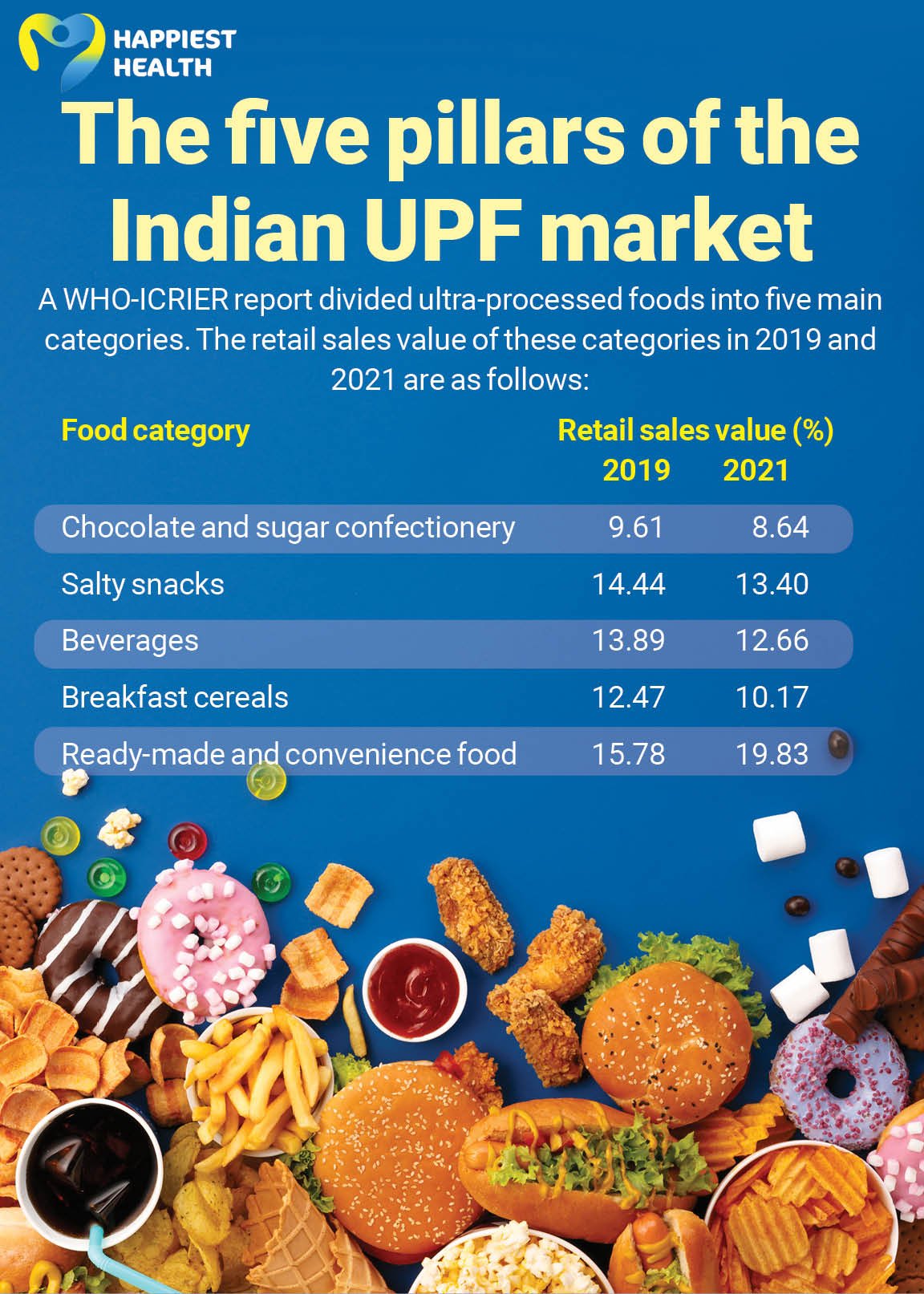
Ultra-processed food (UPF) consumption in India is surging rapidly, driven by urbanization, aggressive marketing, and changing lifestyles. Retail sales of UPFs in India jumped from USD 0.9 billion in 2006 to nearly USD 38 billion by 2019, making it one of the fastest-growing markets globally and presenting new public health challenges.
What Are Ultra-Processed Foods (UPFs)? The NOVA Classification
To analyze the metabolic impact of modern foods, researchers use the NOVA Classification System, which categorizes foods based on the extent and purpose of industrial processing rather than traditional nutrient categories (carbohydrates, fats, proteins)
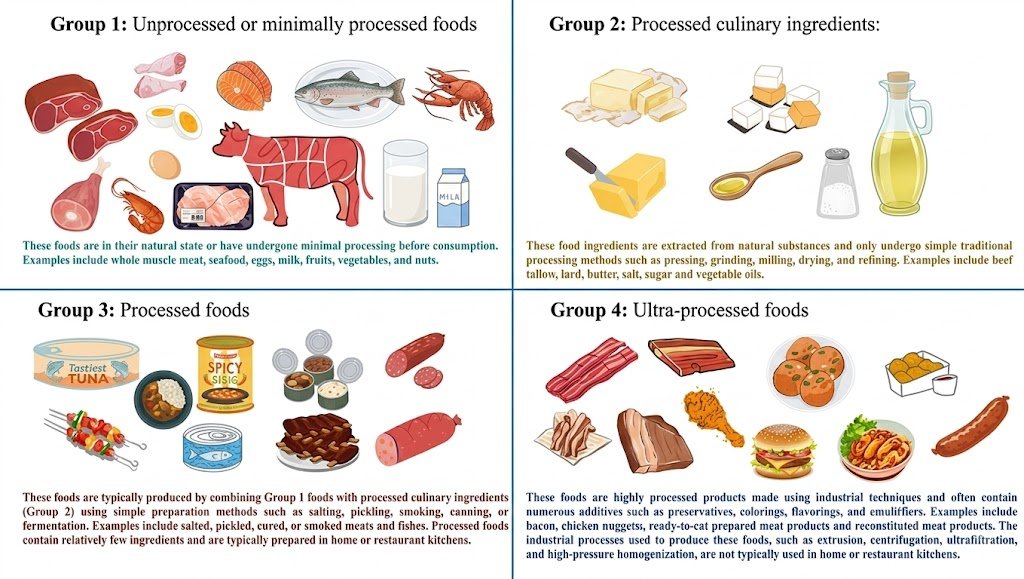
UPFs are not simply “junk food.” They represent industrial creations engineered for long shelf stability, high profit margins, hyper-palatability, and rapid consumption.
The Landmark NIH Trial: UPFs Drive Passive Overconsumption
For years, critics argued that the association between UPFs and obesity was merely correlational—that people eating UPFs simply had lower incomes, poorer health habits, or higher stress levels.
In 2019, Dr. Kevin Hall and his team at the National Institutes of Health (NIH) published a randomized, tightly controlled inpatient study in Cell Metabolism that tested cause-and-effect directly.
The Study Design
-
Participants: 20 healthy adults lived in a metabolic ward for 28 days
-
The Diets: Participants spent 2 weeks on an Ultra-Processed Diet and 2 weeks on an Unprocessed Diet in random order
-
The Controls: Both diets were strictly matched for total presented calories, energy density, macronutrients (fat, carbohydrate, protein), fiber, sugar, and sodium
-
The Rule: Participants were told they could eat as much or as little as they desired (ad libitum)
The Results
When on the ultra-processed diet, participants consumed an average of ~508 additional kilocalories per day, resulting in a weight gain of 0.9 kg (2 lbs) in just 14 days. Conversely, when placed on the unprocessed diet, they spontaneously reduced their intake and lost 0.9 kg.
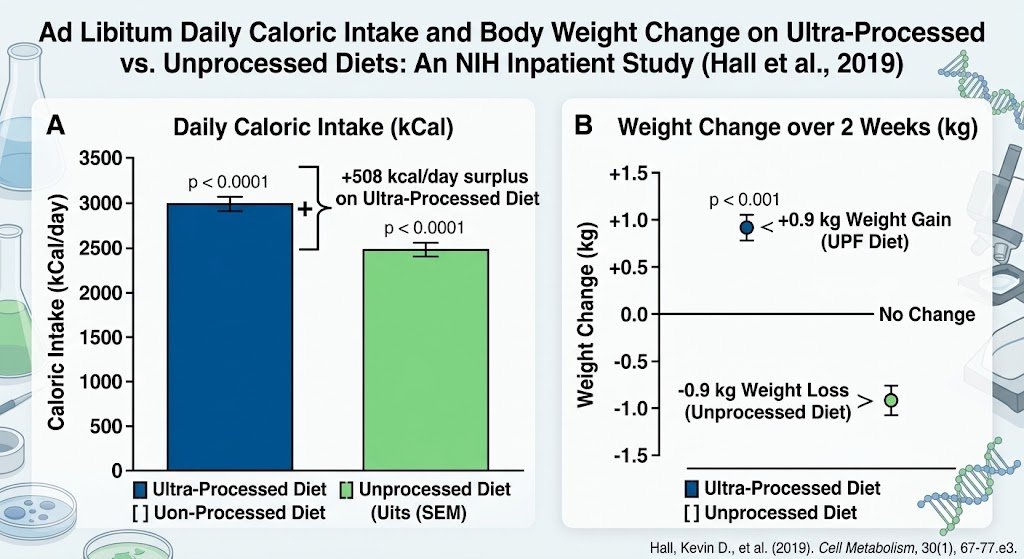
Because the nutrients were identical, the study proved that food structure, processing, and delivery matrix alter food intake independent of nutrient composition or personal discipline.
Neurobiology of the “Super-Normal” Stimulus: Food Reward Pathways
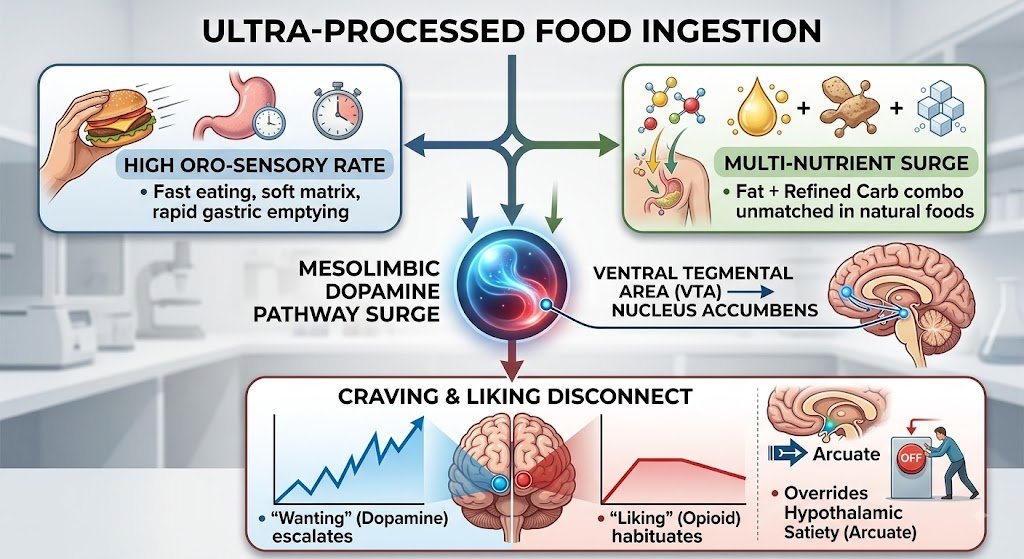
Human biology evolved during millions of years of nutrient scarcity. To ensure survival, the brain developed neural circuits that reward us when we locate calorie-dense food. UPFs exploit these evolutionary circuits by creating a “super-normal stimulus.”
1. Dual Fat-Carbohydrate Synergies
In nature, foods are typically rich in either fat (e.g., nuts, meat) or carbohydrate/sugar (e.g., fruit, tubers), rarely both in high concentrations. UPFs combine high levels of refined carbohydrates and saturated/trans fats in ratios (e.g., 50:50 fat-to-carb ratios in ice cream, chocolate, pastries, and chips) that do not exist in natural state foods.
Brain imaging studies show that combining fats and carbohydrates activates the mesolimbic dopamine pathway (the reward system: Ventral Tegmental Area to Nucleus Accumbens) to a far greater degree than fat or carbohydrate alone—producing a supra-additive dopamine response.
2. Oro-Sensory Processing and Consumption Speed
UPFs are systematically engineered to be soft, pre-chewed, or liquid, dramatically reducing the mechanical effort needed to eat. In the Hall et al. trial, participants consumed the UPF diet at a rate of 17 grams (37 calories) per minute faster than the unprocessed diet.
Eating quickly outpaces the gut’s ability to release satiation peptides (GLP-1, PYY, CCK) to signal the brainstem and hypothalamus. By the time the brain registers fullness, hundreds of excess calories have already been ingested.
Mechanical and Hormonal Disruption: Bypassing the Gut-Brain Axis
Beyond brain reward signaling, UPFs disrupt the physiological brakes that stop us from overeating.
1. Loss of the Cellular Matrix
Whole plant and animal foods contain intact cell walls and fiber matrices. Digestion of whole foods requires mechanical breakdown and slow enzyme penetration, leading to gradual nutrient release throughout the entire length of the small intestine.
UPFs are constructed from refined starches, isolated sugars, and extracted oils stripped of their natural matrix. They absorb rapidly in the proximal duodenum, causing:
-
Exaggerated Postprandial Glucose & Insulin Spikes: Followed by rapid reactive hypoglycemia, which triggers renewed hunger within hours of a meal.
-
Blunted Proximal-to-Distal Incretin Release: Rapid early absorption prevents nutrients from reaching the distal ileum, impairing the “ileal brake”—a mechanism that triggers GLP-1 and PYY release to slow gastric emptying and induce satiety.
2. Emulsifiers, Micro-Inflammation, and Gut Permeability
Industrial UPFs frequently contain synthetic emulsifiers (e.g., carboxymethylcellulose, polysorbate-80) and artificial additives designed to improve texture and shelf life.
Animal and human gut microbiome studies demonstrate that these compounds degrade the mucosal lining of the gastrointestinal tract, alter microbial diversity, and promote low-grade intestinal inflammation. This inflammation impairs vagal nerve signaling to the brain, contributing to central leptin resistance in the arcuate nucleus of the hypothalamus.
Comparative Analysis: Whole Foods vs. Ultra-Processed Foods
Characteristic |
Whole / Minimally Processed Foods |
Ultra-Processed Foods (UPFs) |
Physical Matrix |
Intact cellular structure; high fiber content. |
Extruded, slurried, or restructured; minimal matrix. |
Eating Velocity |
Slow (requires chewing; $20\text{–}30\text{ g/min}$). |
Rapid (soft, melt-in-mouth; $40\text{–}60\text{ g/min}$). |
Neuro-Dopaminergic Impact |
Moderate, proportional dopamine release. |
Supra-additive dopamine surge via dual fat-sugar combos. |
Gut-Brain Response |
Gradual absorption; robust GLP-1 and PYY release. |
Proximal absorption; delayed/blunted satiety signaling. |
Metabolic Effect |
Stable blood glucose; high thermic effect of food (TEF). |
Rapid glucose spikes; reduced TEF by up to 50%. |
Clinical Implications for Obesity Management
Understanding the biological impact of UPFs transforms how clinicians approach nutritional counseling and medical management:
-
Shift Focus from Calorie Counting to Food Quality: Asking patients to cut calories while continuing to consume a diet dominated by UPFs forces them to battle constant physiological hunger and hyper-palatable cues. Eliminating or replacing UPFs reduces spontaneous caloric intake without requiring active starvation
-
Support the Gut-Brain Pathway: Replacing UPFs with intact whole foods slows gastric emptying, restores gut microbiome signaling, and enhances endogenous satiety hormone production
-
Synergy with Pharmacotherapy: Modern obesity medications—such as GLP-1 and GIP receptor agonists (e.g., semaglutide, tirzepatide)—work precisely by restoring the satiety and reward-dampening signals that UPFs disrupt. Pairing these therapies with a whole-food, low-UPF dietary framework yields optimal long-term metabolic health
Key Takeaways
-
UPFs Are Engineered to Overwrite and Override Satiety: Processing techniques alter food matrices, resulting in faster eating rates that outpace natural gastrointestinal satiety signaling
-
Rewiring the Reward System: Combinations of refined carbohydrates and added fats trigger unnatural surges in mesolimbic dopamine, driving food seeking independent of metabolic energy needs
-
Obesity Is an Environmental Interaction: The rapid rise in global obesity matches the rise in UPF availability. Overeating in a UPF-dominated environment reflects an expected biological response to an engineered environment rather than an individual failure of willpower
In Part-3 of this Series, we talk about “the local and global craze about weight loss drugs – semaglutide and tirzepatide” — How GLP-1, GIP, and Glucagon Receptor Agonists Rewire Gut-Brain Signaling and Rather than forcing weight loss through central stimulation or starvation, these bio-engineered peptides restore and amplify the body’s endogenous gut-brain signaling. Don’t Miss a Word.