


Diabetes is surely, certainly and definitely reversible – even if anyone else has an opinion to the contrary.
We say this with responsibility as Diabetes is largely a disease of our indisciplined lifestyle and “poor” food habits. The moment you get a handle on your food habits and lifestyle – improvements are visible. Why diabetes reversal for Indians is important is solely because this is an awfully expensive disease, physically, fiscally and psychologically. Read on for a reversal plan…
Introduction
According to the World Health Organization, diabetes mellitus is a chronic, metabolic disease characterized by elevated levels of blood glucose, which leads to the damage of vasculature, eyes, kidneys, and nerves.
The prevalence of type 2 diabetes (T2D) in India is very high with almost 22 Crore people either diabetic or pre-diabetic and unfortunately a further larger number of Indians are at risk and may follow suit if no corrective steps are initiated urgently and immediately. For our very extensive coverage on Diabetes in Indians – pls check the 10-Part Series on – Silent Death of Pancreas in Indians (Hyperlinked).
A systematic review showed that the estimated country-level health care expenditure on diabetes mellitus in India after amending purchasing power difference was USD 31 billion dollars in 2017, pushing India in fourth place globally after the USA, China, and Germany. Looking at the economic burden, in India, diabetes alone exhausts 5% to 25% share of an average Indian household earning.
Given the rising cost of these antidiabetic medicines and insulin, patients may potentially save significant money by disease remission. This lifestyle modification gives the patients liberty to live without any intensified restrictions, and transforms their lifestyle into a healthy one. So lets transform our lives, lets save money from Diabetes and use it to improve our health and attain “disease-free status”.
Case Study – Reference Purposes Only
This case exemplifies that lifestyle modifications can be practiced as a therapeutic alternative to antidiabetic medications and insulin therapy in T2D patients with obesity. “Daily only two meals and exercise” was the basic rule and the only restriction of this diet was abstinence from having any sugar or sugar substitute containing foodstuff.
This diet did not promote fasting or starvation, as during fasting periods, patient were allowed to drink fluids such as water, coffee, tea, and buttermilk without any sugar or sugar substitutes. In the meal prep, patient was encouraged to eat a diet low in refined carbohydrates. The patient was encouraged to add a regular exercise routine in the form of 4.5 km walking in 45 min.
Therefore, patients with T2D can certainly, surely and definitely reverse their disease without the worry of side effects and financial burden of many pharmaceuticals, all by means of a simple therapeutic lifestyle modification. This can be a new treatment option prescribed by your specialist Endocrinologist / Diabetologist etc.
Case Presentation & Clinical Baseline
Patient Profile: 40-year-old Indian Male
Primary Diagnosis: Uncontrolled Type 2 Diabetes Mellitus (T2DM), Metabolic Syndrome and early-stage Diabetic Peripheral Neuropathy.
Dietary Pattern: Predominantly lacto-vegetarian, high in refined carbohydrates (polished white rice, wheat flour rotis), low in bioavailable trace minerals, with high dietary phytate-to-mineral ratios.
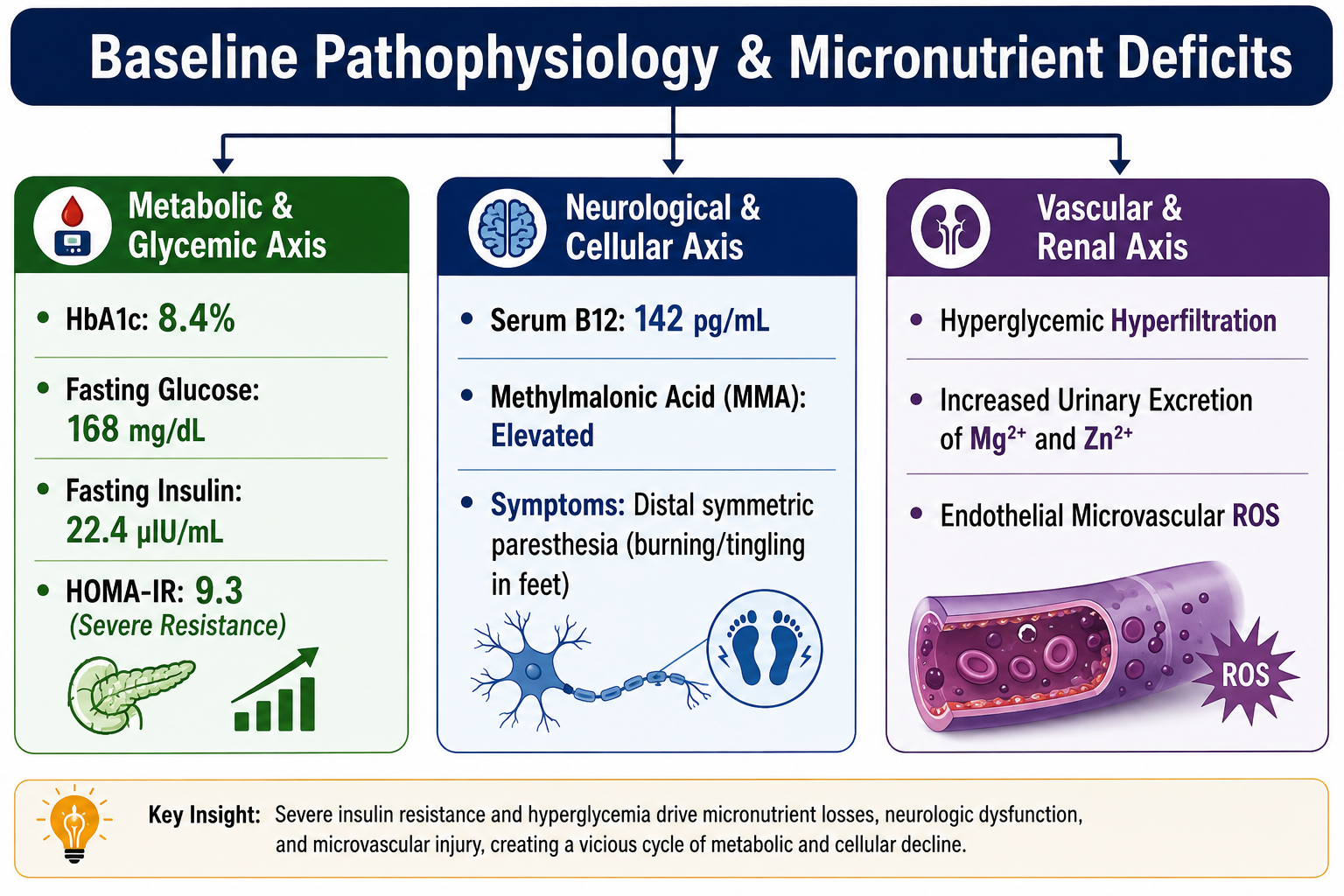
Baseline Diagnostic Panel
Biomarker |
Baseline Value |
Standard Reference Range |
Pathophysiological Significance |
HbA1c |
8.4% |
< 5.7% |
Suboptimal long-term glycemic control |
Fasting Blood Glucose (FBG) |
168 mg/dL |
70 – 99 mg/dL |
Elevated hepatic gluconeogenesis |
Postprandial Glucose (PPG) |
242 mg/dL |
<140 mg/dL |
Postprandial metabolic flux & GLUT-4 resistance |
Fasting Insulin |
22.4 mu IU/mL |
2.0 – 6.0 IU/mL |
Severe compensatory hyperinsulinemia |
HOMA-IR |
9.3 |
<1.9 |
Severe insulin receptor tyrosine kinase impairment |
Serum Vitamin B12 |
142 pg/mL |
200 – 900 pg/mL |
Secondary to long-term Metformin therapy |
Active Methylcobalamin |
Low |
Normal |
Peripheral nerve demyelination |
Serum Magnesium (Mg) |
1.5 mg/dL |
1.7 – 2.2 mg/dL |
Hypomagnesemia due to diabetic hyperfiltration |
Serum Zinc (Zn) |
62 mcg/dL |
70 – 120 mcg/dL |
Impaired pancreatic beta-cell insulin hexamer storage |
25-OH Vitamin D3 |
12.4 ng/mL |
30 – 100 ng/mL |
Downregulated pancreatic beta-cell VDR expression |
2. Molecular Mechanisms of Diabetic Micronutrient Deficiencies
A. Metformin-Induced Vitamin B12 Depletion & Neuropathy
Metformin downregulates calcium-dependent membrane uptake of the Intrinsic Factor–Vitamin B12 complex at the terminal ileum. In South Asian diets lacking heme sources, this accelerates absolute cobalamin clearance, driving accumulation of Methylmalonic Acid (MMA) and Homocysteine, which damages peripheral nerve axons.
B. Renal Hyperfiltration & Urinary Mineral Excretion
Chronic hyperglycemia induces osmotic diuresis and hyperfiltration in the renal glomerulus. Divalent cations—specifically Magnesium (Mg) and Zinc (Zn)—are lost in excessive amounts in the urine.
-
Hypomagnesemia impairs Autophosphorylation of the Insulin Receptor beta-subunit.
-
Zinc deficiency destabilizes the Insulin Hexamer Storage Complex within pancreatic beta-cell secretory granules and suppresses Cu/Zn-SOD activity.
C. High Phytate-to-Mineral Ratio in Indian Vegetarian Diets
Phytates (myo-inositol hexakisphosphate) present in unfermented grains, pulses, and legumes form insoluble, non-absorbable chelate complexes with Zn, Mg, Fe, and Mn in the intestinal lumen, rendering standard inorganic supplements ineffective.
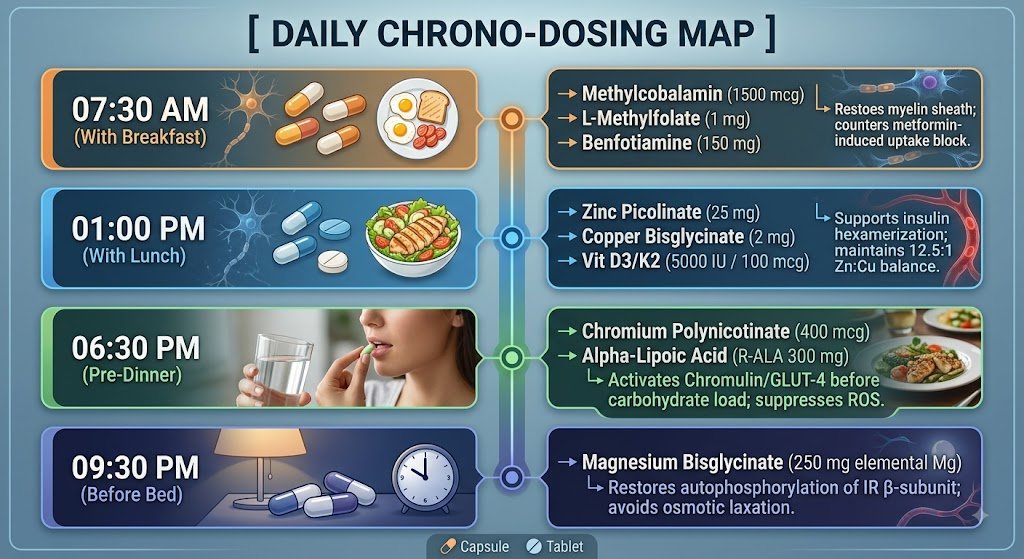

Window 1: Morning / Breakfast (07:30 AM)
Target Axis: Neuroprotection, Homocysteine Control & Advanced Glycation End-Product (AGE) Inhibition
-
Methylcobalamin (Active Vitamin B12): 1,500 mcg
-
L-Methylfolate (5-MTHF): 1,000 mcg (1 mg)
-
Pyridoxal-5′-Phosphate (P5P / Active Vitamin B6): 25 mg
-
Benfotiamine (Fat-Soluble Vitamin B1 Derivative): 150 mg
Biochemical & Physiological Mechanisms
-
Methylcobalamin & 5-MTHF: Bypasses calcium-dependent terminal ileal uptake blocks caused by Metformin. Converts toxic Homocysteine back into L-Methionine via Methionine Synthase, halting microvascular endothelial inflammation and axonal degeneration.
-
Benfotiamine: A lipophilic thiamine prodrug with $5\times$ greater bioavailability than water-soluble thiamine. It activates transketolase, blocking three major pathways of diabetic vascular damage: the Hexosamine pathway, the Advanced Glycation End-product (AGE) pathway, and the Protein Kinase C (PKC) pathway.
Window 2: Mid-Day / Lunch (01:00 PM)
Target Axis: Pancreatic beta-Cell Support, Anti-Oxidative Balance & Immunomodulation
-
Zinc Picolinate: 25 mg elemental Zn
-
Copper Bisglycinate: 2.0 mg elemental Cu (12.5:1 Zn:Cu ratio)
-
Vitamin D3 (Cholecalciferol): 5,000 IU daily
-
Vitamin K2 (Menaquinone-7 / MK-7): 100 mcg
Biochemical & Physiological Mechanisms
-
Zinc Picolinate: Pancreatic beta-cells require high intracellular zinc concentrations to form stable Insulin Hexamers stored in secretory granules. Picolinic acid allows ZIP4-independent uptake, overriding high luminal phytates from lentils and flatbreads.
-
Copper Bisglycinate: Prevents secondary enterocyte metallothionein trapping caused by 25 mg of zinc, maintaining Cu/Zn-Superoxide Dismutase (SOD1) antioxidant protection.
-
Vitamin D3 & MK-7: Activates Vitamin D Receptors (VDR) on pancreatic beta-cells, enhancing glucose-stimulated insulin secretion (GSIS). MK-7 directs calcium into bone matrix, preventing vascular calcification triggered by high-dose Vitamin D3.
Window 3: Late Afternoon / Pre-Dinner (06:30 PM)
Target Axis: Insulin Receptor Sensitization, GLUT-4 Translocation & Mitochondrial ROS Clearance
-
Chromium Polynicotinate (Niacin-Bound Chromium): 400 mcg
-
R-Alpha-Lipoic Acid (Sodium R-Lipoate / R-ALA): 300 mg
Biochemical & Physiological Mechanisms
-
Chromium Polynicotinate: Delivers bioactive Cr to form intracellular Chromulin. Chromulin binds the insulin receptor beta-subunit, increasing Tyrosine Kinase autophosphorylation up to 8-fold and driving GLUT-4 transporter translocation to muscle membranes ahead of the evening meal.
-
R-Alpha-Lipoic Acid: A universal antioxidant that neutralizes reactive oxygen species (ROS) in both aqueous and lipid environments. It activates AMPK (AMP-activated protein kinase), increasing glucose uptake in skeletal muscle independent of classical insulin signaling, while improving nerve conduction velocity.
Window 4: Evening / Before Bed (09:30 PM)
Target Axis: Insulin Receptor Kinase Stabilization, Endothelial Health & Parasympathetic Activation
-
Magnesium Bisglycinate: 250 mg elemental Mg (approx. 1,250 mg – 1,500 mg, fully reacted chelate)
Biochemical & Physiological Mechanisms
-
Magnesium Bisglycinate: Restores intracellular Mg lost through diabetic hyperfiltration. Magnesium serves as an essential cofactor for Adenosine Triphosphate (ATP) binding to the intracellular domain of the insulin receptor. Fully chelated bisglycinate utilizes PEPT1 dipeptide transporters, avoiding competition with dietary calcium and preventing osmotic diarrhea.
4. Dosing, Timing & Mechanism Summary
Active Compound |
Target Clinical Dose |
Timing Window |
Primary Pathway / Transporter |
Key Mechanism & Outcome |
Methylcobalamin |
1,500 mcg |
Morning (With Breakfast) |
Passive Diffusion / Transcobalamin II |
Remyelinates peripheral nerves; lowers Homocysteine |
L-Methylfolate |
1,000 mcg |
Morning (With Breakfast) |
Proton-Coupled Folate Transporter |
Synergizes with B12 to convert Homocysteine to Methionine |
Benfotiamine |
150 mg |
Morning (With Breakfast) |
Passive Lipophilic Absorption |
Activates Transketolase; blocks AGE and PKC pathways |
Zinc Picolinate |
25 mg |
Mid-Day (With Lunch) |
Picolinate-Facilitated Transport |
Promotes beta-cell insulin hexamer storage; restores SOD1 |
Copper Bisglycinate |
2.0 mg |
Mid-Day (With Lunch) |
PEPT1 / ATOX1 Chaperone |
Prevents zinc-induced metallothionein trapping |
Vitamin D3 / MK-7 |
5,000 IU} / 100 mcg |
Mid-Day (With Lunch) |
Micellar / Passive Diffusion |
Activates beta-cell VDRs; prevents arterial calcification |
Chromium Polynicotinate |
400 mcg |
Pre-Dinner (15-30 min prior) |
Organic Complex / Passive |
Increases Insulin Receptor Tyrosine Kinase autophosphorylation |
R-Alpha Lipoic Acid |
300 mg |
Pre-Dinner (15-30 min prior) |
Monocarboxylate Transporters |
Activates AMPK glucose uptake; reduces oxidative stress |
Magnesium Bisglycinate |
250 mg |
Night (Before Bed) |
PEPT1 Transporter |
Restores intracellular Mg for ATP-bound insulin signaling |
16-Week Clinical Case Outcomes
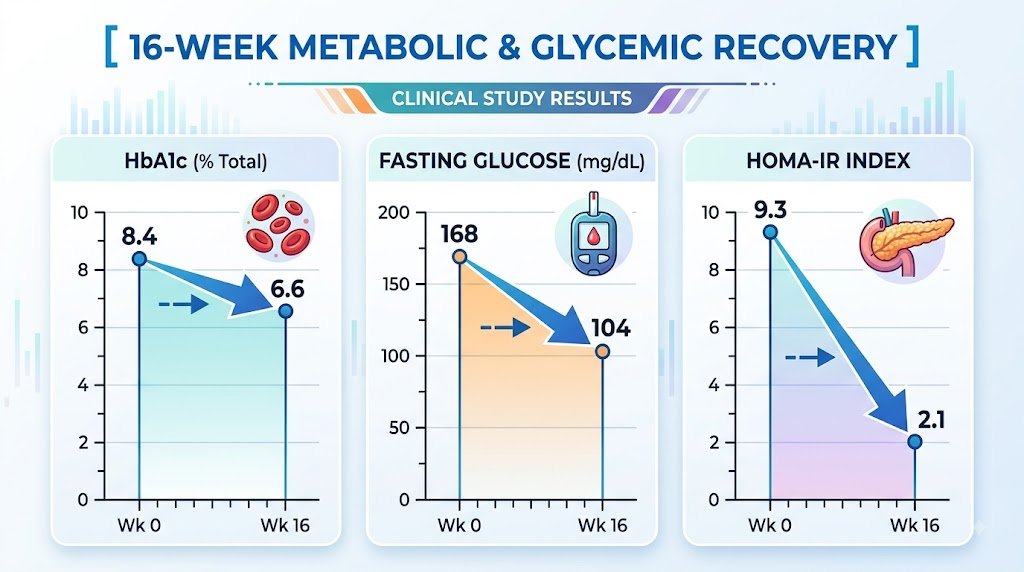
Comparative Laboratory Analysis (Week 0 vs. Week 16)
Parameter |
Baseline (Wk 0) |
Intermediate (Wk 8) |
Endpoint (Wk 16) |
Clinical Status & Target |
HbA1c |
8.4% |
7.2% |
6.6% |
1.8% Total Reduction (<7.0% Target Met) |
Fasting Blood Glucose |
168 mg/dL |
124 mg/dL |
104 mg/dL |
Near-normal glycemic baseline |
Postprandial Glucose |
242 mg/dL |
162 mg/dL |
138 mg/dL |
Effective postprandial glucose control |
Fasting Insulin |
22.4 mu IU/mL |
14.1 mu IU/mL |
9.2 mu IU/mL |
58.9% Reduction in Hyper-insulinemia |
HOMA-IR |
9.3 |
4.32 |
2.1 |
Significant reversal of insulin resistance |
Serum B12 |
142 pg/mL |
480 pg/mL |
710 pg/mL |
Normal neurological range |
Serum Magnesium |
1.5 mg/dL |
1.8 mg/dL |
2.1 mg/dL |
Replaced hyperfiltration losses |
Serum 25-OH D3 |
12.4 ng/mL |
34.2 ng/mL |
52.1 ng/mL |
Optimal endocrine target range |
Neuropathy Score (TCNS) |
9 (Moderate) |
5 (Mild) |
1 (Resolved) |
Complete resolution of paresthesia |
6. Learning Points
-
Patients who have developed T2DM due to their lifestyle must be given the first choice of medically supervised lifestyle modification for the remission of their condition and minimize the use of pharmacological interventions
-
2-Giid Quality, Diabetes Compliant Meals a Day is an effective and easy to adapt lifestyle modification and can aid in achieving better blood glucose control as compared to standard pharmacological agents
-
There is a chance of diabetes reversal, and lifestyle modification is a practically feasible strategy for that
-
With proper health education and counseling, we found compliance to this lifestyle modification better than the adherence to lifelong medications
7. Key Scientific References & Validated Literature
-
https://pubmed.ncbi.nlm.nih.gov/19878986/
-
https://pubmed.ncbi.nlm.nih.gov/23093136/
-
Indian Study using SMS Reminders to Diabetes Patients for their Lifestyle Modifications Must Read Study – https://pubmed.ncbi.nlm.nih.gov/29859274/
-
Metformin & B12 Depletion: Aroda VR, et al. Long-term Metformin Use and Vitamin B12 Deficiency in the Diabetes Prevention Program Outcomes Study. J Clin Endocrinol Metab. 2016;101(4):1754-1761
-
Benfotiamine in Diabetic Neuropathy: Stracke H, et al. Benfotiamine in Diabetic Polyneuropathy (BENDIP Study). Exp Clin Endocrinol Diabetes. 2008;116(10):600-605
-
Chromium & Insulin Receptor Signaling: Vincent JB. Biochemical mechanisms of chromium(III) action on insulin signaling. Biol Trace Elem Res. 2015;166(1):27-35
-
Magnesium Loss in T2DM: Barbagallo M, Dominguez LJ. Magnesium and type 2 diabetes. World J Diabetes. 2015;6(10):1152-1157
-
R-Alpha Lipoic Acid & AMPK Activation: Ziegler D, et al. Oral treatment with alpha-lipoic acid improves symptomatic diabetic polyneuropathy: The SYDNEY 2 trial. Diabetes Care. 2006;29(11):2365-2370
-
Zinc & Pancreatic Insulin Hexamers: Chausmer AB. Zinc, insulin and diabetes. J Am Coll Nutr. 1998;17(2):109-115