


Food and Nutrition is an individual choice and God has endowed every living human being with an equal weight brain and positioned the Brain at the Top of Body for Human Beings to make informed choices.
Its our choice to make good or bad decisions for our body and health – science can only do so much as share all details for an informed choice. Ultimate choice is of an individual exercising the option. While Science, Histroy and Human Evolution establishes that Human beings are omnivores and at Top of Food Chain – Veganism and Vegetarianism are 2 food / lifestyle choices, poeple make for whatever reasons and human bodies have to learn and adapt to these choices, even if these choices may result in health issues in mid- to long term.
With the inherent limitations in plants foods, savvy marketing companies keep creating “product innovations” to try and address these precise “inherent limitations” of plant foods and in turn creating 1 or 2 additional new issues for human body. Human beings after being swayed by such marketing efforts embark on fad nutritional trends contrary to practices in their own homes or in their grand parents homes.
One such an extensive marketing campaign is playing out daily in our real lives in form of Daily Protein Consumtpion and Different Sources of Proteins for Vegans, Vegetarians and Omnivores. We share our perspective, based purely on science and evidence, as we have no personal stakes whatsoever in this matter, except that Human Beings should make Right Choices for their Health and Stay healthy, whichever food sources help achieve that singular objective.
1. Reference Product Analysis
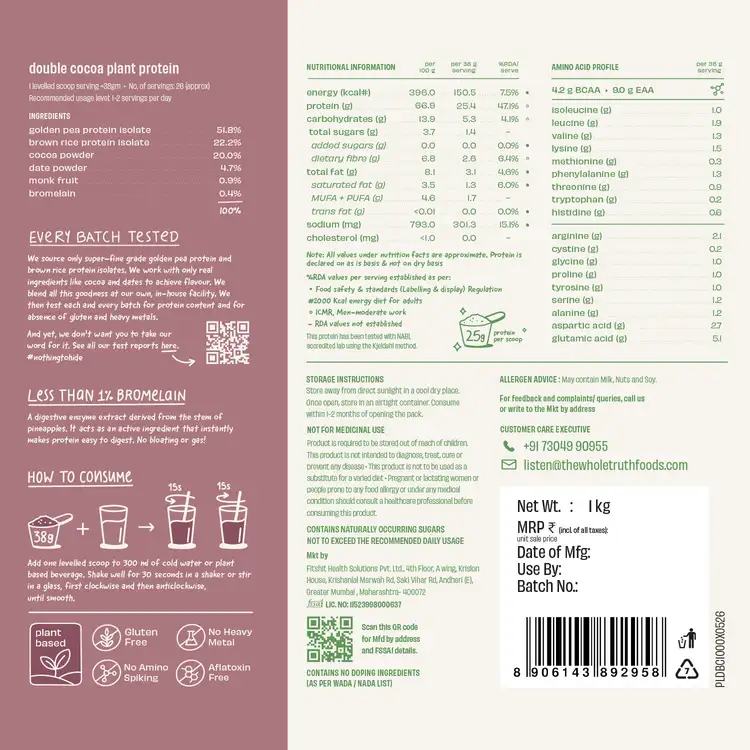
This post is triggered by an advert for “Double Cocoa Plant Protein” by The Whole Truth Foods. The relevant parameters from the back panel include:

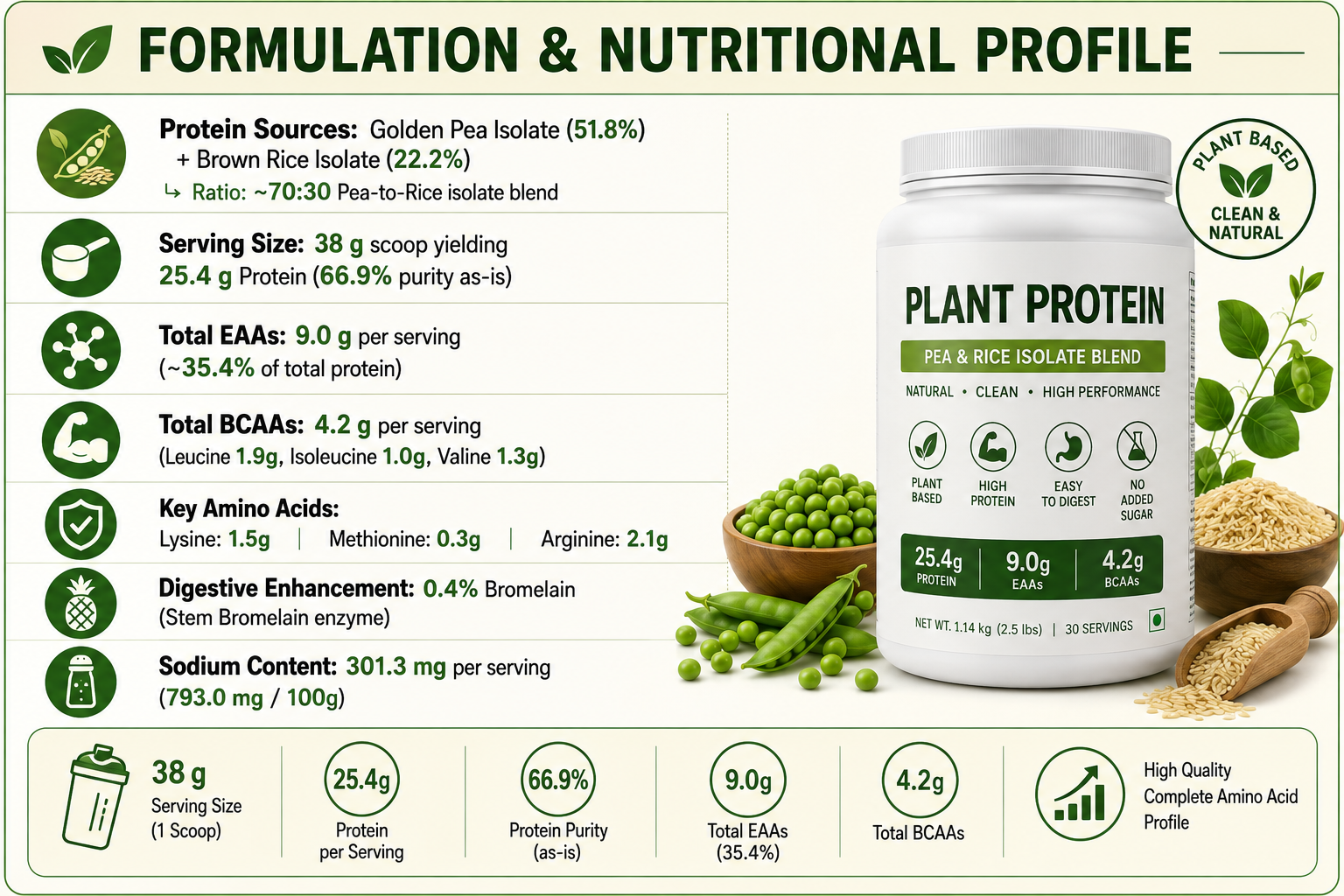
A Summary of All Nutritional Details Per Serving of “Double Cocoa Plant Protein” as per our understanding is:
2. Comprehensive Comparative Matrix
Parameter |
Single Pea Protein Isolate |
Single Brown Rice Protein Isolate |
Pea + Brown Rice Blend (~70:30) (Label Ref) |
Whey Protein Isolate / Concentrate |
Protein Purity (Raw Isolate) |
80% – 85% |
80% – 90% |
~67% – 80% (varies by flavor additions) |
80% (WPC80) – 90%+ (WPI) |
Total EAA Content |
~30% – 35% of total protein |
~34% – 38% of total protein |
~35.4% of total protein (9.0g / 25.4g) |
~43% – 52% of total protein |
BCAA Content |
~16% – 18% of total protein |
~16% – 18% of total protein |
~16.5% of total protein (4.2g / 25.4g) |
~23% – 26% of total protein |
Leucine Concentration |
~7.5% – 8.2% |
~8.0% – 8.6% |
~7.5% (1.9g / 25.4g) |
~10.5% – 13.0% |
Limiting Amino Acid |
Methionine & Cysteine (Sulfur AAs) |
Lysine |
None (Complemented) |
None (Exceeds FAO human reference) |
Arginine Content |
Very High (~8.5% – 8.7%) |
Moderate (~7.5% – 8.0%) |
High (~8.3%) (2.1g / 25.4g) |
Low (~2.0% – 2.5%) |
PDCAAS Score |
0.82 – 0.89 (capped at 1.0) |
0.42 – 0.53 (raw); ~0.80 (isolate) |
~0.97 – 1.00 (capped) |
1.00 (capped) |
DIAAS Score |
0.62 – 0.82 |
0.37 – 0.42 |
~0.85 – 0.92 |
1.07 – 1.18 |
True Ileal Digestibility |
~89% – 94% |
~85% – 90% |
~90% – 93% |
96% – 99% |
Anti-Nutritional Factors |
Phytates, Lectins, Tannins (Low in Isolate) |
Phytates, Hemagglutinins (Low in Isolate) |
Minimal (removed via iso-electric washing) |
None (Lactose / Lactoglobulins in WPC) |
Heavy Metals Risk |
Low-Moderate (Lead, Cadmium via soil) |
Low-Moderate (Inorganic Arsenic) |
Low (Requires batch testing for raw inputs) |
None (Heavy metals non-factor) |
Sodium Burden |
High (~700–1100 mg / 100g) |
Low (~100–300 mg / 100g) |
Moderate-High (~793 mg / 100g) |
Low (~150–250 mg / 100g) |
Allergenic Potential |
Low (Legume cross-reactivity rare) |
Very Low (Hypoallergenic) |
Hypoallergenic / Gluten-Free |
High (Milk allergen: Whey, Lactose, Casein) |
3. Amino Acid Kinetics, Bioavailability, and Muscle Protein Synthesis (MPS)
A. The Concept of Amino Acid Complementation
Plant proteins consumed individually often have a “limiting amino acid”—an indispensable amino acid present in amounts below human metabolic requirements, which limits total protein synthesis:
-
Pea Protein Isolate: Rich in Lysine (~7.2 g/100g) and Arginine (~8.7 g/100g), but deficient in sulfur-containing amino acids (Methionine + Cysteine: ~2.1 g/100g).
-
Brown Rice Protein Isolate: Rich in Methionine + Cysteine (~3.8 g/100g), but deficient in Lysine (~3.1 g/100g).
By blending Pea and Rice at a 70:30 ratio (matching the product’s 51.8% pea to 22.2% rice proportion), the deficiency of each source is covered:
{Pea (High Lysine, Low Met)} + {Rice (High Met, Low Lys)} = {Complete Essential Amino Acid (EAA) Profile}
B. The Leucine Trigger & MPS
Muscle Protein Synthesis (MPS) activation via the mTORC1 signaling pathway depends heavily on reaching the critical “Leucine Trigger” threshold (~2.5 g to 3.0 g of L-leucine per bolus):
-
Whey Protein: Delivers ~2.5g – 3.0g Leucine in a standard 25g protein dose (~11% Leucine density).
-
Pea + Rice Blend (Enclosed Label): Delivers 1.9g Leucine per 25.4g protein serving (~7.5% Leucine density).
-
Physiological Implication: To achieve an equivalent intracellular leucine spike to 25g of Whey Isolate, a user would need to consume ~33g – 35g of net protein from this plant blend (approx. 1.3 scoops) or rely on a slightly slower postprandial plasma amino acid peak.
4. Protein Quality Evaluation: PDCAAS vs. DIAAS
-
PDCAAS (Protein Digestibility-Corrected Amino Acid Score):
-
Formula: {PDCAAS} = {Lowest Amino Acid Score} X {Fecal True Digestibility}
-
PDCAAS truncates (caps) all values exceeding 1.0 to 1.0. While standalone Pea (0.82–0.89) and Rice (0.50–0.80) fall short, the 70:30 Pea+Rice blend reaches ~0.97–1.00, making it structurally comparable to Whey under legacy FDA/WHO metrics.
-
-
DIAAS (Digestible Indispensable Amino Acid Score):
-
DIAAS measures amino acid absorption at the terminal ileum (before colonic microflora digest unabsorbed amino acids) and is uncapped.
-
Whey Isolate achieves a DIAAS of 1.07–1.18 due to high ileal bioavailability.
-
The Pea + Rice isolate blend scores ~0.85–0.92. While slightly lower than dairy, it significantly outperforms raw plant sources and provides sufficient amino acid availability for non-catabolic maintenance and hyper-trophic adaptations.
-
5. Anti-Nutritional Factors (ANFs) & Isolation Processes
Raw legumes and grains contain natural anti-nutritional factors (ANFs) designed to protect seeds from predation:
-
Phytates (Phytic Acid): Binds divalent cations (Fe, Zn, Ca and Mg), forming insoluble complexes that inhibit mineral absorption.
-
Trypsin & Chymotrypsin Inhibitors: Block pancreatic serine proteases, lowering protein breakdown rates.
-
Tannins & Polyphenols: Precipitate proteins, reducing enzymatic access to peptide bonds.
Impact of Modern Isolation Technology:
Commercial protein isolation (alkaline extraction followed by iso-electric precipitation and enzymatic washing) removes 85%–95% of water-soluble phytates and protease inhibitors. Consequently, high-grade isolates (like the 51.8% pea / 22.2% rice isolations in the reference product) MAY contain negligible ANFs, rendering their digestibility near to that of animal proteins (~90–93% vs 96–99% for whey).
6. Heavy Metals, Long-Term Safety, & Micro-Contaminants
A. Heavy Metal Bioaccumulation (Lead, Cadmium, Arsenic)
-
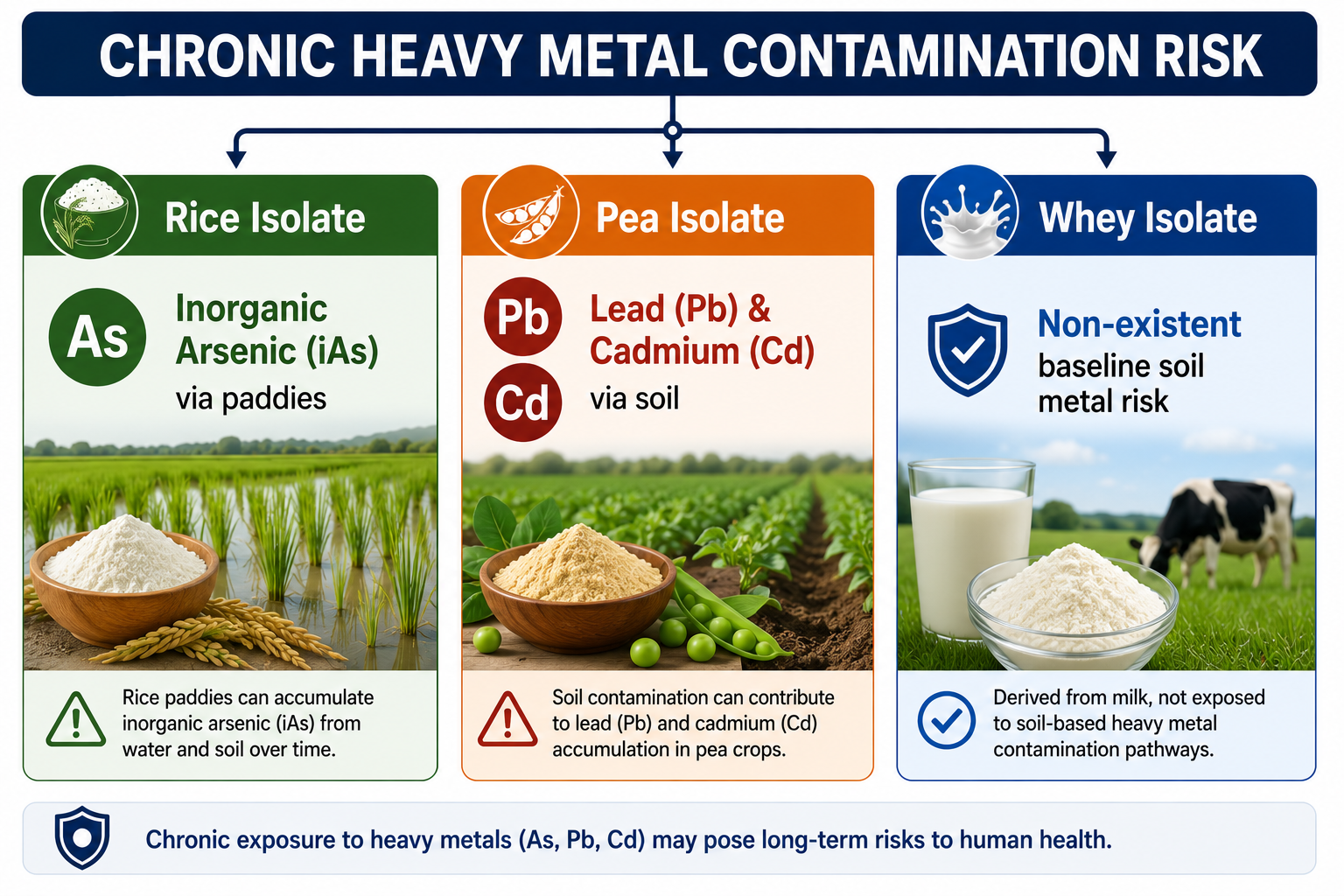
Plant Proteins: Because peas and rice absorb soil minerals during cultivation, plant isolates carry a higher baseline risk of accumulating heavy metals:
-
Rice: Accumulates inorganic arsenic (As) via root silicic acid pathways.
-
Pea: Bioaccumulates trace amounts of lead (Pb) and cadmium (Cd).
-
Mitigation: Reputable manufacturers conduct batch testing (as stated on the product label: “tested for absence of heavy metals and aflatoxin”). BUT THIS BATCH TESTING MUST BE DONE FOR EACH AND EVERY BATCH with no exceptions or excuses.
-
-
Whey Protein: Animal filtration removes environmental heavy metals, resulting in non-detectable levels.
B. Sodium Load in Pea Isolates
-
During industrial pea protein isolation, sodium hydroxide (NaOH) is used for alkaline extraction, followed by acid precipitation.
-
As shown on the reference label, 1 serving (38g) contains 301.3 mg of Sodium (793 mg / 100g). Pretty High levels at least for our comfort.
-
Clinical Consideration: Individuals on strict low-sodium diets or managing hypertension need to account for this supplemental sodium load if consuming 2+ servings per day. Whey protein generally contains substantially less sodium (~150–200 mg / 100g).
7. Gastrointestinal Profile, Tolerability, & Bromelain Addition
-
Lactose & Allergenic Reactions: Whey protein concentrate (WPC) contains low levels of lactose and dairy immunoglobulins, which can trigger GI distress in some lactose-intolerant individuals. Pea and Rice isolates are lactose-free, dairy-free, and hypoallergenic.
-
FODMAP Content: While whole peas contain high oligosaccharides (galacto-oligosaccharides / GOS), the isolation process separates the protein fraction from soluble carbohydrates, rendering pea protein isolates low-FODMAP and easy on the stomach.
-
The Role of Bromelain (0.4%): The inclusion of Bromelain (a cysteine endopeptidase extracted from pineapple stem) helps cleave complex peptide chains into shorter di- and tri-peptides within the stomach. This accelerates gastric emptying and reduces potential bloating or sensation of heaviness.
8. Final Verdict & Application Guidelines
-
Choose Whey Protein Isolate IF: Your priority is safe, clean and maximum leucine density per gram (~2.5g–3.0g leucine per 25g serving), rapid digestion speed, and an uncapped DIAAS score > 1.0, provided you are NOT Vegan or have no dairy or lactose sensitivities. Whey Protein is your safest bet.
-
Choose a Pea + Brown Rice Blend (as shown on the label) IF: You seek a complete plant-based protein with an amino acid profile complemented across Lysine and Methionine, high Arginine content, low allergenicity, and a PDCAAS score approaching 1.0 but a Relatively Low DIAAS score of 0.9 vs 1.2 for Why Protein. DIAAS is a way better parameter than old, PDCAAS. To optimize muscle protein synthesis, consider taking ~35g–38g of plant protein per dose to hit the ~2.5g leucine threshold but be wary of checking every batch of Heavy Metals Content and also Risk of Anti-Nutritional Factors as listed above.
NO-Non Sensical / No-Brainer Approach
While we have special sympathies for Vegans, for Vegetarians and Omnivores – please do allow us presenting you a pure common sensical, no-brainer appraoch to achieve at least 25 gm per day of protein requirement.
1 Liter of Cow / Buffalo / No-A2 Milk contains at least 24 to 25 gm and maybe higher, of High Qulaity Protein – the same protein which Whay Protein companies extract and market you at fancier prices. On cost and benefits basis:
-
1 Ltr of Good Quality Milk costs around Rs 60 for 3.5% Fat Content and this has 2.5% High Qulity Protein (25 g in 1 Ltr) – compared to “Double Cocoa Plant Potein” which at Rs. 1,973 per Kg (deeply discounted price) – costs around Rs 75 gm and delivers same 25 g of Protein, although of proven slightly poor Amino Acids Profile as well as risk of anti-nutritional factors and heavy metals (need 3rd Party Independent Lab Reports for each and every batch) – also as compared to Rs 90 per 30 gm of Whey Protein which also delivers almost 25 gm of Protein.
-
1 Ltr of Milk, apart from 25 g protein delivers 35 gm High Quality, super nutritious and highly useful Fat for human body. Contrary to your belief, Saturated Fats are extremely good for human body and Saturated Fats from Animal Sources are even better for Human Body
-
1 Ltr of Milk delivers 1.1 gm of Calcium and 1.0 g of Pottasium, around 800 mg of Phosphorus and around 400 g Sodium, apart from 40 to 45 gm of Lactose (Crabohydrate) and 870 ML of high quality water. Thus making Milk a very complete, scientific food required by humn body – a fact which our Bhagwan Shree Krishna has been propagating for more than 15,000 Years, only if we care to listen
-
None of Cocoa Double Plant Protein Blend as well as Whey Protein have any of these benefits that Pure 1 Ltr of HUMBLE Milk delivers and at a cost which is at least 20% lower than the fancy Cocoa Double Plant Protein and little over 30% lower than well established, Whey Protein – on a like to like, 25 gm of protein delivered basis. In one of our earlier publications we established with evidence that Milk even helps increase height – do explore that section as well
We made our choices way long back and its over to you now to make your own choice based either on science or on fad or faith. Consequences of such choices belong sadly to Human Body. Be Careful Choosing – May The Power Be With You!
Frequently Asked Questions (FAQs)
Q1: Does pea protein cause bloating like whey protein?
No. Pea protein is naturally dairy-free, lactose-free, and low in FODMAP carbohydrates. Unlike whey concentrate, pea isolate rarely causes stomach cramps or gas
Q2: Is pea protein a complete protein?
Yes. Pea protein contains all 9 essential amino acids that the human body cannot produce on its own. While its methionine levels are slightly lower than animal sources, pairing it with foods like rice protein completes the profile
Q3: Which is better for weight loss, pea or whey?
Both support fat loss by preserving lean muscle mass during a calorie deficit. However, whey protein digests at a slightly slower, more sustained rate than pea = rice blend, which can promote longer feelings of fullness (satiety) and suppress appetite between meals
Q4: Which has more anti-nutritional factors and risk of heavy metals – pea+rice blend or whey protein?
Pea + Rice Protein blend suffers from inherent inssues of fairly high levels of anti-nutritional factors as well as risk of heavy metals such as Arsenic and Lead – though modern processing takes care of such risks but consumers require definitive proof in form of independent, 3rd Party Lab analysis to allay such fears. Why Protein on the other hand has no such concerns whatsoever. In addition – whey protein score pretty high on DIAAS Scorie as compared to Pea Protein + Rice Protein blend – pls refer to details, above