



Vitamin A is one of the most biologically important fat-soluble vitamins, playing essential roles in vision, immune function, epithelial integrity, reproduction, embryonic development and gene regulation. Unlike many nutrients, however, “Vitamin A” is not a single molecule. It encompasses a family of compounds with different chemical structures, biological activities and metabolic pathways.
For consumers choosing a supplement, the key question is simple: Which form of Vitamin A has the strongest scientific evidence?
The answer depends on whether the goal is correcting deficiency, routine supplementation, supporting general health or avoiding toxicity.
Vitamin A Chemistry and All Natural & Supplemental Forms
Vitamin A exists in two principal categories:
1. Preformed Vitamin A (Retinoids)
These are biologically active compounds found almost exclusively in animal-derived foods and most conventional supplements. They include:
-
Retinol – the primary transport form circulating in blood, bound to Retinol-Binding Protein (RBP4).
-
Retinal (Retinaldehyde) – required for the visual cycle, where 11-cis-retinal combines with opsin to form rhodopsin.
-
Retinoic Acid – the hormonally active metabolite that regulates hundreds of genes through retinoic acid receptors (RAR) and retinoid X receptors (RXR). It is not converted back to retinol.
-
Retinyl Esters (primarily retinyl palmitate and retinyl acetate) – storage and supplemental forms that are hydrolyzed to retinol after absorption.
Because preformed vitamin A does not require conversion from plant pigments, it is highly bioavailable and rapidly replenishes vitamin A stores.
2. Provitamin A Carotenoids
These are plant-derived pigments that must first be converted into retinol before they can perform classical vitamin A functions. The most important are:
-
Beta-carotene (most potent provitamin A carotenoid)
-
Alpha-carotene
-
Beta-cryptoxanthin
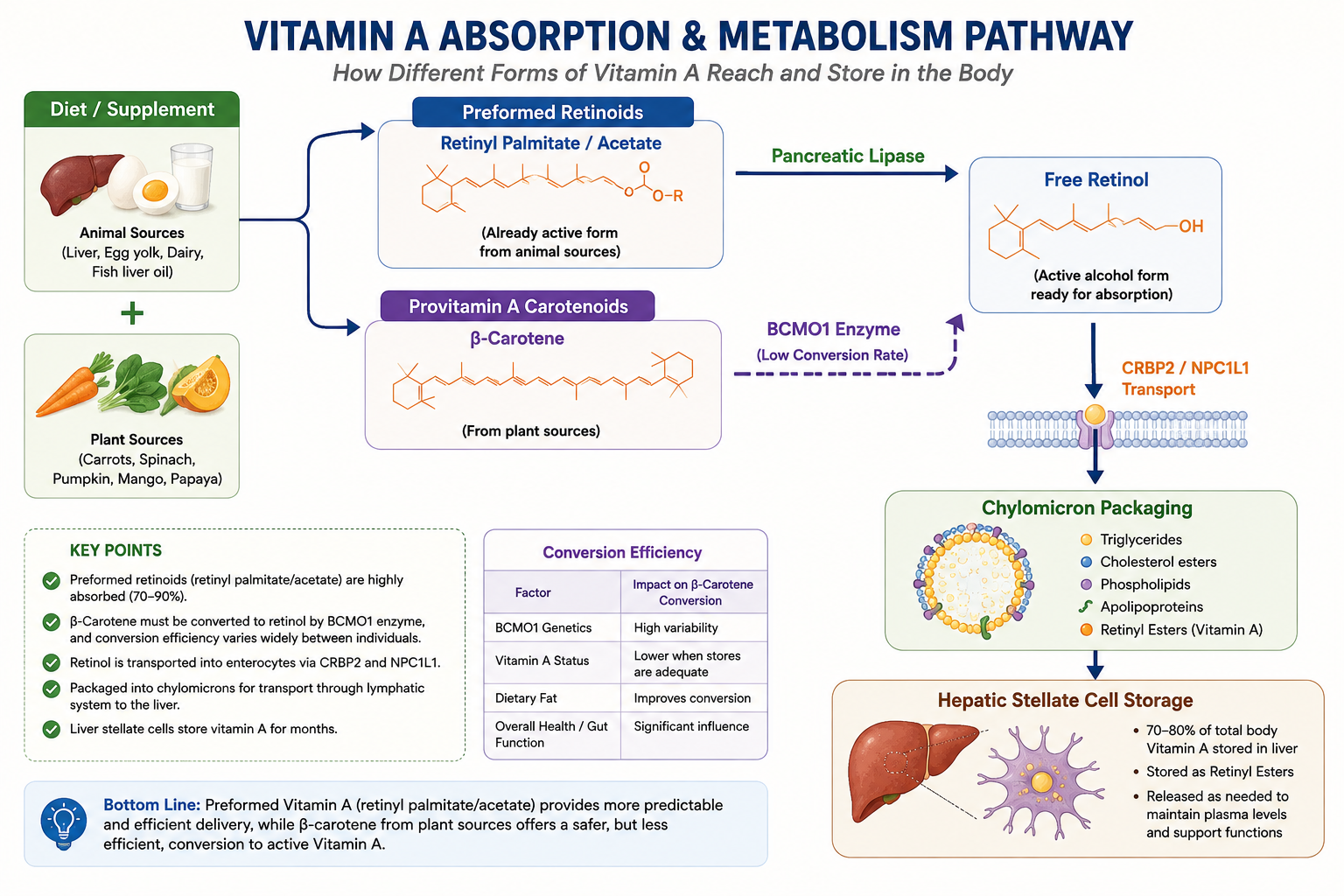
Conversion occurs primarily in intestinal enterocytes through β-carotene 15,15′-monooxygenase (BCMO1), producing retinal, which is subsequently reduced to retinol. Importantly, conversion efficiency varies widely between individuals. Common genetic variants in the BCMO1 gene can substantially reduce conversion, meaning some people obtain much less vitamin A from beta-carotene than others.
Biochemical & Pharmacokinetic Rationale
-
Vitamin A from animal sources (retinol) is absorbed easily by your gut. Plant sources (beta-carotene) needs an enzyme to convert into usable Vitamin A
-
Many people have genetic changes that block this conversion. This makes plant sources less reliable for getting enough Vitamin A
How Your Body Absorbs Vitamin A
Animal Vitamin A (Retinyl Palmitate)
- Your gut breaks it down into free retinol
- Tiny fluid drops (micelles) carry it into your cells
- Absorption is direct and very fast
Plant Vitamin A (Beta-Carotene)
- Your body must cut beta-carotene in half to make retinol
- An enzyme named BCMO1 does this job
- Common gene changes (SNPs) can lower this enzyme’s power by up to 69%
- Plant diets may leave many people short on true Vitamin A. Relying solely on plant-based beta-carotene leaves a significant percentage of the population functionally deficient in bioavailable retinol.
Superior vs. Suboptimal Form Comparison
Parameter |
Retinyl Palmitate (Preformed Ester) |
Synthetic β-Carotene (Isomeric Isolated) |
Conversion Dependency |
Zero (Directly converted to Retinol) |
High (BCMO1 enzyme rate-limited) |
Intestinal Uptake Efficiency |
70%–90% (via lipid micellar absorption) |
10%–28% (varies by genetic polymorphisms) |
Hepatic Storage Efficiency |
High (Directly stored in Hepatic Stellate Cells) |
Low (Requires cleavage prior to retinyl esterification) |
Safety Threshold |
High doses require monitoring for hypervitaminosis |
Non-toxic, but high doses increase oxidative stress in smokers |
Clinical Synergies & Co-Factors
-
Zinc Co-factor: Zinc is essential for the synthesis of Retinol-Binding Protein (RBP4) and serves as a catalytic cofactor for Retinol Dehydrogenase, which converts retinol to active retinaldehyde.
-
Lipid Matrix Requirement: Must be co-ingested with 3–5 grams of dietary fats / lipids to trigger pancreatic lipase secretion and bile acid micellization.
Comparative Evidence: Retinol vs Retinyl Palmitate vs Beta-Carotene
Retinol is the physiologically active alcohol form of vitamin A and represents the reference compound against which other supplemental forms are compared.
Advantages
-
High intestinal absorption under normal conditions
-
No metabolic conversion required
-
Rapid correction of deficiency
-
Well-studied in clinical medicine
-
Reliable regardless of BCMO1 genotype
Limitations
-
Excess intake may lead to hypervitaminosis A
-
Higher teratogenic risk during pregnancy when consumed in excessive amounts
-
Requires careful dosing because it accumulates in the liver
Retinol is therefore particularly valuable when correcting documented deficiency but should be used within established intake recommendations.
Retinyl Palmitate
Retinyl palmitate is an esterified storage form naturally present in animal liver and is the most common form used in multivitamins and fortified foods. After intestinal absorption, pancreatic esterases hydrolyze retinyl palmitate to free retinol before transport.
Advantages
-
Excellent stability during storage
-
High bioavailability
-
Extensive human safety data
-
Widely used in clinical supplementation
-
Efficient restoration of hepatic vitamin A stores
For most healthy adults, retinyl palmitate performs similarly to retinol because both ultimately provide bioavailable retinol.
Beta-Carotene
Beta-carotene differs fundamentally because it is a provitamin rather than active Vitamin A. Its conversion into retinol is tightly regulated according to the body’s Vitamin A status. When stores are adequate, conversion decreases, providing a natural safeguard against Vitamin A toxicity.
Advantages
-
Lower risk of hypervitaminosis A
-
Suitable for many vegetarian and vegan supplements
-
Provides antioxidant activity independent of vitamin A
-
Physiological regulation of conversion
Limitations
-
Conversion varies widely between individuals
-
Reduced conversion in BCMO1 polymorphisms
-
Less effective in correcting deficiency rapidly
-
High-dose beta-carotene supplements increased lung cancer risk in smokers and asbestos-exposed individuals in large randomized trials (ATBC and CARET), so such supplementation is not recommended for these groups.
What Does the Human Evidence Show?
The overall body of evidence indicates that:
-
Preformed vitamin A (retinol or retinyl esters) reliably raises vitamin A status because it bypasses the need for enzymatic conversion.
-
Retinyl palmitate has decades of successful use in food fortification, clinical supplementation and deficiency prevention programs.
-
Beta-carotene is an effective provitamin A source for some people but exhibits considerable inter-individual variability due to genetics, nutritional status and overall diet.