

If there is one public health challenge of India which we wish to urgently and immediately address and do our best bit is – Iron Deficiency Anaemia in Indians. This 3-Part Series is just one of our endevaros to help create awreness and scientific temper about this persistent, pervasive and seriously problematic healthcare challenge in India. Pls share extensively and take good care of yourself and your loved ones. Lets start with basics of Iron absorption.
Understanding the Science Behind Iron Bioavailability in India
Iron deficiency remains one of India’s most persistent and pervasive public health challenges despite decades of nutrition programs, food fortification initiatives, and iron supplementation campaigns. According to recent national surveys, anemia affects a substantial proportion of Indian women, adolescent girls and young children, making it one of the country’s most important nutritional disorders.
At first glance, this appears paradoxical. Indian diets often contain foods naturally rich in iron, including lentils, pulses, whole grains, green leafy vegetables, jaggery and millets. Yet iron deficiency continues to be widespread. Did you ever wondered, why this is happening.
The answer lies in a concept that is frequently and routinelt overlooked: iron bioavailability.
The amount of iron listed in a food composition table is not necessarily the amount the body absorbs. Two meals containing identical quantities of iron can produce dramatically different levels of absorption depending on the chemical form of iron, accompanying foods, the health of the intestine, and the body’s current iron requirements.
This distinction forms the basis of one of the most important concepts in nutritional science—the difference between heme iron and non-heme iron.
Understanding how these two forms differ is particularly important for India, where vegetarian dietary patterns predominate and more than three-quarters of dietary iron is derived from plant-based sources – hence very high levels of iron deficiency anaemia in Indians.
Why Iron Matters
Iron is an essential trace mineral required by virtually every cell in the human body. Although the average adult contains only 3–4 grams of iron, this small quantity performs several indispensable biological functions. Iron is required for:
-
Oxygen transport through hemoglobin
-
Oxygen storage in muscle via myoglobin
-
Cellular energy production within mitochondria
-
DNA synthesis and cell division
-
Immune system function
-
Brain growth and cognitive development
-
Normal pregnancy and fetal development
-
Physical performance and endurance
Unlike many vitamins, the human body has no regulated pathway for actively excreting excess iron. Instead, iron balance is maintained primarily by controlling how much iron is absorbed from the intestine. This makes intestinal absorption one of the most tightly regulated processes in human nutrition.
Two Different Forms of Dietary Iron
Dietary iron exists in two chemically distinct forms:
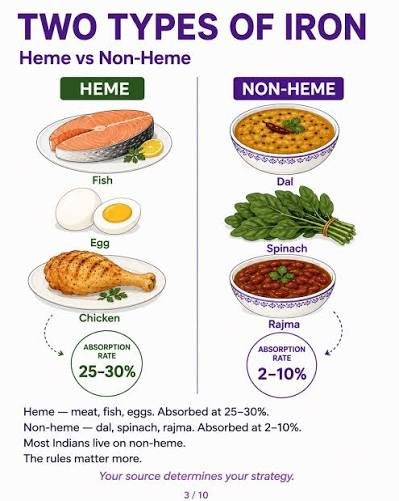
1. Heme Iron – Heme iron is found almost exclusively in animal tissues, where it forms part of hemoglobin and myoglobin. Major Indian dietary sources include:
-
Goat meat (mutton), Lamb Meat
-
Fish
-
Organ meats such as liver, heart
-
Eggs (small amounts)
Chemically, heme iron is enclosed within a porphyrin ring that protects it from many dietary inhibitors encountered during digestion. Because of this protective structure, heme iron is absorbed efficiently, with approximately 20–35% of ingested iron typically entering the bloodstream. Perhaps more importantly, heme iron absorption remains relatively stable even when meals contain compounds that strongly inhibit non-heme iron absorption.
2. Non-Heme Iron – Non-heme iron accounts for the overwhelming majority of dietary iron consumed by Indians. It is found in:
-
Lentils (dal)
-
Chickpeas
-
Kidney beans (rajma)
-
Black gram
-
Soybeans
-
Spinach
-
Fenugreek leaves
-
Amaranth
-
Ragi
-
Bajra
-
Whole wheat
-
Sesame seeds
-
Pumpkin seeds
-
Jaggery
-
Fortified cereals
Unlike heme iron, non-heme iron exists primarily in the ferric (Fe³⁺) form, which must first be converted into ferrous (Fe²⁺) iron before absorption. This additional chemical step makes non-heme iron highly susceptible to numerous dietary factors. Typical absorption ranges between 2% and 8%, although absorption may increase substantially during iron deficiency or decrease further in meals rich in phytates or polyphenols.
Why Heme Iron Is Better Absorbed
One of the most important differences between the two forms lies in how they enter intestinal cells.
Heme Iron – Heme molecules are absorbed largely intact through specialized transport systems in the small intestine. Once inside the intestinal cell, the enzyme heme oxygenase releases iron from the porphyrin ring. Because the iron remains protected until after absorption, substances such as phytates, tea polyphenols and dietary fibre exert relatively little influence on uptake.
Non-Heme Iron – Non-heme iron follows a far more complex pathway. Before absorption can occur:
-
Ferric iron (Fe³⁺) must be chemically reduced to ferrous iron (Fe²⁺)
-
Gastric acid and vitamin C facilitate this conversion
-
Ferrous iron is transported into intestinal cells by the Divalent Metal Transporter 1 (DMT1)
-
Iron is either stored temporarily as ferritin or exported into the bloodstream through ferroportin
-
The liver-derived hormone hepcidin tightly regulates ferroportin, determining how much iron ultimately reaches the circulation
Each of these steps is influenced by nutrition, inflammation and overall health, making non-heme iron absorption highly variable.
The Indian Diet: Rich in Iron but Poor in Bioavailability
This is where India’s nutritional story becomes particularly important. Many traditional Indian diets contain respectable amounts of total iron, yet much of this iron is non-heme iron accompanied by natural absorption inhibitors. Common examples include:
-
Whole grains rich in phytates
-
Lentils and legumes containing phytates and polyphenols
-
Millets with high phytate content
-
Tea consumed immediately after meals
-
Low intake of vitamin C-rich fruits with main meals
-
Limited consumption of animal-source foods in many households
As a result, the bioavailable iron reaching the bloodstream may be substantially lower than expected from dietary intake alone. This explains why iron deficiency can occur even when calculated iron intake appears adequate.
Heme vs Non-Heme Iron: A Scientific Comparison
| Feature | Heme Iron | Non-Heme Iron |
|---|---|---|
| Main dietary source | Animal foods | Plant foods and fortified foods |
| Chemical form | Hemoglobin and myoglobin | Ferric or ferrous salts |
| Typical absorption | 20–35% | 2–8% |
| Effect of phytates | Nil | Significant inhibition |
| Effect of tea or coffee | Nil | Marked reduction in absorption |
| Response to vitamin C | Limited | Strongly enhanced |
| Dependence on stomach acid | Nil | Higher – vast majority of Indians have less stomach acid |
| Predominant source in Indian diets | Minor | Overwhelmingly Major |
This table illustrates why two individuals consuming similar quantities of iron may absorb very different amounts.
Bioavailability Matters WAY More Than Iron Content
Nutrition labels typically report total iron, not absorbed iron. Consider two simplified examples:
Meal A
-
8 mg iron from spinach and lentils
-
Absorption: ~5%
-
Iron absorbed: ~0.4 mg
Meal B
-
4 mg iron from mutton
-
Absorption: ~30%
-
Iron absorbed: ~1.2 mg
Although Meal A contains twice as much iron on paper, Meal B delivers considerably more absorbable iron. This concept has profound implications for dietary planning in India and explains why improving bioavailability can sometimes be more effective than simply increasing iron intake.
Role of Hepcidin: The Master Regulator of Iron
Modern iron biology has transformed our understanding of iron deficiency. At the center of this regulation is hepcidin, a peptide hormone produced by the liver. Hepcidin controls the activity of ferroportin, the only known cellular iron exporter. When hepcidin levels rise:
-
Ferroportin is degraded
-
Iron becomes trapped inside intestinal cells and macrophages
-
Less dietary iron reaches the bloodstream
When hepcidin levels fall:
-
Ferroportin remains active
-
More dietary iron is absorbed
-
Iron stores are replenished more efficiently
Inflammation, obesity, chronic infections and certain chronic diseases can increase hepcidin production, reducing iron absorption even when dietary iron intake is adequate. This mechanism is increasingly recognized as a contributor to iron deficiency in India.
Key Takeaways
The distinction between heme and non-heme iron extends far beyond chemistry. It helps explain why India continues to face a high burden of iron deficiency despite diets that often appear iron-rich on paper. While heme iron from animal foods is absorbed efficiently and is relatively resistant to dietary inhibitors, non-heme iron—the principal source for most Indians—is far more sensitive to factors such as phytates, tea, coffee, calcium and inflammation.
For healthcare professionals, nutritionists and families alike, the focus should not simply be on increasing iron intake but on maximizing iron bioavailability through evidence-based dietary practices. Only then will we able to get a handle on this pervasive, persistent deficiency in Indians.