

Cholesterol Paradox Revisited: Low LDL Cholesterol May Be Linked to Higher Mortality in Olds — What the Totality of Evidence Really Shows

This is about an extremely critical for human body, element called Cholesterol which in our opinion gets more bad press than good, despite the fact that each and every cell in human body requires cholesterol, most of body hormones are made from cholesterol and that human brain is Most cholesterol RichOrgan in Human body. This much is the importance of cholesterol for human beings. Objective of this write up is to understand Cholesterol and its levels in human body more scientifically, rationally and un-emotionally.

Cholesterol – More Hero Than Villain

For more than half a century, lowering low-density lipoprotein cholesterol (LDL-C, unwittingly dubbed as “bad cholesterol”) has been a central strategy in the prevention of atherosclerotic cardiovascular disease (ASCVD). Large randomized clinical trials, genetic studies and international guidelines consistently identify elevated LDL-C as a causal contributor to atherosclerosis and cardiovascular events.

However, an intriguing body of observational research has reported an apparently contradictory finding. In several community-based cohorts, particularly among adults aged 60 years and older, individuals with lower baseline LDL-C or total cholesterol (TC) have sometimes experienced higher rates of all-cause mortality than those with moderately elevated cholesterol levels. This observation has become widely known as the cholesterol paradox.”

At first glance, these findings appear to challenge decades of cardiovascular research. Yet a closer examination reveals a far more complex picture. Modern epidemiology, Mendelian randomization studies and randomized controlled trials suggest that – Low serum cholesterol is frequently a potential biomarker of underlying frailty, subclinical disease, or systemic inflammation (reverse causation) rather than a direct cause of death, while lifelong exposure to elevated ApoB-containing lipoproteins remains a causal driver of atherosclerotic cardiovascular disease (ASCVD).

Understanding this distinction is essential for clinicians, researchers and patients alike. Misinterpreting observational associations as proof of causation can lead to misleading conclusions and inappropriate clinical decisions.

This review examines the biological basis of the cholesterol paradox, critically evaluates the major observational and interventional studies published over the past six decades, and explains why the relationship between cholesterol and mortality differs depending on age, health status, and study design.


1. Cholesterol Paradox: Understanding the Epidemiological Observation

One of the most consistent findings in nutritional epidemiology is that biological relationships are rarely linear. Instead, many biomarkers—including blood pressure, body weight, fasting glucose, and cholesterol—demonstrate U-shaped or J-shaped associations with mortality.

Several large observational studies have reported that both extremely low and extremely high LDL-C concentrations are associated with higher all-cause mortality, while intermediate concentrations are associated with the greatest survival.
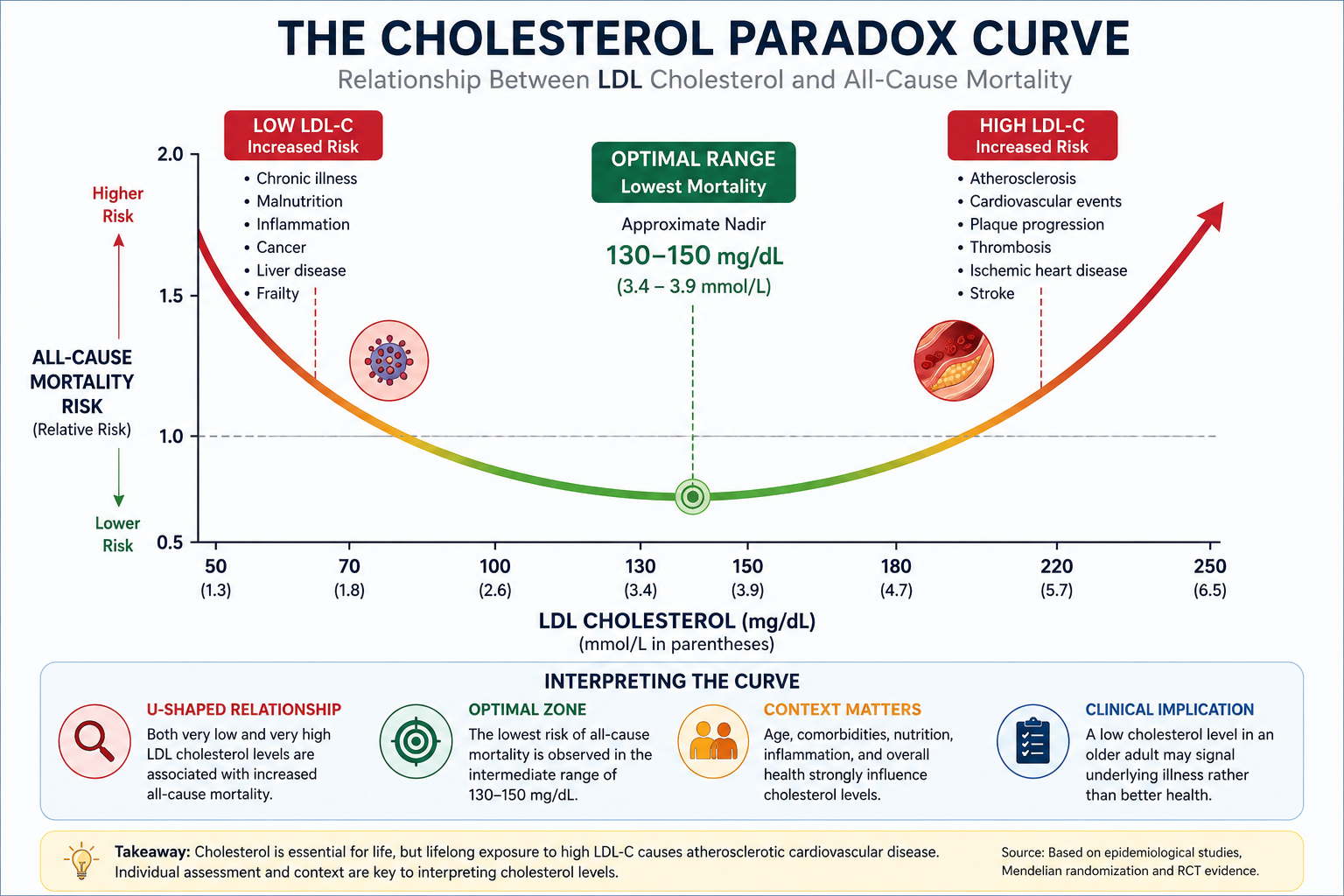
Importantly, this curve describes population-level associations, not proof that changing an individual's LDL concentration will necessarily alter mortality in the same way.
Importantly, this curve describes population-level associations, not proof that changing an individual’s LDL concentration will necessarily alter mortality in the same way.

Key Epidemiological Evidence

Copenhagen General Population Study – One of the largest community-based cohorts examining cholesterol and mortality included more than 108,000 Danish adults. Among individuals not receiving lipid-lowering therapy, investigators observed a U-shaped relationship between LDL-C and all-cause mortality. Mortality was lowest at intermediate LDL-C concentrations, whereas both very low (<70 mg/dL) and markedly elevated (>190 mg/dL) LDL-C levels were associated with higher mortality.

The study generated considerable interest because it suggested that extremely low LDL-C in apparently healthy individuals might reflect underlying biological processes rather than optimal health.


Studies in Older Adults

Several observational studies involving adults aged 65 years and above—including systematic reviews of cohorts in Europe, North America and Asia—have reported inverse associations between LDL-C and all-cause mortality. In many of these studies:

  • Higher baseline LDL-C was associated with lower all-cause mortality.

  • Cardiovascular mortality did not necessarily increase proportionally.

  • The inverse association became stronger in very elderly populations (>80 years).

These findings have frequently been cited as evidence that cholesterol may become protective later in life. However, interpretation requires considerable caution because observational studies cannot distinguish causation from association.


2. Biological Mechanisms That May Contribute to the Cholesterol Paradox

Researchers have proposed several physiological mechanisms that might explain why moderately higher circulating cholesterol is sometimes associated with improved survival in older adults.

A. Lipoproteins and Innate Immunity – Beyond transporting cholesterol, LDL and HDL participate in the innate immune response. Experimental studies suggest that circulating lipoproteins can bind bacterial lipopolysaccharides (LPS), facilitating their clearance and reducing inflammatory signaling.

This has led to the hypothesis that modestly higher lipoprotein concentrations may enhance resilience during severe bacterial infections, particularly in older adults with declining immune function.

B. Cellular Repair and Steroid Hormone Synthesis – Cholesterol is an indispensable structural component of every human cell membrane and serves as the precursor for:

  • Cortisol

  • Aldosterone

  • Estrogens

  • Testosterone

  • Vitamin D

  • Bile acids

Adequate cholesterol availability is therefore essential for cellular integrity, endocrine function and normal physiology. These biological roles, however, should not be interpreted as evidence that chronically elevated circulating LDL-C is beneficial for arterial health.


3. Reverse Causation: The Most Important Explanation

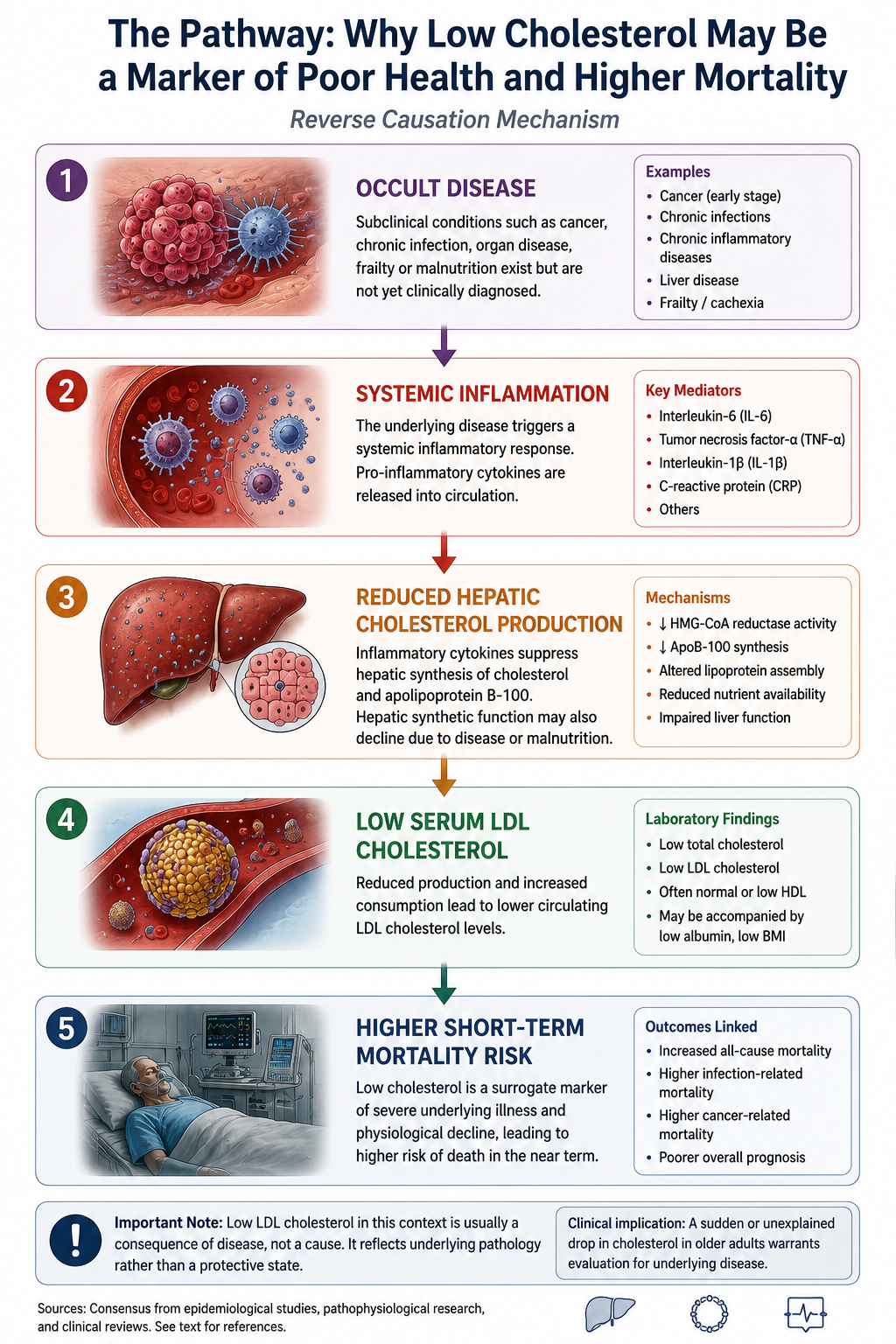
Most lipid researchers consider reverse causation to be the principal explanation for the cholesterol paradox. Rather than low cholesterol causing death, chronic illness often lowers cholesterol long before clinical diagnosis.

Occult Disease
      │
      ▼
Systemic Inflammation
      │
      ▼
Reduced Hepatic Cholesterol Production
      │
      ▼
Low Serum LDL Cholesterol
      │
      ▼
Higher Short-Term Mortality
Conditions capable of lowering LDL-C include:
  • Undiagnosed malignancy

  • Chronic inflammatory diseases

  • Liver disease

  • Protein-energy malnutrition

  • Frailty

  • Sarcopenia

  • Advanced heart failure

Consequently, declining cholesterol in older adults may function as a clinical biomarker of deteriorating health, rather than a direct cause of mortality.

Key Conclusion
Elevated cholesterol is not inherently "heart-friendly" or protective against cardiovascular disease. While observational studies demonstrate that abnormally low cholesterol levels track with higher overall mortality, this is primarily driven by reverse causation—where subclinical illness, chronic inflammation, and frailty depress lipid levels prior to death.

Context Matters: In robust, healthy individuals, elevated LDL-C promotes the development of vascular plaque.

Biomarker of Frailty: In frail elderly patients or those with severe chronic illness, a rapid drop in total cholesterol should serve as a clinical warning sign of systemic decline or malnourishment rather than an indicator of ideal health.

Lipid Goals: Lipid-lowering interventions (statins, ezetimibe, PCSK9 inhibitors) reduce total and cardiovascular mortality proportionally to baseline risk and absolute LDL-C reduction.


4. Integrating Observational, Genetic and Clinical Trial Evidence

The strongest conclusions in medicine emerge when multiple independent lines of evidence converge.

Evidence Source Principal Finding
Observational Cohorts Lower LDL-C is sometimes associated with higher all-cause mortality, especially in frail older adults.
Mendelian Randomization Lifelong genetically lower LDL-C consistently reduces ASCVD risk without evidence of increased non-cardiovascular mortality.
Randomized Clinical Trials LDL-C lowering with statins, ezetimibe and PCSK9 inhibitors reduces major cardiovascular events in appropriate high-risk populations.

Viewed together, these data suggest that the cholesterol paradox reflects the complexity of aging and chronic disease rather than evidence that elevated LDL-C protects against atherosclerosis.


Clinical Perspective

The cholesterol paradox should not be interpreted as a reason to abandon evidence-based lipid management. Instead, it highlights an important clinical principle:

  • In healthy middle-aged adults, persistently elevated LDL-C remains an established causal risk factor for atherosclerotic cardiovascular disease

  • In frail older adults, an unexpected decline in cholesterol may warrant evaluation for underlying illness, malnutrition, chronic inflammation or hepatic dysfunction

The challenge for clinicians is to interpret cholesterol values within the broader context of an individual’s age, comorbidities, nutritional status, inflammatory burden and overall cardiovascular risk, rather than relying on a single laboratory measurement in isolation. This balanced framing is more likely to be viewed as authoritative by clinicians, researchers and search engines because it accurately reflects the current state of evidence while avoiding conclusions that extend beyond what the research can support.

Key Conclusion

Elevated cholesterol is not inherently “heart-friendly” or protective against cardiovascular disease. While observational studies demonstrate that abnormally low cholesterol levels track with higher overall mortality, this is primarily driven by reverse causation—where subclinical illness, chronic inflammation, and frailty depress lipid levels prior to death.

  1. Context Matters: In robust, healthy individuals, elevated oxidised-LDL-C promotes the development of vascular plaque

  2. Biomarker of Frailty: In frail elderly patients or those with severe chronic illness, a rapid drop in total cholesterol should serve as a clinical warning sign of systemic decline or malnourishment rather than an indicator of ideal health

  3. Lipid Goals: Lipid-lowering interventions (statins, ezetimibe, PCSK9 inhibitors) reduce total and cardiovascular mortality proportionally to baseline risk and absolute LDL-C reduction

More from the blog

Osteoporosis and Fractures Diet Guide: Low Oxalate Meal Plan for Indians

If you are a PURE Vegetarian - this write up and every single word of this, greatly helps you understand the inherent risk of...

Anti-Nutrient Crisis: High Oxalates and Low Calcium cause Increased Bone Fractures in Indians

As part of our Evidence-Explained™ - we present you learnings from a long, 20 years running clinical study on Osteoporosis and Fractures in Americans...

Efficacy of Vitamin K2 (MK-7) on Linear Growth in Children: Addressing Growth Deficit in Indian Children

Height and Bone Developments in Children Childhood linear growth represents a sensitive biomarker of cumulative somatic health, adequate cellular nutrition, and harmonious skeletal development. Globally—and within...

Role of Vit K2 in Arterial Health, Inter99 Study & Vit K2 Deficiency in Indians

If you love your Heart and care for your Heart Health - you won't miss a word of this special series on Heart Health...