



Science supported and Evidence-Based Guide of all essential, Vitamins, Minerals and Supplements that a Sarcopenic Indian must consider.
This is last and final, Part 5 of 5-Part Series on Gut Health and Muscle Loss / Sarcopenia in Indians. You may check Part 1 to 4 on the site under Section – Gut Health.
Sarcopenia – which simply means Loss of Muscle Mass, is extensively reported from Indian Population, so much so that Indian Doctors have come together for Consensus Guidelines for Diagnosing and Managing Sarcpenia.
India’s Leading Doctors across including Endocrinologists, Geriatric Medicine, Internal Medicine, Respiratory Medicine, Medical Oncology, Critical Care, Medicine, Sports & Exercise Medine and Dietetics – have come together for Consensus Guidelines titled:
An Indian Consensus on Sarcopenia: Epidemiology, Etiology, Clinical Impact, Screening, and Therapeutic Approaches
PMCID: PMC11955740 PMID: 40165836

Excerpts from India’s Cinsensus on Sarcopenia –
Epidemiology of Sarcopenia
What Is the Burden of Sarcopenia in India?
Among the elderly (≥60 years of age) in India, primary sarcopenia has a prevalence of 39.2%. The Sarcopenia‑Chandigarh Urban Bone Epidemiological Study demonstrated that muscle mass is lower in Indians across all age groups than in Caucasians; hence, using Western cutoffs can overestimate the prevalence of sarcopenia in India. In another study – In 2022, Verma et al showed a high sarcopenia prevalence of 46.7% in adults who led a sedentary lifestyle.
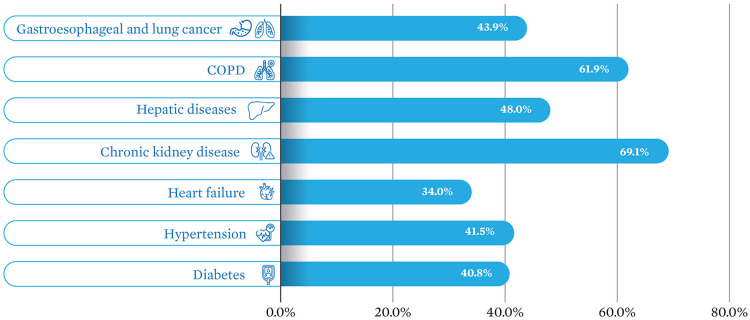
Sarcopenia is also highly prevalent in individuals with various comorbidities, as illustrated in following figure: Source – India’s Consensus Guidelines.
What Measures and Interventions are Considered Effective in the Prevention and Management of Sarcopenia?
A minimum 12-week program of resistance exercise combined with nutritional supplementation can be recommended for the prevention and management of sarcopenia.
Nutritional supplements with exercise showed a greater impact on HGS than exercise alone. Vitamin D supplementation along with beta-hydroxy-beta-methylbutyrate (HMB) enhanced muscle parameters in older adults, even when they did not engage in a physical exercise program.
The NOURISH study’s COPD subgroup (n=214) of malnourished adults aged ≥65 years, participants received either standard-of-care plus high-protein-HMB (HP-HMB) (n=109) or standard-of-care with a placebo supplement (n=105). The dosage was two servings per day (1.5 g of calcium-HMB), initiated within 3 days of hospital admission (baseline), and continued for up to 90 days after discharge.
The supplementation of HP-HMB resulted in an approximately 71% lower mortality risk at 30, 60, and 90 days compared to the placebo. Furthermore, it led to a notable enhancement in Hand Grip Strength, an increase of +1.56 kg vs −0.34 kg (p=0.0413) from discharge to day 30, an increase in body weight from baseline to hospital discharge (0.66 kg vs −0.01 kg, p<0.05), and improvements in blood nutritional biomarker concentrations.
In hospitalized older adults supplemented with HP-HMB, a reduced 90-day mortality was seen due to congestive heart failure, acute myocardial infarction, pneumonia, or COPD.
A systematic review of 15 randomized controlled trials (N=2,137) evaluating the effect of HMB or supplements with HMB showed improved muscle strength in addition to mass in various clinical groups, with a small–moderate effect size.
In adults aged ≥65 years in Singapore, the SHIELD study found that nutritional supplements containing HMB and vitamin D significantly improved outcomes over 6 months compared to the placebo group. The intervention group showed significantly higher survival rates without hospital re-admission along with increased weight gain, MUAC, and BMI compared to the placebo group throughout the study.
Specialized nutrients such as calcium beta-hydroxy-beta-methylbutyrate (Ca-HMB), when used in the range of 1.5 to 3 g/day along with exercise, have been found to enhance muscle parameters in older adults.
Tier 1 – Strongest Evidence
Core Nutrients that Most Sarcopenic Indians must include in daily diet and potentially every meal. These nutrients have the strongest evidence for supporting muscle health when deficiencies are present or intake is inadequate.
Basis – Nutrient Evidence Importance
Protein ★★★★★ Foundation of muscle protein synthesis
HMB ★★★★★ Reduces muscle breakdown
Vitamin D ★★★★★ Muscle strength, falls, physical performance
Vitamin B12 ★★★★☆ Nerves, muscle function, energy
Calcium ★★★★☆ Muscle contraction, bone health
Magnesium ★★★★☆ ATP production, muscle contraction
Zinc ★★★★☆ Protein synthesis, tissue repair
Tier 2 – Good Supporting Evidence
Omega-3 EPA/DHA – Muscle protein synthesis, inflammation
Creatine Monohydrate – Strength, lean mass
Selenium – Antioxidant defence
Iron (when deficient) – Oxygen delivery
Vitamin C – Collagen synthesis, antioxidant
Vitamin E – Protects muscle membranes
Tier 3 – Emerging Evidence
PHGG – Gut microbiome
Butyrate – Gut-muscle axis
Probiotics – Strain-specific
Vitamin K2 – Muscle and bone interaction
Curcumin – Inflammation
CoQ10 – Mitochondrial support
Final Thoughts
Sarcopenia is a pervasive and potentially life threatening condition, especially when exists with co-morbidities. Prevention of Sarcopenia in at-risk (which actually and unfortunately means, virtually almost every single elder Indian) and management in Sarcopenic patients must be instituted on an urgent basis.
Measures such as physical activity and animal protein-rich diet in at-risk populations, could play a key role in arresting and slowing down the progression of sarcopenia. Lifestyle modifications, including select nutritional supplements and extensive resistance exercises, are the suggested and scientifically proven strategies in preventing and managing sarcopenia.