



How Elevated Homocysteine Affects Your Heart, Brain, Diabetes, Kidneys and Healthy Ageing – Since this is driven largely by Vit B12 and Folic Acid Deficiencies – Hence Indians MUST Increase Consumption of Animal Foods.
If Part 1 explained what homocysteine is, this chapter answers the question millions of people ask:
“If my homocysteine level is high, what does it actually mean for my health?“
Over the past 30 years, thousands of scientific studies have explored the relationship between elevated homocysteine and chronic disease.
Researchers have consistently found that people with higher homocysteine levels are more likely to develop cardiovascular disease, stroke, kidney disease and certain neurological disorders. However, an important distinction must be made: Association does not always prove causation.
Lowering homocysteine with Supplementing Vitamins reliably reduces blood homocysteine levels, but large clinical trials have not consistently shown reductions in heart attacks or overall cardiovascular mortality in unselected populations. This means homocysteine is best viewed as an important risk marker and, in some situations, a modifiable contributor to disease rather than a standalone cause.
Our Personal Opinion – Since Homocysteine levels are intricately linked to Vit B12 and Folic Acid deficiencies (indians are particularly deficient being largely vegetarians) – its only logical and scientifically accurate to increase consumption of animal foods including animal meats only from Goat and Lamb which not only provide high quality protein but also Vit b12, Folic Acid, Zince and many more micronutrients such as anti-oxidant Selenium. This approach scientifically also will take care of Sarcopenia in Indians – which again is more of a crisis rather than a minor issue. Click this hyperlink for Sarcopenia prevalence in India and among Indians.
How Can Homocysteine Damage the Body?
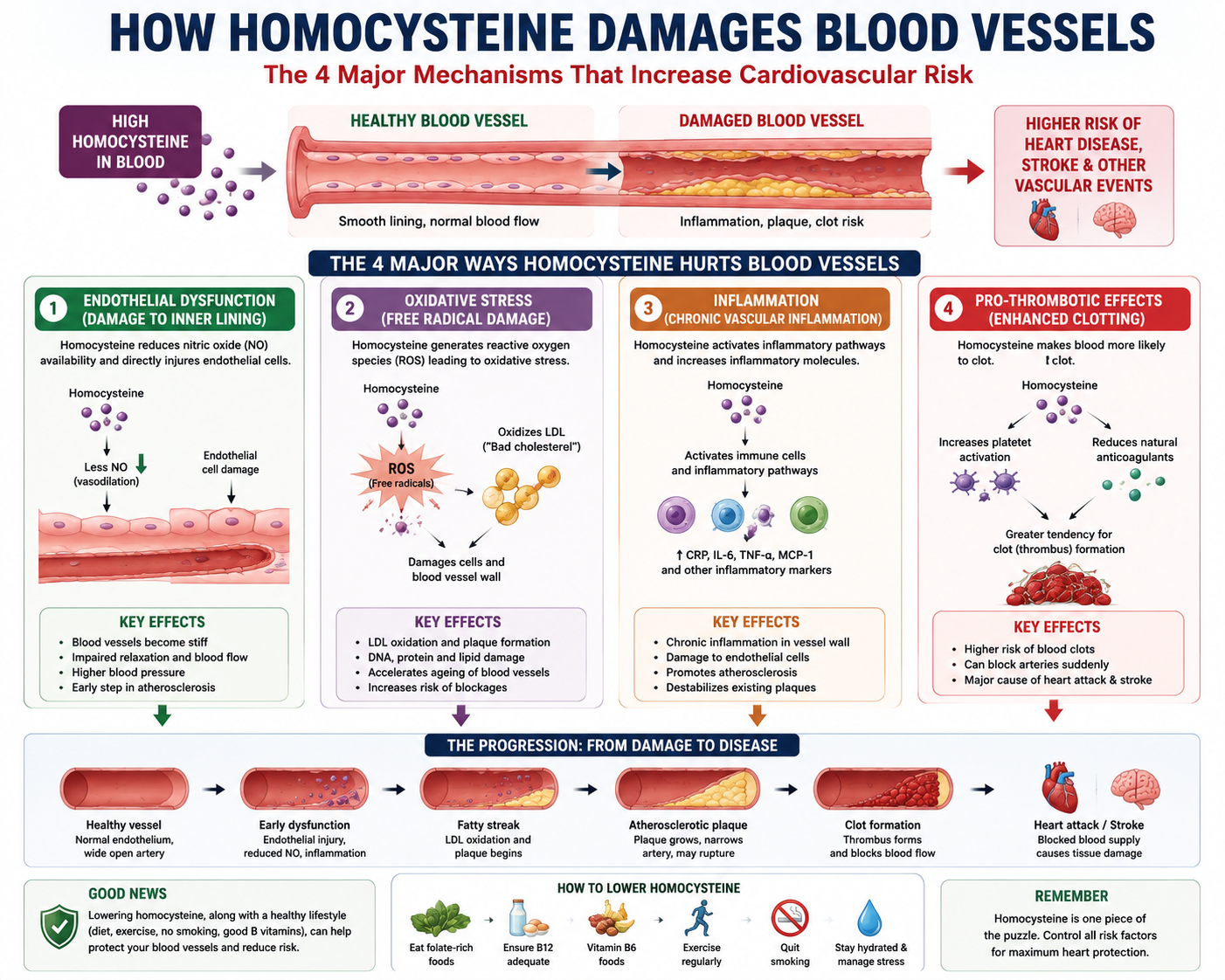
Scientists believe elevated homocysteine may affect several biological pathways.
1. Damage to Blood Vessel Lining (Endothelial Dysfunction) – The endothelium is the thin inner lining of every artery. Healthy endothelial cells: regulate blood flow, control inflammation, prevent abnormal clotting and produce nitric oxide
Elevated homocysteine has been associated with reduced nitric oxide availability and impaired endothelial function, which may contribute to vascular disease.
2. Increased Oxidative Stress – High homocysteine can promote the production of reactive oxygen species (ROS).Oxidative stress may: damage cells, oxidize LDL (true bad cholesterol) cholesterol, accelerate atherosclerosis and impair your so precious pancreatic beta cells
3. Chronic Inflammation – Several studies suggest elevated homocysteine is associated with increased inflammatory activity, although inflammation is influenced by many interacting factors.
4. Increased Blood Clotting – Hyperhomocysteinemia has been linked to: platelet activation, impaired anticoagulant pathways and greater thrombotic tendency
These mechanisms may partly explain the association with ischemic stroke and vascular disease.
Homocysteine and Heart Disease
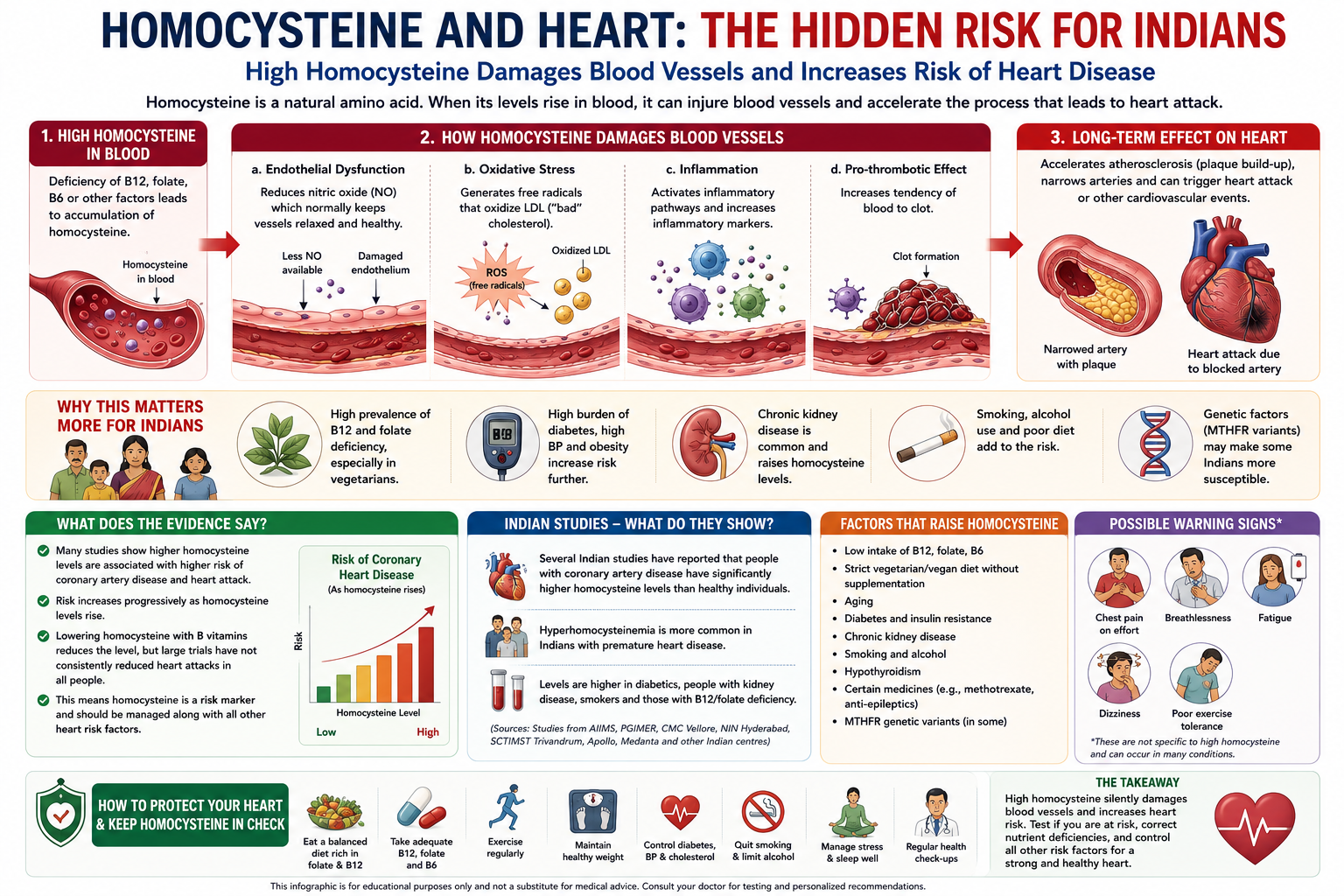
Heart disease remains the leading cause of death worldwide, and India has one of the highest burdens of premature coronary artery disease. Multiple observational studies have reported that individuals with elevated homocysteine are more likely to have:
-
coronary artery disease
-
heart attacks
-
peripheral arterial disease
Meta-analyses have shown a graded association between higher homocysteine concentrations and cardiovascular risk. However, randomized trials of folic acid and B-vitamin supplementation have generally not demonstrated consistent reductions in major cardiovascular events in broad populations.
What this means: Elevated homocysteine identifies people who may be at higher cardiovascular risk, but correcting the number alone does not replace comprehensive risk reduction (blood pressure control, lipid management, smoking cessation, healthy diet and physical activity also matter a lot).
Homocysteine and Stroke
The evidence linking homocysteine to stroke is stronger than for some other cardiovascular outcomes. Elevated homocysteine has been associated with:
-
ischemic stroke
-
recurrent stroke
-
carotid artery disease
Some large studies, particularly in populations without folic acid food fortification, have reported modest reductions in stroke risk with folic acid supplementation, especially in individuals with low folate status.
For India, where mandatory folic acid fortification is still not universal, this area remains of particular interest.
Homocysteine and High Blood Pressure
High homocysteine has been associated with:
-
increased arterial stiffness
-
endothelial dysfunction
-
impaired nitric oxide production
These changes may contribute to hypertension in susceptible individuals. Blood pressure, however, is influenced by many factors including salt intake, obesity, genetics, kidney function and age.
Homocysteine and Diabetes
India has more than 100 million adults living with diabetes, making this relationship especially important. People with diabetes may have elevated homocysteine because of:
-
kidney impairment
-
vitamin B12 deficiency related to long-term metformin use
-
poor nutritional status
-
chronic inflammation
Higher homocysteine has been associated with several diabetic complications.
Diabetic Neuropathy
Elevated homocysteine (hyperhomocysteinemia) is an independent risk factor for the development and increased severity of diabetic neuropathy. For every 1 μmol/l increase in homocysteine, the risk of developing neuropathy increases by roughly 7%. High levels promote microvascular ischemia and direct nerve toxicity.
Vitamin B12 deficiency should always be considered in metformin-treated patients with neuropathy. Supplementation of Vit B12 is part solution – real benefits flow from cinsumption of Goat Liver, Lamb Liver and Chicken liver to some extent. Start gorging on Keema Kalezis from today.
Diabetic Kidney Disease
Reduced kidney function decreases homocysteine clearance. As kidney disease progresses, homocysteine levels often rise further.
Diabetic Retinopathy
Some studies have reported an association between elevated homocysteine and diabetic eye disease, although findings are not entirely consistent.
Homocysteine and Chronic Kidney Disease (CKD)
Healthy kidneys help remove homocysteine. As kidney function declines: homocysteine accumulates, oxidative stress increases and cardiovascular risk rises.
This is one reason why cardiovascular disease is the leading cause of death in many patients with CKD.
Homocysteine and Brain Health
The brain depends on healthy blood vessels and efficient methylation. Researchers have examined links between elevated homocysteine and: cognitive decline, vascular dementia, Alzheimer’s disease and depression.
Higher homocysteine levels have been associated with faster cognitive decline in several cohort studies. Whether lowering homocysteine slows cognitive decline remains an area of ongoing research.
Homocysteine and Pregnancy
Adequate folate before and during early pregnancy is well established in reducing neural tube defects. Elevated homocysteine has also been associated in some studies with:
-
recurrent pregnancy loss
-
placental dysfunction
-
pre-eclampsia
-
fetal growth restriction
Pregnancy planning should always include discussion of folic acid supplementation according to national recommendations.
Homocysteine and Healthy Ageing
As people age:
-
vitamin B12 absorption often declines
-
kidney function gradually decreases
-
medication use increases
These factors may contribute to higher homocysteine concentrations in older adults. Maintaining adequate nutrition becomes increasingly important with ageing.
Does High Homocysteine Increase the Risk of Death?
Several large cohort studies have reported that elevated homocysteine is associated with increased all-cause mortality and cardiovascular mortality.
However, elevated homocysteine often reflects broader underlying health issues, including poor nutrition, kidney disease or chronic illness. It should therefore be interpreted as part of an overall health assessment.
Key Takeaways
-
Elevated homocysteine is best viewed as an important marker of cardiometabolic health
-
It has been associated with heart disease, stroke, diabetes complications, kidney disease and cognitive decline
-
Correcting vitamin deficiencies is important only via animal foods largely and not from cheap supplements, but lowering homocysteine alone has not consistently reduced major cardiovascular events in unselected populations
-
Comprehensive risk reduction—including healthy diet, physical activity, blood pressure control, lipid management and smoking cessation—remains the cornerstone of prevention
Select References
-
Homocysteine Studies Collaboration. JAMA. 2002
-
Wald DS, et al. Homocysteine and Cardiovascular Disease Meta-analysis. BMJ
-
American Heart Association Scientific Statement on Homocysteine and Cardiovascular Disease
-
European Society of Cardiology Guidelines on Cardiovascular Prevention
-
Clarke R, et al. Homocysteine Lowering with B Vitamins. Lancet
-
Bazzano LA, et al. Folic Acid Supplementation and Stroke Prevention. Stroke
-
Cochrane Review: Homocysteine-Lowering Interventions for Cardiovascular Disease
-
American Diabetes Association. Standards of Care in Diabetes
-
KDIGO Clinical Practice Guideline for Chronic Kidney Disease
-
Smith AD, Refsum H. Homocysteine, B Vitamins and Cognitive Function. American Journal of Clinical Nutrition