

Can Reduced Sense of Smell Be One of Earliest Signs of Alzheimer’s Disease? Read On..

Its our solemn oath to help Indians and fellow Earthians stay healthy and stay strong with MINIMAL intervention of medicines. We truly mean every word of it. In pursuit of our stated objective – we share a very interesting perspective on earliest possible sign of picking up Dementia in Our Respected Seniors, around a decade before, by a simple, benign symptom and take all necessary measures when these matter.

Loss of smell (olfactory dysfunction) is an early biomarker associated with an increased risk of cognitive decline and Alzheimer’s disease—it is not, by itself, a proof that someone has dementia, but a potential early marker – What Modern Neuroscience Reveals About Olfactory Dysfunction, Cognitive Decline and Brain Health.

Sober Reality First – India is Growing Older, Faster

India is ageing faster much to the discomfort of Indian policy-makers, if any of them still exist. India’s population aged 60 years and above is over 140 million (above 14 crore people), making up nearly 9.7 to 10.5 percent of the total population. This senior group is growing fast due to longer life spans and lower birth rates.

By 2026 – 140 Million, constituting above 10% of Total Population

By 2036 – Seniors’ Population is expected to reach 230 Million (23 Crore) or nearly 15% of India’s the, then population

By 2050 – Olds are projected to be around 347 Million, and may potentially outnumber children under 15 Years of Age, with India potentially lossing Demographic Dividend

Prevalence of Dementia in India

A large 2023 Study, Published in July 2023 (hyperlinked) pegs India’s Dementia Population at around 9 Million, representing around 8% of India’s Seniors’ Population. Cases of Dementia are expected to double over next 10 years and may cross 17 Million by 2036, or earlier.

Dementia occurs at higher rates among women and in rural areas, rural communities compared to urban areas.
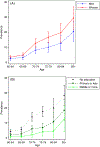

Dementia Rates in Indians
Urban vs Rural Divide of Dementia Population in India

Dementia – Introduction

Imagine noticing that your morning coffee has little aroma, your favourite spices seem less fragrant, or you can no longer distinguish the smell of jasmine, sandalwood or rain-soaked earth. Most people assume these changes are simply part of ageing. Modern neuroscience suggests otherwise.

Over the past 20 years, researchers have discovered that declining smell function (olfactory dysfunction) may be one of the earliest measurable biological changes in several neurodegenerative diseases, including Alzheimer’s disease (AD), Parkinson’s disease (PD), Lewy body dementia and frontotemporal dementia.

In many individuals, smell impairment appears years—even decades—before memory problems become clinically apparent. Pls read this again for your elders’ benefits.

Importantly, loss of smell does not mean a person has Alzheimer’s disease. Many common conditions—including allergies, chronic sinus disease, viral infections, smoking, head injury and ageing—can also reduce smell. However, when unexplained olfactory decline occurs alongside subtle changes in memory or thinking, it deserves medical attention.


Why the Sense of Smell Is Different From Other Senses

Unlike vision or hearing, smell has a direct anatomical connection to brain regions involved in memory and emotion. When you smell food:

Odor molecules

↓

Olfactory receptors inside the nose

↓

Olfactory bulb

↓

Entorhinal cortex

↓

Hippocampus

↓

Memory formation

↓

Emotional processing

Notice something important.

The entorhinal cortex and hippocampus are among the first brain regions affected by Alzheimer’s disease. This biological overlap explains why smell changes may occur long before significant memory loss.


Olfactory System: A Direct Window Into the Brain

The olfactory pathway is unique because it bypasses the thalamus and projects directly to limbic structures, including the:

  • Olfactory bulb

  • Piriform cortex

  • Amygdala

  • Entorhinal cortex

  • Hippocampus

  • Orbitofrontal cortex

These areas govern: Learning / Memory / Emotion / Recognition / Spatial navigation.  Equally unfortunately, they are also among the earliest targets of Alzheimer’s pathology.


Alzheimer’s Disease Begins Years Before Symptoms

One of the biggest advances in neuroscience has been the recognition that Alzheimer’s develops silently for many years. Researchers now describe three broad phases:

Phase 1: Preclinical Alzheimer’s – Duration 10 to 20 Years

  • No noticeable memory problems

  • Amyloid accumulation begins

  • Tau pathology starts spreading

  • Smell may decline

Phase 2: Mild Cognitive Impairment (MCI)

  • Mild forgetfulness

  • Difficulty finding words

  • Reduced smell identification

  • Brain shrinkage becomes measurable

Phase 3: Alzheimer’s Dementia – By the time dementia develops, brain changes have often been present for years:

  • Progressive memory loss

  • Impaired daily functioning

  • Language difficulties

  • Behavioural changes


Why Does Smell Decline?

Multiple pathological processes contribute.

1. Tau Protein Accumulation – Tau tangles appear early in:

  • Entorhinal cortex

  • Hippocampus

  • Olfactory cortex

These regions are essential for odour recognition.

2. Amyloid Plaques – Amyloid-beta deposits disrupt neuronal communication and may impair olfactory pathways.

3. Olfactory Bulb Degeneration – Autopsy studies have demonstrated:

  • Neuronal loss

  • Synaptic dysfunction

  • Tau pathology

  • Amyloid deposition

4. Neuroinflammation – Microglial activation and chronic inflammation may further damage olfactory circuits.


What Do the Major Studies Show?

Rush Memory and Aging Project (United States)

Participants with poorer smell identification were significantly more likely to develop:

  • Mild cognitive impairment

  • Alzheimer’s disease

  • Faster cognitive decline

Reduced smell scores correlated with greater Alzheimer’s pathology at autopsy.


Mayo Clinic Studies

Researchers observed that olfactory impairment predicted:

  • Brain atrophy

  • Memory decline

  • Conversion from MCI to Alzheimer’s disease


NIH National Institute on Aging Research

Longitudinal studies found that individuals with impaired smell had:

  • Faster cognitive decline

  • Increased dementia risk

  • Greater hippocampal volume loss


UK Biobank

Large population analyses have linked impaired smell with increased risks of:

  • Dementia

  • Parkinson’s disease

  • Frailty

  • Mortality

after adjustment for multiple confounding factors.


Meta-Analyses

Multiple systematic reviews conclude that impaired odour identification is consistently associated with:

  • Alzheimer’s disease

  • Mild cognitive impairment

  • Parkinson’s disease

  • Lewy body dementia

Across studies, olfactory testing demonstrates moderate predictive accuracy and is increasingly viewed as a useful, low-cost screening tool when interpreted alongside other clinical findings.


Why Smell Testing Matters

Unlike MRI or PET imaging, smell tests are: Non-invasive / Inexpensive / Quick / Easy to administer / Repeatable.

Common assessments include:

  • University of Pennsylvania Smell Identification Test (UPSIT)

  • Sniffin’ Sticks Test

  • Brief Smell Identification Test (B-SIT)

These tests evaluate odour identification rather than simply asking whether a smell is detected.


Other Causes of Reduced Smell

Not every person with smell loss has dementia. Common non-neurological causes include:

  • Ageing

  • COVID-19 and other viral infections

  • Chronic rhinosinusitis

  • Allergic rhinitis

  • Nasal polyps

  • Smoking

  • Air pollution

  • Occupational chemical exposure

  • Head trauma

  • Certain medications

A comprehensive medical assessment is therefore essential.


When Should You Seek Medical Advice?

Medical evaluation is advisable if:

  • Smell loss develops without a clear cause

  • It persists for several weeks or months

  • It is accompanied by memory problems, personality changes or difficulty performing familiar tasks

  • It follows a head injury

  • It is associated with neurological symptoms such as tremor or balance difficulties

Depending on the clinical picture, evaluation may include ENT examination, neurological assessment, cognitive testing, brain imaging or laboratory investigations.


Can Lifestyle Reduce Dementia Risk?

Although smell loss itself cannot be prevented in every case, many established dementia risk factors are modifiable. Evidence supports:

  • Regular physical activity

  • Mediterranean-style or MIND dietary patterns

  • Blood pressure control

  • Diabetes management

  • Adequate sleep

  • Hearing loss management

  • Smoking cessation

  • Social engagement

  • Lifelong learning

  • Treatment of depression

These interventions may lower the overall risk of cognitive decline.


Future Directions

Researchers are investigating whether combining smell testing with:

  • Blood biomarkers (phosphorylated tau, neurofilament light chain)

  • Plasma amyloid ratios

  • Genetic profiling (APOE ε4)

  • MRI

  • Digital cognitive assessments

could improve early detection of Alzheimer’s disease before irreversible brain damage occurs.


Key Take-Home Messages

  • A declining sense of smell is increasingly recognised as an early biomarker associated with Alzheimer’s disease and other neurodegenerative disorders

  • The olfactory system is closely connected to the hippocampus and entorhinal cortex, regions affected early in Alzheimer’s disease

  • Smell impairment alone does not diagnose dementia

  • Many common, treatable conditions—including sinus disease, allergies and viral infections—can also reduce smell

  • Persistent, unexplained smell loss, especially when accompanied by cognitive changes, should prompt medical evaluation

  • As blood-based biomarkers and imaging techniques evolve, olfactory testing may become an important component of early dementia risk assessment


Conclusion

The sense of smell has traditionally been overlooked in routine clinical practice, yet it offers a unique window into brain health. A growing body of evidence suggests that subtle changes in olfactory function may precede the onset of Alzheimer’s disease by many years, reflecting early pathological changes in the brain’s memory networks. While smell loss should never be interpreted as proof of dementia, it represents an important clinical clue that warrants careful assessment in the appropriate context.

As our understanding of neurodegenerative diseases advances, the humble sense of smell may become one of the simplest and most accessible tools for identifying individuals who could benefit from earlier evaluation, preventive strategies and closer follow-up.


Select Scientific References

  1. Devanand DP, et al. Olfactory deficits predict cognitive decline and Alzheimer’s disease in older adults. Neurology

  2. Roberts RO, et al. Association between olfactory dysfunction and amnestic mild cognitive impairment and Alzheimer’s disease dementia. JAMA Neurology

  3. Murphy C. Olfactory and other sensory impairments in Alzheimer’s disease. Nature Reviews Neurology

  4. Doty RL. Olfactory dysfunction in neurodegenerative diseases. Nature Reviews Neurology

  5. Albers MW, et al. At the interface of sensory and motor dysfunctions and Alzheimer’s disease. The Lancet Neurology.\

  6. National Institute on Aging. Research on olfactory impairment and Alzheimer’s disease

  7. World Alzheimer Report (Alzheimer’s Disease International)


More from the blog

Osteoporosis and Fractures Diet Guide: Low Oxalate Meal Plan for Indians

If you are a PURE Vegetarian - this write up and every single word of this, greatly helps you understand the inherent risk of...

Anti-Nutrient Crisis: High Oxalates and Low Calcium cause Increased Bone Fractures in Indians

As part of our Evidence-Explained™ - we present you learnings from a long, 20 years running clinical study on Osteoporosis and Fractures in Americans...

Efficacy of Vitamin K2 (MK-7) on Linear Growth in Children: Addressing Growth Deficit in Indian Children

Height and Bone Developments in Children Childhood linear growth represents a sensitive biomarker of cumulative somatic health, adequate cellular nutrition, and harmonious skeletal development. Globally—and within...

Role of Vit K2 in Arterial Health, Inter99 Study & Vit K2 Deficiency in Indians

If you love your Heart and care for your Heart Health - you won't miss a word of this special series on Heart Health...