



How Artificial Intelligence, Precision Nutrition, New Medicines and Regenerative Science Could Transform Pancreatic Health
Part 10 of 10 – Concluding Part – The Silent Death of Pancreas – For Part 9 Click Here
A New, Interesting, Human Intelligence as well as Artificial Intelligence Dominated Era Has Truly Begun
For nearly a century, diabetes treatment focused primarily on lowering blood sugar. Today, the focus has shifted.
Scientists as well as People (some Doctors too) are asking a different question: “Can we prevent diabetes before the pancreas reaches its breaking point?”
The answer is increasingly, resoundingly yes and yes and yes – we can.
Around the world, researchers are developing smarter ways to identify risk faster and earlier, personalize prevention, protect beta cells, and in some cases, restore insulin production – we are convinced not only pre-diabetes but even diabetes is REVERSIBLE – not by meds but by diet and physical activity.
Part 10 this series explores the innovations that could redefine diabetes prevention over the next decade. This series has most of evidence based details but as well our own experience and opinion.
As always, do challenge us, do your own dilligence, develop your own understanding, its your body afterall and you may not get a new body, not just as yet, though we are getting there as well 🙂
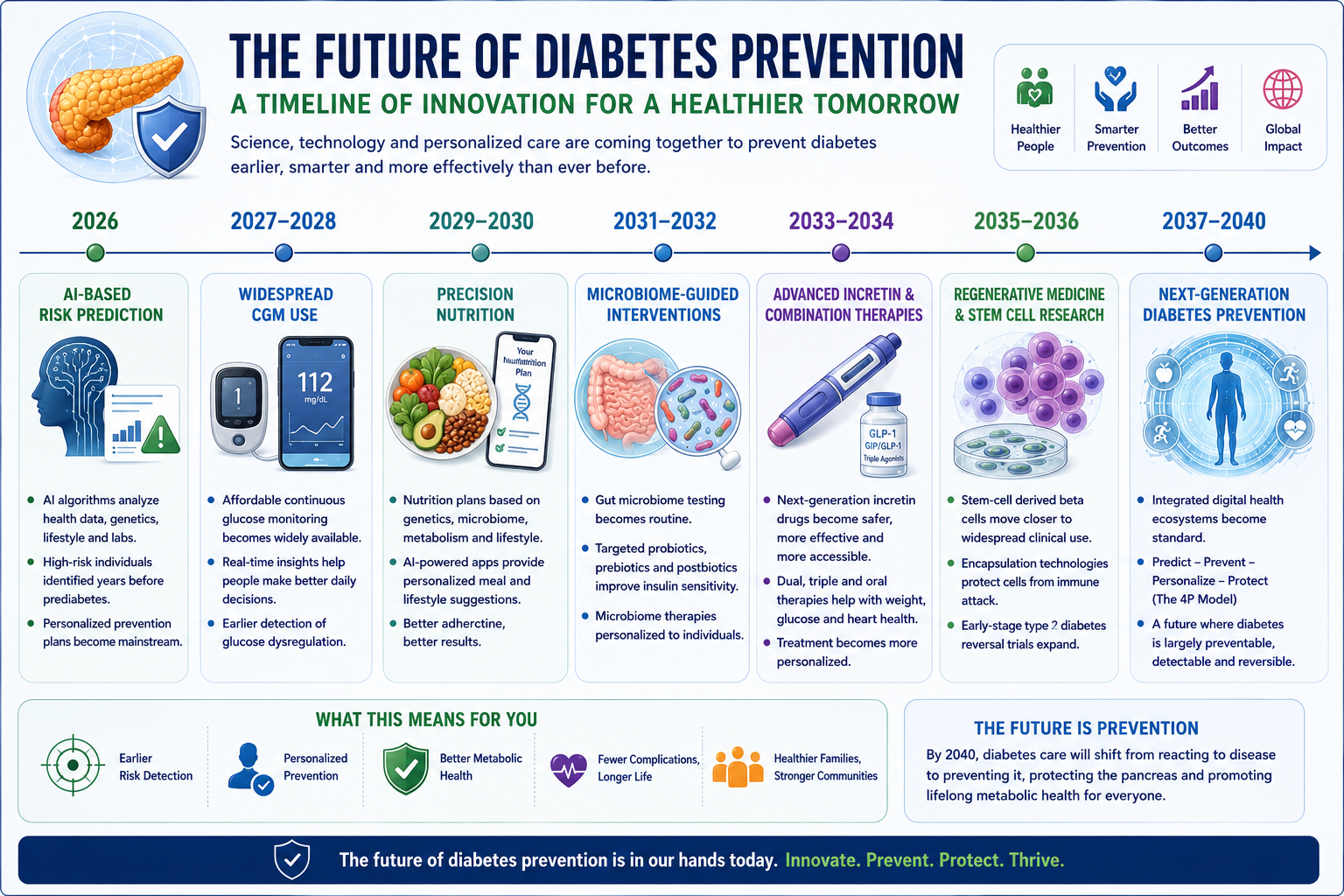
1. Artificial Intelligence Will Detect Diabetes Earlier, Faster, Accurately Maybe
Artificial intelligence (AI) is rapidly changing healthcare, and is transforming diabetes prevention by shifting care from reactive treatment to proactive, personalized intervention. Key applications include predictive risk modeling that analyzes medical records and wearable data to identify high-risk individuals before disease onset, and AI-powered lifestyle apps that provide real-time behavioral coaching to promote weight loss and glucose control.
Click here for extensive details – https://www.sciencedirect.com/science/article/pii/S2666990024000089
Several hospitals and research institutions are already evaluating AI-assisted prediction models, although widespread clinical use will require continued validation across diverse populations and this validation is underway across many countries.
Here is a link to Top 10 HealthTech Startups Revolutionizing Cardiometabolic Care
2. Continuous Glucose Monitoring (CGM)
Until recently, glucose measurements were limited to occasional finger-prick tests. Continuous Glucose Monitoring has changed that.
A small wearable sensor measures glucose throughout the day and night. CGM provides insights into:
-
Meal responses
-
Exercise effects
-
Overnight glucose patterns
-
Time spent within target glucose ranges
-
Glucose variability
While CGM is primarily used in people with diabetes, it is increasingly being studied in selected high-risk individuals to support personalized lifestyle interventions.
3. Precision Nutrition
Why does one person tolerate rice well while another experiences a large glucose spike? Precision nutrition for diabetes replaces one-size-fits-all diets with personalized eating plans. By utilizing continuous glucose monitoring (CGM), genetic profiling, and microbiome analysis, this approach tailors macronutrient ratios and meal timing to your unique metabolic responses, drastically improving glycemic control
Precision nutrition aims to develop dietary recommendations tailored to the individual rather than relying solely on generalized advice. Although still an evolving field, it represents one of the most promising areas in metabolic medicine.
4. Gut Microbiome – Our most favourite topic of all time
The human gut microbiome acts as an endocrine organ, heavily influencing glucose metabolism and insulin sensitivity. In diabetics, reduced bacterial diversity and a lack of beneficial, butyrate-producing bacteria (like Faecalibacterium prausnitzii) often lead to “leaky gut”. This allows bacterial toxins into the bloodstream, triggering systemic inflammation and insulin resistance. Specific details on how the microbiome interacts with diabetes include:
- SCFA Production: Healthy microbes ferment dietary fibers into short-chain fatty acids (SCFAs) like butyrate, which protect the gut lining, regulate blood sugar, and modulate the immune system
- Inflammation: A depleted microbiome fails to produce enough SCFAs, causing the intestinal barrier to weaken and permitting toxins (lipopolysaccharides) to escape into the bloodstream, worsening insulin resistance
- Bile Acids & Hormones: Gut bacteria modify bile acids, which directly affects how your body processes incretin hormones to maintain metabolic balance
- Medication Interaction: Common diabetes medications, such as metformin, are known to partially exert their glucose-lowering effects by enriching beneficial bacteria like Akkermansia muciniphila
Your daily diet should include animal proteins and fermented foods like cheese, curd, tofu, butter milk, home-made pickles and kaanjis and kimchis etc.
5. GLP-1 and Combo Medicines
One of the biggest advances in diabetes treatment has been the development of GLP-1 receptor agonists and newer medicines that also target additional gut hormones.
These medicines can: Improve glucose control, Promote weight loss, Reduce appetite and Lower cardiovascular risk in appropriate patients
They work by enhancing the body’s natural hormonal responses involved in blood sugar regulation. These medicines require medical supervision and are not appropriate for everyone.
6. Smarter Combination Therapies
Researchers are developing medicines that act on multiple biological pathways simultaneously. Examples include:
-
Dual incretin receptor agonists
-
Triple hormone agonists (under investigation)
The goal is to improve: Weight management, Insulin sensitivity and Blood glucose control
Many of these therapies remain under active study, and long-term outcomes continue to be evaluated.
7. Stem Cells and Beta-Cell Replacement
One of the most exciting research areas is replacing damaged insulin-producing cells. Scientists are exploring:
-
Stem-cell-derived beta cells
-
Islet cell transplantation
-
Encapsulated cell therapies
-
Gene-editing technologies
Some early clinical studies have shown encouraging results in selected people with Type 1 diabetes. For Type 2 diabetes, these approaches remain investigational, and widespread clinical application will require further research on long-term safety, effectiveness, immune protection and cost.
8. Digital Diabetes Prevention
Your smartphone may become one of your most powerful healthcare tools. Digital health platforms can now help users:
-
Track physical activity
-
Monitor nutrition
-
Record sleep
-
Measure weight
-
Receive coaching
-
Set reminders
-
Share information with healthcare teams
Several structured digital lifestyle programs have demonstrated improvements in weight loss and metabolic health when used consistently.
9. Population Screening
India faces one of the world’s largest diabetes burdens. Future screening strategies may include:
-
Earlier screening for high-risk individuals
-
Community-based risk assessment
-
Digital risk calculators
-
AI-assisted interpretation of health data
-
Greater integration of primary care and preventive medicine
Earlier detection means more opportunities to intervene before significant beta-cell dysfunction develops.
10. Future Is Prevention
Perhaps the greatest change is philosophical. Healthcare is gradually moving from treating disease to preventing disease, unfortunately largely driven at this moment by informed patients and media than by practising doctors, including us.
Instead of waiting for diabetes to develop, clinicians should increasingly focus more on identifying risk early and supporting long-term metabolic health. That shift benefits individuals, families and healthcare systems alike.
Most Important Lesson From This Series
Let’s return to where we began – Part 1 of 10 Part Series.
The UK Prospective Diabetes Study (UKPDS) showed that by the time many people are diagnosed with Type 2 diabetes, beta-cell function has already declined substantially. That finding is not meant to create fear.
It is only meant to create urgency. Your pancreas rarely fails overnight. It tires slowly, gradually but surely over many years. The encouraging news is that these intervening years provide opportunities to act.
Healthy eating – animal proteins as a national priority as Indians have one of the lowest per capita per annum animal foods consumption. Drastically Regular Daily Physical Activity. Adequate sleep. Weight management. Routine health checks which may lead to Early detection.
These evidence-based strategies remain the foundation of protecting your pancreatic health. No technology, doctor’s advice, medicines or supplements can replace them – but only complement. Nobody is coming to save you, nobody is concerned about your good health – only you, take action, take it today.
Select References:
-
Holman RR, et al. UK Prospective Diabetes Study (UKPDS). The Lancet
-
American Diabetes Association. Standards of Care in Diabetes (latest edition)
-
International Diabetes Federation. IDF Diabetes Atlas (latest edition)
-
Lean MEJ, et al. DiRECT Trial. The Lancet. 2018
-
Knowler WC, et al. Diabetes Prevention Program. New England Journal of Medicine. 2002
-
Taylor R. Type 2 Diabetes: Etiology and Reversibility. Diabetologia
-
EASD/ADA Consensus Reports on Hyperglycaemia Management
-
Nature Reviews Endocrinology. Precision Medicine and Diabetes
-
Cell Metabolism. Beta-Cell Biology and Diabetes
-
World Health Organization. Global Diabetes Reports