


Diabetes / Sugar as colloquially known in India is purely a common-sensical disorder. First we buy the disease by excessive consumption of carbohydrates, irregular meal timings, shunning the sun and our progressively reducing movements. Then we spend money on either medications or on “fancy” dietary fads such as quinoa etc. while neglecting the basics of this metabolic disorder. This write up explores, With Evidence, a few simple, in-expensinve interventions to help you blunt blood sugar spikes, post your meals. All it takes is 3 Minutes, 180 seconds – Read for the Evidence.
Every One is a Doctor in India
The clinical conversation surrounding type 2 diabetes and metabolic dysfunction in India is routinely dominated by broad, ambitious prescriptions: 150 minutes of structured zone-2 cardio per week, drastic dietary elimination, or early pharmacological / medicinal interventions or my friend’s Dadi’s Formula of bitter gord juice.
Yet, the physiological reality of post-prandial glycemic excursions / blood sugar spikes —the sharp spikes in blood sugar that occur immediately following a meal—reveals a far more accessible leverage point requiring Only 3 Minutes of Efforts.
The volume of muscular contraction required to significantly blunt a post-meal glucose spike is far smaller than almost anyone assumes and certainly not our Gym Bros.
Understanding why requires examining the fundamental physiology of skeletal muscle glucose uptake, the distinct metabolic vulnerability of the Indian phenotype, and a suite of ultra-brief, precisely timed movement interventions that fit seamlessly into daily life.
Physiology: Bypassing Insulin via Contraction-Mediated GLUT4 Translocation
To manage blood glucose, the human body primarily relies on the hormone insulin to signal cells to absorb sugar from the bloodstream.
In a healthy state, insulin binds to surface receptors on skeletal muscle cells, initiating an intracellular cascade that mobilizes Glucose Transporter Type 4 (GLUT4) storage vesicles to fuse with the cell membrane, allowing glucose to enter.
In individuals with insulin resistance—a hallmark of prediabetes and type 2 diabetes—this chemical signaling pathway is blunted. Insulin binds to its receptor, but the internal signal falters, leaving GLUT4 vesicles trapped inside the cell while glucose accumulates in the vascular system.
However, cellular biology provides a biological workaround: contraction-mediated GLUT4 translocation.
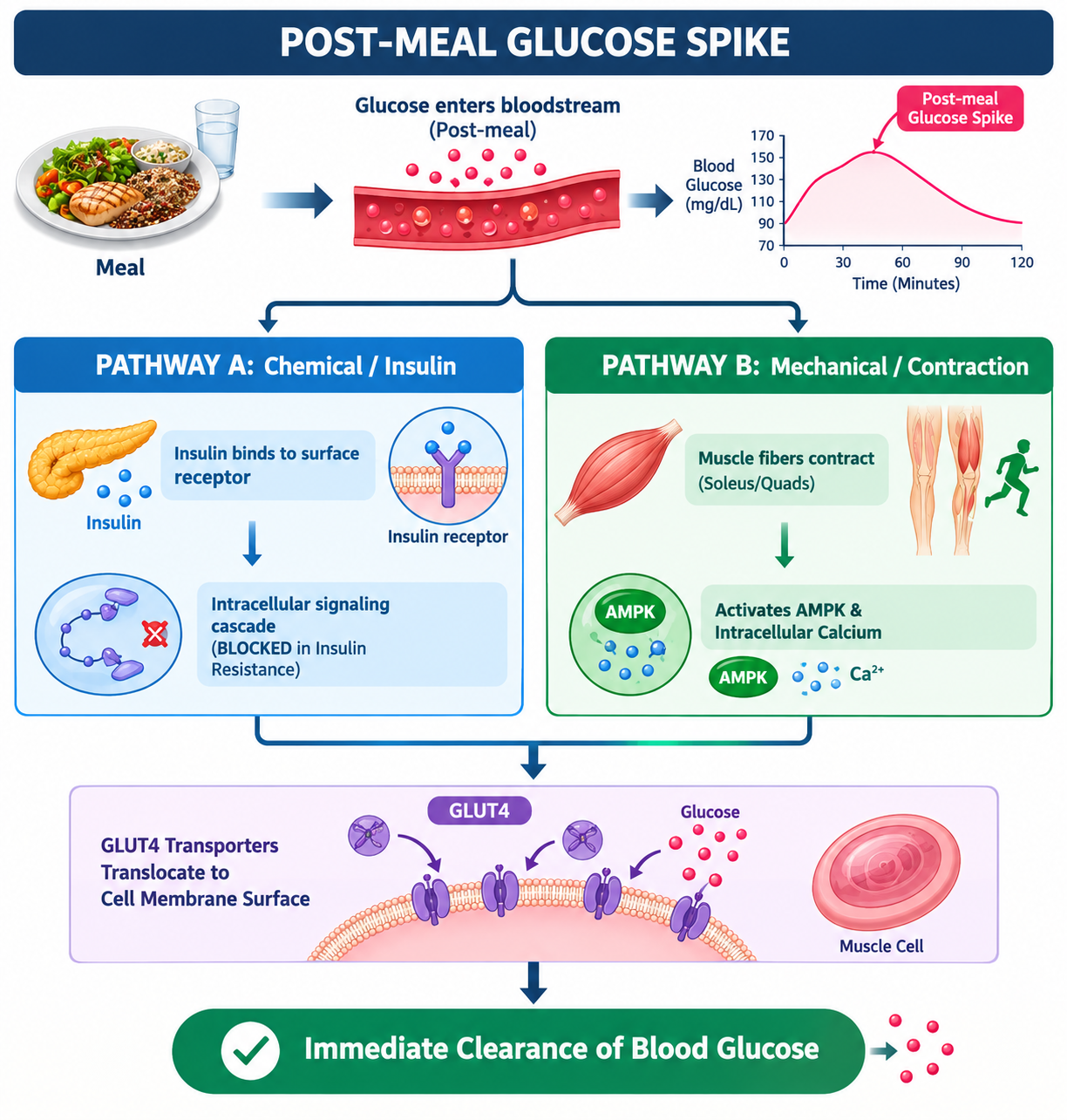
When skeletal muscle fibers contract, mechanical tension, intracellular calcium influx, and the activation of AMP-activated protein kinase (AMPK) trigger GLUT4 transporters to move to the cell surface entirely independent of insulin.
Because this pathway does not rely on defective insulin receptors, it functions effectively even in severe states of insulin resistance. Furthermore, because this is a direct mechanical response rather than an endocrine or enzymatic adaptation, the clearance of blood glucose begins within minutes of active contraction. It does not require weeks of cardiovascular conditioning or athletic adaptation to work.
Clinical Proof: How Small Can the Movement “Dose” Go?
Recent clinical trials have systematically tested the absolute minimum threshold of movement required to flatten post-prandial glucose curves.
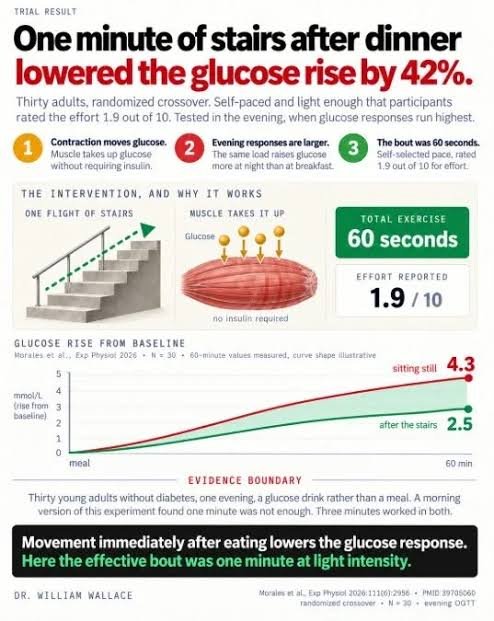
A 2026 trial (Morales et al., Exp Physiol, PMID: 39705060) investigated how minimal the physical stimulus could be while retaining clinical efficacy.
Thirty adults underwent two evening sessions after consuming a standardized 75-gram glucose drink. In one session, participants remained seated; in the other, they performed a single minute of stair stepping at a self-selected, comfortable pace. Participants rated the physical exertion at an average of 1.9 out of 10—an effort barely distinguishable from sitting.
The results were striking:
-
The average rise in blood glucose from baseline to 60 minutes post-ingestion was 4.3 mmol/L (~77 mg/dL) in the sedentary control group.
-
In the single-minute stair-stepping group, the rise was held to 2.5 mmol/L (~45 mg/dL)—a 42% reduction in post-meal glucose excursion.
-
Overall glucose exposure (Area Under the Curve) across the entire session was significantly lowered.
The trial deliberately selected an evening timeframe because human circadian biology renders glucose tolerance significantly worse at night than in the morning.
Robustness Threshold: Why 3 Minutes Beats 1 Minute
When researchers tested this identical single-minute protocol across different times of day and meal compositions, subtle nuances emerged:
-
Morning Glucose Challenge: A single minute of movement failed to produce a statistically significant reduction following a pure morning glucose drink. However, increasing the duration to 3 minutes and 10 minutes successfully suppressed the spike.
-
Mixed Solid Meals: When tested after a real, mixed 650-calorie meal (containing complex fats, proteins, and carbohydrates), a 1-minute bout was effective, blunting blood glucose by an average of 14 mg/dL.
The Clinical Takeaway: While 60 seconds of movement provides a meaningful effect after standard evening meals, a 3-minute duration is universally robust across all times of day, meal compositions, and baseline metabolic profiles.
Timing Over Duration: The Post-Meal Window
The clinical impact of movement is governed far more by when it occurs than how long it lasts.
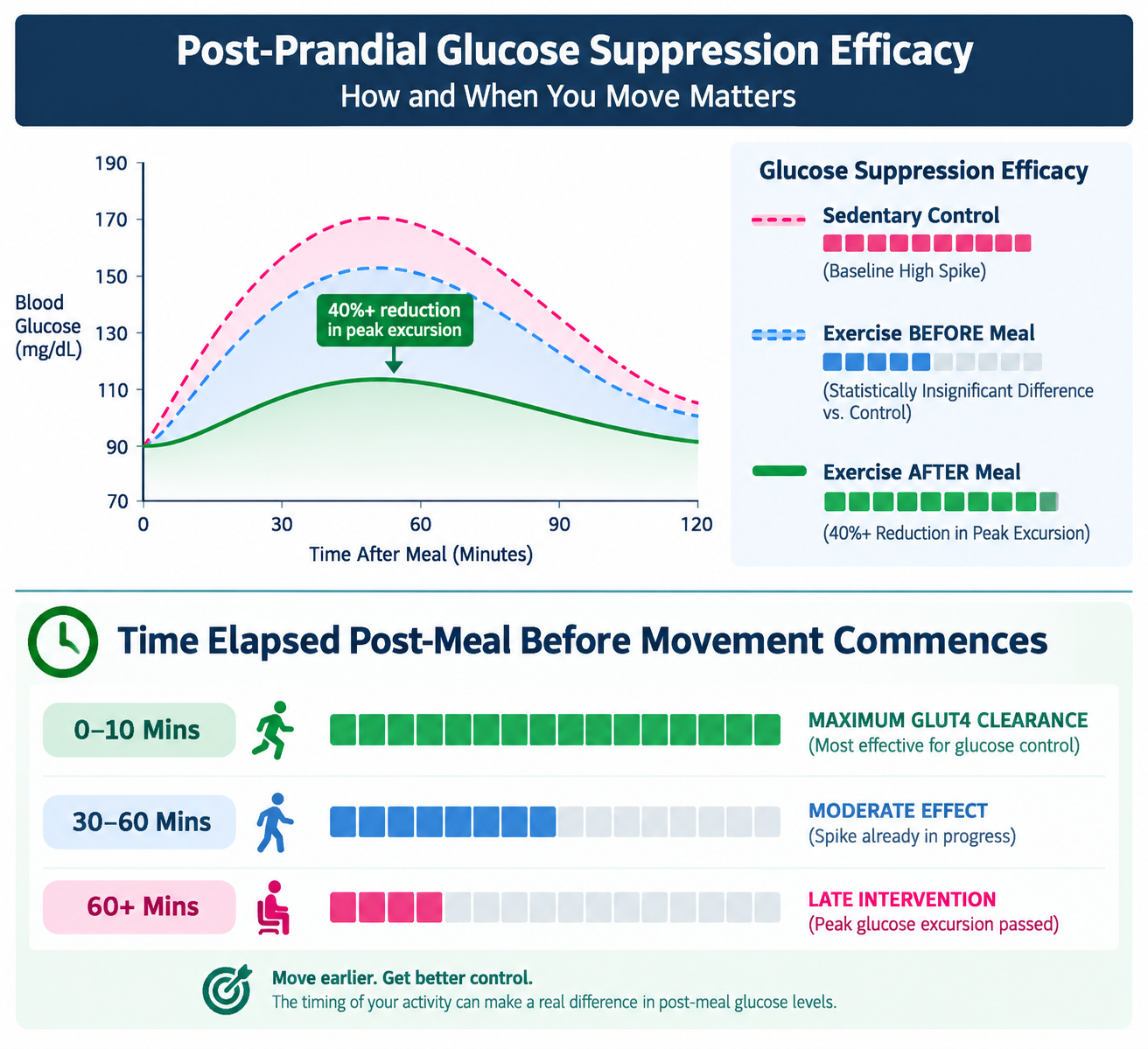
A comprehensive meta-analysis of eight randomized crossover trials (Engeroff et al., Sports Med, PMID: 36715875)—covering individuals with and without type 2 diabetes—evaluated three distinct conditions: exercising before a meal, exercising after a meal, and remaining sedentary.
The findings established two critical principles:
-
Pre-Meal Exercise vs. Post-Meal Movement: Moving before a meal showed no statistically significant difference in blunting post-prandial spikes compared to doing nothing at all. Moving after a meal consistently flattened the glucose curve.
-
The Latency Gap: The time elapsed between finishing a meal and initiating movement directly predicted the magnitude of glucose suppression. Shorter gaps yielded substantially larger benefits.
A 3-minute walk initiated within 10 minutes of completing a meal significantly outperforms a 30-minute walk delayed by an hour, because immediate movement intercepts glucose as it enters the portal circulation, clearing it before peak systemic arterial concentration is reached.
Indian Epidemiological Context: The South Asian Phenotype
These mechanistic insights are particularly critical for the Indian population. According to data from the landmark ICMR-INDIAB study, India is home to over 101 million people living with diabetes and an additional 136 million with prediabetes.
This epidemic is driven by a unique metabolic profile known clinically as the Thin-Fat Indian Phenotype or the South Asian Phenotype:
-
High Visceral Adiposity at Lower BMI: Indians tend to exhibit higher body fat percentages, particularly visceral and hepatic fat, at lower Body Mass Index (BMI) thresholds compared to Western populations.
-
Reduced Skeletal Muscle Mass (Sarcopenic Obesity): South Asians naturally possess less skeletal muscle mass relative to total body weight. Because skeletal muscle acts as the body’s primary “glucose sink” (accounting for over 80% of post-meal glucose disposal), having less muscle mass dramatically lowers the body’s capacity to absorb glucose surges.
-
Dietary Carbohydrate Density: Traditional Indian dietary patterns across both urban and rural demographics derive a high percentage of daily caloric intake (often 60–70%) from refined, high-glycemic carbohydrates—such as polished white rice, refined wheat flour (maida), and potato-based starches.
-
Severe Post-Prandial Excursions: Due to the combination of high carbohydrate loads and reduced muscle sink capacity, Indians experience pronounced, prolonged post-meal glucose spikes that accelerate beta-cell exhaustion and vascular dysfunction long before fasting blood sugar levels appear abnormal.
For an Indian demographic, waiting for structured 45-minute workout blocks is often impractical and economically unviable for shift workers, homemakers, or corporate desk workers. Ultra-brief post-meal movement directly targets the exact physiological vulnerability of the South Asian metabolic profile.
Protocol Options: 4 Ultra-Brief Interventions for Indians
Implementing post-prandial movement does not require athletic gear or gym memberships. The following four protocols leverage distinct muscle groups to maximize non-insulin-mediated glucose uptake within 10 minutes of finishing a meal:
1. The Soleus Pushup (Seated Calves)
-
Target Muscles: Soleus muscle (deep calf muscle)
-
Execution: While sitting at a desk or dinner table, keep the front of the foot planted on the floor and elevate the heel as high as possible to contract the calf, then lower it. Repeat continuously at a steady rhythm for 3 to 5 minutes
-
Physiological Advantage: Research from the University of Houston demonstrated that the soleus muscle possesses a unique metabolic profile: it relies minimally on stored glycogen and preferentially burns circulating blood glucose and lipids. It can contract for extended periods without fatiguing or causing systemic cardiovascular strain, making it an ideal covert movement option for office settings or formal family dinners

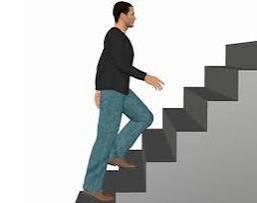
2. The Post-Meal Stair Climb
-
Target Muscles: Quadriceps, gluteal complex, hamstrings
-
Execution: Ascend and descend a standard flight of household or office stairs at a comfortable, self-selected pace for 1 to 3 minutes
-
Physiological Advantage: Vertical locomotion recruits the body’s largest muscle groups (quadriceps and glutes) against gravity. The high mechanical load rapidly engages large volumes of GLUT4 vesicles, making it the most potent short-duration intervention available
3. The 180-Second “Kitchen Walk” / Post-Thali Stroll
-
Target Muscles: Whole-body lower-chain activation
-
Execution: Immediately upon placing the plate in the sink, walk continuously around the hallway, living room, or balcony for 3 full minutes before sitting down
-
Physiological Advantage: Eliminates the latency gap. By starting before the first wave of dietary glucose leaves the stomach and enters the small intestine, it flattens the curve before a spike can form
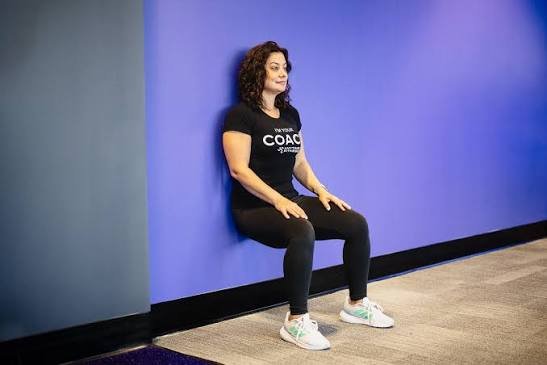
4. Bodyweight Wall Sits or Air Squats
-
Target Muscles: Quadriceps and core stabilization
-
Execution: Perform 15 to 20 slow, controlled bodyweight squats, or hold a 60-to-90-second wall sit within 5 minutes of eating
-
Physiological Advantage: Isometric wall sits create high intramuscular pressure and localized hypoxia, which serves as a potent stimulus for AMPK activation and GLUT4 translocation without requiring spatial movement