



There is a quiet, unspoken reality among middle-aged Indian men. When a 45-year-old man from Mumbai, Delhi, Hyderabad or Bengaluru begins struggling to get or maintain an erection, he almost always attributes it to something harmless: long work hours, urban stress, long traffic hours, fatigue or simply “getting older.”
Because of deep-seated cultural taboos, he usually keeps quiet. He might try over-the-counter herbal supplements, performance boosters or simply ignore the problem entirely.
What he does not realize is that his body is handing him an extraordinary window of time to save his own life.
Medical science now confirms a striking biological reality: Erectile dysfunction (ED) is not just a sexual or reproductive issue; it is a vascular warning / cardiac risk warning signal.
A landmark 2005 prospective study published in European Urology (PubMed ID: 15998563) followed thousands of men and reached a clear conclusion: men who develop erectile dysfunction are significantly more likely to suffer a heart attack or stroke within three to five years, even if they have zero chest pain, normal ECGs, and no obvious signs of heart disease.
For Indian men—who suffer from heart attacks a decade earlier than men in the West—listening to this early signal can mean the difference between a preventable lifestyle shift and a fatal cardiac event.
What is ED – Erectile Dysfunction and Not Enforcement Directorate
Erectile dysfunction (ED) is defined as the inability to maintain an erection sufficient for a satisfactory sexual performance is a highly prevalent disorder in ageing men that affects more than 150 million worldwide.
Although the causes of ED are multifactorial, the vascular component is dominant and ED therefore shares a variety of modifiable risk factors with arteriosclerosis such as hypertension, diabetes mellitus, hyperlipidaemia and smoking.
Furthermore increased prevalence rates of ED have been reported in patients with vascular disorders such as myocardial infarction, peripheral vascular and cerebrovascular diseases.

ED in Indian Men – Prevalence
Erectile dysfunction (ED) affects roughly 15% to over 60% of Indian men depending on age, region, and underlying health conditions like diabetes.
Prevalence Rates
- General and Rural Populations: Community-based studies across India report a general prevalence ranging from 5% in some rural cohorts up to roughly 15% to 21% in broader regional surveys. General clinical reviews suggest wider community estimates can span higher depending on how symptoms are reported
- Diabetic Populations: The burden is significantly higher among men with metabolic conditions. Recent meta-analyses show that approx. 60.57% of Indian men with Type 2 diabetes mellitus experience erectile dysfunction
-
Younger Adults: Subsets of younger Indian men (under 40) show a prevalence between 15% and 33%, often driven by lifestyle and psychological factors
Pipe Size Difference: Why the Penile Arteries Clog First
To understand why an erection issue predicts a heart attack years before it happens, you don’t need a medical degree—you just need basic physics and plumbing.
Atherosclerosis (the buildup of fatty plaque inside blood vessels) does not happen in just one part of your body. It affects your entire circulatory system at the exact same time. However, the symptoms show up in smaller pipes first.
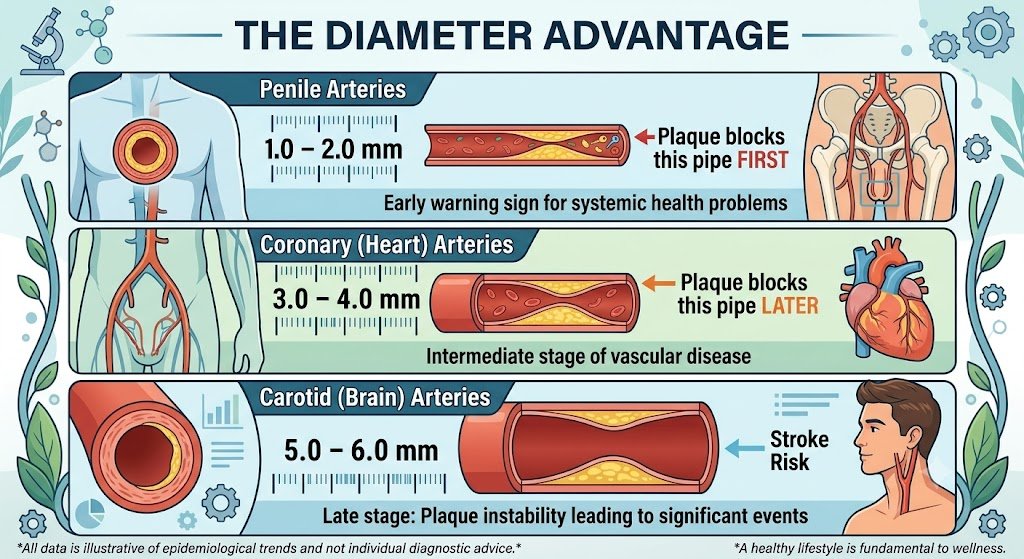
Mathematics of Blood Flow
-
The Penile Arteries (1–2 mm): The delicate blood vessels supplying the penis are extremely narrow. When cholesterol plaques begin to build up, a tiny amount of plaque is enough to choke off blood flow to these small vessels, causing erectile difficulty
-
The Coronary Arteries (3–4 mm): The arteries supplying blood to your heart muscle are twice as thick. At this early stage, the exact same amount of plaque building up in your heart arteries won’t block them enough to cause chest pain (angina) or abnormal ECG readings
-
The Carotid Arteries (5–6 mm): The arteries supplying the brain are even wider, meaning stroke symptoms often show up even later in the disease timeline
Erectile dysfunction is simply the earliest warning system of systemic arterial disease. The narrowest pipes choke first.
Indian Context: Premature Heart Disease in South Asian Men
While the link between erectile dysfunction and heart disease applies globally, it carries an urgent threat for Indian men due to a well-known health pattern in South Asia.
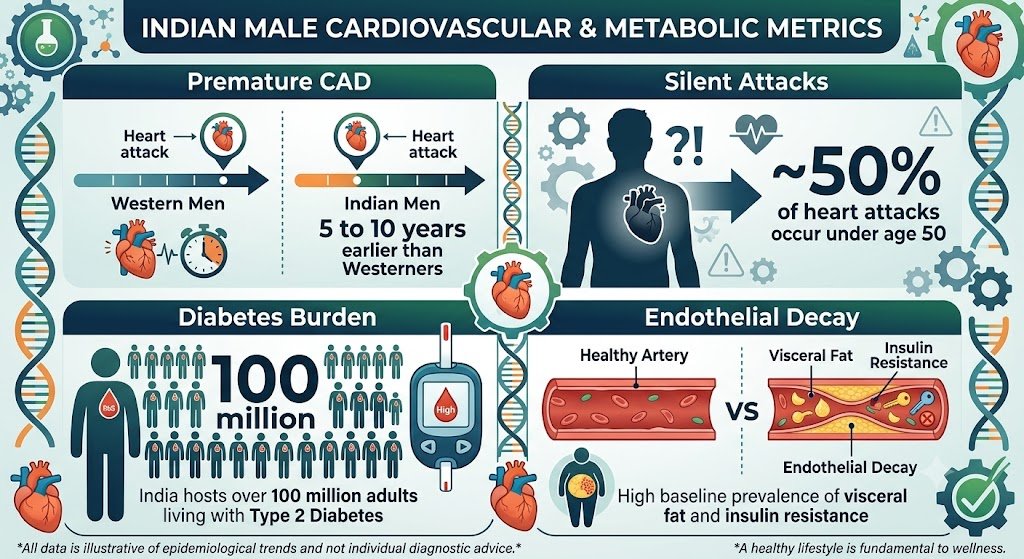
“Thin-Outside, Fat-Inside” Phenotype
Many Indian men maintain a relatively normal weight on the scale, but carry hidden abdominal fat (visceral fat). This specific body type, known as the TOFI phenotype, drives chronic low-grade inflammation, damages the inner lining of blood vessels (the endothelium), and causes early insulin resistance.
Diabetic Acceleration
India is often called the diabetes capital of the world. High blood sugar directly destroys the blood vessels’ ability to produce Nitric Oxide (NO)—the natural molecule your body uses to relax and widen blood vessels during an erection.
For an Indian man living with undiagnosed prediabetes or high cholesterol, erectile dysfunction is often the very first visible sign of underlying vascular damage.
Understaning 2005 Study Data
The 2005 study published in European Urology provided clear, data-driven proof that erectile dysfunction precedes cardiac events.
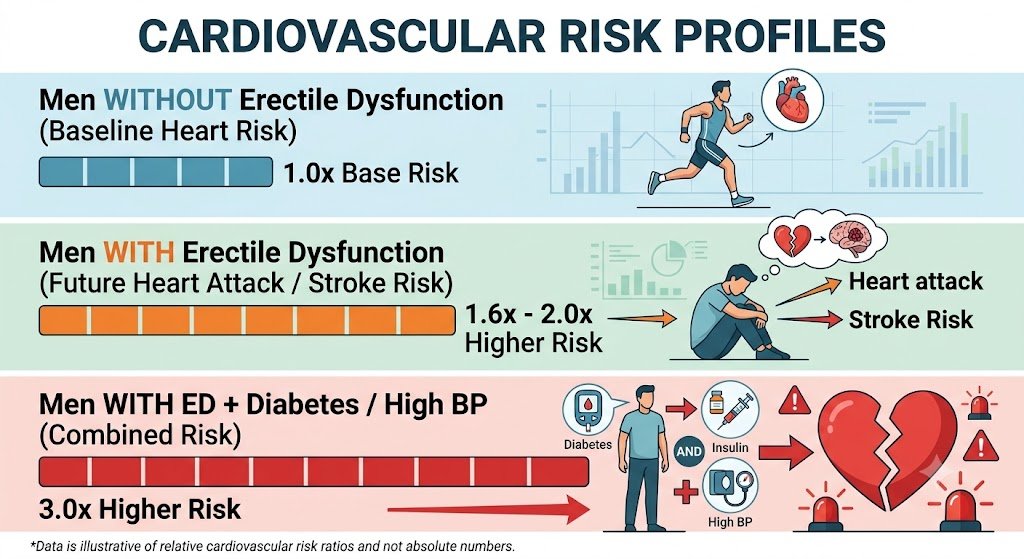
Key Takeaways from the Research
-
A Predictor, Not Just a Side Effect: The study proved that ED is an independent risk factor for heart disease. Having ED raises your cardiovascular risk just as much as a history of heavy smoking or a strong family history of heart attacks
-
The 3-to-5-Year Window: On average, symptomatic erectile dysfunction appears 36 to 60 months before a major adverse cardiac event (like a heart attack or stroke) occurs
-
Asymptomatic Heart Disease: Most of the men in the study who developed ED had completely normal treadmill tests and zero chest discomfort at the start. The vascular damage was happening silently
Why Hesitation Is Dangerous
The cultural silence surrounding male sexual health in India actively prevents early medical intervention.
When an Indian man experiences erectile difficulty, the common reaction involves three stages of delay:
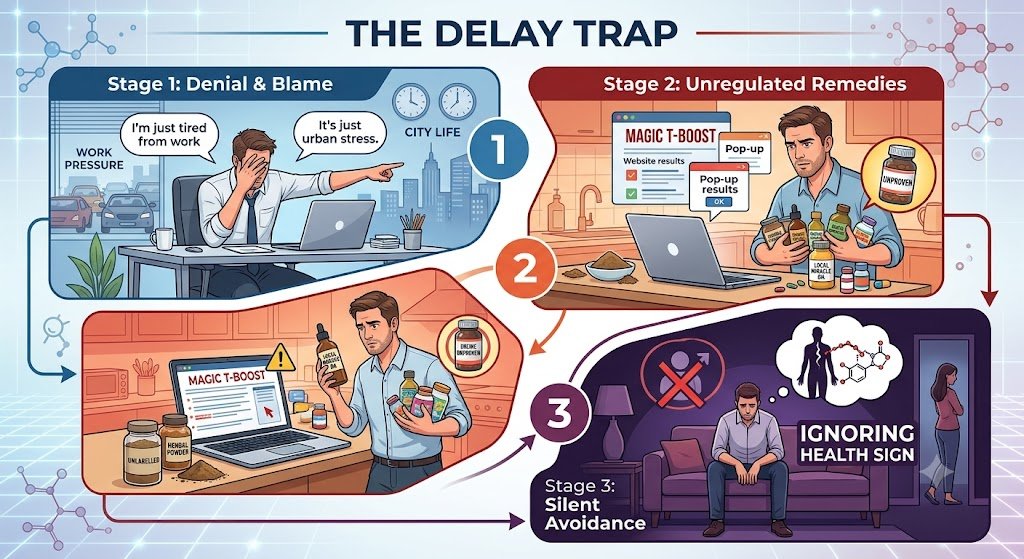
By the time he finally visits a doctor years later, the disease has often progressed from the small 1 mm penile arteries into the 3 mm heart arteries, significantly reducing his lead time to prevent a heart attack.
What You Should Do: A Practical Action Plan for Erectile Dysfuntion
Cardiologists around the world now agree: An Indian man over 35 who experiences persistent erectile dysfunction should receive a cardiac checkup, just as if he were experiencing mild chest pain.
If you or someone you care about is experiencing erectile difficulties, follow this action plan:

1. Essential Health Tests
Ask your physician to run the following targeted tests:
-
ApoB (Apolipoprotein B): A much more accurate measure of bad cholesterol particles than a basic LDL test for South Asian men
-
HbA1c & Fasting Insulin: To catch hidden prediabetes and insulin resistance early
-
hs-CRP (High-Sensitivity C-Reactive Protein): To measure chronic inflammation inside your blood vessels
-
Lipoprotein(a): A genetic marker common in South Asians that accelerates blood vessel clogging
2. Simple Lifestyle Adjustments
-
Protect Your Nitric Oxide: Smoking, chewing tobacco, and high-sugar diets directly destroy the nitric oxide your blood vessels need to dilate. Quitting tobacco restores endothelial function relatively quickly
-
Prioritize Daily Physical Movement: Aerobic exercise (like brisk walking, cycling, or swimming) stimulates blood flow and encourages your body to release natural compounds that keep blood vessels flexible
-
Focus on Whole Foods: Shift toward fiber-rich foods, leafy greens, pulses, and healthy fats while cutting down on refined flour (maida), sugary drinks, and ultra-processed snacks
Conclusion: ED is a Warning That Can Save Your Life
Erectile dysfunction is not a personal failure, an inevitable part of aging, or a secret to keep hidden out of embarrassment.
It is an early, clear signal sent by an intelligent vascular system. Your body uses its smallest blood vessels to alert you about a problem long before your larger vessels choke.
If you notice this sign, do not ignore it or search for quick fixes. Talk openly with a doctor, run a complete cardiovascular checkup, and use your 3-to-5-year lead time to protect your heart health for the future.
Scientific References
-
Montorsi, F., Briganti, A., Salonia, A., Rigatti, P., Margonato, A., Macchi, A., Galli, S., Ravagnani, P. M., & Montorsi, P. (2005). Erectile dysfunction and coronary artery disease: concise review of the literature. European Urology, 47(3), 282–289. PubMed ID: 15998563
-
Montorsi, P., Ravagnani, P. M., Galli, S., Rotatori, F., Briganti, A., Salonia, A., Deho, F., Schulman, C., & Montorsi, F. (2006). The artery size hypothesis: a macrovascular link between erectile dysfunction and coronary artery disease. European Urology Supplements, 5(4), 435–441.
-
Enas, E. A., Singh, V. B., Munjal, Y. P., Bhandari, S., Yadave, R. D., & Anderson, S. J. (2008). Reducing the burden of coronary artery disease in India: challenges and opportunities. Indian Heart Journal, 60(2), 161–175.