



This is yet another, absoultely interesting write up on a topic which our parents and elders are potentially going through this phase and almost all of us will be approaching this phase later in our lives. How good quality nutrition rich in key Vitamins + Omega-3 can be very effective for maintaining Brain Health.
We share a detailed summary of The Oxford VITACOG Trial That Changed How Scientists Think About Brain Ageing and how this is critically relevant and applicable for Indians.
For decades, Alzheimer’s disease and age-related memory loss were considered almost inevitable consequences of ageing. Drug development focused primarily on removing amyloid plaques from the brain, yet most clinical trials delivered only modest benefits.
Meanwhile, a very different story was unfolding at the University of Oxford. Led by Professor David Smith, one of the world’s leading researchers in nutritional neuroscience and Director of the Oxford Project to Investigate Memory and Ageing (OPTIMA), scientists asked a deceptively simple question:
Could correcting common vitamin deficiencies slow the physical shrinking of the ageing brain? The answer surprised the scientific community.
In one of the most influential nutrition trials ever conducted in cognitive ageing, researchers found that high-dose B-vitamin supplementation (folic acid, vitamin B12 and vitamin B6) significantly slowed brain atrophy in older adults with Mild Cognitive Impairment (MCI). Even more remarkable, among participants with higher blood omega-3 fatty acid levels, the rate of brain shrinkage was up to 73% lower than in the placebo group.
Most incredible part of this study is that the degree of reduction in brain atrophy greatly exceeded that reported in many pharmaceutical drugs at the time and highlighted an important concept in modern nutrition science:
Nutrients rarely work in isolation. Their biological effects often depend on the presence of other essential nutrients. Hence our repeat, almost boring repetition for increased consumption of Goat Meat and other animal meats which offer multiple essential nutritional benefits in a single meal.
This three-part series explores the science behind this discovery, what subsequent studies have confirmed, and why these findings may be especially relevant for India’s rapidly ageing population.
Why Brain Shrinkage Matters
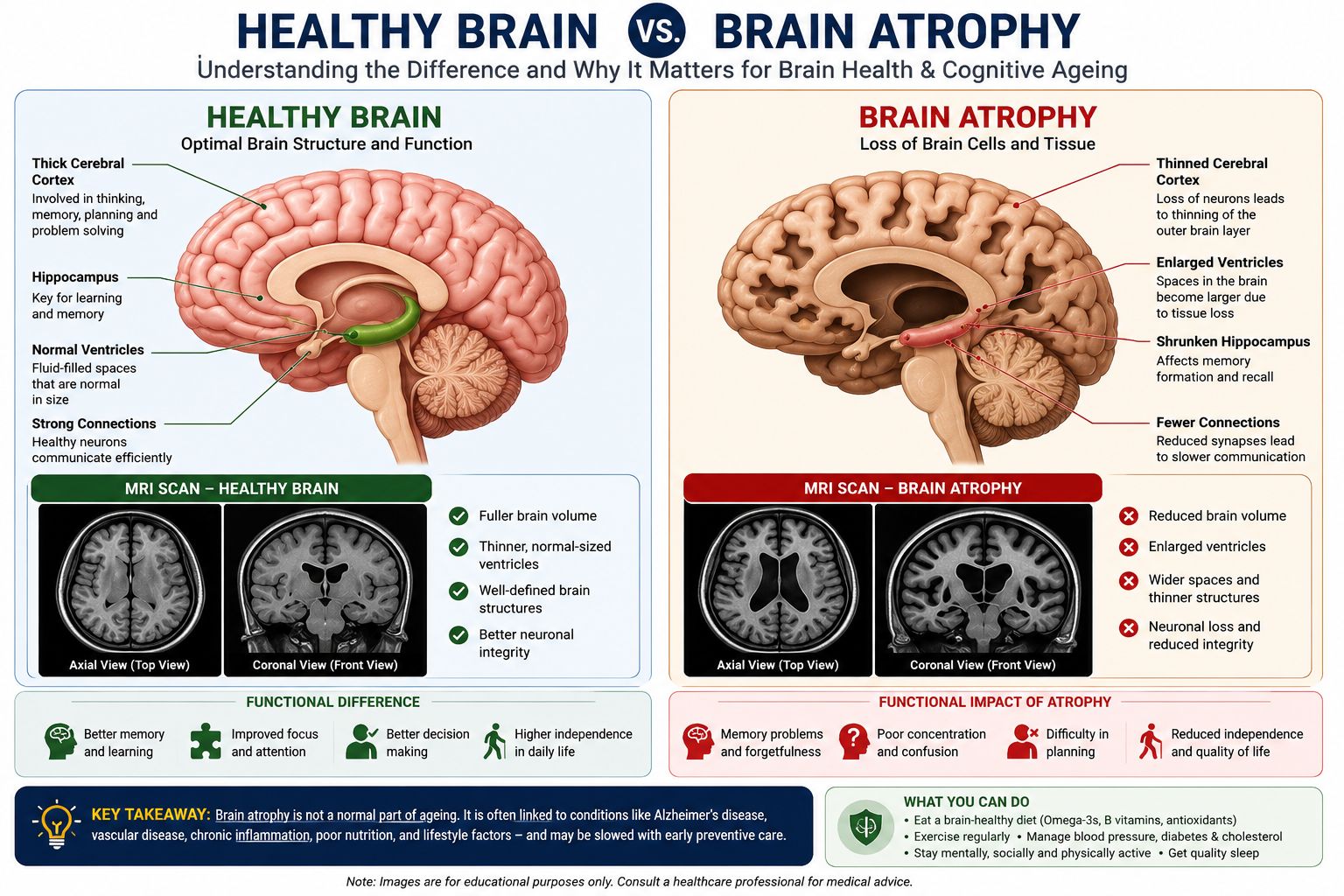
Every human brain changes with age. From early adulthood onwards, small numbers of neurons are naturally lost, synaptic connections remodel continuously, and certain brain regions gradually decrease in volume.
This process is known as brain atrophy or brain shrinkage. A small amount is expected as part of normal ageing. However, accelerated brain atrophy is associated with:
-
Mild Cognitive Impairment (MCI)
-
Alzheimer’s disease
-
Vascular dementia
-
Parkinson’s disease
-
Reduced processing speed
-
Poor executive function
-
Memory decline
Brain shrinkage is therefore more than an imaging finding—it is a measurable marker of neurodegeneration.
Normal Ageing vs Accelerated Brain Atrophy
Scientists distinguish between healthy ageing and pathological ageing.
Healthy Ageing – Typical features include:
-
Mild slowing of information processing
-
Preserved independence
-
Stable daily functioning
-
Gradual, expected loss of brain volume
Most healthy older adults remain cognitively intact despite these changes.
Accelerated Brain Atrophy – In contrast, excessive brain shrinkage may indicate underlying disease. This is often accompanied by:
-
Progressive forgetfulness
-
Difficulty learning new information
-
Word-finding problems
-
Reduced planning ability
-
Changes in spatial navigation
Accelerated brain atrophy is particularly pronounced in Alzheimer’s disease.
Which Brain Regions Shrink First? – One of the earliest regions affected is the hippocampus. The hippocampus plays a central role in:
-
Forming new memories
-
Learning
-
Navigation
-
Memory consolidation
Nearby lies the entorhinal cortex, another region critically involved in memory networks. These structures are among the first affected by Alzheimer’s pathology. Modern MRI techniques allow researchers to measure even subtle changes in their volume over time.
Mild Cognitive Impairment: The Window of Opportunity
Between healthy ageing and dementia lies an intermediate stage called Mild Cognitive Impairment (MCI). Individuals with MCI typically:
-
Notice increasing forgetfulness
-
Remain largely independent
-
Perform daily activities successfully
-
Show measurable decline on cognitive testing
Not everyone with MCI develops Alzheimer’s disease. However, MCI represents one of the most important stages for preventive intervention because brain damage is still relatively limited. Most modern prevention studies therefore recruit participants with MCI rather than advanced dementia.
Oxford Project to Investigate Memory and Ageing (OPTIMA)
Among the pioneers of nutritional neuroscience is the Oxford Project to Investigate Memory and Ageing (OPTIMA). Established at the University of Oxford, OPTIMA has spent decades studying:
-
Age-related cognitive decline
-
Alzheimer’s disease
-
Brain imaging
-
Nutrition
-
Homocysteine metabolism
-
Vitamin status
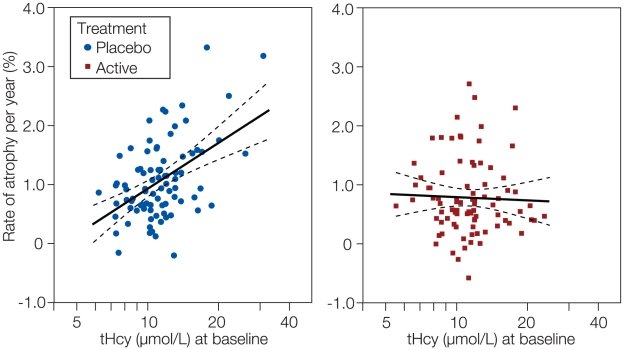
Professor David Smith and colleagues proposed an idea that initially received limited attention: Elevated homocysteine—a common biochemical abnormality in older adults—might accelerate brain atrophy. This hypothesis eventually led to the landmark VITACOG Trial.
Downloaded version of OPTIMA – VITACOG Trial – OPTIMA VITACOG Trial
Why Scientists Focused on Homocysteine
Homocysteine is a sulfur-containing amino acid produced during normal methionine metabolism. Under healthy conditions, homocysteine is rapidly recycled with the help of:
-
Vitamin B12
-
Folate (Vitamin B9)
-
Vitamin B6
When these vitamins are insufficient, homocysteine accumulates in the bloodstream. Elevated homocysteine has been associated with:
-
Stroke
-
Cardiovascular disease
-
Brain atrophy
-
Cognitive decline
-
Alzheimer’s disease
Although researchers continue to investigate whether homocysteine is a direct cause of neurodegeneration or a marker of underlying pathology, consistently elevated levels are widely regarded as undesirable.
Biological Hypothesis
The Oxford researchers proposed a simple pathway:
Low B Vitamins
↓
High Homocysteine
↓
Oxidative Stress
↓
Inflammation
↓
Blood Vessel Damage
↓
Accelerated Brain Atrophy
If this pathway were correct, reducing homocysteine with targeted B-vitamin supplementation might slow the loss of brain tissue. The only way to answer this question was through a randomized controlled trial.
The VITACOG Trial
The VITACOG study remains one of the most important nutrition intervention trials in cognitive ageing. Study Design
-
Randomized
-
Double-blind
-
Placebo-controlled
-
Conducted at the University of Oxford
Participants: Older adults / Diagnosed with Mild Cognitive Impairment / Elevated risk of future dementia
Duration: 24 months
Primary Outcome: Rate of whole-brain atrophy measured by MRI
This was a major strength of the study. Rather than relying only on memory questionnaires, researchers measured actual structural changes within the brain.
Nutritional Intervention
Participants received daily supplementation containing:
-
Folic acid (0.8 mg)
-
Vitamin B12 (0.5 mg)
-
Vitamin B6 (20 mg)
These doses are substantially higher than typical dietary intakes but remain within ranges commonly used in clinical research under medical supervision. The placebo group received identical-looking tablets without active vitamins. Neither participants nor investigators knew who received which treatment until the trial concluded.
First Major Discovery
At the end of two years, MRI scans revealed a striking finding. Compared with placebo, participants receiving B vitamins experienced a significantly slower rate of whole-brain atrophy. The effect was particularly pronounced among those with elevated baseline homocysteine concentrations.
This provided some of the strongest evidence to date that correcting functional B-vitamin insufficiency could influence measurable changes in brain structure. For nutritional neuroscience, it represented a pivotal moment.
An Even Bigger Surprise Was Yet to Come
The Oxford team then performed additional analyses to determine why some participants responded better than others. One factor stood out:
Omega-3 fatty acid status.
Participants with higher blood concentrations of omega-3 fatty acids—particularly DHA and EPA—experienced dramatically greater benefits from B-vitamin supplementation.
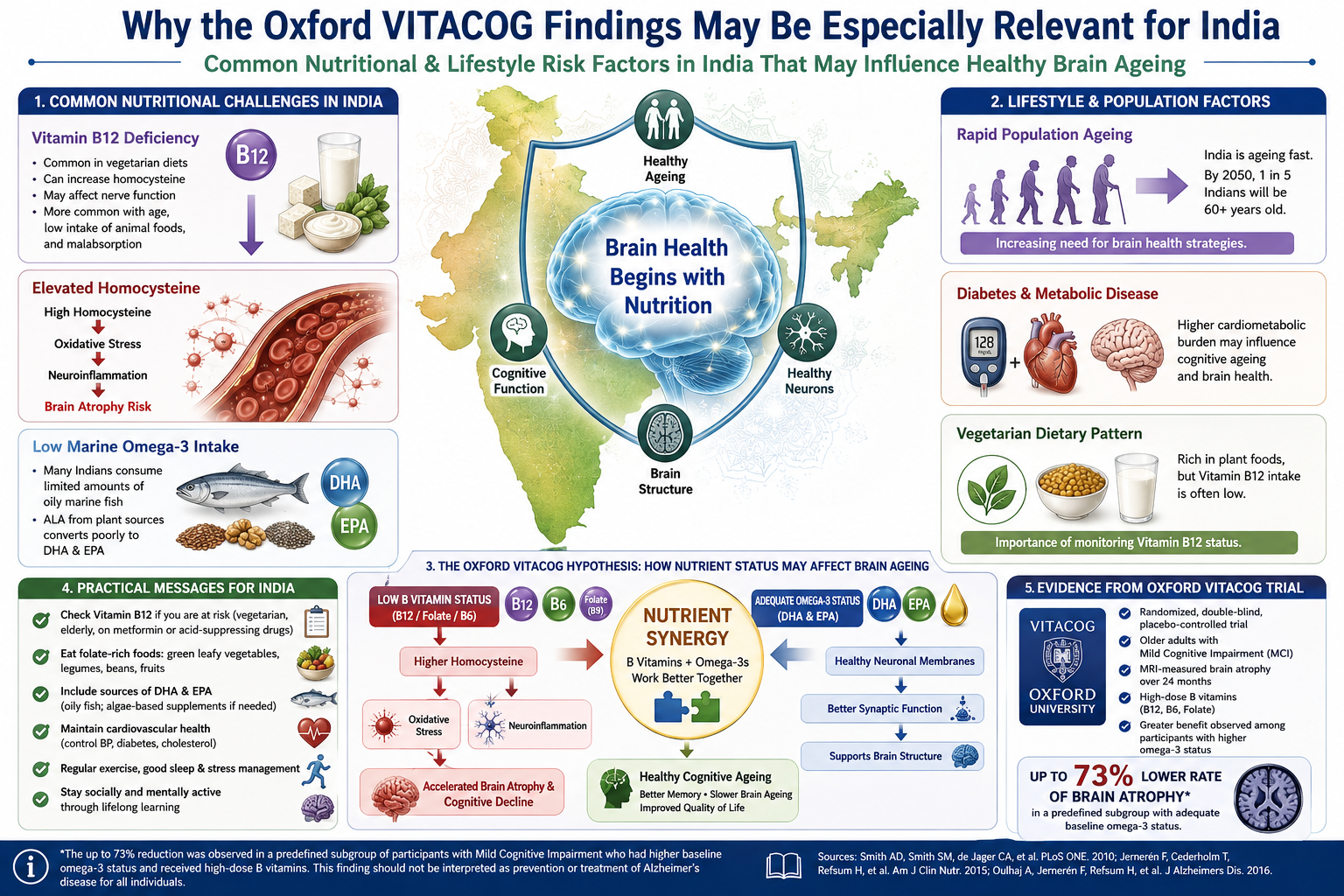
Among those with adequate omega-3 status, brain atrophy was reduced by up to 73% compared with placebo.
This remarkable interaction suggested that B vitamins and omega-3 fatty acids work synergistically, rather than independently, to support brain health. It also shifted scientific thinking away from the traditional “single nutrient” model toward a systems-based understanding of nutritional biology.
Why This Discovery Matters for India
The VITACOG findings may have particular relevance for India. Several nutritional characteristics of the Indian population deserve attention:
-
High prevalence of vitamin B12 deficiency, especially among vegetarians.
-
Variable folate intake depending on dietary diversity.
-
Low consumption of oily marine fish in many regions.
-
Generally lower intake of long-chain omega-3 fatty acids (EPA and DHA).
-
High prevalence of elevated homocysteine reported in multiple Indian studies.
-
Rapidly ageing population and increasing burden of dementia.
These factors make India an important setting for future research exploring whether improving nutritional status could contribute to healthier cognitive ageing. However, it is important to emphasize that large, well-designed Indian clinical trials are still needed before the Oxford findings can be directly generalized to the Indian population.
Key Messages from Part 1
-
Brain atrophy is one of the earliest measurable biological features of cognitive decline
-
Mild Cognitive Impairment represents a critical stage for preventive interventions
-
The Oxford VITACOG trial demonstrated that high-dose B vitamins significantly slowed brain atrophy in older adults with MCI
-
The greatest benefit was observed in participants with higher omega-3 fatty acid status, where brain atrophy was reduced by up to 73% compared with placebo
-
These findings suggest that nutrient synergy may be more important than focusing on individual vitamins in isolation