



The only objective of this Series on Gallbladder Diseases in Indians, sorry, North Indians is to create full and evidence based awareness about an extremely important but not so discussed topic in India – Why North India Has One of the World’s Highest Rates of Gallbladder Disease. Together with us, try and understand the causes, symptoms and potential preventive steps.
Epidemiology, Geography and the 50-Year Scientific Mystery – That Has Puzzled Indian Scientists and Unfortunate Patients alike, for More Than 50 Years.
Few diseases demonstrate such remarkable geographical variation as gallbladder associated diseases in India.
For over half a century, surgeons, gastroenterologists, epidemiologists and cancer researchers have observed a striking phenomenon: people living in North and North-Eastern India develop gallstones and gallbladder cancer far more frequently than those living in southern India.
This observation is not based on isolated hospital reports. It has been confirmed repeatedly by population-based cancer registries, hospital databases, epidemiological studies and systematic reviews spanning more than five decades. The most fascinating aspect of this mystery is that no single explanation has been found.
Instead, scientists now believe gallbladder disease results from a complex interaction between genetics, diet, metabolism, environmental exposures, chronic inflammation, infections and lifestyle.
Understanding this disease is particularly important for India because gallbladder disorders are becoming increasingly common alongside obesity, diabetes, fatty liver disease and metabolic syndrome. This 4-Part series reviews the current scientific evidence, separating established facts from emerging hypotheses.
Gallbladder: A Small Organ with a Big Role
The gallbladder is a small pear-shaped organ located beneath the liver. Its primary function is simple but essential:
-
Store bile produced by the liver
-
Concentrate bile
-
Release bile into the small intestine after meals
Bile contains: Bile salts, Cholesterol, Phospholipids. Bilirubin, Water and Electrolytes
During digestion—particularly after consuming fats—the hormone cholecystokinin (CCK) stimulates gallbladder contraction, releasing bile into the intestine where it helps digest and absorb dietary fats and fat-soluble vitamins (A, D, E and K). When this finely balanced system is disturbed, cholesterol or pigment can crystallize, eventually forming gallstones.
Gallstones Are Not the Same as Gallbladder Disease
Many people use these terms interchangeably, but they represent different stages of disease.
Gallstones (Cholelithiasis) – Solid deposits that develop inside the gallbladder. Many remain completely asymptomatic.
Gallbladder Inflammation (Cholecystitis) – Occurs when stones block the cystic duct, causing inflammation and infection.
Gallbladder Polyps – Usually benign but occasionally precancerous.
Gallbladder Cancer – A rare but highly aggressive cancer that frequently develops after years of chronic inflammation.
Although gallstones are the strongest known risk factor, most individuals with gallstones never develop cancer. This distinction is extremely important.
Gallbladder Disease Around the World
Gallstones affect approximately 10–20% of adults in many Western countries, although prevalence varies considerably according to ethnicity, genetics and lifestyle. Well-known high-risk populations include:
-
Native Americans
-
Chileans
-
Scandinavians
-
Northern Europeans
India has now joined this list—not because gallstones are universally common throughout the country, but because certain regions experience exceptionally high rates.
India: One of the World’s Most Fascinating Nature’s Natural Experiments
India offers researchers an extraordinary opportunity. Within one country, there are enormous differences in: Genetics, Diet, Climate, Water quality, Environmental exposures, Cultural practices and Metabolic health. Yet one disease pattern consistently stands out.
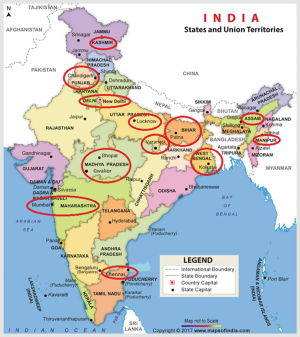
Gallbladder disease clusters predominantly within the Indo-Gangetic plain, extending across:
-
Uttar Pradesh
-
Bihar
-
Delhi
-
Haryana
-
Punjab
-
West Bengal
-
Assam
-
Parts of Odisha
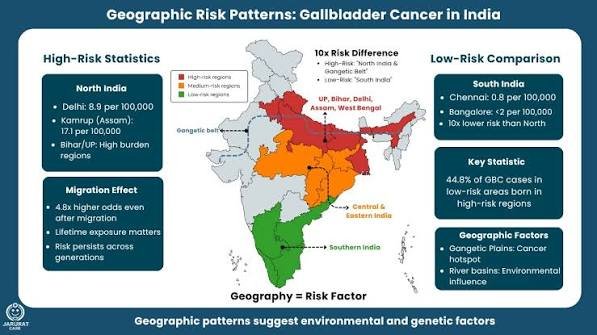
Several districts within this region report gallbladder cancer incidence comparable to the highest rates documented anywhere in the world. By contrast, southern states of India generally report much lower incidence. This striking geographic gradient has remained remarkably consistent despite advances in healthcare, imaging and diagnosis.
The North–South Divide
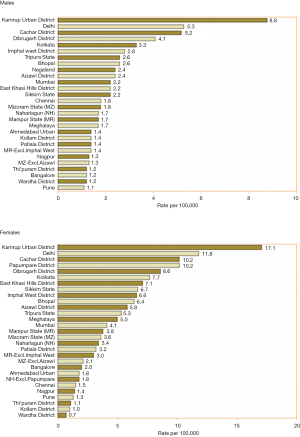
One of the strongest observations in Indian epidemiology is the North–South gradient. Population-based studies consistently demonstrate that gallbladder cancer incidence in northern India is several-fold higher than in southern India.
For example:
-
Delhi
-
Varanasi
-
Lucknow
-
Patna
-
Dibrugarh
have repeatedly ranked among India’s highest-incidence regions. In contrast: Chennai, Bengaluru and Thiruvananthapuram have reported substantially lower incidence rates.
Some registry analyses suggest nearly a ten-fold difference between the highest- and lowest-incidence regions. Few cancers show such dramatic geographic variation within a single country.
EVIDENCE – A large, Extensive REVIEW on Epidemiology of Gall Bladder Cancer in India, published by Doctors from PGIMER Chandigarh and SGPGIMS, Lucknow covers this topic in extensive details. A full copy of the Publication can be accessed here – Epidemiology of GallBladder Cancers in North India. Some excerpts from the publication –
Key Districts of India with Higher Incidences
Summary of All Findings
When Did Scientists First Notice This Pattern?
The story began during the 1970s. General surgeons working in North India noticed that gallbladder operations were becoming increasingly common. Pathologists observed another concerning trend:
Many gallbladder specimens removed for presumed benign disease unexpectedly contained cancer. Initially, researchers wondered whether this reflected referral bias. However, during the 1980s and 1990s, establishment of the National Cancer Registry Programme (NCRP) by the Indian Council of Medical Research confirmed that the geographic pattern was genuine.
Multiple independent registries demonstrated similar findings. The North Indian excess was real.
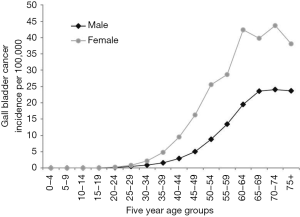
Women Are Affected Far More Often Than Men
One of the most reproducible findings worldwide is the predominance of gallbladder disease among women. Indian studies generally report that women experience:
-
More gallstones
-
More gallbladder surgery
-
Higher gallbladder cancer incidence
Possible explanations include:
Estrogen – Increases cholesterol secretion into bile.
Progesterone – Reduces gallbladder emptying.
Pregnancy – Repeated pregnancies increase biliary stasis, allowing cholesterol crystals to develop. This explains why female sex remains one of the strongest established risk factors for gallstones.
Age Matters – Gallstones become increasingly common with advancing age. However, unlike many Western populations where disease often peaks in later life, Indian patients sometimes present at comparatively younger ages. Gallbladder cancer usually develops after decades of chronic inflammation.Most patients are diagnosed after 50 years of age, although younger cases do occur.
Rural Versus Urban India
Interestingly, the relationship between urbanization and gallbladder disease is less straightforward than for diabetes or obesity. Some studies have reported higher incidence in rural populations living along the Gangetic belt.
Others suggest urbanization and metabolic disease are increasing gallstone prevalence across cities. Current evidence indicates that both environmental exposures and modern metabolic risk factors may operate simultaneously, rather than one replacing the other.
Why Is This Such an Important Public Health Issue?
Gallstones are not simply a surgical problem. They have important links with:
-
Obesity
-
Type 2 diabetes
-
Fatty liver disease (NAFLD)
-
Metabolic syndrome
-
Insulin resistance
-
Dyslipidemia
Gallstones also remain the single strongest known risk factor for gallbladder cancer. Although only a minority of individuals with gallstones develop cancer, identifying those at greatest risk remains an important research priority.
Great Scientific Mystery Remains Unsolved
Perhaps the most fascinating aspect of Indian gallbladder research is that no single explanation adequately accounts for the extraordinary North–South gradient. Over the past five decades, investigators have explored numerous hypotheses, including:
-
Genetic susceptibility
-
Dietary patterns
-
Female reproductive factors
-
Cholesterol metabolism
-
Obesity and insulin resistance
-
Chronic Salmonella Typhi carriage
-
Helicobacter species
-
Gallbladder microbiome
-
Heavy metals
-
Arsenic contamination
-
Industrial pollution
-
River-water exposure
-
Agricultural chemicals
-
Bile acid composition
-
Gallbladder motility disorders
Each factor may contribute, but none fully explains the observed geographic distribution. Current evidence supports a multifactorial model, where several biological and environmental influences interact over many years before disease becomes clinically apparent.
What We Know With Confidence
After reviewing more than 50 years of research, several conclusions are well established:
✅ Gallbladder disease is substantially more common in North and North-Eastern India than in much of South India
✅ Gallstones are the strongest known risk factor for gallbladder cancer
✅ Women are affected significantly more often than men
✅ Increasing age, obesity, diabetes and metabolic syndrome increase gallstone risk
✅ The North–South difference cannot be explained by genetics or diet alone
✅ The disease likely results from interactions among genetics, metabolism, chronic inflammation, environmental exposures and lifestyle
Looking Ahead
The story of gallbladder disease in India is far from complete. New technologies—including genomics, microbiome analysis, metabolomics and artificial intelligence—are helping researchers uncover mechanisms that were unimaginable when this mystery was first recognized in the 1970s.
The hope is that these advances will eventually make it possible to identify high-risk individuals before complications develop. In the interim, Eat Healthy and Stay Active and Healthy.
In Part 2 of tis Series – we explore in detail why Gall Bladder Disease develops. We also critically examine every major risk factor—from cholesterol supersaturation and bile chemistry to obesity, diabetes, pregnancy, environmental toxins, chronic infections, the gallbladder microbiome and genetic susceptibility—carefully distinguishing well-established evidence from emerging scientific hypotheses.