



This is Part 2 of our 3-Part Series on Vit C efficacy and evidence for skin health. For Part 1 of the series, please click here. and for Part 2, please click here.
Oral Vitamin C, Head-to-Head Comparison and What the Latest Evidence Really Says…
Vitamin C serums often receive most of the attention in skincare, but healthy skin is built from the inside out. Every collagen fibre, every healing wound and every new skin cell depends on an adequate supply of nutrients delivered through the bloodstream—and Vitamin C is one of the most important.
This raises an important question:
If Vitamin C is essential for healthy skin, can simply taking a daily supplement improve your complexion, reduce wrinkles and slow ageing?
The answer, according to current scientific evidence, is yes—but only to a certain extent.
Unlike topical Vitamin C, which acts directly on the skin’s surface, oral Vitamin C supports the biological processes that maintain healthy skin throughout the body. The two approaches are not competitors—they work through different pathways and often complement one another.
How Oral Vitamin C Reaches the Skin
After you eat a Vitamin C-rich food or take a supplement, the vitamin is absorbed in the small intestine through specialised transport proteins known as SVCT1 (Sodium-Dependent Vitamin C Transporter 1). From there, Vitamin C enters the bloodstream and is distributed to tissues throughout the body.
The skin actively accumulates Vitamin C using another transporter, SVCT2, which allows skin cells to concentrate Vitamin C at levels higher than those found in the blood. However, this process is tightly regulated.
Once body tissues have adequate Vitamin C, absorption efficiency decreases and excess amounts are excreted in urine. This explains why swallowing increasingly large doses does not continuously increase Vitamin C levels in the skin.
Role of Vit C in the Skin – Role of Vit C in Skin Health
Oral Vitamin C and Collagen Production
Perhaps the strongest scientific evidence for oral Vitamin C relates to collagen synthesis. Collagen is not simply a cosmetic protein—it is the structural framework that gives skin its strength, elasticity and resilience.
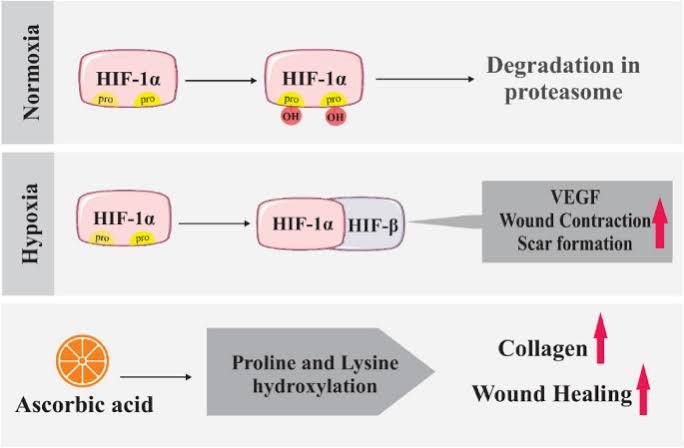
Vitamin C is essential for activating the enzymes that stabilise collagen fibres during their formation. Without adequate Vitamin C:
-
Collagen becomes weaker.
-
Wound healing slows.
-
Blood vessels become fragile.
-
Skin loses structural integrity.
Numerous laboratory, animal and human studies have confirmed that maintaining adequate Vitamin C intake is necessary for normal collagen production throughout the body. However, there is an important distinction.
Adequate Vitamin C is essential for collagen formation, but taking very high doses above normal nutritional requirements has not consistently been shown to produce proportionally greater collagen production in healthy individuals.
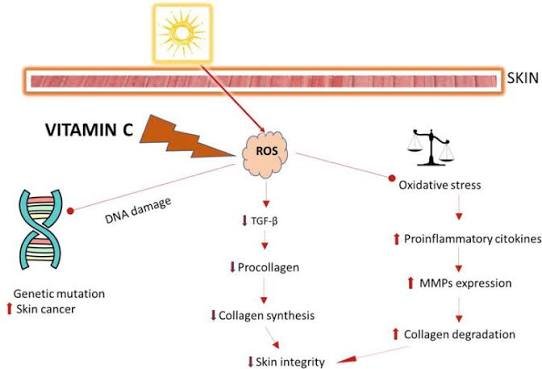
Can Oral Vitamin C Reduce Wrinkles?
This is one of the most frequently asked questions in dermatology. Observational studies have found that people who consume diets rich in Vitamin C-containing fruits and vegetables often have:
-
Better skin appearance
-
Fewer wrinkles
-
Less dryness
-
Improved skin elasticity
However, these studies cannot prove that Vitamin C alone is responsible. People who eat more fruits and vegetables also tend to: Consume more antioxidants, Eat healthier diets overall, Exercise more, Smoke less and Spend more time on preventive healthcare.
Randomised clinical trials of oral Vitamin C supplementation have generally produced modest improvements, particularly in people with inadequate dietary intake or increased nutritional needs. The strongest evidence suggests that oral Vitamin C helps maintain healthy skin rather than dramatically reversing visible signs of ageing.
Vitamin C and Wound Healing
One area where oral Vitamin C has consistently demonstrated clinical importance is wound healing. Skin repair is a highly complex process involving:
-
Collagen synthesis
-
New blood vessel formation
-
Immune function
-
Cellular growth
-
Tissue remodelling
Vitamin C participates in each of these stages. Individuals with low Vitamin C status often experience delayed wound healing, while correcting deficiency helps restore normal repair mechanisms.
For this reason, adequate Vitamin C intake is particularly important for: Older adults, Surgical patients, Individuals recovering from burns, Patients with pressure ulcers and People with poor nutritional status.
Several clinical guidelines recommend ensuring adequate Vitamin C intake as part of comprehensive wound management, although routine megadoses are not universally recommended.
Oral Vitamin C and Skin Hydration
Emerging research suggests Vitamin C may also contribute to maintaining the skin barrier. Healthy collagen, reduced oxidative stress and improved connective tissue function all help support normal skin hydration.
Some observational studies have linked higher dietary Vitamin C intake with: Better skin moisture, Reduced roughness and Improved elasticity.
However, evidence remains less robust than for collagen synthesis or antioxidant protection. More high-quality clinical trials are still needed.
Can High-Dose Vitamin C Slow Skin Ageing?
Many supplements contain 500 mg, 1,000 mg or even 2,000 mg of Vitamin C per tablet. Do these large doses produce younger-looking skin?
Current evidence says probably not for most healthy people. Once blood Vitamin C levels reach saturation, additional intake produces only modest increases in circulating concentrations. The kidneys efficiently remove excess Vitamin C through urine.
As a result, taking several times the recommended daily intake does not necessarily translate into proportionally greater benefits for healthy skin. This is one of the most important messages emerging from recent nutrition research.
More Vitamin C is not automatically better.
Topical vs Oral Vitamin C: Head-to-Head Comparison
Although they contain the same vitamin, topical and oral Vitamin C work very differently.
Feature |
Topical Vitamin C |
Oral Vitamin C |
|---|---|---|
Primary route |
Applied directly to the skin |
Absorbed through the digestive system |
Main target |
Epidermis and upper dermis |
Entire body, including the skin |
Best evidence |
Photoageing, pigmentation, antioxidant protection |
Collagen synthesis, nutritional support, wound healing |
Speed of action |
Local effects within weeks |
Gradual systemic support |
Collagen support |
Direct stimulation in treated skin |
Essential for collagen production throughout the body |
Skin brightening |
Strong evidence |
Limited direct evidence |
Hyperpigmentation |
Good clinical evidence |
Limited evidence |
Corrects deficiency |
No |
Yes |
Supports overall health |
Minimal systemic effect |
Yes |
The comparison makes one point very clear:
Topical and oral Vitamin C are not interchangeable. Each has strengths that the other cannot fully replace.
Should You Combine Both?
Based on current evidence, yes—when appropriate. For individuals with healthy diets, using a well-formulated topical Vitamin C serum while continuing to obtain adequate Vitamin C through food represents a logical strategy.
Each approach addresses different biological needs. Topical Vitamin C helps protect the skin from external environmental damage. Dietary Vitamin C supports:
-
Collagen formation
-
Immune function
-
Blood vessel health
-
Wound healing
-
Normal antioxidant defence throughout the body
People with poor diets or confirmed deficiency may also benefit from oral supplementation under the guidance of a healthcare professional.
What Does the Latest Research (2023–2026) Show?
Recent systematic reviews and dermatology publications have strengthened several important conclusions. Strong Evidence:
✔ Vitamin C is essential for collagen synthesis
✔ Topical Vitamin C improves signs of photoageing
✔ Topical Vitamin C helps reduce oxidative stress
✔ Topical Vitamin C improves certain forms of hyperpigmentation
✔ Adequate oral Vitamin C supports normal wound healing
Moderate Evidence
✔ Improved skin texture
✔ Increased skin elasticity
✔ Better overall skin appearance
✔ Reduced skin roughness
Limited or Emerging Evidence
-
Prevention of deep wrinkles
-
Long-term anti-ageing effects
-
Oral megadoses for cosmetic improvement.
-
Prevention of skin cancer through supplementation alone.