



This is Part 1 of our 2-Part Series on a Very Important Topic which is of high value for each and every Indian. Coronary Artery Calcification and associated risks are a huge healthcare burden on Indians. Understanding about this can help save precious financial resources.
Understanding Coronary Artery Calcium and Why Vitamin K2 Is Generating Scientific Interest – Can Vitamin K2 REALLY Help Reduce Coronary Artery Calcification? The Science Explained.
Introduction
Coronary artery calcification (CAC) is one of the strongest indicators of future cardiovascular risk. It reflects the build-up of calcium within the walls of the coronary arteries, making blood vessels stiffer and contributing to the progression of atherosclerosis. While cholesterol and inflammation have long been recognised as major drivers of heart disease, scientists are increasingly investigating another important question: why does calcium end up inside arteries instead of remaining in bones?
This has brought renewed attention to Vitamin K2, particularly its role in activating a protective protein called Matrix Gla Protein (MGP). Laboratory studies and several large observational studies suggest that Vitamin K2 may help regulate where calcium is deposited in the body. However, it is important to understand that although the science is promising, current evidence does not prove that Vitamin K2 reverses coronary artery calcification or prevents heart attacks.
This article explains the biology behind coronary artery calcification, why Vitamins K2 and D work together, and why cardiologists and nutrition scientists are paying increasing attention to this fascinating area of research.
First-Thing-First: Vit K2 Deficiency in Indians
Like Vitamin D3, Vitamin K2 deficiencies are extremely common in India, affecting over 80% of the population due to indoor lifestyles, darker skin tones, and plant-based diets lacking natural K2 sources.
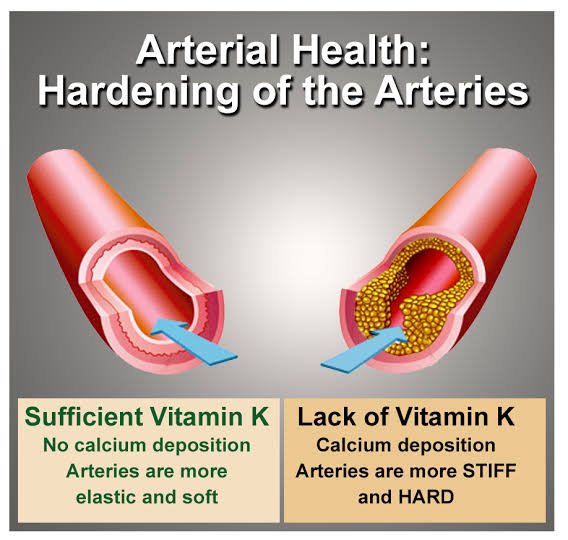
Vitamin D3 helps absorb calcium, while Vitamin K2 ensures that calcium goes to the bones instead of building up in blood vessels – in your arteries.
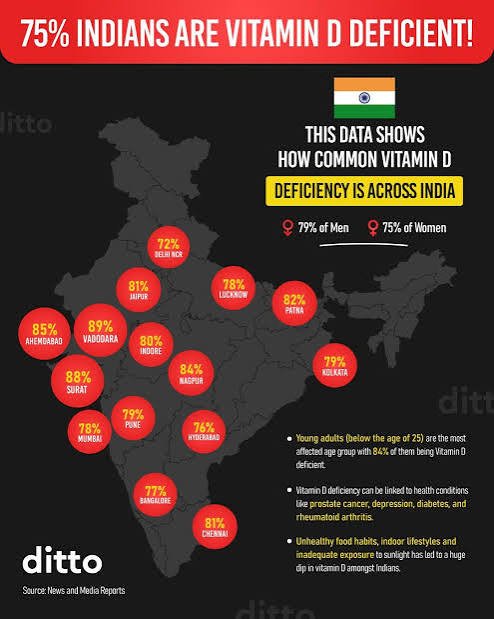
Why These Deficiencies Happen More in Indians
Indoor routines: Most urban Indians work indoors and avoid midday sun.
Skin pigment: Darker skin naturally blocks a lot of ultraviolet rays needed to make Vitamin D3
Diet limits: Traditional Indian VEGETARIAN foods lack sufficient Vitamin K2, which is mainly found in animal meat products and fermented foods.
How They (Vit D3 and Vit K2) Work Together
Vitamin D3 (Cholecalciferol): Raises calcium levels in your blood
Vitamin K2 (MK-7): Activates proteins to move this calcium safely into your bones and teeth
Magnesium role: Magnesium helps activate Vitamin D inside the body, thus making supplements work better. So faor any Vit D3 and Vit K2 (MK-7) supplements to work better, you must have sufficient Magnesium levels
Coronary Artery Calcification: Why It Matters
Heart disease remains the leading cause of death worldwide in cluding India. For decades, doctors have focused on traditional risk factors such as:
High LDL cholesterol
High blood pressure
Smoking
Diabetes
Obesity
Physical inactivity
Yet many people who experience heart attacks have no warning symptoms. This is where Coronary Artery Calcium (CAC) scoring has become an important tool. A CAC scan is a specialised CT scan that measures calcium deposits within the coronary arteries. Unlike cholesterol measurements, which estimate future risk, a CAC score provides direct evidence that atherosclerosis is already present.
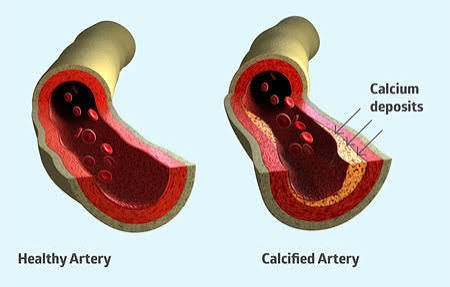
Numerous studies have shown that higher CAC scores are associated with a substantially increased risk of future heart attack, stroke and cardiovascular death.
General interpretation is:
CAC Score – What It Usually Means
0 No detectable calcification; very low short-term cardiovascular risk
1–99 Mild coronary calcification
100–299 Moderate plaque burden; increased cardiovascular risk
300 or higher Extensive coronary calcification and significantly increased
cardiovascular risk
Although CAC scoring has become widely used in preventive cardiology, it is important to remember that calcium is ONLY a marker of disease, not necessarily the direct cause of heart attacks. Most heart attacks occur when unstable plaques rupture, leading to blood clot formation.
Why Does Calcium Build Up Inside Arteries?
Many people assume calcium deposits in arteries result from consuming too much dietary calcium. Current research does not support this simple explanation.
Instead, vascular calcification is now recognised as an active biological process, not merely passive mineral accumulation. Healthy arteries contain specialised smooth muscle cells that help regulate blood vessel function. Under conditions such as:
Chronic inflammation
Diabetes
Chronic kidney disease
Ageing
Oxidative stress
High phosphate levels
these cells can undergo a remarkable transformation. They begin behaving more like bone-forming cells, producing proteins that encourage calcium crystal formation within the artery wall.
In other words, arteries begin developing characteristics similar to bone tissue. This process contributes to: Increased arterial stiffness, Reduced vascular elasticity, Higher blood pressure and Progressive cardiovascular disease Understanding this process has transformed how scientists think about vascular calcification.
The Calcium Paradox
One of the most intriguing concepts in nutrition science is known as the Calcium Paradox. As people grow older, two seemingly opposite events often occur simultaneously:
Bones gradually lose calcium and become weaker
↓
Arteries gradually accumulate calcium and become stiffer
This means calcium appears to move away from where it is needed most—the skeleton—and accumulate where it can become harmful. Researchers have been trying to understand why this happens. Although many factors contribute, one of the most important discoveries has been the identification of proteins that regulate calcium movement throughout the body. Among these proteins, none has received more attention than Matrix Gla Protein (MGP).
Matrix Gla Protein: The Body’s Natural Defence Against Arterial Calcification. Matrix Gla Protein, commonly called MGP, is produced by cells within blood vessel walls. Its primary function is to prevent calcium from depositing inside arteries. However, there is an important catch.
MGP must first be activated before it can perform this protective role. Activation of MGP requires Vitamin K, particularly Vitamin K2.
Without sufficient Vitamin K, much of the MGP circulating in the body remains inactive. Inactive MGP is far less effective at preventing vascular calcification. Researchers therefore measure dephosphorylated-uncarboxylated Matrix Gla Protein (dp-ucMGP) as a marker of poor Vitamin K status.
Higher dp-ucMGP levels have repeatedly been associated with:
Greater arterial stiffness
Increased vascular calcification
Higher cardiovascular risk
Chronic kidney disease
Increased mortality in several observational studies
While these findings do not prove causation, they provide a biologically plausible explanation for why Vitamin K2 has attracted growing scientific interest.
Where Does Vitamin D3 Fit Into the Story?
Vitamin D and Vitamin K2 perform different—but complementary—functions.
Vitamin D – Vitamin D increases intestinal absorption of calcium and phosphorus.. Without adequate Vitamin D, maintaining healthy bones becomes difficult.
Vitamin K2 – Vitamin K2 helps activate proteins responsible for directing calcium to appropriate tissues, particularly bones and teeth.
One way to think about it is this: Vitamin D helps absorb calcium and Vitamin K2 helps regulate where that calcium is used. This concept has led to widespread interest in combining Vitamins D and K2. These, however, still remain active areas of scientific investigation.
What Do Population Studies Tell Us?
Several large observational studies have explored whether higher Vitamin K2 intake is associated with better cardiovascular health.
Rotterdam Study – One of the most influential studies followed thousands of older adults in the Netherlands. Researchers found that participants with the highest dietary intake of Vitamin K2 had:
Lower coronary artery calcification.
Reduced risk of severe aortic calcification.
Lower cardiovascular mortality.
Interestingly, similar associations were not observed for Vitamin K1, suggesting the two forms of Vitamin K may have different biological roles.
Prospect-EPIC Study – Another large Dutch cohort reported that higher dietary Vitamin K2 intake was associated with a lower risk of coronary heart disease. Again, these were observational findings, meaning they show an association but cannot prove that Vitamin K2 directly caused the lower risk.
People consuming more Vitamin K2 may also have differed in other lifestyle factors such as diet quality, physical activity or smoking habits.
Chronic Kidney Disease Research
Patients with chronic kidney disease develop vascular calcification much more rapidly than the general population. Several studies have shown that these patients often have markedly elevated levels of inactive MGP, suggesting poorer Vitamin K status. This has made CKD an important area for ongoing Vitamin K2 research.
Why Scientists Are Excited—but Still Cautious
The scientific case for Vitamin K2 is compelling because several pieces of evidence fit together remarkably well. Researchers have demonstrated:
✓ Vitamin K activates Matrix Gla Protein
✓ Matrix Gla Protein inhibits vascular calcification in experimental models
✓ Low Vitamin K status is associated with inactive MGP
✓ Higher inactive MGP levels are associated with greater cardiovascular risk
✓ Higher dietary Vitamin K2 intake has been linked with lower vascular calcification in several observational studies
However, one crucial question remains unanswered: Does Vitamin K2 supplementation reduce heart attacks, strokes or cardiovascular deaths?
At present, the answer is we do not know with certainty. Large, long-term randomised clinical trials powered for cardiovascular events are still limited. That is why major cardiology societies have not yet recommended routine Vitamin K2 supplementation specifically to prevent coronary artery calcification.
Key Takeaways
-
Coronary artery calcification is one of the strongest markers of future cardiovascular risk
-
Arterial calcification is an active biological process rather than simple calcium accumulation
-
Matrix Gla Protein is a key natural inhibitor of vascular calcification
-
Vitamin K2 is required to activate Matrix Gla Protein
-
Vitamin D3 and Vitamin K2 have complementary roles in calcium metabolism
-
Large observational studies suggest higher Vitamin K2 intake may be associated with lower vascular calcification – Vegetarians and Vegans to Take Note, pls
-
Current evidence is promising and evolving to prove that Vitamin K2 reverses coronary artery calcification or prevents heart attacks
Coming Up in Part 2
In the second and concluding part of this series – we’ll examine the human clinical trials investigating Vitamin K2 supplementation, compare MK-4 versus MK-7, discuss whether combining Vitamin D3 with Vitamin K2 offers additional benefits, review current cardiology guidelines, and answer the practical question many readers ask: Should you consider taking Vitamin K2 for heart health?
Select References
- Geleijnse JM, et al. Dietary intake of menaquinone is associated with a reduced risk of coronary heart disease: The Rotterdam Study. Journal of Nutrition
-
Gast GCM, et al. Vitamin K intake and coronary heart disease: The Prospect-EPIC Cohort Study. Journal of Nutrition
-
Schurgers LJ, et al. Vitamin K-containing dietary supplements: Comparison of synthetic vitamin K1 and natto-derived menaquinone-7. Blood
-
Brandenburg VM, et al. Vitamin K and vascular calcification in chronic kidney disease. Kidney International
-
Shea MK, Booth SL. Concepts and controversies in evaluating vitamin K status in cardiovascular health. Advances in Nutrition
-
European Society of Cardiology (ESC). Guidelines on Cardiovascular Disease Prevention
-
American College of Cardiology/American Heart Association (ACC/AHA). Primary Prevention of Cardiovascular Disease Guidelines