



Most Indians Think High Uric Acid Causes Only Gout. That May Be Only Half the Story.
This is one of the biggest paradigm shifts occurring in metabolic medicine. Most Indians still associate high serum uric acid levels only with gout, whereas the scientific literature increasingly suggests that hyperuricemia often appears years before insulin resistance, metabolic syndrome and Type 2 diabetes and could potentially be looked at from Metabolic Syndrome perspective rather than Gout or Urolithiasis (kidney stones).
High uric acid is not just a gout marker—it may be one of the earliest warning signs that your metabolism is becoming unhealthy.
For decades, doctors have associated high uric acid levels with painful gout attacks and kidney stones. If your blood test showed elevated uric acid but you had no joint pain, you were often told not to worry. That advice is beginning to change.
A growing body of research suggests that hyperuricemia may be one of the earliest biochemical signs of insulin resistance, the metabolic abnormality that eventually leads to Type 2 diabetes, fatty liver disease, obesity and cardiovascular disease. Instead of asking only whether high uric acid causes gout, researchers are now asking a much bigger question:
Could high uric acid be warning us that diabetes is already developing? The answer appears increasingly likely.
What Is Hyperuricemia / High Serum Uric Acid Levels?
Hyperuricemia simply means too much uric acid in the bloodstream. Uric acid is produced when the body breaks down natural compounds called purines. Purines come from: normal cell turnover, fructose, sugary drinks, alcohol and some meats.
Normally, the kidneys remove most uric acid. When production exceeds removal, blood levels rise. Most experts define hyperuricemia as:
Serum uric acid > 6.8 mg/dL
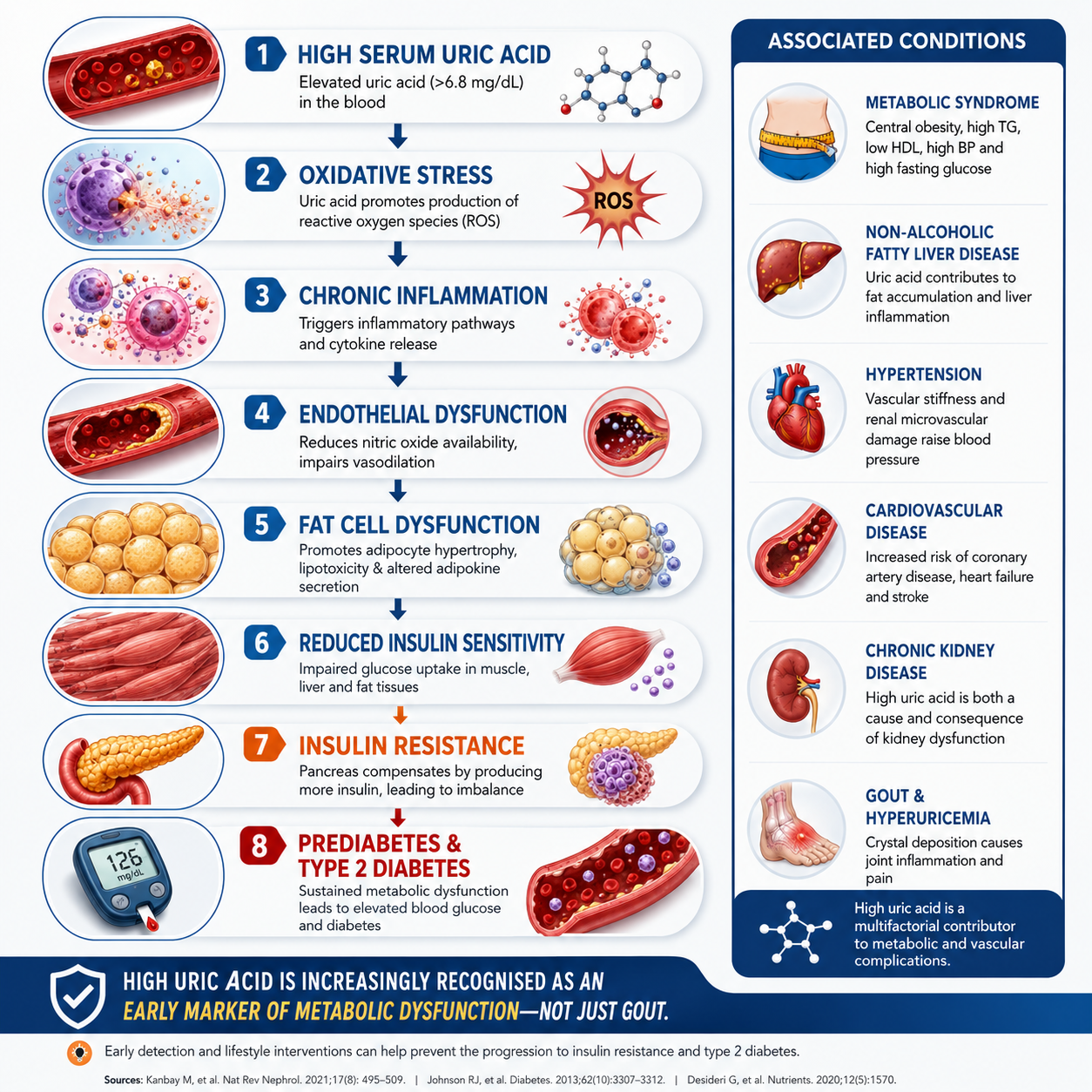
This is the concentration above which uric acid crystals can begin forming. However, recent metabolic research suggests that harmful effects on blood vessels and insulin sensitivity may begin even before crystal formation occurs.
Why Are Scientists Interested in Uric Acid?
Large population studies have found something surprising. People with high uric acid are much more likely to develop: insulin resistance, metabolic syndrome, obesity, hypertension, fatty liver, chronic kidney disease and Type 2 diabetes.
The relationship remains significant even after accounting for age, body weight and several other risk factors.
Large epidemiological studies, including analyses from the National Health and Nutrition Examination Survey (NHANES) and multiple prospective cohorts, report that people with hyperuricemia have approximately 1.6 to 2.5 times higher risk of developing Type 2 diabetes than those with normal uric acid levels. That is a substantial increase for a routine blood test that is already widely available.
How Can Uric Acid Affect Insulin Resistance?
Scientists now believe uric acid is far more than a waste product. Inside cells, excess uric acid appears capable of disrupting several important biological pathways.
1. Oxidative Stress – High uric acid increases production of reactive oxygen species. These unstable molecules damage cells and interfere with insulin signalling. Over time, muscles respond less effectively to insulin, meaning more insulin is required to keep blood sugar normal. This is known as insulin resistance.
2. Chronic Inflammation – High uric acid can activate inflammatory pathways throughout the body. Persistent low-grade inflammation is now recognised as one of the central drivers of: obesity, Type 2 diabetes and cardiovascular disease. Inflammation also worsens insulin resistance.
3. Endothelial Dysfunction – Healthy blood vessels produce nitric oxide. Nitric oxide helps insulin deliver glucose into muscle cells. High uric acid reduces nitric oxide availability. As blood vessels become less healthy, insulin becomes less effective.
4. Fat Cell Dysfunction – Adipose tissue is now recognised as an active endocrine organ. High uric acid appears to alter fat-cell biology by: increasing inflammatory cytokines, reducing adiponectin, worsening insulin resistance and promoting abdominal obesity.
This creates a vicious cycle. More fat leads to more insulin resistance. More insulin resistance leads to higher uric acid.
Why This Matters for Indians
Indians develop Type 2 diabetes nearly 10–15 years earlier than many Western populations. Even more concerning, Indians often develop diabetes at a lower BMI. Researchers believe this reflects greater visceral fat accumulation, lower muscle mass and a tendency toward insulin resistance.
Because insulin resistance is already common, identifying early warning markers becomes critically important. High uric acid could become one such marker. Rather than waiting until fasting glucose or HbA1c rises, elevated serum uric acid may offer an earlier opportunity to identify metabolic risk.
Is High Uric Acid Causing Diabetes—or Is Diabetes Raising Uric Acid?
This remains one of the biggest scientific questions. Current evidence suggests the relationship is bidirectional. Early in the disease process:
-
high uric acid may contribute to insulin resistance and Later,
-
worsening insulin resistance reduces kidney excretion of uric acid
This further increases blood uric acid.The result is a self-perpetuating metabolic cycle.
Should High Uric Acid Be Treated?
At present, international guidelines primarily recommend uric acid-lowering medicines for: gout, recurrent kidney stones and severe hyperuricemia in selected situations.
For people with asymptomatic hyperuricemia, there is not yet enough evidence to recommend medication solely to prevent diabetes. However, lifestyle interventions that lower uric acid also improve metabolic health.
These include:
-
losing excess body weight
-
regular physical activity
-
reducing sugar-sweetened beverages
-
limiting excessive fructose intake
-
improving diet quality
-
maintaining adequate hydration
These same measures reduce insulin resistance and lower diabetes risk.
Future of Hyperuricemia Research
Over the past twenty years, scientific publications linking hyperuricemia with insulin resistance have increased dramatically. Researchers are now exploring whether hyperuricemia should become part of routine metabolic risk assessment alongside:
-
fasting glucose
-
HbA1c
-
waist circumference
-
triglycerides
-
HDL cholesterol