


Uric acid is usually discussed as a harmful waste product linked to gout. But science tells a more complicated story. Very high uric acid is clearly a health concern. Surprisingly, very low levels have also been linked with poor health outcomes in several large studies.
For millions of Indians, a uric acid test has become a routine part of a health check-up. When the number is high, the advice is often immediate: reduce purine-rich foods, drink more water and in some cases, start medicines.
But there is another side to the uric acid story.
The human body may need balance. Uric acid that is too high can cause harm. But pushing it extremely low may not always be harmless either.
What exactly is uric acid?
Uric acid is produced when the body breaks down substances called purines. Purines occur naturally in our cells and are also present in food. Most uric acid travels in the blood to the kidneys and is then removed through urine.
The problem begins when the body produces too much uric acid or the kidneys cannot remove enough uric acid.
The level in the blood then rises. At sufficiently high concentrations, urate crystals can form and cause gout and kidney stones.
High uric acid is linked with more than only gout
Most people associate uric acid with a painful, swollen big toe. That is only part of the story.
A large review of 32 studies involving more than 1.13 million people found that higher uric acid was associated with a 45% higher risk of death from cardiovascular disease. The relationship appeared stronger in women.
Among almost 50,000 people with hypertension, a separate analysis found that those in the highest uric acid groups had a 51% higher risk of death from any cause and a 68% higher risk of cardiovascular death compared with reference lower groups.
The kidney connection is also important. A study combining data from 27,081 people with chronic kidney disease found that patients with the highest uric acid levels had a 47% higher risk of cardiovascular death. For every 1 mg/dL rise in uric acid, cardiovascular death risk increased by 12% in the pooled analysis, although results varied considerably between studies. These studies show a strong association. They do not prove that uric acid alone causes every heart or kidney problem.
High uric acid often travels with obesity, insulin resistance, high blood pressure, diabetes and poor kidney function. But uric acid is not simply a useless waste product
Here is the surprising part. Uric acid also acts as an antioxidant in the blood. Antioxidants help limit damage caused by highly reactive molecules produced during normal body processes and illness.
This has created an important scientific question.
If excessive uric acid is harmful, could extremely low uric acid also remove part of the body’s natural antioxidant protection?
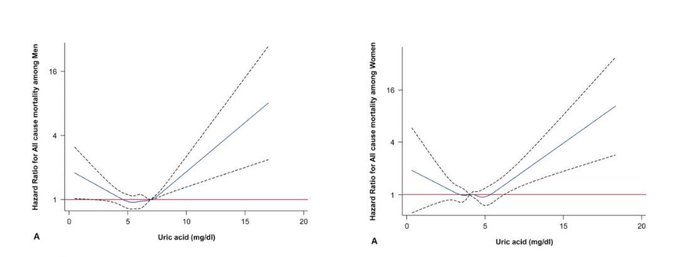
A study of 375,000 people found a U-shaped risk. One of the strongest studies followed 375,163 South Korean adults. Researchers examined deaths across more than 2 million person-years of follow-up. The results showed what scientists call a U-shaped relationship.
In simple language, risk was higher at both ends of the uric acid range.
Men with uric acid below 3.5 mg/dL had a 58% higher risk of death from any cause compared with the study’s reference group. Women with levels below 2.5 mg/dL had an 80% higher risk.
At the opposite extreme, very high uric acid was also associated with sharply increased mortality.
Men with levels of 9.5 mg/dL or higher had more than twice the risk of death. Women with levels of 8.5 mg/dL or higher had an even greater increase, although the estimate in women was less precise. The message was striking.
The lowest uric acid level was not automatically the healthiest level.
US data found a similar pattern
A study of 9,118 US adults also found a U-shaped relationship between uric acid and death. During follow-up, 448 people died.
The researchers found increased risk at both low and high uric acid levels. Their statistical analysis identified approximately 5.7 mg/dL as the turning point of the mortality curve in that particular population.
This does not mean every person should aim for exactly 5.7 mg/dL. It means the relationship between uric acid and health may be more complicated than “lower is always better”.

What about low uric acid and the brain?
Low uric acid has also attracted attention in research on diseases such as Parkinson’s disease and other disorders involving gradual loss of brain cells. One possible explanation is uric acid’s antioxidant activity.
Studies have found links between lower uric acid and some brain diseases, but association does not prove that low uric acid causes the disease.
The 2020 American College of Rheumatology gout guideline specifically noted epidemiological studies suggesting an inverse relationship between uric acid and selected neurodegenerative disorders. The guideline also said that the safety of prolonged, very low treatment-related uric acid—around 3 mg/dL or below—remains an important research gap.
In other words, scientists are interested. But it would be wrong to claim that raising uric acid prevents dementia or Parkinson’s disease.
Does very low uric acid increase cancer risk?
In the large Korean study of 375,163 adults, both low and high uric acid levels were associated with increased cancer mortality. But that does not prove low uric acid causes cancer.
Cancer, poor nutrition, weight loss and changes in body metabolism may themselves affect uric acid. Very low uric acid has been associated with higher cancer mortality in some population studies, but a direct cause-and-effect relationship has not been established.
Why can very low uric acid occur?
An unusually low uric acid result should not simply be celebrated. Low levels can occur with certain medicines, kidney-related problems that cause excess uric acid loss, rare inherited conditions and some other illnesses.
Nutrition and underlying disease may also influence the result. A single low reading does not diagnose a disease. But a repeatedly and unexpectedly very low level deserves clinical interpretation, particularly if the person is not taking uric acid-lowering medicine.
Should everyone with high uric acid take medicine?
No. This is another common misunderstanding.
The American College of Rheumatology defines asymptomatic hyperuricaemia in its guideline as serum urate of 6.8 mg/dL or higher without previous gout attacks or visible urate deposits.
For most people with high uric acid but no gout symptoms, the guideline conditionally recommends against automatically starting uric acid-lowering medicines.
The guideline noted that even among people with uric acid above 9 mg/dL, observational data suggested only about 20% developed gout within five years.
For patients receiving uric acid-lowering treatment for gout, the recommended target is generally below 6 mg/dL.
Indian obsession with lowering uric acid needs more balance
In India, a mildly high uric acid result often creates panic.
People suddenly stop dal and non-veg foods.
They avoid tomatoes.
They remove spinach.
Some begin extreme diets.
Others take medicines or supplements without properly understanding why their uric acid is high. The scientific evidence supports a more sensible approach.
High uric acid matters, especially when linked with gout, kidney stones or other medical problems.
But the goal should not be to push uric acid towards zero. Uric acid is a normal substance in the human body. It has biological functions, including antioxidant activity.
Large studies involving hundreds of thousands of people suggest that both very high and very low uric acid levels may be markers of increased health risk.
Uric acid is about balance, not fear
The old message was simple: Uric acid is bad. Lower is better.
The newer evidence is more nuanced: High uric acid is associated with gout and is linked with kidney, blood pressure and cardiovascular problems.
And at the other extreme, very low uric acid has been associated with higher mortality and has attracted scientific interest because of possible links with brain health and the body’s antioxidant defence.
The best message is therefore much simpler:
High uric acid can be harmful. Very low uric acid should not automatically be assumed to be ideal. The right level depends on the person, the reason for testing and whether gout or another disease is present.