

Timing of Heart Attacks / Strokes – Is there a Pattern
Heart attacks, cardiac arrests, strokes, and other cardiovascular events often appear to strike at random times and out of the blue. Although they can occur at any time, researchers have documented fairly consistent clusters at certain hours of the day, days of the week, and times of the year.
It’s good to be aware of these patterns and why they occur so you can take steps to sidestep associated increases in cardiovascular risk factors.
Do Heart Attacks Peak on Monday? Evidence?
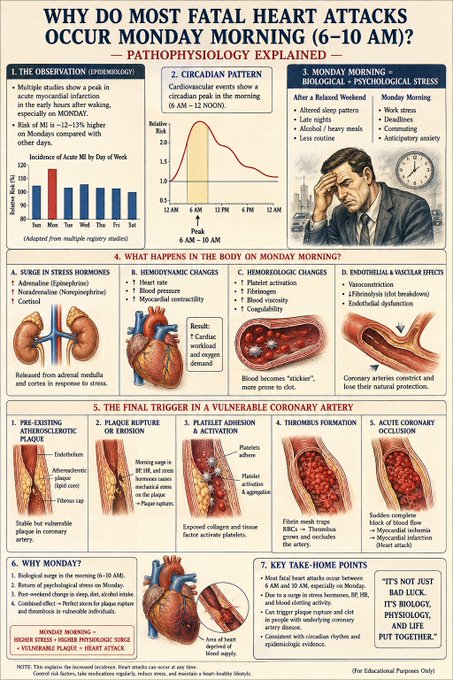
Research dating back decades reveals that Monday mornings are prime time for heart attacks. A study published in the American Heart Journal, which looked at more than 156,000 hospital admissions for heart attacks, confirmed that the most “popular” day was Monday; the fewest heart attacks occurred on Saturday. The researchers reported that this was likely related to “psychosocial stress levels,” which tend to increase with the onset of the work week.
Even for India – anecdotal evidence points to the same fact that most number of Fatal heart attacks are reported to occur on Monday mornings. Statistically, the highest incidences and the most severe cases occur in the early hours, specifically between 6:00 AM and 12:00 Noon and peaking around 8:00 AM to 9:00 AM.
Why Monday Mornings – Why Fatal Attacks
But WHY does this happen? What does Science Says? Well – It comes down to a dangerous “perfect Monday Morning storm” inside your body as you wake up:
-
The Hormonal Surge: Waking up triggers a massive spike in adrenaline and cortisol. Your blood pressure and heart rate shoot up rapidly to transition you from sleep to high alert
-
Mechanical Stress: This sudden jump in blood pressure acts like a pressure washer inside your arteries, putting intense stress on any existing cholesterol plaques, increasing chances of a rupture, trigerring the heart attack
-
“Sticky” Blood: In the early morning hours, your blood platelets are naturally stickier. Worse, your body’s natural ability to dissolve clots (fibrinolysis) is at its absolute lowest at this point of time
-
The Monday Factor: The psychological shock of jumping from a relaxed weekend back into the high-stress work week acts as an amplifier for all of these physical changes. Your body goes from 0 to 100 in a few seconds, probably faster than a ferrari or bugati. For a healthy cardiovascular system, it’s just a normal Monday. But for vulnerable arteries, it can trigger a sudden occlusion!